Huntington’s Disease Caregiver Guide: What to Expect and How to Cope with Lori Jones - Episode 200
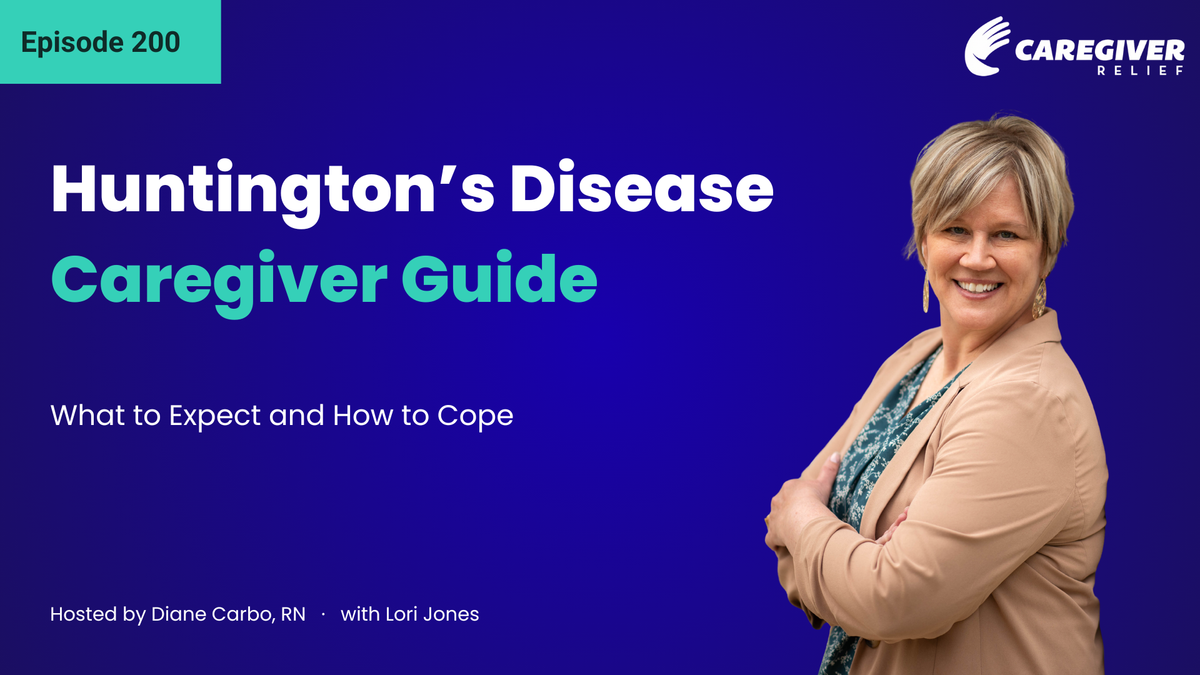
In this deeply moving episode of the Caregiver Relief podcast, host Diane Carbo sits down with advocate, speaker, and author Lori Jones. Lori shares her deeply personal journey growing up in the shadow of Huntington’s Disease (HD)—an autosomal dominant genetic illness that her father battled and that she lived at risk of inheriting for half of her life.
From the secret "black market" feeling of confidential genetic testing in the 1990s to navigating a decade of co-guardianship and moving her father through nine different adult care homes, Lori opens up about the raw realities of caregiving, the heavy burden of survivor's guilt, and the incredible power of breaking through the isolation that genetic diseases often bring.
If you have ever faced an uncertain future, managed difficult behavioral symptoms in a loved one, or struggled to find your purpose amidst a family crisis, this episode is a must-listen. ❤️
📋 What You’ll Learn in This Episode
- 🧬 The Reality of Living "At Risk": What it feels like on a daily basis to live with a 50% chance of inheriting a terminal illness.
- 🚪 The Hidden "Black Market" of Testing: Why Lori and her genetics counselor chose to test confidentially using cash in the 1990s to protect her healthcare and life insurance.
- 🧠 Psychiatric vs. Physical Symptoms: Understanding how psychiatric changes (like unpredicted rage and manic outbursts) often predate physical symptoms by a solid decade.
- 🚨 Orchestrating a Crisis Event: The heartbreaking, necessary steps Lori’s family took to force the healthcare system to intervene when her father refused care.
- 💔 Overcoming Survivor's Guilt & Imposter Syndrome: How Lori processed being gene-negative ("spared") and found her true calling as an advocate for those who are gene-positive.
- 🤝 Advocating for Flexibility in Care Facilities: How to educate nursing home staff on slowing the pace, reducing noise, and relaxing rigorous schedules to prevent behavioral triggers.
💡 Key Takeaway from Lori:
"You do not have to do this alone. Whatever isolating situation you have found yourself in... start talking about it now. Talk about it sooner. If you can't talk about it with the person in your home, find someone else to talk about it with. Communication makes all the difference."
📖 About the Guest & Resources Mentioned
Lori Jones is an author, speaker, and tech leader. After a decade of navigating care for her father, she dedicated her life to helping the HD community break through isolation.
- 🌐 Connect with Lori: Visit lorijoneswrites.com to contact Lori for virtual support groups or speaking events.
- 📘 Read the Book: Spared: A Memoir of Risk and Resolve is available for purchase online, on Audible, and at libraries. Reach out to Lori via her website for a free Audible copy!
- 🏢 Organizations Mentioned: * Huntington’s Disease Society of America (HDSA)
- HDBuzz
- Help 4 HD International
Podcast Episode Transcript
Diane: Welcome to the Caregiver Relief podcast, where we share real stories, expert insights, and practical guidance to help caregivers feel supported, informed, and less alone. I'm Diane Carbo, your host. Today's conversation is a deeply meaningful one. We're talking about what it means to live with uncertainty when a serious genetic illness like Huntington's disease touches your family and shapes the decisions you make about your future.
My guest today is Lori Jones, an advocate, speaker, storyteller, and business leader who has personally experienced the impact of Huntington's disease in her family. Lori has dedicated years to raising awareness, supporting research, and helping others understand the emotional and ethical realities of living at risk.
In this conversation, Lori shares her personal journey, what she has learned about courage and purpose, and how families can navigate caregiving while still finding meaning and connection along the way.
So if you've ever faced uncertainty, supported a loved one through illness, or wondered how to live fully even when the future feels unclear, this episode is for you.
Lori, thanks so much for joining me today. You have an amazing story, and you've had the courage to write a book about your experience.
Diane: Before we get started about talking about the disease, can you tell us a little bit about yourself and what brings you joy these days?
Lori: Happily, and thank you so much for having me. I think what brings me joy these days is having conversations like this. I never thought 20 years ago that what I was going through would be an opportunity to help other people.
And so I'm a grandmother. I just became a grandmother five months ago.
Diane: Congratulations!
Lori: I have a day job. I lead tech teams every day across the United States. But, truly, this little side passion, it gets me up every morning.
Diane: Thank you for that. I really appreciate it. I want you to share your family story with Huntington's disease and how it first entered your life.
Lori: Yes. So I always say that we thought there was something there, but we couldn't quite put our finger on it. Our family didn't talk about Huntington's disease very much. Now, to date myself, I was born in 1970 the, and as some of you know, but, the predictive test for HD didn't come out until 1993.
So you're looking at over 20 years prior to any testing. And so it was observation, family pedigree, conversations, and fear that took place. And like I said, I heard words about it, thoughts about it. My dad called Huntington's disease the shake, and he had witnessed his aunt, his mother's sisters begin to have symptoms.
And so he knew it was in our family, but it was loosely discussed as something that could happen to you when you were old, and that we shouldn't worry about it now, even though I think he was worrying about it, on the daily because he was seeing it starting to happen to his family. So my father had HD.
We didn't have him officially diagnosed until late, much later in his life. he didn't want to know. He was resistant to go to the doctor. but my grandmother, went ahead and did the predictive test as soon as it became available in '93. So my grandmother and her sister, one of her sisters, went and got tested in '93, and that was when I guess you could say officially Huntington's disease was in our family, was when my grandmother tested positive.
Diane: God bless your grandmother for having the courage
Lori: Yes
Diane: And the curiosity and
Lori: Yes ...
Diane: and overcoming fear of, the unknown.
Lori: Yeah. She was the most progressive of anyone. She got the newsletters from the Guthrie organization. She was always talking about it. I will tell you, some people in the family didn't wanna hear- Yes, yes
What grandma had to say. It was scary. It was unknown, and she had opinions. But I commend her bravery for being so progressive at that time.
Diane: Yeah. Oh, I, that's amazing. what does living at risk really mean on a day-to-day emotional level?
Lori: Yeah. Living at ri- at risk on a daily basis depends on how busy you are because you can put it out of your mind
Diane: Yeah
Lori: Until you drop something, or you stumble, or you forget your word, or you have an emotion that feels too strong. and then you think, "Is this Huntington's disease?" And so once you know your risk, you know that if your parent is diagnosed, you have a 50% risk of inheriting the illness. And there are no carriers, so as an autosomal dominant disease, regardless of gender, a biological parent sends 50% risk to each biological child.
So living at risk, you're a coin flip. you might have this, you maybe won't, and it might present itself in your 30s, 40s, 50s, or 60s
Diane: I had a young patient, a 40-year-old man, re- in, in a nursing home, unable to swallow, still able to speak a little bit. But, it was in the '90s, and they tested his son, and his t- son was positive for it too.
So they never brought the son to visit the dad because they didn't want him to see what could happen to him. And it, and they never told the father that the son had developed, had gotten the gene. So it's just,it was very hard for them. Now, you've spoken publicly about ethical considerations around genetic testing.
What are some of the hardest decisions families face?
Lori: Yeah. it's a hotbed for sure.
Diane: Oh, absolutely.
Lori: And I always say everyone has to make their own personal choice, and there's no wrong answer. Yeah. there are so many factors to consider. And what my genetics counselor said to me was, "Are you certain you want to know this information?
Because I can't untell you once you know." And so that's one of the biggest things is if you wanna open that envelope, you can't seal it again. And so you have to decide, would I rather live at risk with what some people call the tortured hope, where the possibility of being negative, can help you through days of worrying if you're positive, or do I wanna know so I can make a life plan?
And that really is up to each family to decide what they wanna do with that information. now knowing where we are at in scientific research and where we are at with potential treatments and therapies, there are, clinical trials you can get involved in. I'd like to say that if I was testing today, my, my decision to do so would have been that much easier because I would have seen here are some immediate things that I can do.
In the 1990s, eh, there, you could find out, and then what would you do? What would you do with that information to make your life better? Now, I will say you can start talking about it. You can talk about it with your family, and what we didn't do as a family was talk about it. And I think truly the communication, the awareness, and the understanding, and creating that empathy for the person really early on when potential psych symptoms may present that can damage family relationships, knowing that there's a reason for those psych symptoms could make all the difference.
And so I'm all over the map on, do you test, don't you test, and of course there's the consideration of families that might want to start having a biological family, and they might want to decide whether they would go that route or not. So many decisions, but I guess it all comes back to you can't unknow once
Diane: Yes.
Lori: And that is your decision point.
Diane: I have people that, they're, they can be tested for Alzheimer's now, and they don't wanna know. But the other consideration families look at is once are you able to get c- insurance coverage in the future?
That's a whole 'nother ballgame.
That's a challenge that many face because they, if it's going to impact their ability to get in- health insurance, they would prefer to be in denial at this point in time. And I don't know-
Lori: I agree
Diane: How you overcome that. But,
Lori: Yeah, I was guided-
Diane: It's unfair 'cause you know that if you do-
Lori: Yeah.
And I was guided very wisely by a social worker from the HDSA, the Huntington's Disease Society of America, and she was an angel for me. Her name is Jean. She's still living today, and we still speak today. And, she sat with me and helped me navigate how to prepare for this. And I'll tell you, Diane, it felt a little covert.
She said, "Do you have life insurance? Are you actively covered by health insurance?" And I was, by my spouse. ... "Do all these things. Go to the clinic. We tested confidentially and with cash." and so it felt just black market, I tell you. It was-
Diane: Oh, I understand.
Lori: Yes. yeah.
Diane: But it's sad.
Lori: And then once we found out, what the results were, we could move forward.
But she said, "Get your ducks in a row before you undertake this process." And I think part of that is still a little true today, and probably good for anyone undergoing such a monumental discovery test. Whatever you're testing for-
Diane: Yes
Lori: Get your ducks in a row before you enter this, because you're probably gonna need some emotional time to unwind-
Diane: Yeah
Lori: a- and determine your next steps, and the last thing you wanna be doing is scrambling to find out if you have coverage.
Diane: Yes, exactly, 100%. And it's sad that we are determined whether we could have insurance coverage or not because we may develop a disease.
Lori: Yeah. It's just very frustrating.
Lori: Well-
Diane: So how
Lori: has Hunting-
We're headed down a slippery road. Yes.
Diane: Yes. Yeah. It is. It's a very slippery slope. So how has Huntington's disease shaped your perspective on planning for the future?
Lori: That's a great question. I would say, and I've, when I speak to audiences I'll say, when I lived at risk, I lived in two places at the same time, if you can imagine it.
One, w- I was in a tremendous hurry. I was in a hurry to do everything before I got sick. Because in my head I thought, I'm gonna get sick." So I was very driven to the milestones, get married, buy a house, do the things, buy a dog, have children, in case something might happen to you.
And yet- I didn't commit to anything long term. Any dreams or plans that my spouse and I talked about, like maybe we'll buy a cottage, maybe we'll do this. Oh, I couldn't think about any of those things- Yeah ... because those were too far out. And so that was a weird dichotomy, and but it makes sense now that I was in a hurry and yet commitment-phobic.
Now, looking back, I think earlier awareness, earlier conversation, I would've been more mindful. I would have thought, here are some goals I'd like to achieve. They would've been realistic. I wouldn't have had all the spun up, all the hurry. And I would've tried- Yeah ... to live a little more in the present, instead of racing through it.
Diane: My mom died when I was 18. She was in her 40s, and, I had the same kind of issues. Not because I thought in my head, "My mom died early, I'm going to die early." So I too did all the things just like that because, it was commitment-phobic and I didn't wanna get attached to anything.
Property, anything did not matter to me. It's just get rid of it, It's, I'm not gonna need it. And here I am at 72, soon to be 73, and I'm thinking, "Daggone, Yeah.
Lori: Get rid of it all
Diane: Gave a lot of stuff away." Yep.
Lori: Yeah. I, yeah. Yes. Very little possessions. Which, minimalistic living is great, but, that detachment, that, almost disassociates-
Diane: Yeah
Lori: What's happening to you because it would hurt too much to care. Yeah. And it's not a great- Yes ... way to live. Yes. Yes. No.
Diane: No. it is absolutely not a good way to live at all. ... now let, I wanna talk about s- common misconceptions people have about Huntington's Disease, and maybe even a little bit about the caregivers that are providing the care for them.
Lori: I would love to talk about that. and it comes back again to diagnosis. And so you see someone in a wheelchair, you hold the door for them, right? If you see someone staggering around, a little unkempt, maybe, too loud and acting erratic, maybe overly angry, you instantly go to that person is unwell.
That person is on a substance. That person has a problem and I don't want anything to do with them. And so-
Diane: Yes ...
Lori: It's hard. My dad didn't get diagnosed, and truly when I was a small person, in your home normal is what Normal is what you live with. And so I really only noticed- Yes ... his early symptoms when we went out and about.
And one example, we're at a ballgame, and he liked to sit in the top of the bleachers. And he was gonna fall off the bleachers. He was staggering around, holding the handle of the bleachers. And I can remember to this day, in the pit of my stomach, because people were staring. And I can remember thinking, "Something's not right.
I don't know what it is, but they're looking at him, and they're... It's not kind." Those aren't kind eyes. "We better watch that guy, he's gonna fall." It was, "Why is he moving like that?" So early symptoms
Diane: Yeah, they're judging him for It
Lori: Yeah. Yeah, exactly. Or the early symptoms, the choreatic movement or the shuffling gait can often be misunderstood as being on a substance or alcohol induced.
Diane: Yes.
Lori: And so there's that. Yes. But even earlier than a shuffling gait or maybe a, an uncontrolled movement are psychiatric symptoms. And so I would say, looking back on my dad's life and his battle with HD, is for a solid decade before he had movements, he had psychiatric symptoms. In him, they exhibited as unpredicted rage, outbursts, very manic talking, lots of big speeches that went on and on, and just some really erratic behavior.
And I, I don't know what you do with that unless people know there's a reason. Yeah. Yes. And so I go back to the awareness and the understanding. And even a caretaker who maybe doesn't know they're a caretaker yet, sees this- Yep ... person in the family as someone, boy, they sure don't want to be around.
Yeah ... the earlier you can detect and understand why unexpected behavior is happening in your relationship, the earlier the empathy can start. And I'm not gonna say it all ends with roses and candy, it's hard.
Diane: Yeah.
Lori: Yes, yeah. But knowing the why makes all the difference.
Diane: There are several conditions of, different types of dementia or Parkinson's where some untoward behaviors, confusing behaviors start before a diagnosis, which caught Many people get divorced, many people separate because they, they don't get the diagnosis, and they're thinking this person is, changing, they're awful, they're terrible.
And, it's not really that at all, it's just a condition. Once... And I've had so many, people tell me, the children of these kids, or, the adult children tell me that their parents separated, and the, and whichever one was ill, the other one felt guilty after because they left, because they didn't understand what was happening, and that's hard.
Lori: Yeah. It is. It's hard, especially if the person whose behavior is changing thinks they're fine. Yes.
Diane: Oh,
Lori: Yes ... they have no desire- That's always ... yeah, they have no desire to seek, medical attention, Yep,
Diane: Yep ... no,
Lori: Just impossible to live with, and yet. So I've had, I've gone to HD support groups and spoken with caregivers and they say, what do you do?
What do you do with your unwilling person?" the person who's unwilling to get help, but you know there must be help. And I have commented that sometimes, almost always, it takes an event. It takes an event to- Yes ... get that person care. And so perhaps we find the safest event that could happen.
And with my family, we literally orchestrated the event. And my mother was my dad's caregiver, but he didn't want to be cared for. He was obstinate and difficult, and he wasn't taking meds, and it was very difficult. And we had to orchestrate her exiting the home and the social services coming in and doing a welfare check before we could eventually, move the cogs of the system to get- Yes
Diane: Yeah.
Lori: Yeah. And it was difficult and heartbreaking, and yet I don't know at that point that there would've been another way.
Diane: I tell people, there are a lot of uncooperative seniors out there, or private seniors out there- Yeah ... that don't want their families to know anything. And I just tell the...
And the adult children come to me and say, "What am I gonna do? What should I do?" And I just say, "You're going to have to function in a crisis mode," because until something happens, as you say, an event, that they fall, they injure, they get into, need to be admitted to the hospital for something, you can't intervene.
And because they're still deemed competent by our society, you can't do anything. You can't force anybody to do anything they don't want. So it is a very challenging situation. And, God bless your family for creating an event.
Lori: Oh it wasn't great, but it needed to be done.
Diane: Yeah. you know what?
And bless your mom. that took courage for her to leave, even for a short period of time. I'm sure be- And the feelings of guilt and shame that she couldn't handle it must have been overwhelming for her,
Lori: I'm sure. Yeah, the whole family. And the hard part was he didn't understand, Yeah. And he thought we were leaving him. And I eventually became his guardian, and so al- most of our talks started with, "Are you my guardian?" and, "Yes, I am your guardian, and you needed care." and we just kept reinforcing you needed care. we are not nurses, and you needed a nurse. You needed care.
And, and- Yeah ... the more I, we would say it, I think it started to sink in
Diane: Yeah.
Lori: Just to lead with those facts,
Diane: Denial is one of the strongest coping mechanisms, and it's one of the hardest to overcome in people. I see it all the time. And,it is. It takes patience and time.
Lori: Yeah.
Diane: And like you said, an event to maybe change the situation.
Now, I wanna ask you, how in the world did you find the strength to move into advocacy and education around HD? Oh. oh my God, that's a challenge in itself.
Lori: I think it, it happened of its own accord. I don't know that I made- ... a conscious decision. It just sucked me in. we were, my husband and I were co-guardians for my father for a decade, the last decade of his life.
And so he cycled through nine adult care homes during 10 years. And that social worker never gave up on me. I called her so many times, said, "We have ... We need a new place. This place isn't working. We need a new place." and so after that roller coaster, and he passed away in 2013, I had been writing about it, and I've written as long as I can remember.
Words are just how I process.
Diane: Yes.
Lori: And so I had been writing a lot of memories of my dad and processing how life was with him and how his disease progressed and trying to make sense of it all. And- Yeah ... after he passed away, I spent the next decade just unpacking and figuring out who I was next and writing about this.
And as these pieces started to come together, they were little chapters, little vignettes. I had taken a nonfiction writing class, and after it was over, I had found so much just healing in putting a lot of those chapters into the homework assignments. ... so I get done with the course, and I had taken the course simply for an outlet, something, something to do.
And my husband said, "I think it's about time you put this together and put it out there. I think this is something that needs to go out there." Oh my goodness, I gotta put that out there. Put it where? so- ... I reached out to the professor of the course and said, "Hey, I'm thinking about making this into something, and I could use an editor.
Do you have a suggestion?" And she replied back to me and said, "Well, I edit, and I would love to edit." So here we are. and I said to her, "The only people who have ever writ- read what I have written like me, so I don't know if it's unbiased." And she said, we're not friends." So it's a joke. We're not friends.
And we led every, editing session with she'd say, "We're not friends. This is good, and you need to keep writing." So that was our joke. when I sent her a copy and it was finished, I said, "We're not friends. Thanks for- ... editing this book." So-
Diane: It takes courage to put things on paper.
Lori: We put it on paper. And what she helped me with is I said, "My charge to you is I do not want one word of this to be disrespectful, and yet- And yet it must be authentic, and that is going to involve some dark chapters because it can't be fluffy.
This has to be what really happened. And so she, all through that, the charge of we're not friends, is it really good, and are you balancing authenticity with dignity? And I tell you, she helped me all the way through that process. So when we were done, she says, "You've got a book. it's time.
It needs to go out." And wow, when you submit it, that's super scary because now people are going, they're going to read your stuff, right? you're standing out there in your skivvies. and then it just started happening. I started to go to a few events. we had volunteered and for years we had volunteered in the HD community.
After my father passed away, I felt like I needed a minute, and so it was about, just about two years where I didn't do anything. I didn't participate. And so I started dipping my toe back into that, and some speaking engagements started, and people said, "Yeah, we'd love to have you come and talk."
So I go to lifelong learners, I go to the ADRC, and I go to the HD support groups. and so slowly, just starting to get back into it. But what I found most,I don't know if satisfying is the word, but I was recently at an HD education day, and a gentleman stopped to my table. And let me tell you, I hate standing at a table.
It's so awkward. So here I'm standing at the table with the books, and the gentleman came up and he said, "Thank you for putting into words what happened in my family." He said, "I actually, when I read your book, felt like you had been looking in our window." And not that I would have ever wanted another person to have experienced the same thing.
We were instantly connected. Yes. And he was validated, and I was validated, and it came around to you don't have to do this alone. Yes. And it might be difficult, but the shared struggle is what's gonna get you through. So at that point, I said I need to keep coming back to all of these. As awkwardly as it is to stand at the table, I need to go and participate in that struggle with other people.
So I don't know if I answered your question. Do what I can. It happened, I think, outside of my own will. And here we are.
Diane: I love that because, I do what I do to help others too because I want them to know they're not alone. So I, and many people become very selfish of their time. I know I had to take time off when I lost my oldest son.
so I understand. you just, after so much energy and attention to caregiving for such a long period of time, sometimes you just need to step off the world and get into the normal world again and just learn to breathe and take care of yourself. And be just you.
Lori: Yeah. Who even am I outside of that role that was consuming, yeah
with the phone ringing. And we weren't in direct active care because- Yeah ... he was in a care home. Yes. But boy, I tell you, every time that phone rang, and it was a landline, every time that landline rang- Yeah ... I, my heart would drop. what has happened now? Yeah. what, what's, what are we headed into? And that constant adrenaline was...
It's something. It takes a toll on you after a while.
Diane: And you also had to advocate for him always. That never goes away, and that's what I tell caregivers when their family member does go into an alternative setting like assisted living or nursing home. You still have to advocate. So you need to be there on a regular basis, check out what's going on, make the DON, the director of nursing, and the administrator or whoever your best friend because let them know that you're there and you want the best possible care.
But as you're, here you're talking about 10 settings that your father had to move to, 10 different. And when you have situations with behaviors, that's, we don't have a system that handles behaviors well anywhere. And it's so hard for families to realize, And then they do struggle.
And is the next place gonna be better? Or you pray that, "Oh, Dad will behave himself so that he can stay and he doesn't have to move to a different place," because he's also being impacted by a new everything, new people, new environment. it's really challenging. But that I see is a failure on our healthcare system's part, and it is, it's a big, it's one of the biggest failures 'cause the other thing is they want to just sh- sedate everybody because of those untoward behaviors.
And what nobody wants to see their family member sedated and not interactive and, it just, it hurries along death. it just is so unpleasant. And, it's hard 'cause that's what, they call it chemical restraints, and they're not supposed to do that, when it's behaviors, they don't think twice about it.
They just want to zonk them, and it's not a good thing.
Lori: Yeah. Very difficult. No, it's not good. Yeah. and then you also have the roommates, so you know
Diane: Yeah
Lori: At any given time, my dad would have multiple different roommates, and of course-
Diane: Yeah
Lori: They all had some sort of neurological challenge.
Diane: Yes. Yeah. and so the loudness, there was,
Diane: It was loud.
Lori: Yeah. And that was, I'm learning, very affecting on him, and it would cause chaos in his brain. Yeah. And he just couldn't take the loud.
Diane: Yeah ...
Lori: So it, once we started to learn what the triggers were-
Then we could educate and help the staff. And plus understanding and saying, "Hey, I know you've got really hard jobs.
I know you're managing eight individuals in this home with very unique issues." But the biggest things for my dad was he needs flexibility. Yeah. this rigorous schedule is not working. Yeah. he needs to be able to get up when he wants and eat when he wants. He's a grown man. I, can we do a flexible schedule was always what I would ask for, and could we try to balance the noise, the temperature.
And then give him a minute. every, let's slow the pace down. If your brain is degenerating, if the brain cells are being stolen from you- Yeah ... you are not going to process quickly. And so if we could slow it down, quiet it down, and relax the schedule, we would have more success. And the last place we found for him did all three of those in spades, and I couldn't say enough about how creative they got.
Diane: I'm impressed that you found a place, because I find that most facilities are inflexible and the people that provide the care are expected to get things done, or administration's looking at them, "You didn't do this, you didn't do this, you didn't do this," so they're in a hurry to hurry up and get things done.
So you were very blessed to find a home where they were willing to work with you and him- Yeah ... to meet his needs. I-
Lori: We got pretty creative. I am, amazed that it worked out, and I actually came from, I was a certified nursing assistant, and I remember that rush. I needed to put- yes
30 humans in 30 beds in 45 minutes. Yeah. that's what needed to happen.
Diane: Yeah. I, you had to be superhuman. I know.
Lori: Oh, definitely.
Diane: Superwoman coming in, bathing and getting them to bed and brushing their teeth and going on to the next one. And oh, it's hard. It's really hard.
Lori: It is very difficult.
So I tried to balance the understanding for what I knew the caregivers were going through along with, hey, this is a human who needs dignity and flexibility. And, they got pretty creative. it wasn't always perfect. Trust me, there were probably days we both wanted to end our relationship.
They got pretty creative.
Diane: Yeah. So what have you learned about yourself, your resilience through your family's journey?
Lori: Oh, for a long time I felt inadequate in every area. I felt that I had failed miserably. I also battled survivor's guilt for a long time. why- Yeah ... why some family members get this, why others don't.
It doesn't feel fair. And then imposter syndrome, if you want to add another syndrome, to why would I come back to the HD community? I didn't- Feel like I even should have a seat at that table. Because here- ... the real heroes are the ones that are, actually battling the illness. And, I think I credit my spouse for kind of, giving me a reality check.
A- and he said, and I'll never forget, we were trying to plan the- we planned the, fundraiser in our local community, which we started and is still running today. I was having second guessing. should I be running this? Should I be starting this? Should I be even involved in any of this? and he said to me, I'll never forget, "If the gene-negative people do not help the gene-positive people, then who will?"
Exactly. Okay. You got a point there. very candid, very frank, very practical, that man. and so then, yeah, get over yourself and get in and help. And since then, I've had conversations with gene-positive people who have predictive tested. They're not symptomatic yet, but they know it's coming.
And one gentleman in particular, he had said to me, because I said to him, "I struggle still with survivor's guilt. Like, why should I be here? Why should we be having this conversation? You're positive, I'm negative." and he said, "I'm just gonna say to you, thanks for not dipping out. Thanks for not saying, 'This isn't affecting me, I'm moving on with my life.'"
Yeah. Because you could have. Yeah. And so we just really arrived at a really nice partnership where he can speak to the symptoms that are going to be coming, and I can be there to help when the positive is no longer able to. There are gene-positive people out in the world today doing superhuman things, writing books, doing podcasts.
I'm in amazement of them. But what I have learned about myself is, get over yourself, and don't stop doing what you're doing because it matters. Yes. So the book is Spared, and people say, "Oh, spoiler alert." yeah. Like it's not a ... Some people didn't realize it, but no, I am gene negative. but it's almost Spared with a question mark, because every family member of Huntington's is in some way affected.
Yeah. You're either looking at risk, you either are gene positive, you may be gene negative living with survivor's guilt or processing broken family relationships, or you're caregiving. So y- you're in it in some way, and every aspect of that needs attention. Yes. And so what I've learned about myself is I have a place, I have a lane, and I'm gonna drive in that as long as it's needed, and as long as I can add value.
I, for a long time I ran away. I ran away from all of this. I didn't want to talk about it. I was pretending it wasn't happening to our family. But you can't really run away from genetic risk. It will find you. Yes. Yes ... so I have learned I have a little more strength in me than I thought I did 20 years ago
Diane: One of the common threads through my podcast are, I'm realizing, are all people that cared for somebody with a condition.
They identified an obstacle, a challenge, or a problem, and they provided a solution for it, and I think that is amazing. We're in a culture where we can share information that helps others, and in a, in a society where everybody's hurry, hurry, everything's online, technical, and they don't have conversations anymore, you're a shining light that helps people i- in their darkest hours know that not only are they not alone, but they can get through this and survive.
Lori: Absolutely. I call them isolating illnesses. I think our family hunkered down. We hunkered down. We didn't talk about it. We didn't get help, and there were so many consequences of that. Yeah. And if you look at how you can break through that isolation, how you can reach out a hand and say, "There's something not right in my house."
Yeah. And if I can help one family reach out and get that connection that they need, then it's totally worth it.
Diane: Absolutely. That's the way I feel. Yeah. So you've written and spoken about purposeful living. How do you define purpose when life feels so uncertain at times?
Lori: Yeah. Oh. Purpose for me is leaving things better than when I got here.
Diane: Oh.
Lori: I really think there– what I love is you cannot control your genetic risk, not yet. science is working on it, but you cannot. I couldn't control whether I was going to inherit that disease or not but there are things I can control, and I can control what I passed out to my children and my coworkers and my family and my friends and to this world.
And so you have a generational impact, and you do get to choose some of it.
So I think it's easy to just say, "Well, you know, it's a 50/50. I can't do anything about it. I'm just gonna live my life." and there's the other look that says, there's-- it's 50/50, and yet I have all of this other stuff that I can do and contribute and pass on and create peace, empathy, healthy relationships moving forward."
So to me, that's the purpose, is take what you can control- ... versus, focusing on the things you can't, and what can I do to incrementally make that better?
Diane: Great advice. Now, what gives you hope when you think about future for families affected by HD?
Lori: Yeah. There is a lot going on right now, and if you look in the news, probably more than, anyone would be like, "What's Huntington's disease?"
Now if you look at the news, you see the FDA conversations that are taking place, and uniCURE, tests that are coming out, the clinical trials that have come out. So I feel we're on the edge. and in scientific research, that's years and years, of course, but I feel we are on the edge of some real, treatment that is actually going to stick.
I am not a scientist, nor do I play one on TV, so I would massacre- ... if I tried to explain to you the science that is taking place. But in the community that I'm in, and if you look at HDBuzz, or you look at Help 4 HD International's website or HDSA, you can read about these trials that are coming to fruition.
So I do feel we're, we're on our way to a gene therapy. there will still be generations and generations of people affected by this illness. But never before has there been as much unity amongst the organizations and the scientific community as there is right now, and that's encouraging. I think that's very encouraging.
Diane: Yes. I think AI is going to really change the way ... we're gonna see cures of diseases or treatments that delay or, or lessen the side effects of a condition. it's just gonna be amazing, and I think it's gonna h- help us as humans in so many different conditions in so many ways, So I wanna talk to you about your book. I- Yeah ... you shared a little bit about writing it. tell us why the title. I- you gave it up- Yeah ... a little bit earlier, but
Lori: Yeah, absolutely. So Spared had always been what had come to me as if I was ever going to put all of this together into something, it would be Spared.
But it, and it was mildly ironic, in the sense that I was spared, I was gene negative, and yet, what did that mean? and what did that mean for my dad? and so the book is memoir, but it's also very much biography, because he was larger than life. He was a huge impact on our family and on me as a person.
And, the subtitle is interesting. So the editor said, "You need a good subtitle that's very clear and explains, what the book is about." And then we laughed because she said, "You've got hot competition on the title Spare, because Prince Harry has just released his book." To which I laughed hysterically.
I laughed out loud. Me and Prince Harry, we're out there competing for audiences, right? and so here's the funny part. If you look us up on Audible, we're right next to each other, on the Audible search results.
Diane: You're with royalty. Oh my goodness.
Lori: I'm with royalty, right? It cracks me up. But my subtitle, A Memoir of Risk and Resolve, speaks to the fact that I lived at risk for half of my life, right?
I lived at risk for this disease, and what that does to a person. So the book is almost more about living at risk and making the decision, do you test, do you not? How do you navigate this? And the resolve is what it takes to do that. Yeah. So that's the title of the book.
Diane: Now, if listeners could take one message from your story, what would you want it to be?
Lori: Yeah. The one message I would say is you do not have to do this alone. Whatever isolating situation you have found yourself in, and I guarantee you everyone has something they're probably not talking about.
My advice would be talk about it now. Talk about it sooner. if you feel you cannot talk about it with the person who might be in your home, find someone else to talk about it with.
Start talking about it. we weren't talking about any of this when I was a kid. we're talking about it now, and that would have made all the difference. You do not have to do it alone.
Diane: Lori, this has been an amazing, podcast. You've shared so much of your ex- your experience. how do my listeners find you?
Lori: Absolutely. I have a website, Lorijoneswrites.com. You can find me there. you can find the book in all the places. it's out in, for online purchase. You can listen to it on Audible. I think there are some libraries where you can get it for free. but if you go to the website too, there's a contact me that you can use, and I'm happy to give away Audible copies if people like to listen.
So they can contact me out there. I also do speaking events, and I'm happy to join any support group. I say I'm a cheap date. You invite me- ... I'll probably say yes. So I'm located in Central Wisconsin or northeast area of the state, but, with the internet and all the virtual things, I have spoken across the world on podcasts and, I can do virtual support groups across the United States.
I'm happy to do it. They can reach out there, Lori Jones Writes.
Diane: And Lori, we create on Caregiver Relief, a permanent page on my site- Okay ... which will have your contact information, how to get your book and stuff as well. So I want- Okay ... future visitors to the site to be able to find, all the amazing people I interview.
So thank you for your time and, I wish you much success in sharing your story with others.
Lori: Thank you. I appreciate the opportunity. This has been a pleasure, Diane. Thank you.
Diane: Thank you. To my family caregivers out there, you are the most important part of the caregiving equation. Without you, it all falls apart.
So please learn to be gentle with yourself, practice self-care every day because you are worth it.
Caring for a loved one can be overwhelming — but you're not alone. If you have questions, big or small, our expert team is here to help.
👉 Click here to Ask the Expert
Our Resource section can help you find the information and tools that you need. We have courses, videos, checklists, guidebooks, cheat sheets, how-to guides and more.
You can get started by clicking on the link below. We know that taking care of a loved one is hard work, but with our help you can get the support that you need.
Click here to go to Resource Section now!