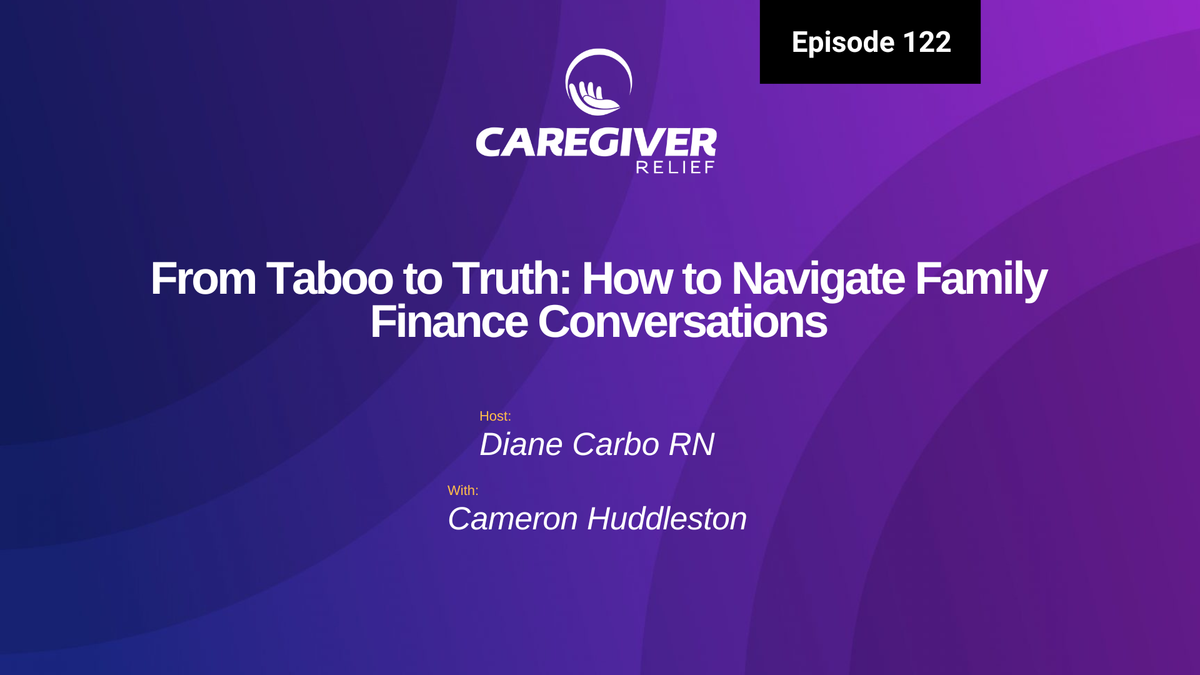
From Taboo to Truth: How to Navigate Family Finance Conversations with Cameron Huddleston - Episode 122

Talking about money can be awkward, especially with parents. It’s a topic many of us avoid, hoping we’ll never have to deal with it. But what happens when a crisis hits and you’re left scrambling, trying to piece together your loved one's financial life? 😥
In this essential episode of the Caregiver Relief Podcast, host Diane Carbo sits down with personal finance expert and author Cameron Huddleston to break down one of the biggest taboos in families: money. Cameron, author of Mom and Dad, We Need to Talk, shares powerful insights from her own personal journey of having to play "detective" with her parents' finances after unexpected life events.
This conversation is a must-listen for every adult child. It’s packed with practical, compassionate advice to help you move from silence and uncertainty to clarity and peace of mind.
What You'll Learn in This Episode:
Why Is Talking About Money So Hard? 🤔
- Generational Habits: Many of our parents were raised with the idea that talking about money is "impolite."
- Shame and Embarrassment: Parents may feel ashamed if they haven't saved enough for retirement or have accumulated debt, making them hesitant to open up.
- Denial: It's common for aging parents to feel like "their time is never gonna come," so they don't see the urgency in planning.
The "Must-Have" Legal Toolkit dokumen
You don't need to be wealthy to have an estate plan. These documents are crucial and must be signed while your parent is mentally competent to avoid court battles later.
- Power of Attorney (Financial): Names someone to make financial decisions on their behalf if they become unable to. Cameron stresses that if you can only get one document, this is the most important one.
- Healthcare Power of Attorney: Names someone to make medical decisions.
- Will or Trust: Specifies who gets what after they pass away, preventing state law from making those decisions for you.
- Advanced Directive (Living Will): Outlines wishes for end-of-life medical care.
Conversation Starters That Actually Work ✨
Approaching the topic doesn't have to be a confrontation. Cameron suggests gentle, effective ways to begin:
- Tell a Story: Talk about a friend or colleague's experience (good or bad) with their parents' finances to make it less direct. "My friend's dad didn't have a will, and it was so tough for their family. Let's make sure we don't end up in that situation."
- Ask for Advice: Frame it as you needing their wisdom, which avoids role reversal. "Mom, I'm starting to plan for my own retirement. What steps did you take?"
- Talk About Scams: Use a recent scam call you received as an entry point. "I just got a call from someone claiming to be with the IRS. Did you know they never call you?"
Key Advice for the "Sandwich Generation" 🥪
Balancing your children's needs with your parents' is incredibly difficult. Cameron’s number one rule:
- Do not sacrifice your own financial well-being. Wrecking your own finances to support your parents only perpetuates the cycle of financial dependency onto your own children.
- Explore all options. Look into government benefits like VA Aid and Attendance or Medicaid. An elder law attorney can be invaluable in navigating this bureaucracy.
Meet Our Expert Guest: Cameron Huddleston

Cameron Huddleston is an award-winning personal finance journalist and the author of "Mom and Dad, We Need to Talk: How to Have Essential Conversations With Your Parents About Their Finances." She was inspired to write the book after learning the hard way how critical these conversations are.
You can find more about Cameron and grab some fantastic free resources on her website:
- Website: cameronhuddleston.com
- Free Resources: Check out her "Scam Red Flag Sheet" and an "In Case of Emergency Organizer" that your parents can fill out to ensure their information is accessible when needed.
Don't wait for a crisis to have this conversation. It might be awkward, but it's one of the most loving and responsible things you can do for your parents—and for yourself. Tune in to the full episode for more of Cameron's invaluable wisdom!
Podcast Episode Transcript
Diane: Welcome to the Caregiver Relief Podcast. I'm Diane Carbo rn, a patient care advocate.
Diane: today we're tackling a subject that's often not only uncomfortable, but absolutely essential family finances. Joining me is Cameron Huddleston, a winning journalist. Personal finance expert and author of Mom and Dad, we need to talk how to have essential conversations with your parents about their finances.
With over 20 years of experience writing for major outlets like Forbes, clinging Jurors and MSN, and appearances on CNNC, NBC and NPR and more. Cameron has guided countless families through the challenges of discussing money matters with their loved ones. Today we're gonna break down why these conversations matter.
How to approach them without creating conflict and practical tips to ensure your family's financial future is secure. Cameron, thanks so much for taking time outta your busy day to share your knowledge, because this is a topic that desperately needs to be talked about often, and it's o it's ignored.
Cameron: thank you so much for having me. I'm happy to be here.
Diane: Now, before we dive into the book and your expertise, I'd love to start with a personal note. What inspired you to write mom and dad, we need to talk, and how did your own caregiving journey shape the lessons we share?
Cameron: I was inspired to write the book because I did not have these conversations with my own parents.
Soon enough. And so I learned the hard way how important these conversations really are. I, when my father died at the age of 61, I was shocked. To learn that he died without a will, even though he was an attorney and in a second marriage, and that second wife was also an attorney. And there, there should have been a will or a trust or something there that would, that had put his wishes into writing.
And then a few years later, my mom was diagnosed at the age of 65 with Alzheimer's disease and Again, I had not had any detailed conversations with her about her finances, and so I had to play Detective Yes, to get the information that I needed about her finances as she was forgetting those details herself.
Diane: Yes. Yes. So why do you think money is still considered such a taboo topic for so many families?
Cameron: It wasn't my family. My father would always say, don't talk about money. It's impolite. I'm sure he was. Raised that way too. My mother was not quite as tightlipped about money matters. I had, a general idea about where she stood financially after my parents.
Got divorced. of course growing up I could observe things and, make my own assumptions about my parents' finances. it's just, it's, I think it's a lot of, it's a generational thing. I think that younger generations are a little more inclined now to talk about money, especially with their.
Their partners with their children, with other family members. my husband and I have been talking to our kids about money matters since they were young. And we actually sat our two oldest children down recently and had this conversation. We shared all of the details of our finances and estate planning with them.
and I just, some people are also embarrassed too, if they're not in a good position financially. Yeah, it's hard to admit to your kids that you haven't saved for retirement or that you have a lot of debt and yeah. people because of that shame, they don't wanna have to confront it.
Diane: And I'll tell you right now,I've been a nurse for 54 years and I can tell you the baby boomers number one. I'm excited that you wrote this book because, this is what I'm finding your experience is a solution that we need for the. On incoming of the silver tsunami, and they're gonna be able to find solutions to problems that we've already faced and addressed.
So I appreciate that about you, but I see the baby boomers in my generation, I see people that are, old family dynamic start to play when you get into that, you're trying to. You're not supposed to parent your parent, but you feel like you have to. And I'm learning, and I've learned and seen, there are people that are so private about anything.
They do not want to share one iota of information. And it's really sad. and, the other thing is, a lot of them just feel like. It's never going to, their time is never gonna come, and they're gonna live forever, so they don't have to worry about it. yeah, I've seen this ongoing and I think that what I wanna make people aware of as we get into this conversation is our Medicare program has gone to a cost sharing
Platform and what we are seeing is people being more financially responsible for the care that they require. The only thing our government did was give billions of dollars to the insurance industry to be ca gatekeepers. And, I, I don't know if you're aware of this, but Medicare Advantage plans are actually a.
Have a copay of 200 to $500 a day if you're in skilled care or rehab, who can afford that? that's why I tell people, you really have to start addressing things early because you wanna, if you wanna protect your finances, you've gotta do it now because the government will take it.
I'm seeing it. They will.
Cameron: I think what a lot of people also don't understand is that Medicare. Does not pay for, yes, long-term care won't pay for the type of care that you would need. For example, if you had Alzheimer's disease, like my mother, yes. You know it's not gonna pay for memory care or assisted living.
It will pay for up to 100 days in a skilled nursing facility. It longer pays. After you've been in a hospital. Yeah. Or three days, right? You have to be in the hospital then, sent to rehab. And skilled nursing, Medicaid is the top payer of long-term care services. Yes. Or I should say it was, it has been historically the top payer of long-term care services in the us.
Who knows what's gonna happen with the changes in Medicaid funding?
Diane: it's not Medicaid funding that we need to be concerned about. It's, we don't, we say they, we, they tell us we have a hundred days. Of, of skilled rehab. We do not with the lower reimbursements, we no longer have restorative rehab in nursing homes because they can't afford it.
The reimbursement is so low for rehab that patients I am seeing, and the whole country is experiencing the most unprecedented number of unsafe discharges to home if no matter if you have a stroke or a head. Whatever. I am seeing patients with Medicare Advantage discharged between the 11th and 14th day, whether they're independent or able to provide, be taken care of.
and it's the, and with traditional Medicare, they're staying 20 days and then they're discharging them because the facilities get a higher reimbursement for not providing rehab. And that's what we are facing. That's why I'm telling people, you have got to get your finances in order and you've got to talk about these things because, when you hear, when you.
Purchase like a Medicare advantage. You're thinking, oh yeah, I get free dental, I get free eyecare. And then you find when, and everybody, I don't care who you are, is going to end up in a skilled unit or rehab for at some point in their life. And when you hear 200 to $500 a day copay, it's shocking people.
And they're being threatened by the facilities that if they appeal. And they don't, and they lose the appeal, which they wouldn't, but they put fear into them that they will have to pay, double or more than their copay. And so people are taking their family members home and home care is just as bad.
So I think, you really, I'm really excited and want to impress on the listeners how valuable your information is. So what are some warning signs that it is time for adult children to start having those financial conversations with their parents?
Cameron: I would say that you don't want to wait until they're warning signs, because that means there's already a problem and those conversations can no longer be hypothetical.
You can't say What if this were to happen, mom and dad? What involvement would you like me to have if this were to happen? How would you pay for this if this were to happen? Would I have the legal right to make financial decisions for your healthcare? Now you're saying this is happening and I need this information right now because I need to be able to help you out.
And that's a very different conversation. It's going to be much more emotionally charged, and if your parents are digging their heels in. You can't get that information, then you're gonna have some real troubles.
Diane: Yes.
Cameron: Because those estate planning documents, and I use the word estate planning block documents and that makes it sound like something that only really rich people do.
And I'll explain what it is. but those estate planning document. Might not be in place. And so what's an estate planning document? a will that spells out who gets what when you die. And if you don't have a will or a trust state, law will determine. Who gets your things and so your stuff might go to someone you don't want to receive it.
and you can't just assume that your family's gonna sort everything out harmoniously When money is involved, and even if it's a small amount or even it's the, favorite family car or the home or something, people will fight over these things. And so there's the will or trust, there's the power of attorney.
Which lets you name someone to make financial decisions for you if you can't. there's the healthcare power of attorney. It's also called a healthcare proxy or a healthcare surrogate. Yes. And that lets you name someone to make medical decisions for you. And there's an advanced directive or living will that lets you specify what end of life medical care you do or do not want.
And These documents must be drafted and signed while you are still mentally competent. So if, for example, your parent had a stroke and is, no longer able to speak for themselves Yes. That an attorney is not going to let your parents sign that document anymore, you've got to prove that you're competent to sign it.
Yes. So at that point, you have to go to court. Yep. You have to petition the court to become your parents' conservator or guardian so you can manage their finances for them and make medical decisions for them. And this can cost tens of thousands of dollars and it can take several months and you're essentially putting your parents on trial.
This can be avoided by making sure these documents are in place. Are they expensive? Potentially. It depends on what you wanna consider expensive. you can get. This full suite of estate planning documents, depending on where you live for A couple thousand dollars. If you cannot afford that, if your parents can't afford it, but you have the means to pay for it, I would encourage you to offer to pay for it for your parents as a
Diane: 100%.
Absolutely.
Cameron: And if they can't, if they can only afford to pay for one of those documents, I would encourage that they meet with an estate planning or elder or attorney to draft that Power of Attorney document. Yeah, that one is so important and that one, if it's not done correctly, you as the adult child are going to run into the most problems.
your parents' bank, you've gotta show up with that document to prove that you are and indeed their agent. Under power of attorney, the bank might say no, and if you've got an attorney who. Written that document, then you call the attorney and get the attorney on the phone to help you out so that you can, this is a valid document.
I have every right to, manage my parents' finances for them now because mom has been diagnosed with Alzheimer's, for example. so having that conversation early can ensure that your parents have those documents. You can talk to them about do they have a way to pay for long-term care if they need it?
And the sooner you figure out. If they don't have a way, then you, they can meet with someone to help them come up with a plan. Again, maybe it's that elder or attorney even, paying to meet with a financial advisor for an hour or two for them to look at their assets. you can, make sure that you know how they pay their bills so that you can make sure they're getting paid for them if they end up in the hospital for whatever reason.
Again, if you wait until there's that emergency and you're seeing the warning signs. Then that conversation is gonna be more difficult. There won't be a plan to deal with the emergency. Those legal documents might not be in place and it's gonna make life harder for you and for your parents. Yes.
Diane: Yes. And people don't understand if they put their documents in a safety deposit box and that person passes, they, the, they will not be able to get into that box for a very long time.
Cameron: Let them, ask that they have those documents. Ask whether they're located and make sure you can get access to them. And yet,
Diane: 100%. So no, the,
Cameron: the lockbox at the bank is not the best place to do it. Encourage them to keep them, maybe in a home safe. Yes, that you can access it if necessary.
Diane: Yes. what are some common mistakes people make when trying to talk about finances with the parents?
Cameron: couple mistakes. I think. First of all, if you have siblings, it's a mistake not to talk to your siblings first. If you go to mom and dad and have this conversation, and then your siblings find out later, your siblings might think that you have gone behind their back and maybe you're trying to Yes.
Win favor with mom and dad so that you get everything when they pass away. Yes. So you wanna talk to your siblings. All of you can get on the same page and decide. Who's going to initiate the conversation? Is it one of you? Is it all of you? When do you wanna start the conversation? How do you wanna start the conversation?
You can also talk to your siblings about what role each of you might be willing to play and mom and dad's financial lives and care as they get older, and so good idea to talk to your siblings first. When you talk to your parents. I think that there are a variety of approaches that you. Can use to make it seem more natural.
You can tell a story about a friend or a colleague who had to perhaps get involved with their parents' finances because of a caregiving situation, or maybe perhaps it's a cautionary tale. my best friend's father passed away. He didn't have a will, and it was very difficult for the family. To deal with that situation.
Let's make sure we don't end up in the same situation. You could start the conversation by asking your parents for advice and that avoids the role reversal, mom and dad 100%. Yes. if you're still, relatively young and just starting out, mom and dad, just had kids Do I, does that mean I need a will now? Or do I need life insurance? Or maybe you're in your forties and fifties already and so you wanna ask your parents about retirement planning. mom and dad, I'm trying to plan for my retirement, 10, 20 years down the road, can you share with me what steps you took?
And their response is gonna give you clues. Yes. About what they did, and then you're gonna keep the conversation going by asking more questions. Yeah. You could even start the conversation by talking to your parents about scams, because we are all targeted by scammers. Yes. And so you can share a phone call that you received.
I just got a call from someone claiming to be with the IRS mom and dad. Did you know that the IRS is never gonna call you? Just wanna make sure you knew that. Yes. It's a way to get parents who maybe aren't comfortable talking about money, talking about a topic. Yeah. Scams are a great way to introduce the idea of money conversations to your parents.
Diane: Yes, I recommend, like you were saying, have a family meeting without the parent first, especially if there's lots of siblings. And, that's a really hard thing for a lot of people to do because, when they've been away from each other for a long time maybe, and they've gone on, they've all moved on in their worlds.
Living their lives and now they come back together as a group and old family dynamics play. I'm the bossy, know-it-all, big sister. they would already, they tell me, no, we're not doing what you say, you can't run. And then, there's my brother who's the peacemaker and my sister, who's the baby, and my other brother is.
He's, him and I are 13 months apart. we both are alphas in our own way. it's really hard that you have those dynamics. So I really, I encourage people to, I have a resource, a family meeting guide that gives you all the rules and everything that you need to do to have a conversation and get on the same page.
Before you approach the parents, because that's a whole nother ball game. So I really like that. I think that those were good points that you brought out because, and I can hear, I, I just know be having come from a big Irish family, all the dysfunctional, chaos that we cause,I, we had one of the smaller families of four, and then there's the port.
Person who's just the solo child, the only child, and the challenges they face. And sometimes they have to get Unextended family members involved. And that's really important so that they have support when they do approach this. so I'm gonna ask you, how can an adult children approach these conversations without making their parents feel defensive or disrespected?
That's a good one
Cameron: for sure. And I mentioned a couple of ways already on Yes. About how to start the conversation naturally. it's, it is very important not to be condescending when you talk to your parents. So you don't wanna come into this conversation, for example, by pointing out that perhaps they're making mistakes with their finances.
Yes. Or that you're noticing that they're falling for scams more frequently, or that you're worried that you're gonna have to take care of them because they have no way to pay for care. Yeah. Do not be critical or condescending in any way, because of course that's gonna put your parents on the defensive.
Diane: Yes.
Cameron: off the bat. And they, there's not any chance of having a productive conversation at that point. Yes. These conversations need to come from a place of love, and so when you're talking to them, it's okay to tell your parents, look. I know this is awkward. It's awkward for you and it's awkward for me.
But the reason I want to have this conversation, mom and dad, is because I love you and you took such good care of me when I was growing up, and if I ever need to take care of you. I wanna do a good job and I, but to do that, I need some information from you and I need to know what your wishes are, and I don't wanna make any mistakes.
And so I need to know how you're managing your finances so I can manage them for you in a way that you would approve of. If something does happen, let them know that they have control in this situation. I don't wanna take away your control at all. In fact, I want to, I want you to stay in control, and the only way you can do that is by telling me what you want, telling me what you, your wishes are.
Because if I don't know what your wishes are. I'm gonna have to guess and I might make some mistakes and I might make the wrong decisions, and I would hate to do that. I would feel really guilty about it if I made the wrong decisions about your money.
Diane: And I have to tell my listeners out there that it's good to start early with these conversations before they're really sick.
even if they've just retired, it's really good. I actually believe anybody over the age of 18 should have advanced directives and things in place. People say, that's crazy. No, it's not. But, and what you want at 18 isn't what you want at 20 or 30 or 50, or 70 or a hundred. but I also think that anybody who is in a relationship, whether they're married or not, should have all these systems in place because you never know.
When an accident or something will happen, a stroke will happen to young people and their whole lives change. So it's important to open those, communication lines and have dialogues. But the other thing is when you get rejected, don't quit. Just do it again at another time. at in another way, you'll find the right way.
it just takes it, you'll get to know what works and what doesn't work with your parent. And sometimes you just have to, function in crisis mode. And that's when you get into the detective mode, like we talked about. and you have to do things behind their backs, in their homes. I know it's awful, but you need.
Get things prepared, and we can talk about that later. But how can parents involve their adult children in financial planning without feeling like they're giving up independence?
Cameron: I certainly think if the parents initiate the conversation, that lets them maintain control of the dialogue. You get to decide, yeah, what you're discussing and what information you're sharing, and at what point you're sharing that information.
my husband and I had the conversation with our two college aged daughters. We shared a lot of details. People don't have to share as many details as we did. You don't have to share how much money is in your checking account, but your kids need to know at the least where you bank. Yes. It's a good idea for them to know how you pay the bills.
Are you writing checks? Are things being set up to be paid? Automatically, and I know sometimes the children don't want to have these conversations because it forces them Yes. To come face to face with the fact that their parents are not going to be there forever, or that as their parents get older, they might need help.
And that's hard. that's really difficult for a lot of us. But again, it's a lot more difficult when you. When you're met with those situations and you don't have a plan and you don't have any information, like if you lose a parent, it's devastating. What's worse though is having to settle a, settle an estate and you don't know anything about
Diane: their accounts.
Yes,
Cameron: their assets, where anything is, and you're grieving and you're digging through every nook and cranny in your parents' house. Trying to get access to the computer to see if there's, information going through files. or again, if you've got a parent who has a stroke and now they're in the hospital and you've gotta pay the bills and the doctor won't talk to you because you haven't been named healthcare power of attorney, the bank won't let you sign a check to pay the hospital bill.
Yep. Because you haven't been named power of attorney. Yep. That's worse. That is a whole lot worse than having a few. Awkward conversations and
Diane: credit card companies won't even talk to you if you don't have, so when you're trying to get information on, 'cause I have had so many families go through this where, they're trying to find who has credit cards, where they're located, how much is on the credit card, what's the balance.
And unless you, they have in their hand your legal power of attorney, they're not gonna give it. Any information out at all. And it's very frustrating because, families are trying to, the caregivers or the adult children are trying to hold it all together while, and the other thing we're missing is there are a lot of family caregivers like you that have adult, have children that are adult children, they're still in, in high school or college or whatever, and you've got.
To manage them and you're managing another household. So the whole gamut of all the things that could go wrong, will go wrong. Murphy's Law always, happens.
Cameron: That's true.
Diane: So what does, the role of transparency play in preventing financial crisis related to aging illness or dementia? Talk about how smooth it can be.
Cameron: Okay. So I'll give you an example, from my experience with my mom.
Diane: So
Cameron: I did not have. Many details about her finances before I got involved with her finances after she was diagnosed with Alzheimer's. We did, I did get her to meet with an estate planning attorney to update her documents. And so I had, that power of attorney document, the medical power of attorney document that made things easy.
we went to the bank together, let the bank know that I had been named her power of attorney, and so then I could get access to her bank account. like I said, I had to play detective, but over time as her Alzheimer's progressed and I. Played a bigger and bigger role in her finances and eventually managed all of her finances.
It got to the point where I knew everything about her finances, and so when she passed away, because I had all those details, I knew every account that she had. I knew everything. It made that process after her death. Easier. I knew which accounts needed to be closed. Oh, absolutely.
And I had that information, I knew that there was a small life insurance policy that I could tap to pay for funeral expenses.
Diane: I
Cameron: know many her social security number, and so that made, things easier to close out accounts. Yes. It made that difficult time.
A little bit easier. It was still difficult. It was still a hassle to have to deal with that after losing my mom, but I can't imagine going through that process. Yeah, and starting from scratch and not having any idea what sort of accounts she had that needed to be closed. If she had any debt, if she had any, what sort of investment accounts she might have had, that would've been a nightmare.
And so having that information made. A difficult situation, easier.
Diane: I had recently have a girlfriend whose sister died unexpectedly, and she was a CEO of a company. and she had lost her husband several years ago. And of course he never shared anything with her. Anything. And here she was stuck running a business trying to find everything out.
she was smart enough 'cause she has two children, but one is, autistic and he's in his twenties and he needs structure and support and help with his daily life. So she actually. this is a typical woman's story. I can't believe this, because she was actually in the healthcare field.
She was having pains for a couple weeks and she just ignored 'em, thought it was heartburn and it got so bad. One day, she, now, her daughter lived right down the street, but she got in the car and drove herself to the er. When she got there, she had all her paperwork and wheeling her to the, test to do a cardiac test on her.
She had a massive heart attack and died. So totally unprepared Were the family, but. Because she had been through what she went through with her husband. she, it was pure hell. And, it really awakened her and alerted her to what she needed to do. And she actually had everything in order from where she wanted to be buried.
everything And even. In fact, her daughter and her husband have agreed to move into the house that she bought. 'cause she, that was her intent. If I die, Chris can't change his environment. We have to adjust to him. And that's a mom that loves her child and the sister and brother-in-law.
Hey, this is cool because it's really nice. but, and they're able to take over the business and everything has gone so smoothly and it just decreases the stress. So it gives you an opportunity to actually grieve. Yes, you're absolutely able to, you're not being pulled and hearing, being called by credit card companies or, a any, the attorneys or the, somebody saying, we're re referring you to, the credit agency or whatever.
I'm like, it just making it so much easier. And you actually do have a chance to grieve and feel your loss, which is so important to work through your grieving process. So I really encourage this. So you are part of the sandwich generation. what strategies do you recommend for balancing those financial responsibilities for both your kids and aging parents?
Cameron: It is difficult. And I think, people need to realize you can't find a good balance. you have to be aware of that. There, there are some compromises that you are going to have to make. I think it is important to remember that you should not sacrifice your own financial wellbeing. And
Diane: could you say that again?
I want my listeners to hear that because that is a big thing that happens with family caregivers. They become financially, devastated.
Cameron: sum end up filing for bankruptcy. You should not sacrifice your own financial Thank you for being, and it might feel like you're abandoning. Mom and dad, but if you have children, yes.
You cannot abandon your children, especially if they're still young. Like mine were.
Diane: Yes,
Cameron: because they're counting on you for financial support. And the thing is, if you wreck your own finances. You're going to perpetuate that cycle. Yeah. You'll not have enough money to support yourself in retirement. You will not have the funds to pay for any sort of professional care.
If you need care, your kids are gonna have to step in, maybe quit their jobs to care for you, or to provide financial support for you that's gonna hurt their finances. They have children, it's gonna impact their kids. And it's just going to continue and continue. And but you say, all right, of course I can't just leave mom and dad.
I can't leave 'em out to dry, I, I have to provide some support. this is when you look into what. Government benefits they might qualify for. For example, if your parents served in the military. Yes. VA has a program called Aid in Attendance. They can provide financial support. For caregiving if you need caregiving support, and that's
Diane: a really good point, and I wanna tell caregivers, as soon as your family member becomes, but even before they become Ill investigate what's available, those benefits, because the government turnaround time is, it's a bureaucracy two to three years.
And,it's gotten worse since COVID. So you're without benefits. That's why as soon as you even begin to stop, talk about this process, you should look into that. Make sure that, 'cause they have, you have to find, again, it's the important paperwork. The DOD number, I don't know what it is. Form that they got with, but that is really a good point because so many people are vets that, have benefits available to them that could financially help them So many ways.
And they aren't aware of it. And so I always say be active, be proactive, and look into it as soon as you can. You may not need it now, but get all the information so when the time comes, you can apply for those. Because the turnaround time is so slow
Cameron: and this is where it can be really a good idea to spend a little money to save yourself some money in the long run by working with.
An elder law attorney.
Diane: Yes, you
Cameron: want someone who specializes in helping people get those VA benefits and qualify for Medicaid. as I mentioned earlier, Medicaid is the top payer of long-term care services in the us. It will pay. For care in a skilled nursing facility in every state, your parent might not need that skilled nursing facility.
In some states, it'll pay for assisted living and it will pay sometimes to bring someone into the home. In some states, it will even pay family members, or I should say essentially reimburse family members. Yes. If they're providing that care. And so if you're caring for the parent, you might be able to get paid.
Through Medicaid, but working with an elder law, and that's the name of elder law attorney. Yep. Who specializes in, helping people get Medicaid benefits. they're gonna know how to get through the bureaucracy. They're gonna know what you qualify, they're gonna know what the rules are in your state and that can pay off big time.
if your parents. Own their house or have paid off most of their mortgage and they have a lot of equity in that home. As a last resort, you could, help them get a reverse mortgage to essentially tap the equity in our home so they have money to pay for care. You could sell the home like they might be saying, please, I need to stay in my home.
Please don't sell the home. As difficult as that might be financially, it might make a lot more sense to sell the home and move them in with you or move them into a facility, because paying for someone to come into their house around the clock to care for them can actually be more expensive than, moving them into an assisted living facility, memory care, skilled nursing facility, and Explore your options. don't just say, don't just assume that your only choice Is to be the primary caregiver. Yes, you might wanna do that. Your parents might want to do that, but again, you cannot sacrifice your financial well thing. mom and dad might say, look, I can't believe you're doing this to me.
You might get a huge guilt trip, if your parents were. In their normal state of mind. if they weren't facing a healthcare emergency, they might have said to you, if you had that conversation earlier, I don't want you to have to sacrifice your wellbeing. I don't want you to be a burden.
Now, the situation's different, and they're saying, don't abandon me, because perhaps they're not thinking the same way as they would've when they were still healthy. And so again, having that conversation earlier. Exactly can let you know what their wishes are. And they might say, like I told my kids, I don't expect you to put your life on hold to care for me.
your father and I had the funds available to pay for care. If I need care, don't, don't abandon me, but, make sure the bills get paid. Find a nice facility to put me in, but I'm not expecting you to be the one to provide hands on care. I, first of all, I want this.
Diane: I want my listeners, and I tell them this often, but I want them to hear it.
63% of family caregivers become seriously ill or die from the chronic stress of caregiving. what they don't know is many. Become, live at poverty level or below. Once they are and are men, some are even homeless because they stayed in a home providing care for their family member. And then the uninvolved siblings and extended family members like vultures come in after the person dies and provides nothing for that caregiver.
And that's why I really encourage. people, every caregiver to put, and they hate when I say this, but I'm going to continue to say it. You have to look at this caregiving position as a job because, it so get a family caregiver contract and face place. And then if you do have uninvolved siblings and extended family members, they need to know what your boundaries and limits are.
So if you say, I can care for somebody until they become sexually abusive, or I'm afraid they're gonna hurt me. Or even if they, I don't want to do, provide intimate care when they're incontinent. Those are real issues. And then the everybody knows, okay, so what do we do then? I also expect everybody to say, you get, you want time off for, for your own healthcare to be able to do, go to the gym or just sit outside and breathe and people aren't able to do that.
So I encourage the family healthcare. Contra or family caregiver contract. And I encourage everybody to build a care team partner support group that will help provide practical assistance. And that's really important too, because people don't understand the average caregiving journey is six to seven years, but it can be as long as 20.
And it was
Cameron: 12 for me.
Diane: Yes. Yes. and it is just devastating. And we talk about bringing in the professionals, like the financial planners or elder care law attorneys, or even CPAs. how do you do that without creating more tension?
Cameron: sometimes that third party. Getting that third party involved can make things a little bit easier because parents might Yes.
Be more willing to listen to the suggestions Yes. Of that unbiased, professional third party than to listen to the suggestions of their children. Like I was so happy when after. The attorney had drafted my mom's estate planning documents when she said, you and your daughter should go to the bank together and show them this Power of Attorney document.
There was the attorney telling my mom to do it. I didn't have to ask my mom to do it. She took the attorney's advice and I was like, wow, this is great. Thank you so much. when my mother had, when she was in the late stage of Alzheimer's, it was easier for. Some of the,professionals, at the facility where she was to get her to do things then for me to get her to do things, Absolutely. They're doing it. That's not uncommon. They're doing it day in and day out, and so the, the attorneys, the financial planners, the accountants. They are better equipped sometimes to help families navigate these conversations because this is what they do. This is their line of work, And another great professional to reach out to is an aging life care professional. They're also called geriatric care managers. And these people can come in. I'm a geriatric care manager. Yes. And they can, yes. And they can mediate these. Family meetings. Yes. Meeting. And they can point you to resources in your community and they can help you find that attorney.
so that's a great resource.
Diane: it, it really is. And people don't utilize care managers enough. They really don't. And it's really sad. So what advice would you give families who, avoided these conversation until a crisis hits buckle down.
Cameron: that's right. my advice is obviously it depends on the situation, if it's death.
there will not be any arguments with the parent at that point. Exactly. The parent exactly is gone. Now you've gotta worry about the siblings, and if there's not a will, then there might be some fights. And so of course working with an attorney is a good idea at that point. If there is a situation like a dementia diagnosis, a stroke, Parkinson's diagnosis.
again, calling that family meeting and yeah. Saying, Hey guys, we've got something difficult that we need to face. Yep. But we're gonna get through this together. And to do that, we need to gather some information. Mom and dad need to share some information. We need to remember that we need to do what's best for mom or dad.
So we're gonna have to find a way to get on the same page. and letting your parents know, look, mom and dad, this is the point where I'm gonna need some information. I've gotta make sure you are getting paid. I need to know what assets you have so that you know I can get you the care that you need.
And I don't wanna, I don't wanna make any mistakes. And just being very clear and open and honest.
Diane: Yeah. One of the things I encourage, if you do have a family meeting, everybody in your family has a skill. You may not see them as a sibling that no, they can't do anything. They're irresponsible or whatever.
But everyone has a skill and an ability to help in some way. it may be someone is great with money and or they're bank, they're in banking or accounting, and then they're the ones you want to have look at for the credit cards and the finances go through the finances with you. oftentimes it takes two and go through the papers to put things organized, but then there's the maintenance of the house and other things.
There's somebody in that family who should be able to help manage the home, and to see what they, what needs fixed, what needs, what's broken, what those kinds of issues as well. And then there's the. There's the end of life issues you always have to address as well. And there's gotta be someone in the family that is willing to sit and, maybe have a minister or a person of faith come in and say, what do we do?
To plan end of life. there's a lot of things and now they have end of life specialists and death doulas that will come in and help you plan prior to your death. I just had a gentleman who had a life celebration and he's 89 and he had such a good time and got so much good whiskey. He decided he's gonna do it yearly till he passes.
I love it. I love it. Oh,if listeners remember just one piece of advice, Cameron, today from our conversation, what should it be to start moving from taboo to truth in their families?
Cameron: These conversations need to happen sooner rather than later. Yeah, you will find yourself in a much more difficult situation.
If you do not have these conversations, and the sooner you start trying. If it takes a while to get through to your parents, yeah. Then the more likely you will be able to start getting some information before an emergency occurs. Yes, and for some people it truly does take years to get parents to open up and share even the smaller Thank you
Diane: for saying that, because it Absolutely.
That's why I say don't stop trying. No, because it may take years because people. Live in denial. Our coping mechanism is the ostrich syndrome. put your head in the sand and just ignore until you can't anymore. And, so that's why I say be patient. Don't give up and keep trying. Cameron, how do people reach you?
And I want, wanna make sure that they know how to find your course, be your book because it's so valuable and such an important need right now. We have a silver tsunami. We've got, 53 million people caregiving right now, and it's going to get to 130 million in the next few years. So they, there's so many of this, and this is a book that they need to find.
Cameron: So the easiest way to get information about me and my book is@cameronhuddleston.com. I've got a page with links to, get my book at Amazon and Barnes and Noble and okay. All the other various places where books are sold. I've got a couple of free resources on my website. I've got a scam red flag sheet that you can download and give to your bank.
Wonderful. Put on their refrigerator or hang up by the phone. I've got an in case of emergency organizer, and this is one thing that people can do is if their parents don't want to tell them information about their finances, ask them to write it down, and this lets them maintain control of that information.
Just say, tell me when. And how I can access this information and they can put it all in that case of emergency organizer that I've got. It's free on my website. So that's a tactic. Good point. That you can use.
Diane: Yes. I love that. we also create, I create a page, a permanent page on caregiver.
And at the bottom of that page they'll have all your contact information as well so that it'll be there permanently. So people will be able to find you as the silver tsunami is upon us, and they can ripple in through the waves and find you. So thank you so much for your time, Cameron, and I really appreciate it and I know my listeners appreciate it.
To my family caregivers out there, you are the most important part of the caregiving equation. Without you, it all falls apart. So please learn to be gentle with yourself. Practice self-care every day because you are worth it.
Caring for a loved one can be overwhelming — but you're not alone. If you have questions, big or small, our expert team is here to help.
👉 Click here to Ask the Expert
Our Resource section can help you find the information and tools that you need. We have courses, videos, checklists, guidebooks, cheat sheets, how-to guides and more.
You can get started by clicking on the link below. We know that taking care of a loved one is hard work, but with our help you can get the support that you need.
Click here to go to Resource Section now!