Connecting Generations: How Geri-Gadgets® Spark Joy and Reduce Stress with Angela Fairhurst - Episode 132
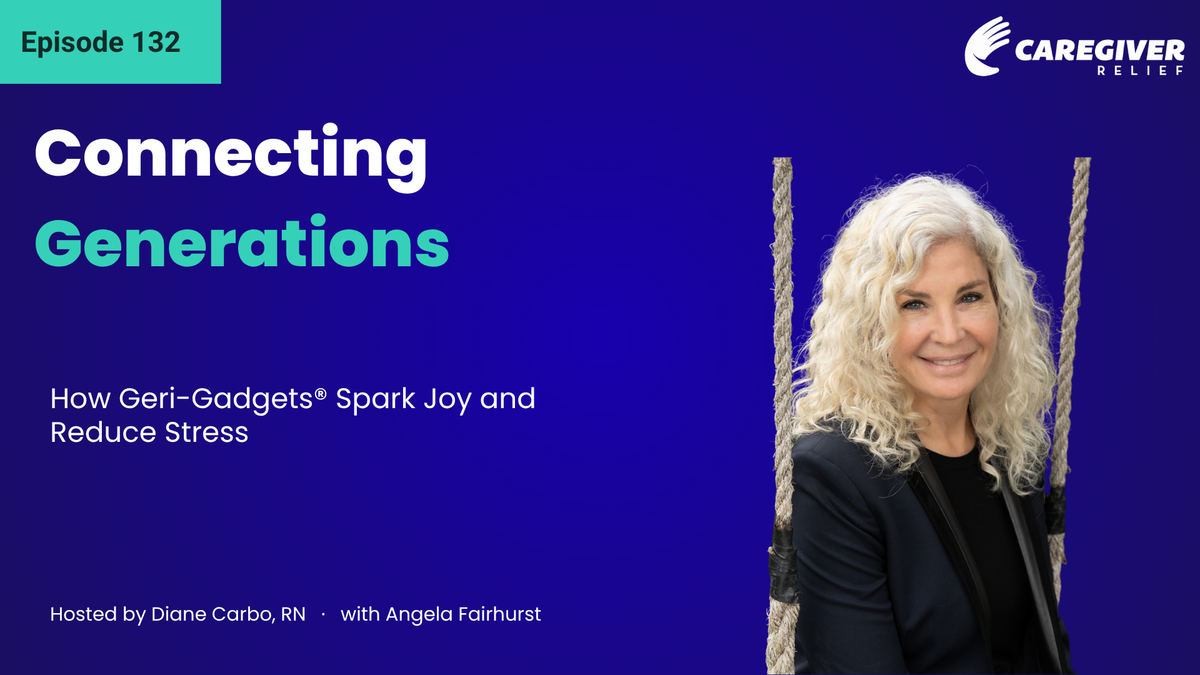
Host Diane Carbo, RN, speaks with Angela Fairhurst, CEO and founder of Geri-Gadgets, about the profound and often undervalued role of meaningful activities in dementia care.
Angela shares the personal caregiving journey with her mother that led to the creation of Geri-Gadgets—innovative, safe, and durable sensory and engagement kits. This episode is a must-listen for anyone seeking to reduce stress, manage challenging behaviors, and create joyful, meaningful connections with loved ones living with dementia or other cognitive conditions.
💡 Key Takeaways from the Conversation
- Activities are Medicine: Meaningful activities can significantly decrease or eliminate negative behaviors, offering opportunities for joy, connection, and memory-making.
- Engagement and connection cause the body to release positive chemicals like serotonin and oxytocin, which can reduce stress and anxiety for days after just a 15-minute visit.
- Activities work like medicine and are a cost-effective solution compared to resorting to heavy psychotropic medications to manage behavior.
- The Power of Geri-Gadgets: Geri-Gadgets were born from Angela's frustration with the lack of safe, non-babyish, and washable sensory toys for her mother, who had Lewy body dementia.
- Safety & Durability: The products are made of safe-touch, medical-grade silicone, making them dishwasher safe, mouth safe, and virtually indestructible. They are non-toxic, heat-resistant, and won't cut or injure the user if dropped.
- Multi-Sensory & Failure-Free: The kits (like the Fidget Gidget Bucket and Shapes Bucket) offer different textures and manipulatives (tuggers, poppers, click chains, etc.) that are flexible and require no direction or language. This provides a sense of accomplishment for people at all stages of cognitive decline.
- Versatile Use: The products can be used during bathing to keep a person occupied, during medical tests to reduce stress, and even safely in bed to prevent nighttime wandering and falls.
- Reimagining Connection: Activities like Geri-Gadgets provide a common focus that removes the stress of the loved one having to remember names or the visitor getting upset when they aren't recognized.
- Multi-Generational Fun: The products are suitable for children and grandchildren, allowing them to safely interact and play with their loved one, creating precious memories for all.
- Beyond Dementia: The products are also successfully used in the neurodivergent space, by occupational and physical therapists, and in rehab centers for their calming and therapeutic qualities.
- A Call to Action for Caregivers: Don't overlook activities! If you're feeling overwhelmed, simple, safe activities like folding washcloths or using the Geri-Gadgets kits can dramatically change the attitude and cooperation level of your loved one.
- Slowing the Slide: Activities and interaction help slow the downward slide of the disease process by keeping existing neuro-pathways alive longer.

💖 A Message to Our Caregivers
Caregiving is one of the hardest, most meaningful things you'll ever do, and no one should have to do it alone. Simple engagement is a game-changer that can dramatically reduce stress and challenging behaviors, making your journey more manageable and enriching for everyone involved.

You are the most important part of the caregiving equation. Please learn to be gentle with yourself. Practice self-care every day because you are worth it!

🔗 Geri-Gadgets Access and Contact Information
To learn more about the products, see them in action, and find out where to purchase them, use the links below:
- Website: www.geri-gadgets.com
- To Purchase Geri-Gadgets: Visit the "Where to Buy" section of the website. They are available through distributors like Eugeria (Canada), Story & Sons (UK), and others, with a Shopify option coming soon.
- Instagram: @Gerigadgets
- YouTube Channel: Geri-Gadgets®
- Facebook: Geri-Gadgets
- LinkedIn: Geri-Gadgets®, Inc.
Podcast Episode Transcript
Diane: Welcome to the Caregiver Relief Podcast. I'm your host, Diane Carbo, rn,
Diane: and today we're talking about something that is often undervalued in dementia care activities. For many caregivers, the focus is on managing symptoms or behaviors. But research and lived experience show that meaningful activities can decrease or even eliminate negative behaviors while creating opportunities for joy, connection and memory making.
I'm thrilled to welcome Angela Fairhurst, CEO, and founder of Jerry Gadgets, an innovative company born out of her personal caregiving journey with her mother, who had Lewy body dementia. With decades of product development experience, Angela has created patented products that bring engagement back into care.
Helping not just seniors, but also neurodivergent individuals, those in rehab and multi-generational families. Today we'll explore why activities are so underutilized, what makes Jerry gadgets different, and how we can reimagine caregiving through the power of engagement. Angela, thanks so much, for taking time out of today's your busy schedule today.
And I have to tell you, I want to promote activities all the time, and I hope that our caregivers will listen to what we have to say because it is the biggest change. A biggest opportunity to stop negative behaviors and have meaningful interactions.
Angela: I couldn't agree more, and I'm so happy to be here today.
Thank you for having
Diane: me. yeah. Can you share a little bit about your personal journey with your mother's Lewy body dementia and how it inspired you to create, the Jerry Gadgets?
Angela: Yeah. 2010 was the year that I saw my mom's. Dementia emerged. This was at the same time that my dad was dying of lung cancer.
He died in 10 weeks. And at the same time, my mom, she had pre symptoms of Lewy body, but we didn't know what that was. Yes. it presents itself differently than Alzheimer's. So she would, Boston car, she would say the weirdest things. Her filter was gone. Yes. she would replace words with other words. she'd get up to stand and her blood pressure would drop.
I think we need to know what kind of dementia somebody has. Yes. In order to properly a approach them in every way, however. Yeah. Because frontal lobe and Lewy body are very different than Alzheimer's, but everything's a dementia. Activities are needed for all of these dementia. Absolutely. But I to absolutely, my mom was hospitalized with a pacemaker to put in for the drops of blood pressure that made her busy and sometimes fall or faint.
Yeah. And that when I went to see her in the hospital here in Los Angeles, that's where I'm born and raised, she had no idea where she was. Zero. She's I need to get my purse. Like, where's my car keys? oh my God. It was scary. I call my brother. Gary is my older brother. He's a doctor, he's a research doctor, and he, at the time was working for Merck.
And I said, and my dad, again, I'm telling you, he was in the lung cancer stage and my brother is trying to help, but all we could do was palliative. And when, so he said, no, she's fine. She'll be okay. And when she packed 16 pairs of pants and one shirt to visit him, that. Christmas time, then he knew and had her tested.
Now, my, my challenge became that she was diagnosed with Alzheimer's when she actually had Lewy body dementia. And sadly, she was given seven different antipsychotics for her behaviors. Yeah. Which were just her having frustration and anxiety and ha because she couldn't communicate her feelings properly.
Diane: I want my listeners to understand that Lewy body dementia is the second most common type of dementia, and also the most misdiagnosed hundred percent it initially, presents as mental health issues. And,the medications you would give for other dementias, you will act as, have a paradoxical meaning opposite effect on people with Lewy body.
you really, if you have a family member. Such as your mom who has misdiagnosed. Eventually the doctors will figure it out because she's having these terrible responses to these psychotic medications, psych medications that she shouldn't even be on. Correct. And one of them made her
Angela: crawl on the floor like a dog when she's. Taking her clothes off in the middle of the hallway. And the last one she was put on, she was non-responsive. I literally went three outta four days and she was losing weight and didn't drink and eat. And I was asking, what's wrong? what's wrong? and that was a hospitalization. She had lost 17 pounds in three weeks.
Oh, she lost? She was short. Two liters of fluid. Oh, she, I can't even believe she made it out of that. We pulled her out of that big care home, fancy care home, put her into a smaller one where she had more one-on-one or two one care because she needed it. But her behaviors were still bad. She was home for four years with care until she needed 36 hours of care in 24 hours.
So became impossible for her to be safe at home. Yeah. So that's when she was still kicking and biting. Because she was so frustrated, so her behaviors were gonna get her kicked out and we were like, at a quandary. What are we gonna do? that's when I noticed her touching Shiny magazine paper with her good hand.
She had a clenched hand that shook right.
Diane: Uhhuh.
Angela: Just very, if people don't know Lewy body has Parkinson's symptoms. Symptoms. Thank you. and so she's touching this shiny magazine paper and even tearing and rolling it, and I see that sensory need. So I started bringing toys. I brought toys from the toy department, and I even started with the bucket and.
That had the shapes, Uhhuh, she couldn't, it was too complicated to get any of those shapes into the holes because of the, her vision and her all the things that go start to go or with cognitive decline. But she took the cups and she's sipping on them, and that's where the bucket idea came from because she was curious about what was inside.
cut to. I am bringing fidget toys. I'm bringing all sorts of things to try and figure out what works. And most things were either too baby-ish. Yes. Too complicated. Yes. Definitely not washable and toxic. When put in the mouth a crayon was lipstick for her. So you and she. Was a school teacher her entire career, and she was a beautiful painter.
She had so much artistic ability,
Diane: Uhhuh,
Angela: then I'm like frustrated. What can I do that's going to work for her? What can I do? And what I found was silicone to be the perfect material. It's the closest thing to human. Uhhuh, these dishwasher safe. It can go up to 400, whatever. You know you cook. Yeah. Silicone.
You have a so pad and a star. yes. And a pot holder that I found, a big pot holder. I cut it down to size. Uhhuh brought it to her. Crunched like a taco. She was, she's hearing the noise. The sound. She loved that she's patting on it like that. We threw it back and forth like a Frisbee. Uhhuh. She was.
Gloriously changed. it was like happiness. This was my pivotal point of, oh my God, I'm onto something. She has to, I have to do this. And the sales guy that worked at the Care Home community who has since passed on, really we, he would've been my co-founder, but we ideated every Saturday for months to try and figure out what works.
So what we have here is the first. Bucket is a fidget gidget bucket, which has all this different textures and different manipulatives from the sensory mat to a tugger. Which for ha, exercising the hands and arms. Same with if you're gonna throw this back and forth like a Frisbee, we can spin it. Some people have the ability to do that.
I can say that I do not have that talent. yeah. And then certainly this can, you don't need to be right or left-handed. And these are all good. I was determined to help her hand so we know what poppers are, but this one is really a great shape, unusual made for us specifically. Yeah. Because of the triangle, you can fit, you can really not only use it as a popper But you have that therapeutic I, quality.
Diane: So it's like squeezing the air bubbles on, on, Bubble wrap Gooding material. Yeah. Yeah. Cool,
Angela: cool. This is a click chain and it's reinforced to be super, super strong Uhhuh. It fit over the head. You can make a bracelet out of it if you want, but this is also made to be louder so that it can remind people of fall stepping on fall leaves, or.
Crackling ice or anything like that, but it's also pretty entertaining to play with. And then of course, eggs are familiar. This fits in the Goldilocks. Not too hard, not too soft, not too big, not too small, and there's no goo inside. So again, everything is dishwasher safe, mouth safe. you can wipe it down in between users, so it's really good for.
Commercial use as well as at home care or caregiving companies and all that. And then that's where we are finding that in the neurodivergent space it works too because it's so flexible in terms of what it does. And even engagement, if they're, put it in your mouth, don't worry. This shapes bucket was a, I loved Tetris.
And a little bit of Lego. And so these are Tetris type shapes that can be put in together and in any configuration.
Diane: So
Angela: somebody that has a lot of dexterity can balance them on their sides, build up structure, endless possibilities, and further along they're just gonna lay them flat. So there's no, there's a sense of accomplishment that comes and there's the stars on one side, and there's stars in my logo.
So they're really significantly symbolic to me, Uhhuh, and a smooth side. So this is all beautiful colors. bright for the aging eye. But not primary colors. So they're absolutely respectful for anybody older. And then my uncle, my mom's older brother was a florist. So the flower bucket is very pretty.
We have four different color flowers and a boss with three with leaves. There's no wire inside. But the beauty about this is that the vase is reinforced and so sturdy are the flowers. And everything that you, so they can't destroy it. You can't destroy it. It can go in the mouth, but this kind of thing can be utilized With the side of the vase, so you don't just have to put them inside.
Like traditionally known again. Failure free entertainment and something that both males and females, I've found like them pretty equally. So these also, everything comes with a bucket. I got patented because of this and, I have ideation for a lot more in the future.
So it's
Diane: really fun and I find that things that I'm seeing as I've been doing podcasts now for over a year or two and every single new product out there, is from a family member who was, found a. A problem or a challenge and then provided a solution for it. And I just love that because you're so innovative and I'm impressed that you were so in tune, but I guess it's your background with products that made you pay attention to what was going on with your mom.
And because a lot of people have no idea about activities or. Any of those things and caregivers overlook activities, they really do. But why do you think engagement is so underutilized in dementia care?
Angela: I don't know. we need good food and water. We need exercise. And when, if the pandemic didn't show us that engagement and connection was so important, I don't know what will, but it makes a huge difference.
And what people need to understand, and you can relate to this as a nurse, is that. When we have engagement connection, our body develops chemicals. we serotonin, oxytocin and the dopamine for anticipation of opening a bucket and it's new every day. So these chemicals in a 15 minutes visit can last days.
Yes. And people don't realize that, oh, why should I bother to visit? It's too heart wrenching for me. I will guarantee that those people with cognitive decline, whether they know your name or not, or are able to take it out of the elevator bank, that 'cause it's very low down and you never know when that's gonna happen.
Definitely are there. So I believe that you shouldn't talk in front of them about them. Treat them like they're there. They're not invisible. You shouldn't talk to them like they're babies, but I am. I'm certain that they are there. We have proof of that.
Diane: one of the things that, that people w might say is, they look baby fied to me.
But I have to tell you, when you are dealing with a senior, from my experience with any kind of dementia, they get to a level where, they wanna clean, they wanna do something with their hands. They wanna be product productive, just like they were in their life. And no matter what they did, I've gone into buildings where, I love the flower thing.
the, Flower pot because I have so many little old ladies that love the garden. And the dirt, sometimes they want to eat the dirt and it's no longer safe for them where they can still through their, their abilities because they may not have the ability to. To show, to think, oh, the dirt's missing.
They do see the flower and can put it into the vase and, feel it and enjoy that experience. But I think that one of the things that's really important for people to understand is, a lot of this, I know people don't understand it. They think, oh, it's attention seeking behavior. And it's not.
It's just, they wanna be productive, they wanna be useful, and it gives them a sense of wellbeing if they have their hands busy. So I'm really impressed with,your products because they, they're safe and they're good for so many levels. People in the middle.
To end stages of dementia really, needs something to keep them busy. And that's when they start acting out. And I will tell you right now, people that have challenging behaviors are hard to place anywhere.
Angela: A hundred percent. Oh my gosh. I've now said a hundred percent three times because you're spot on.
But my mom was labeled difficult and once she had the silicone. tools, I call them sensory and engagement kits. I don't call them toys because they're Oh, no. High level. yes.
safe touch silicone medical grade, they're, they are made in quality. I will never, ever be down in inequality.
That's what we are here to make sure that they're never going to be poisoned or choking or anything. That safety is so important. What other product can they shower with? Bathe with? That's exactly very, they're safe there too, and to keep somebody, because we know that bathing can be an issue.
Occupied, really works well. if they're in a need, an EKG, something that they put on their head or even listen to music and they don't know what it is and struggle and more are pulling it off, giving 'em a Jerry Gadget bucket to, or items from it. Calms them down and takes away that stress so that the test can be run or the music be listened to.
Exactly. So all of these things, and my mom, like I said, was a painter. She was so artistic, but this was a creative outlet she could still have, which she was so important because that sense of accomplished mattered. It's giving that quality of life. She was not good sitting in front of a tv. She would get up, she would fall.
She was so bad, not good. Sitting in a hallway. What on earth, what kind of quality of life is that now? I know it supposedly makes it easier for the caregiver, but this sense it eases way better. Yes, and it works like medicine, whereas you can't change a behavior by putting somebody in front of a TV or an other electronic.
Diane: Yes. I can tell you that behaviors escalate when a person gets frustrated. you have no idea when you were talking about the last medication your mom tried it totally knocked her out. that's is what people, families have to resort to with somebody who has. Terrible behaviors if they want them placed.
And that's not a quality of life either. No
Angela: simple
Diane: solution. This is, that's the most cost effective solution there is. Exactly. And in the nursing homes, or in the memory care units. you find people folding towels and unfolding towels. You do that at home too. You let them fold towels or mismatch socks, they just wanna put socks together.
That's good. and I tell families, don't hesitate to unfold them because they don't even realize, all they do is see that they have an activity. they're happy doing something. They think they're doing something that's good and it. It saves time, energy, and even money for families that, that the caregiver that takes on this activity.
I wanna ask you, how do activities create opportunities for the caregivers's children and even grandchildren to connect with their loved one?
Angela: It's so beautiful. My mom lost language or the ability to communicate appropriately. So imagine a grandchild goes and plays with their grandmother At home, at a facility, wherever it gives a respite for the sandwich caregiver, because we know that's a huge problem these days.
It gives a respite for the paid caregiver to know that they are, have an activity with that's safe. That's not, if it goes in the mouth, no worries that they can go and tend to other people. We have a shortage of caregivers. We know this and that. They're not gonna get up if and to fall if they're busy.
But the beauty of this is that when the grandchild. A visitation. You don't have to say, Hey, do you know who I am? And by the way, that stresses whomever it is out. Everybody out. yes. and then the person who's visiting the loved one gets all upset when they don't know who they are. you can eliminate that as a problem with the Jerry Gadget bucket, but I also train, try and train people to say, hi, I'm Angela.
Mom, it's your daughter, Angela. It's so nice to see you. Don't you look nice today? Something like that. So you don't even give them an opportunity to miss you. And also vision, just like I know that if it's far away, you have to bring it to them. They're not gonna go and get it. so activities have to be brought to the person.
You can't go, oh, they're not interested. Every day is different. Every time a day is different. And the memory. Short term memory, remind your viewers that it's only 30 seconds long, so we never know what somebody's going to retain or not retain, because sometimes it's at that part of the brain that they might retain it, and then other times they don't.
So when they're repeating themselves. You can't get frustrated. What are you gonna yell at somebody? Because they have cancer. It's a disease. You have to meet them where they are. And activities such as mine and other activities that you're, are crucial because you can eliminate those kinds of medications because they are calm and their stress is removed by staying busy like that, by having that sense of accomplishment.
So there's no,it, she didn't have any more medication after
Diane: that. it, isn't it amazing, just a simple solution. But, I always, giggle when family say my mom wants to, she's cleaning all the time, or she's fidgeting wanting, she wants to crochet 'cause she used to crochet and, and I say, tell them, they, they need an activity and people just, Think that it takes up too much of their time. But Angela, what I encourage my family caregivers to do is create a care team, partner support group in within their family and community so that, and ask them to help with practical. Practical things that need to be done around the house. if you need yard work done, ask somebody to do it, because people are willing to help if they know what you need or if you want a break from your loved one, have them do the activity.
In fact. One of the, one of the things that I do with my care team partners is I have somebody who medicate manages medication. I give that as a job and I do have the activities and social director of the family or who or the community, whoever wants to come and help do activities on a regular basis.
And they will find that there are so many things, you'll learn something and. One of the most precious moments you will ever see is when you're saying they don't know you. All of a sudden they're working on an activity with you, and you may be just sitting there just enjoying them and they, you will, all of a sudden they'll look at you and realize who you are.
it's just a fleeting moment and they'll call, may even call you by your name. Or they may call you by your mother's name because you look like your mother, but just that moment of connection and there's a moment of lucidity that hits. I mean it, it is the long goodbye for a reason, but those moments are precious to the caregiver.
Because they can reconnect with their family member. And I know people, the caregivers also feel so overwhelmed that they think, I can't, I don't have time for this stuff. it's ridiculous. I'll tell you what it, then you find people that will do it with your loved one because it is so precious and so important and will totally.
Change the whole attitude for the day in somebody and have that. and they'll be more pleasant, they'll be more cooperative. it's just totally a game changer in so many ways that people don't understand. And one of the issues that I have with memory care problems I have with memory care is they have people that wander all night long wandering is.
Pacing. They need to be doing something and they should actually have an activities person 24 hours a day in a memory care. I just really believe that. But you can also, safely
Angela: give them a bucket in their bed. They're not gonna hurt. They're not gonna get hurt. Exactly. They're not. So if they're busy, then they're not gonna get up and fall.
That's the falls are the biggest thing. And you can eliminate some of those by having activity. Like it would save a lot. Keeping people busy, keeps people. Not
Diane: falling, ga getting up. You're absolutely right. Fall risks are huge. And one fall can actually result in death. Oh, yeah. Easily. And it's very common.
Angela: Yeah. if a hip is broken, the poss the likelihood of them developing pneumonia and dying really soon is very high. Or a head injury, they hit their head coming
Diane: down
Angela: when they go down head. Unbelievable bad brain bleed. You're done. And we're our, our skin gets really thin. We cut easy, we bruise easy as we age.
It's, that's so sad on fair skinned. It's hard. we have to deal with these things, but it is really, it. Look, it's a simple solution to a complicated problem. it really is. Nobody, yeah. Nobody wants. Nobody becomes a caregiver by accident, I don't think. I think you are. and innovation comes from problem solving.
Yeah. So we have a pain point and we are solving it with things like this, but understanding that, it worked so well. I had to take it to market. I had to spend my own money to do it because I believe it makes such a big difference. It's become my mission and my purpose. Mom, my mom's gone. I get to think about her every day with Jerry Gadgets.
It's a beautiful. Full circle, making lemonade, but it was, I did a grief recovery handbook. I wrote, I put my old mom, the teacher, the one I grew up with, to rest so that I could accept. Yes. Yeah, the daily basis where she was meeting her where she was all the time. And a little is a lot, like you said, engagement.
They could just be staring at something and holding it. That's engagement. Yes, that's, that should be celebrated. All of it. look, you've got that in your hand. Amazing. And that sense of joy and accomplishment comes from something really small. There's not gonna, there's no magic wand. No, we don't have it, but I do have.
You were gonna say, I'm a problem solver by nature.
Diane: I grew up, I can see that. And I, when you were telling me about your story about your mom and you're watching her and the magazine, the shiny cover, and I'm thinking, oh my Lord. She was meant, God put her in that place at that moment for her to realize she has a mission and it's to solve a problem that's gonna help.
We have a silver tsunami coming and the family caregiver is the largest. Pillar of the long-term care industry, they provide $650 million of unpaid care a year, and they are they, 63% of them become chronically ill or die before the person they are caring for because the stress is there. And when I look at a product like Jerry Gadgets, that has a.
Is absolutely affordable. it's safe and it's interactive for, to meet the needs at a person with dementia at any level is amazing to me. That's, it just is. Angela, can you tell me how Jerry gadgets difference from traditional sensory products on the market?
Angela: like I said, there, I don't know that many that are going to last.
Over time. So the sustainability factor is huge. Yes. This is never going to wear out. If they bite on it, we're not gonna get teeth marks. There's no, it's heat and heat resistant. it so cold and hot in medical grade silicone and the safe touch silicone is not gonna burn their hands if they're, if it's something's left in the sun.
all of that is important. what we have is the washability, the durability, the fact that. Material is so different than a hard plastic. They're not gonna cut themselves. If something is dropped or they throw it, it's not gonna injure anybody. So all of that is part and parcel of what it does, and a lot of the sensory things are individually.
Made for one person and one person only. I don't know a lot that have the multisensory interactional ability that Jerry gadgets brings, right? So it's a team sport. Sometimes it can be individual, but it also can be group, and that's a beautiful thing too. So we have those benefits that I don't believe other companies do.
Diane: I, I'm seeing it as a multi something for multi-generational families. They're, families are, they can bring the grandkids. In fact. The grandkids can play with them. Even the little ones can play. Yeah. They love it. And they're safe while, grandma sitting doing her thing and it, they're all, and it's, it gives that child a memory of something they did with their grandma or grandfather.
Absolutely. And I love that,
Angela: Yeah. Thank you. I, what, who's buying them? Occupational therapists, physical therapists, disability centers, libraries, hospitals. Schools in the special activity director should be buying them too. Directors are actually, they're then, they're strapped with budget, but they are buying them.
The thing is a little goes a long way. You're not, it's not disposable. You give somebody a crayon and a crayon book and then you then it's trash it water spills on it. You're done, so you spend more. On those disposable things that are dangerous. Technically, if they're putting tell in their mouth, they chewing on a crayon, that's the Yeah, that's
Diane: what I was thinking of.
Oh my God. Where they, or they tear the, they cu they color it for a little bit and then they tear it and rip it and may even try to eat it because they don't remember that they're not supposed to, That's another pro, positive that I see with your products.
Angela: yeah, so there really, and like I said, it, it just, there's a sense of ease.
The fact that you don't need a direction, that there's no wrong answer. You don't need language, you don't have to explain any of it. You're only limited by your own creativity. And it's so surprising what people with cognitive decline can do. They'll do something, they can wear it as a hat, it doesn't matter.
Diane: yes.
Angela: It's beautiful. All of it's beautiful. Or maybe hug it, but it doesn't, it's just squeeze
Diane: this well, the feels good. So I can see. now your products have extended beyond dementia care and you're promoting them to neurodivergent individuals and rehab patients. Can you share some examples of that impact?
I, the
Angela: first time I didn't even pitch schools, but,in Los Angeles I saw, oh my God, a school, they bought 18 shapes, buckets for I was a USD. I grew up here. My mom was a teacher in L-A-U-S-D, so I took the phone number and I called, and it was somebody that just orders the products that somebody found.
I'm like, how did you find me? How? And I, they, that person gave me the number of the school and she's oh my God. Talk about how. Calming. And it is, especially when there's a disruptive kid in a classroom and you can give him something Because my son had a DHD.
Diane: Yeah. He
Angela: was that disruptive
Diane: kid.
Angela: At third grade, the teacher was so mad at him, she threw a pencil at him.
that's not okay. yeah, she got disciplined for that one. But that was, it was hard. If I had these types of tools at that time, that would've helped a lot. So I've gotten really great feedback from a lot of people in, in, in that way that have just found them and didn't, I didn't even know how, but, it's working and I wanna be able to help as
Diane: many people as possible.
I love that. what are your future plans for your products? what do you have in the works? Can you share?
Angela: great. I can, that I can share. I have Canada, geria Canada, open, is a distributor. Ravenport, which historian sons in the UK just became a distributor last week and they're sitting on a shelf at a trade show.
I just got pictures of it, which is pretty exciting. I have, New Zealand, wanting, waiting for an order in Australia and even China or pending, which is really cool. the US distribution is also growing. major retailer is even looking at it this month, later this month. So hopefully.
Things will happen.
Diane: I'm hoping that we get this out before Christmas because I think these are great products. They are
Angela: available. Everybody can go to my website and see where to buy. I have SNS worldwide. I have Geria, I have Regar. So if they're in uk, go ahead. they're pricing is not my responsibility.
Diane: Yes,
Angela: technically, which is why I'm going to be opening my own Shopify to eliminate some of that cost and make it a direct ship possible, which is way easier for a lot of people that's coming in the next month or so, and so that even maybe sooner. that'll make it great with people that do go to SNS and worldwide.
They have a coupon code in the corner of the screen. Please be sure to redeem it because the more people get a discount off. I think they're 25% off this week. changes all the time, but using that fresh code. Is really great because I honestly make the same amount of money no matter what they sell it for.
So I want the customer, you guys, to get the best price possible. I'm not a greedy human. I just wanna make a difference.
Diane: it's so funny because that there's so many of us out there that feel that,it's really true. we just wanna help and we wanna make, 'cause caregiving is a challenge and none of us signed up for what we're going to experience.
It's one of the. Most, the hardest, things that you'll ever take on in your entire life. It's also the most guilt producing. That's why I love these activities because it actually gives you an opportunity to do something positive and feel good about,the response that you get. Yeah. And it decreases the stress.
And like I said, it decreases the bad behaviors. for caregivers who feel overwhelmed. What's one simple activity they can try today to bring more connection and joy into their caregiving routine?
Angela: you talked about just folding washcloths. yes. It's really great one, because they can put that in their mouth too, and that's fine.
And it can get wet and it's gonna dry and it can get dirty and you can wash it. So those are kinds of really good things. There are other types of. Things that I'm sure are household items that are safe. if they do have a potholder, they can use it. It's not the, it's a little big, gently.
That's why mine is custom and Yes. Branded because it's big enough to throw, but you can't. Yeah. But all of these things are something people can do. I obviously recommend that Jerry gadgets are. Are bought because they definitely are custom made to each person that, they're studied and really thought through.
It took a long time to develop it. It takes a lot of innovation to be this simple. I know it looks simple. And then I have ideated. I've got 28 id, ideations now because, the inter, yeah, so I'm ready with different ideas because these aren't gonna wear out. The only thing to do is create new ones.
Now remember, the person with dementia isn't gonna remember that they open this. 30 minutes an hour ago or Exactly. Works really great. It's
Diane: like a brand new thing to them every single time they experience, the product. Yeah. And I'm laughing because I'm thinking of all the things that we try to get people to do,get a muffin tin and put coins or beans in it, but it's so unsafe because Oh,
Angela: buttons.
Oh
Diane: my God. But say from coins Yes. And buttons. Exactly. You have to be super vigilant. When you do, I mean you can't leave
Angela: somebody there with that. Yeah. Because took on it. That scares the living daylights outta me. So whatever you do, make sure
Diane: it's safe. For, yes. and those are the things PA families resort to trying to keep somebody busy where I'm like, this is awesome.
You can give it to them and let them open it up and, whether you're there to help them or not, or just to oversee while you're cooking dinner or something. It's keeping them busy. A hundred percent can a hundred percent interacting with something that is, and I have to tell people that. It also gives activities and people aren't gonna understand that, but activities and interaction help slow the process of the dementia, the disease process, because it's still, they can't create new neuro pathways, but they can keep the ones that they have alive a little longer.
Angela: But, neuroplasticity, you can actually grow some of that too. That's not an impossibility. You're not gonna get outta dementia. We know there's no cure. no. but you can help. The downward slide. Yeah, you can slow it down by connection. You can slow it down by having them have enough water and healthy food.
And exercise and the fidget gidget bucket in particular is really great for the exercising the hands and arms more. Both all of them do, but that they don't realize they're exercising by doing that, and that helps. Motion is lotion in the therapeutic world that. That is Yep. A statement and it
Diane: really does make a difference, Oh, it really does. And, I hope people will really, look into Jerry Gadgets because I think that's, from what I've seen, and I've been a nurse for 50 years. 54 years. I know dementia care patients very well, and I'm a specialist and I, it's hard to find good products. It really is that are going to be suitable for almost everybody and it's.
I love it because if you have an autistic child, and,you're taking them to visit their grandparent with dementia, it's very real. Or you have a healthy, child or toddler that you wanna take, there's there, there's interaction with these that, where it's safe, it's secure, and, it'll be enjoyable for everybody.
Angela: I went to a caregiving resource fair on Saturday, this last weekend, and one of the caregiving that they provide caregivers, it's their business, she brought her daughter, with the two, I don't know, eight and 10-year-old kids. And she bought the shapes bucket and he, the little boy opens it up.
He was building stuff. He just created a tower higher than I've ever been able to build. He was so enthralled with it. The mom was like, oh my God, it's so much better than electronics. Look how he's aging this. And then his sister got into it. It was so much fun seeing it. And then all of the older people are like, oh my God, look at that.
So it was honestly. I, there is no one I haven't been able to reach even in the smallest way.
Diane: Yes.
Angela: By being patient, by being deliberate. By being slow, yes. they take a lot of ti sometimes. I had a story, with Kensington. Redondo Beach is a great customer client. They were the first people that took them.
They bought them, and I went and did a demo day, and I'm always available to do that if it's local or even on a Zoom. But I, there was a gentleman with his head down, which is very familiar with very
Diane: common
Angela: shit.
Diane: Yeah.
Angela: And he very rare, he didn't speak nonverbal. And he starts with this, I put my hands around his hands and I said, oh, look at the colors, and you can pull this and you can push it.
And. So very, it took probably five minutes, but then he literally starts to exercise his hands. His head comes up. Yeah. And he slowly just doing all this stuff. The executive director was like, oh my god. Motion, like he's exercising. And then 10 minutes in, he starts talking.
Diane: Yep. Oh my Lord
Angela: was like, oh my God.
And every single one, there was 10 people with different stages of dementia and different uhhuh, like everybody was engaged. Even the person that runs around the room and they said, stay away from her. She's dangerous. I'm like, ah, that she could hit like she was one of these dangerous people with behavior issues.
And a couple people dropped a couple pieces on the ground and I saw her circle in and circle out and she picked them up and she was putting 'em back on there. She became a helper. Yes. It was incredible. So if that didn't make me feel like I'm doing the right thing by bringing Jerry Gat to market, I don't know what would like, those were just beautiful moments that any caregiver is going to feel so much satisfaction, even if they're just taking it and staring at it literally, because they don't do anything if they're.
I guy that just held it like this and just, it was great. He was late stage. It was fine. That's, he held it onto it for minute, like a long time. A bracelet
Diane: like thing. Yeah,
Angela: I know. And so you've gotta be happy about
Diane: those things. I want my caregivers and listeners to understand that a person with dementia is truly living in the moment.
They are not thinking about the future. They are incapable of doing that anymore. And. They're losing their past. So all they have is that very moment. So when you have, they're,and many are nonverbal. So what do they have? they either feel your energy or your negativity and they pick up on that.
So when you bring a. Positive thing like this box that they open up and you're excited and happy, and you're speaking softly and slowly so that they can hear and understand, but not feel overwhelmed, you. It's a win. It's a win-win for both of you. And it does it, they are literally in the moment and every single thing that they're doing with their hands, whether it's the stretchy thing or the necklace bracelet type thing, or the hand pot holder that squishes and makes noise and stuff.
it, they don't remember that they did it maybe yesterday or just five minutes ago. So those are real, and that just gives them, a positive experience and it's calming for them. So I really love that. Angela, I think you got a real winner here. Thank you. I hope so.
Angela: It's, like I said, it's been. I gave, so I didn't tell you, but I do have product development experience.
I have three patents, two others were things I never even brought to market in the exercise world. And I did work for a product development company for, but I have, my career was a television producer as an executive in charge production in used variety. game shows, talk shows, nonfiction stuff, Uhhuh and stuff.
that as an exec in charge and a producer Right brain, left brain, creative and practical. Yeah. So it was able to design as well as figure out how to get manufacturing and distribution and all of these things that I had no idea at this age to start a company. And get out of fear and in faith that you can do this.
The only thing that we. Gets in our ways, us, and now I, exactly. I'm keeping a be, it seems it's positive response everywhere. And so I just feel that it was the right decision to do it. the money I was making in television gave me the opportunity to be able to pay for the ship,the tooling and the shipment.
now hopefully it just works its way back into it. So we'll be seeing you on QVC. I heard maybe, I don't know. oh geez, I'm going with it. everybody's or home shopping network, whatever it is, shark Tank. They're like, have you shot of thought of Shark Tank? And I'm like, I actually, I've met Damon.
I can't use my connections to do that 'cause that would be a conflict of interest. But I did apply and never heard at very beginning. And they probably have 10,000 people that apply at one time sometimes. Yeah. So I don't know, but I wouldn't sell half my company to a shark for a very minimal amount of money.
Oh,
Diane: no. the silver tsunami is coming and it's the beginning of it is here. And, people are, family caregivers are more responsible for providing care once provided by healthcare professionals. So this type of product is absolutely necessary. So Angela, how can caregivers and families across or access, GE gadgets and start incorporating them into their care practices?
Angela: go to jerry gadgets.com, GERI, with or without a dash in between Jerry gadgets. Gadgets is the regular spelling, G-A-D-G-E-T-S. So jerry gadgets.com. Just make sure they're Gs and you can, it says where to buy on. A column, you'll flip down and find it. I know it's an extra step to go to my distributor again soon.
It'll be Shopify, but that is the key. There's Instagram on that you can link to. There's YouTube on there you can link to, there are videos to watch, to show people ideas and even how it's watched. So there's a lot of. Information that is fun to watch. Everything is very short. I don't keep long videos or anything like that, but it does show other people engaging with them, young and old, and that's, very easy.
And I am also reachable. If you have any questions through the website, you can always keep, send me a message and I will get back to whomever.
Diane: And to my listeners out there, we will absolutely have all the information. We create a permanent page, so it'll be there for forever, and it'll have contact information, all the information you provided us with a video of the, all the products as well that I have down, I, you've provided me or I downloaded from YouTube or whatever.
So yeah,
Angela: I multiple
Diane: two of
Angela: them also. I do have a sponsorship program. Like this morning I was at a sunrise. Community and, estate manager who does Medicare,actually an insurance guy bought a bucket and donated it because they do these meetings every month to the activity director. So she came down, she was very excited.
She was like, oh my God, I need this bucket. I suffer from anxiety. and so I'm gonna use it, but he. He donated it so that they benefit from it. So that's lovely. And what I did was take a picture of them. I have a big in, LinkedIn following Facebook. Personally, I do not, the business doesn't.
Angela Reverse does, but he'll get publicity for that. And that's one of the ways that if somebody wonders what kind of gift. People don't know what to get somebody. So they can do that, and I can, it can be sponsored. I will certainly, show people on video or Zoom in person, whatever I can do to show them how it works and best to engage and give them some ideas like that.
So I'm, I want it to be accessible, so as much as I can, I am, and I do have a small team that can also do that if I'm not available, but it's a good thing.
Diane: Caregivers need easy access and nothing hard. So you're doing a good job. Trying to make it as easy as you can. Thank you so much.
My pleasure. To my family caregivers out there, you are the most important part of the caregiving equation. Without you, it all falls apart. So please learn to be gentle with yourself. Practice self care every day because you are worth it.
Caring for a loved one can be overwhelming — but you're not alone. If you have questions, big or small, our expert team is here to help.
👉 Click here to Ask the Expert
Our Resource section can help you find the information and tools that you need. We have courses, videos, checklists, guidebooks, cheat sheets, how-to guides and more.
You can get started by clicking on the link below. We know that taking care of a loved one is hard work, but with our help you can get the support that you need.
Click here to go to Resource Section now!