Beyond ‘Normal Aging’: How Neurotherapy Can Help Improve Focus, Memory, and Clarity with Tiff Thompson -Episode 171
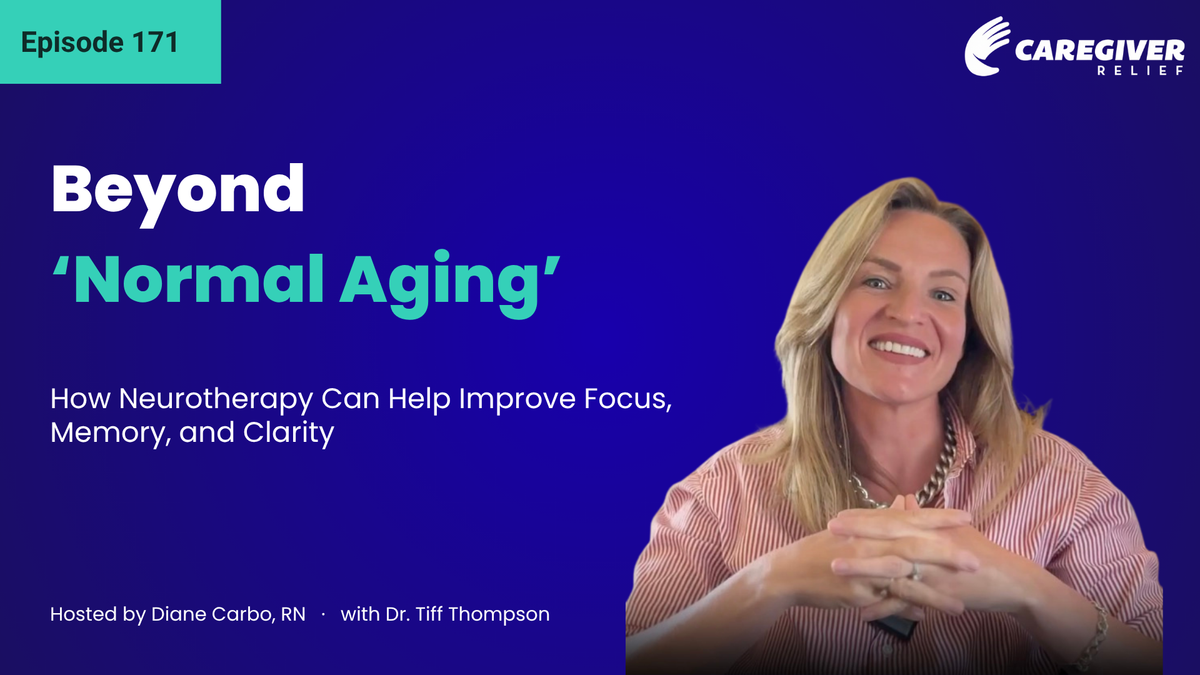
Forgetfulness and declining focus are often dismissed as "normal," but Dr. Thompson explains that these are frequently symptoms of age-related cognitive decline that can be targeted and improved. Through customized brain stimulation and quantitative analysis, neurotherapy offers a non-invasive alternative to medication for seniors looking to reclaim their mental clarity.
📋 What You’ll Learn in This Episode
- The Neurotherapy Umbrella: Understand the difference between traditional biofeedback and modern, multimodal neurostimulation.
- The Power of Data: How 19-channel EEGs and "brain mapping" create a personalized profile of your cognitive health.
- Healing the Brain: Insights into how therapy can encourage neurogenesis (creating new neurons) and angiogenesis (creating new blood vessels).
- The "Tool Belt" Approach: A breakdown of various techniques including:
- PEMF: Pulsed Electromagnetic Field therapy, described as a "vibratory soak" for the brain.
- Photobiomodulation: Using light therapy to stimulate healing.
- TACS/TDCS: Using low-level electrical currents to "polish" brain patterns.
- Real Success Stories: Hear about a patient who regained her ability to recognize her daughter after struggling with severe word-finding and memory issues.
📖 Episode Outline
- Introduction: Meet Dr. Tiff Thompson and the mission of Neurotherapy.
- The Leap of Faith: Dr. Thompson’s journey from corporate America to neuroscience.
- The Process: What to expect during a brain assessment and mapping session.
- Stroke & Injury: Can neurotherapy help with rehabilitation after a brain bleed?
- TMS vs. Neurotherapy: Comparing the "sledgehammer" approach to "custom tools".
- The Magic Frequency: Why 13–14 Hz is the key to blood perfusion and memory.
- The 90-Minute Window: Maximizing neuroplasticity after a session.
- Early Detection: Using neurotherapy to get ahead of dementia biomarkers.
💡 Key Takeaways for Caregivers
- Don't wait for a diagnosis: You can start "cleaning up" cognitive patterns long before a formal dementia diagnosis occurs.
- Look for Credentials: When seeking a provider, look for QEEG-D (Diplomate) or BCN (Board Certified in Neurofeedback) status.
- It’s Not Invasive: Unlike older methods, modern neurotherapy uses a simple conductive paste—no needles or shaving required.
"We relieve some of the worst symptoms of normal age-related cognitive decline... It’s a bit of polishing. Give me three to four weeks." — Dr. Tiff Thompson
Podcast Episode Transcript
Diane: Welcome to Caregiver Relief, the podcast dedicated to empowering caregivers with practical advice, expert insights, and a dose of hope. I'm your host, Diane Carbo, a registered nurse with years of experience in supporting families through life's toughest challenges. Today we're diving into a fascinating topic.
Beyond normal aging, how neurotherapy can help improve focus, memory, and clarity. As seniors, we often hear that forgetfulness or mental fog is just part of getting older, but what if it's not inevitable? Joining me is Dr. Tiff Thompson, PhD. A trailblazing clinical neuroscientist, a licensed therapist and educator.
She's the founder of CEO of Neuro Field Neurotherapy in Santa Barbara, California, where she specializes in QEEG based brain consulting, neurofeedback and advanced neuromodulation techniques. Dr. Thompson is also the creator of the School of Neurotherapy, offering certification courses and hosting an annual conference to advance the field with board certifications in neurotherapy and quantitative EEG.
She's a leading voice in interpreting brainwave patterns and optimizing cognitive health as a board member for organizations like the International QEEG certification board and Jody House for TBI recovery. Dr. Thompson is a passionate about bridging neuroscience with mental health.
Diane: Dr. Tiff, thanks being here with me today. I really appreciate it. I'm really thrilled to have your expertise on, how neurotherapy, is transforming the aging experience for our listeners.
Tiff: Yeah. that was a great introduction. You impressed me with your introduction, and thank you for your kind words.
Diane: before we get started, could you share a little bit about what initially drew you to the field of neurotherapy?
Tiff: It's a bit of a story. and I'll, I'll give you a condensed version, but I was in corporate America, actually. I was a renewable energy developer. It was my first career outta graduate school.
And, I happened to simultaneously decide to pursue a, second master's degree in counseling psychology. thinking,
yeah, I'm
Tiff: probably not gonna use this degree for anything but. It'll be a backup career. And then, I had an auspicious serendipitous experience, and I was told that my whole life would change On one particular day by a Vedic astrologer on May 17th, 2011, I had this.
Seer say to me, your whole life will change on this day. And actually it did. I came across, a clinic in Hawaii and this woman, put electrodes on my head and, I watched a red bar and a green bar. I had to make the red bar shrink and the green bar grow. And I had to make a mandala get big and bright and flowery and colorful.
I was Blown away by the fact that I was using my own brain to control the screen. Anyway, I walked out of the office that day and I thought, I'm gonna do this, and so within a month or so, I quit my job. I, began to go into debt. not officially. It took a little while, but I pursued, I found everybody who I could find who did this thing, and I dedicated myself to it, which was actually really scary.
It was a really scary leap of faith and, there's a long version of that story, but the short version is it worked out beautifully and I'm really lucky, that I made that leap. I ended up getting my license, my marriage and family therapist license. I ended up getting a PhD in psychology, so it, a fork in the road.
and I was able to keep pursuing all the things that I'm here to do.
Diane: explain to my listeners what neurotherapy is and how a different
Tiff: Yeah.
Diane: Traditional therapies.
Tiff: So neurotherapy is an umbrella term.
And it encompasses, something called neurofeedback, which I do a little bit of.
Neurofeedback is like biofeedback for the brain, right? So if you remember biofeedback from the 1970s, it's self-regulation. It's learning how to self-regulate your body. that's where I first cut my teeth, but a lot of the neurotherapy that I do is, customized brain stimulation, multimodal brain stimulation,and that's really what I visualize neurotherapy as.
So if you came into my clinic and you said, God, Tiff, my memory is not what it used to be. I'm forgetting words. I'm forgetting names. we would get a 19 channel EEG on you and something called an ERP. E event related potentials test to see how your brain behaves under task and give you a cognitive assessment, which will take 45 minutes, an online series of games, and, and then do a deep analysis of your data.
And quantitative EEG is, it's computational neuro analysis. So we look at your data and there's the raw data. Just like your voice has its own tonal register. There's raw, but then you can also image it and the imaging of it is exciting and beautiful and interesting. And you would then have a profile that would, relate to me what your memory deficits looked like, where they lived, and even more importantly, what to do.
Them. How to target them and how to alleviate them. Yeah. And that's where, this is really interesting because, and this is where it's unprecedented, is that accepting individuals who use, our system. Our system is called Neuro Field. It's, we have a hardware, software, company as well, which I didn't mention in the bio.
Anyway, people that use our system are doing this work all over the world. I think we're in 42 countries, but it's not, it's still not really well known. And it's exotic. And the people think, oh gosh, brain stimulation. ooh, that might, I don't know if I need that.
And what I'll tell you is that it is, it's low level, it's non-invasive, it's way better than medication. It's a alternative to medication. And for things like memory, you can't really medicate that out. Anyway, and so what we do is we relieve, some of the worst symptoms of normal age-related cognitive decline.
Diane: baby boomers are looking for alternative treatments to, anything that will keep them away from medicine. And I think that this is a therapy that people are gonna wanna know about. And that's why I approached you. does this work for people that have had strokes?
Tiff: Yeah. No. I will say to you, strokes are a little bit more challenging, right?
Because a stroke is. There's a hemorrhagic or an ischemic stroke, right? We have a bleed or we have, where your oxygen is choked off from the brain. And it depends on the severity of the stroke. 'cause essentially what we're trying to do is encourage neurogenesis and angiogenesis the creation of little new, teeny tiny blood vessels.
And we're also trying to offset, some of the worser frequencies. I'll just say to keep it simple. So if you have a pretty bad brain bleed, you're going to have a, region of your brain that's been, deprived of oxygen and to bring it back to life. I don't think that's an impossibility, but that's not a reality either.
I'm not, however, I've worked with many, we work with many head injury patients, many stroke patients, and, There are absolutely levels of rehabilitation available. it just isn't, give us two months and you'll be back to square one. it takes time. and stroke, would be something that would take a little bit longer.
Maybe years to To, Yeah.
Diane: many people accept declining focus and memory as normal aging. Yeah. why does science, what does science say about this? And, how are you addressing that with your, this neurotherapy.
Tiff: there's lots of reasons why we see it happening, right?
So within just, there's normal age related cognitive decline. There's pathological age related cognitive decline, and then there's all of your dementias, right? And we're looking at that first category, which is normal age related cognitive decline. What does science have to say about it? okay, this is wear and tear and things go wrong.
And people have,high blood pressure and hypertension and there's little ischemic changes in the brain and infarcts, ischemic changes as or tiny little pockets of the tissue. And that's just, natural that's just wear and tear on the system from a lifestyle and diet. And you know what I would say to that is,
there's absolutely number one preventative measures, but number two, it's not something that's gone and lost forever. Of course not. this is the big perk of my job, I'll tell you, is that when something is sideways right with me or with any of my staff or. we've all done this.
And so I've done work on myself when I've, moved through anxiety, And I know we're talking about age-related cognitive decline, but I just,my, I brought my own child in who's seven because he was really acting impulsive at school and getting in trouble and worked on him for several weeks and.
he's doing swimmingly beautifully. And I just recently had a woman who, this is more your demographic who is here. 'cause she was forgetting all these words and lovely lady. and she went from really having terrible memory and,to feeling great.
And we interviewed her, right? We interviewed her for a testimonial and she said,I never told you this, but. I was sitting with my daughter one day, she said, and I had this thought, who is this nice young woman talking to me? He said, and then two seconds later I realized it was my daughter.
And she said, and it just jarred me. It scared me. She said, I never told her. And she said, this is the first time I'm telling you. 'cause I didn't want to scare her in front of you. she's just one case example. I actually love this demographic because it's a cleanup job.
It's a bit of polishing, it's not oh my God, this is gonna take us a year. It's give me. Gimme like three to four weeks. and people fly in and do this work with myself and my husband, but there's clinicians all over the place that do this, like I said.
Yeah.
Diane: what does a normal session look like?
Tiff: Oh, it's such a good question. Yeah, that's a great question. it must look pretty exotic. It's something that I've been looking at for, a decade and a half now, but, most people have several electrodes on their head. I'll show you what those look like here. depending on what we're working on, we're gonna target different brain regions, right?
And so just simple silver, silver chloride electrodes. and then on top of that, we'll put a mesh cap. And then on top of that we'll put a Velcro cap. And then we put these oils we call them, it's like this on top of the cap. And this is a, PEMF, so that, that's pulse electromagnetic field therapy, and that's like a vibratory soak.
And then we use lights, we use photobiomodulation. So we, when I say multimodal. Neurostimulation the core, the electrodes themselves, which is the heaviest hitter, can give a really any, an almost an infinite number of protocols. And we have hundreds that we've developed. Again, it's customized to the individual's brain.
so that's palpable. You can feel it. not painful, itchy, prickly. It's, but people get used to it and they'll sit and they'll either. They'll meditate or they'll do some sort of,reading or they'll watch a show always something relaxing, or we'll give them some sort of occupational therapy thing with an iPad.
And so it's, a lot of folks come in for two, two sessions a day. When they come in from out of town. and many will come for about two weeks, and that's about 20 sessions, five days a week. and people, come in from everywhere. we have a couple here right now who, was in a bad car accident,and they're also in their seventies and they're coming for rehabilitation.
so what's neat about it is that it's fast. It's fast. Yeah. And it's not drugs.
so what I'll say to folks is, it's not, if you can't operate on it and drugs, you don't wanna take drugs, then this is where we fit in. Yeah. Yeah,
Diane: I worked with head injuries for years, so I know the challenges they have and It's fascinating. now I have a question. I have,a dear friend who's going for TMS
For depression. How does that differ or how is that related in some way?
Tiff: Good question again. Yeah, so I used to be the vice president of a TMS company in town, a clinic in town. So I'm very familiar. So when I describe neurostimulation to people, I do it as follows.
I say, okay, there's a hierarchy. at the top of the hierarchy, and I'm going to use an analogy, a sculpting analogy, so hang with me. Here at the top of the, the grade right is Electroconvulsive Shock Therapy. Now, that's what you've seen in the movies, right? and that's a forced seizure. It's like a stick of dynamite, right?
We don't do that. Yeah, so old school and a bit barbaric. And it's usually for really treatment resistant depression that's pretty bad. You go down a step and we are at transcranial magnetic stem TMS, right? TMS is a magnet that's used to, it forces a depolarization of the neurons underneath the magnet.
So what that means is it makes your brain fire right there. Okay. Okay. And it's, it feels like a woodpecker, maybe a little bit harder than a woodpecker. And for depression, the protocol that they use or the placement is at a region called the left dorsal lateral prefrontal cortex.
Diane: Of course.
Tiff: of course. and that there's been, there's many. Here's where this is interesting. So the reason they do that there for depression is because There's a biomarker for depression. That's a, it's called an alpha asymmetry. At the left. And I won't give you more details than that.
There are so many variations of what depression looks like, of what anxiety looks like, of what you know. So it's silly. I get it. I get they have to get through the FDA on something, But to say, oh, this is what depression looks like.
Diane: Yeah.
Tiff: And that's what we do to it is this, that one size fits all model that's not really working.
So I, in my work with TMS found roughly. Maybe 20 to 30% of the patients improved with this particular modality, but I digress. So TMS does have its place. It's a sledgehammer, that forced magnet. So we had stick a dynamite. Now we have sledgehammer.
Diane: Okay.
Tiff: Now we go down a level and we're in what we do with the electrodes to begin.
And these are all transcranial modalities. Okay? So transcranial direct current stem, TDCS, transcranial, alternating current stem, TACS. That's frequency, pink noise and brown noise stimulation. You can't hear it.
But they're called noise stim. and different by phase stimulations. Those are things that we deliver through the electrodes.
And, And it's, it's almost as though now you have this huge tool belt full of all these different tools that we can do for the brain. not as aggressive as a aforementioned,types of stimulation. But highly customized. Okay. and then beneath that is EMF, which is a bit of a soak, like a nice soak.
It's good for the body actually. And photobiomodulation, which is light, which does actually doesn't fit nicely into the analogy at all. So that's what we're up to. And so you have the dynamite and the sledgehammer, which is not what we do. And then you have this huge belt of an infinite number of tools.
And,we can choose what to do with the system based upon what it's showing us.
Diane: Wow. I find you explained that very well. 'causeI have done podcasts on ECT and I've done podcasts on Cool s and and I'm finding this very fascinating because I love the personalized approach and The gentler approach. so when you put these electrodes on, what I think of is, I'm an old nurse, so you have to bear with me, I think of having to shave the head to. So their hair. So the electrodes sit, hang on them. Did they have to do that? They have to shave them.
Tiff: Oh, no. I'm realizing maybe when you were working, you were still using the needles and you had to hook in.
They used to be painful, right?
Diane: yes.
Tiff: Yeah. Okay. no. we're not there anymore. I used to work in neurology, so I know, I know the history. No, we use a paste. We use a salt impregnated paste. And it's like a Vaseline kinda, and that's how we secure the electrode to the head and it just transmits electricity.
Diane: Yeah.
Tiff: yeah.
Diane: That's fascinating to me.
Now, you talked about the, direct transcranial, direct current stimulation, and then you talked about the, pulsed electromagnetic field, the PEMF. How do they play, what, how do they enhance brain health for seniors?
Tiff: Oh, this is, this is where it gets so exciting, right?
there's so many. So essentially what we're doing is, and this is not with EMF as much as with the, transcranial modalities. we are, it's an either, either both, or one, right? And or we are, breaking down deviant patterns, right? and or supplanting them. with new ones.
so there's a balancing act. So let's just say, 'cause this is very common. Let's say that you had some memory issues just from quite as sharp as you used to be. the areas that we see, that show signs of, ischemic changes faster than others, degradation are the, Put your fingers at your temples, your piece fingers at your temples, and you're at the, bilateral, anterior temporal poles.
But basically this is where the frontal lobe and the temporal lobe come together. and there's a great big groove there called the syl and fissure. and it's a vulnerable area in the brain. Left frontotemporal is all about, expressive speech. So what's that thing called?
What's that? What's that person's name again? and then the back of the head, the posterior temporal, so right behind your ears. Also a region where we have the junction of three different lobes of the brain, temporal par occipital junction. So these are naturally weaker areas to, vascular,changes and atrophies and things like that.
And so that's where we often see pockets of slower alpha content. Alphas are clocking speed. Your upload download speed. So it naturally slows down just a bit as we age, but when it slows down a more than just a bit often, that's where we're gonna see these changes. And the range that they respond to is roughly a 13, 13 14 hertz range.
And
Diane: wow. Okay,
Tiff: so this is, so it that's, if you could clap 13 times a minute,
Diane: Uhhuh,
Tiff: that's what that would be. Okay. And it's a magic frequency range actually. it actually, there's been studies that have shown that this, enhances blood profusion Greater than any other frequency range, which of course will bring in oxygenated blood and lead to Yeah.
all kinds of wonderful things. Yeah.
Diane: Now, as a caregiver, what signs should someone look for, to know if their loved one's cognitive changes might benefit from neurotherapy?
Tiff: that's a tough question to answer because Yeah, anybody really can like it could be okay, somebody's 60-year-old husband, who just is not as, he's forgetting more than he used to, or he's not as on it as he used to be.
that's super subtle, but that would be a great kinda case. but it's these things like, God, why'd I walk into this room? what am I doing in here? Or,
Diane: oh, yes, I do that. I go, all right, what did I come for?and multitasking is really bad and women do it more than. men and multitasking doesn't give us the, it's destroying our brains because we're not focused on one thing at a time.
I've learned that and I'm making myself be focused more.
Tiff: yeah.
Diane: But
Tiff: yeah,
Diane: I find this therapy, very fascinating.
Tiff: Yeah. Yeah. let me just say this much. You will be, you'll be able to multitask again. Yeah. as a woman, it's a hard thing to get away from, you know what I mean?
Yeah,
Diane: I know. Absolutely. Yeah. I agree. But
Tiff: yeah.
Diane: Now, what are some practical at home strategies, that a family caregiver or a senior can use? To go along with their neurotherapy or to support it, their focus and memory. Is there things they do at home to continue?
Tiff: yeah, what I, yes, so actually a lot of times when, if somebody's undergoing a regimen here at our clinic, it's the things you already know about.
it's eat healthy, lots of greens, lots of vegetables, exercise, get outside, get sunshine, don't smoke, don't drink. Don't watch too much tv, blah, blah, blah. when you're, when people come into our clinic after stimulation, they're in a 90 minute window of neuroplasticity, and so their system is literally more plastic, more malleable, and it's an incredibly rich time to learn new skills or, try to ingrain those things that they wanna see occurring in their lives.
Now, as we move through treatment, we will. we will get new EEGs, we'll get new maps, we'll get new data at session 10. At session 20. If someone wants to go 10 more at session 30, and the whole point of that is to quantify their changes, right? So it's not just oh, good, you feel better. So glad to hear it, but it's and this is why, right?
This we're seeing a 72% reduction in the amount of. Theta content and you, I'm not surprised at all that you're finding that words are coming easier and your memory's clearer and your focus is better. So after somebody is done with that,a lot of times they just move on down the road and continue on with life.
But sometimes they'll pop in for a Spot treatment. And sometimes people say, oh, I've gotten this far, I'll see you in a couple months. And they'll go back to their home and they'll maybe come back for another intensive in, a couple months. and that would be, more challenging cases.
Diane: Yes.
Tiff: Yeah.
Diane: Yeah. Oh, I can see. I need this.
Tiff: I, come on over. We'll give you a blue
Diane: special. I love Barbara. Now,how do you find, you, how do you find, the neurotherapy anywhere in the United States?
Tiff: Yeah, so listen, here's a bit of a trick. number one,
There are clinicians of varying competencies.
Diane: Okay.
Tiff: and the system that I use, this multimodal neurostimulation system is called Neuro field. And, we treat, we teach people all the time. we have hundreds and hundreds of students, so there's a lot of qualified people out there.
One way, actually, this would be the easiest way, is,we have a directory and someone could just call our office, neuro field neurotherapy office.
Diane: huh.
Tiff: That would be neuro field neurotherapy.com. and we could tell you who's close to you. Great. right now we're updating our provider directory and we're going to be rolling out a neurostimulation certification program so that people have a stamp and you'll just know, who's worth their, who's worth their merit.
Diane: That's really important. It is, it really is that people have a certification or something to prove because, I find some of the. People, there are people out there that are willing to take your money for different things without any kind of knowledge that, and yet, I just,
Tiff: yes. Yes. And so what I would say then, just for someone who's that's a lot of work.
I would say that if you're looking up neurotherapy in your area, you, if you're working with someone that has a Q-E-E-G-D, that's a quantitative EEG,diplomat status, Q-E-E-G-D, uhhuh, that's a good sign. That means that they've gotten, vetted and they've been, marked as someone who knows how to do this.
And the other, certification is board certification and neurotherapy. and it's BCN. And so these are two of the, certification programs that we provide education for. Now, we're not the credentialing body, but we provide education with the school of Neurotherapy. Yeah.
Diane: Okay. I think this is fascinating that you're at.
They're teaching, the future students,of, for this field. Now, what excites you most about the future of neurotherapy?
Tiff: Oh, so this is original knowledge. what we are up to is not out there yet. Right? So it is a brand new field. It's unprecedented. this multimodal neurostimulation thing, in the sense that, of course there's been studies on TDCS, there's been studies on what if we give six hertz to this person, or what if we do this, but this customized multimodal neurostimulation modality.
it's a dark horse, right? So what's it's, what's exciting about this is that it's not really known yet and it's about to happen. yeah. and we're at the a then we're at the head of the, Yeah. The crest of the wave or Yeah. The head of the movement.
Diane: That's exciting. if people see like dementia.
The signs and symptoms of dementia can occur as, as early as 20 years before a person has, a diagnosis. Are there times within that period that a fa a senior, a family member should probably look for neurotherapy to, to try it to.
Tiff: Yeah, we certainly have, I'll have to say one of our favorite clients is somebody who's in her eighties, and she has some of the biomarkers, From dementia, and she wants to get ahead of it. and so she's doing that and she's just
Diane: at 80. God bless
Tiff: her. Yeah. Yeah, she's brilliant. she's brilliant. I wanna be like her when I grow up. but as you said, you're going, there's gonna be a lot of normal cognition.
While we're seeing, plaques and tangles and these things are arriving and then we see MCI, then we see mild cognitive impairment and then people move into, whatever, Alzheimer's or frontotemporal or Lewy body or vascular or you name it. and I will say this much, it's. I would hang a shingle for dementias if I felt confident doing that.
What I can say about dementias is, we're better off catching them early, right? Yeah. and preventing that decline. 'cause once the degradation has occurred, then it's harder to get back the faculties and the functions. Yeah.
Diane: But this is a hopeful treatment that may be, as it advances can be revolutionary.
Tiff: Absolutely. And the pieces of it are already out there, for this particular demographic. So pb m photobiomodulation, which is light therapy, there's a whole industry that's popping up around that one particular component of it, for this kind of, this kind of disorder for different, for dementing conditions.
Yeah.
Diane: Fascinating.
Tiff: Yeah, it's coming. It's coming.
Diane: TIFF, how do my listeners find you?
Tiff: so my website's, like I said, neuro Field Neurotherapy or School of Neurotherapy. but my email is my name.
It's tiffThompson@gmail.com. and I'm pretty friendly, and, and I have a brilliant staff. That I work with. And I'm happy to help anybody, in any way. I'm, I'm here to serve. and yeah, if anybody hears about it and they're intrigued, then that's great.
Diane: I,I created a permanent page on my website with the podcast, with your headshot and links to your social media and everything that you've sent me and links to your site so that people can explore your website and, find more information out about neurotherapy.
Tiff: Cool. Yeah, you're a trailblazer. You really are
Diane: too. Yeah. I just want people to know what's out there. I really do. I think it's important, so
Tiff: for
Diane: sure. thank you so much for your time. I appreciate it. And to my family, caregivers, you are the most important part of the caregiving equation. Without you, it all falls apart.
So please learn to be gentle with yourself. Practice self-care every day. Because you are worth it.
Caring for a loved one can be overwhelming — but you're not alone. If you have questions, big or small, our expert team is here to help.
👉 Click here to Ask the Expert
Our Resource section can help you find the information and tools that you need. We have courses, videos, checklists, guidebooks, cheat sheets, how-to guides and more.
You can get started by clicking on the link below. We know that taking care of a loved one is hard work, but with our help you can get the support that you need.
Click here to go to Resource Section now!