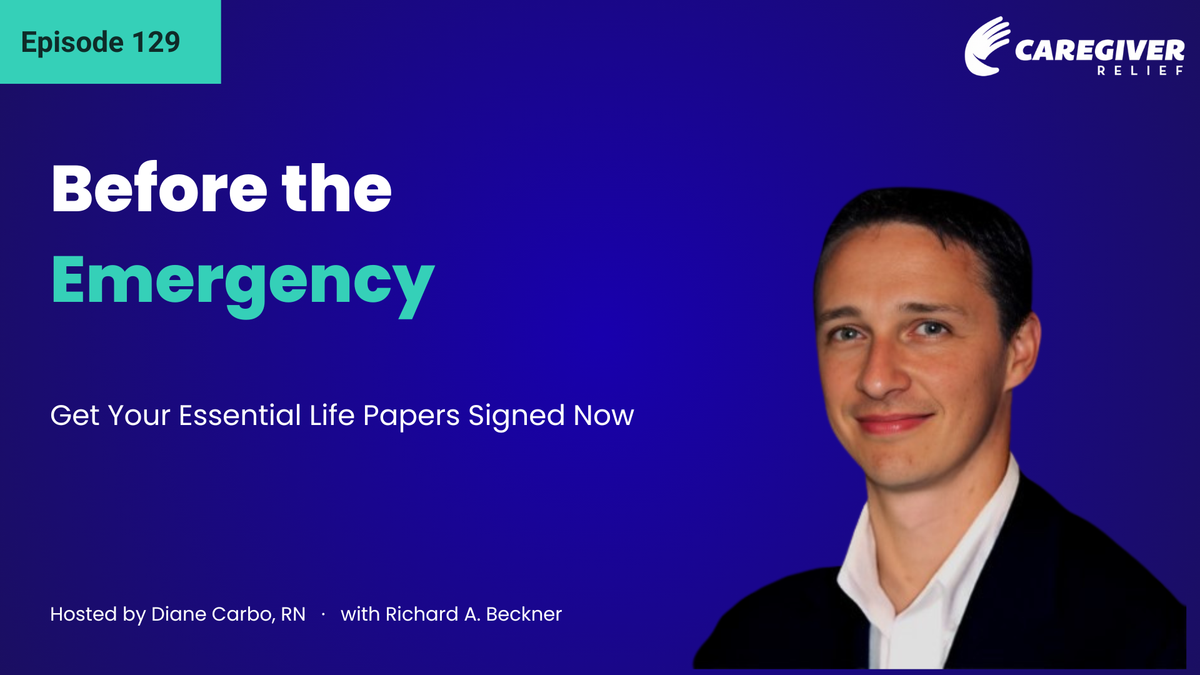
Before the Emergency: Get Your Essential Life Papers Signed Now with Richard A. Beckner - Episode 129
What happens if a medical crisis strikes today? Do your loved ones know your wishes? Can they access your finances to pay your bills? Or would it be chaos?
Waiting for an emergency is the worst time to start planning. In this critical episode of the Caregiver Relief podcast, host Diane Carbo sits down with elder law attorney Richard A. Beckner, who brings a unique background in healthcare to the table. They cut through the legal jargon to explain exactly what documents you need, why you need them, and the "administrative nightmare" that unfolds if you wait too long.
This isn't just about aging; it's about protecting yourself and your family at any adult age. Don't wait for the crisis. Listen now and get the peace of mind you deserve.
In This Episode, You'll Learn:
- ✍️ The absolute "must-have" documents every single adult needs (Hint: it's more than just a will).
- ⚖️ The #1 mistake people make with their estate plan (Are you guilty of this "one and done" thinking?).
- 🏡 The real difference between a will and a trust, and how a trust can keep your family's assets private and out of court.
- ⏳ What "probate" actually is, why you want to avoid it, and how long it can tie up your family's assets (9-12 months!).
- 💰 A legal strategy to "spend down" assets for Medicaid eligibility by paying a family member for care—and how to do it correctly.
- 🩺 Why Diane strongly recommends never naming two siblings as co-Healthcare POAs and what to do instead.
- 😱 The stressful, expensive legal process your family must go through just to take care of you if you're incapacitated without these documents.
About Our Guest

Richard A. Beckner is an elder law attorney with an extensive background in healthcare. This unique perspective allows him to understand the intersection of legal and medical planning. He founded Faithful Elder Law Solutions to collaborate with individuals and families, helping them protect their futures through estate planning, trusts, and essential life documents.
Episode Outline
Why Prepare Before the Crisis?
- Diane introduces the episode's topic: preparing before a crisis happens to avoid chaos.
- Richard shares his journey from healthcare to elder law, driven by his faith and a desire to help people plan.
The "Must-Have" Essential Documents
- Richard identifies the most critical documents:
- Durable (Financial) Power of Attorney (POA): Allows a loved one to step in and pay bills or manage finances if you become incapacitated.
- Healthcare Power of Attorney: Appoints someone to communicate with doctors on your behalf if you cannot.
- Diane emphasizes that Advanced Directives are equally important for honoring your end-of-life wishes.
- Richard clarifies that he typically executes Healthcare POAs and Advanced Directives "in tandem".
- A Standard Will is the other must-have, allowing you to express your wishes for your assets and values after you're gone.
- Diane stresses that everyone over 18 should have a POA and advanced directive.
Will vs. Trust: What's the Difference?
- Will: Expresses your wishes for who gets your assets.
- Trust: Works with a will (often as a "pour-over will") and gives you more control over how and when assets are distributed (e.g., when grandchildren reach a certain age).
- Key Benefit of a Trust: Avoiding probate.
Understanding Probate (And Why to Avoid It)
- If you pass away (even with a will), your estate must go through probate.
- This is a court process where a judge identifies creditors and assets.
- The Problems with Probate:
- It's Slow: It can take 9 to 12 months on a "good day".
- It's Expensive.
- It's Public: Anyone can look up your assets and proceedings. A trust keeps this information private.
Medicaid, "Spend Down," & Personal Care Agreements
- Diane asks about protecting a home from long-term care costs.
- Richard discusses Medicaid Asset Protection Trusts, which can help one qualify for long-term care.
- Diane strongly advocates for Family Caregiver Contracts (or Personal Care Agreements).
- Richard confirms this is a valid "spend down" strategy. Medicaid has a 5-year (60-month) "look back" period and will penalize large "gifts" given to qualify.
- However, paying an adult daughter (or other family member) for their services is not considered a gift. It is a recognized expense that allows you to legally spend down assets while compensating your caregiver.
- Diane emphasizes this must be set up properly from the start, not retroactively.
The Critical Role of Advanced Directives
- Richard explains that advanced directives provide peace of mind and prevent devastating family conflicts.
- He gives the example of a son wanting to "keep dad hooked up on the machine" while the daughter knows he "wanted to let me go". An advanced directive provides clear, loving direction.
- Diane's Pro-Tip: Never make two siblings co-healthcare POAs. This often leads to arguments at the worst possible time. Make one person the primary agent and another the backup.
The Most Common Estate Planning Mistakes
- "One and Done" Thinking: Creating a will 20 years ago and thinking you're set. Life changes, and so should your documents. Richard advises a review every 3-5 years.
- Assuming People Know What You Want: Your loved ones may have different interpretations or memories of your wishes. If it's not in writing, it can lead to conflict.
What Happens if You Wait Too Long?
- If an emergency hits and no documents are in place, the result is an "administrative nightmare".
- A shocking fact: Your spouse has no legal authority to make decisions for you without these documents.
- Your loved one (e.g., your wife) would have to file a petition and go before a judge to have you legally deemed incapacitated. This requires hearings, physician testimony, and is both time-consuming and expensive—all just to get the authority to care for you.
How to Find the Right Help
- Don't just go with the first attorney you find. Talk to at least two.
- Find someone you "gel" with, who listens to your needs, and doesn't just push a pre-set plan on you.
A Final Word for Overwhelmed Caregivers
- Caregiver burnout is real. Richard reminds caregivers to focus on their "why"—the love that motivates them.
- Diane urges caregivers: You have to be able to ask for help.
- Build a "care team" or support group for practical assistance (like rides, groceries, or cleaning). People genuinely want to help; you just have to ask.
The first step is the most important: Do it now.
Podcast Episode Transcript
Diane: Welcome to the Caregiver Relief podcast. I'm your host Diane Carbo, an rn,
Diane: and today's episode is all about preparing before a crisis happens.
My guest. Richard a Beckner is an elder law attorney with an extensive background in healthcare, which gives him a unique perspective on the intersection of legal and medical planning. He helps individuals and families protect their futures through estate planning. Trust and essential life documents.
Richard, thank you so much for being here today. I know you had a very busy morning and I'm glad you were able to take time out of your busy schedule to share this very important information. I know that what you have, our listeners are eager to learn about because I can help them avoid.
Chaos in crisis. yeah, let's dive in.
Richard: Great. Great. Thank you for having me, Diane. I very much appreciate it. Yeah,
Diane: I'm gl I'm glad. I, this is such a, an important topic. It's, and we can't talk about it enough. Okay. Before we dive into the legal side, can you share a little bit about what inspired you to transition from healthcare into elder law?
Richard: I'd be happy to do that. so I've been an attorney for almost 25 years. And the sole focus for the first about 20 was, in essence healthcare. In the past five years, I've really saw and observed the need to have more of a presence in trying to assist people. so that's one of the, I'm a person of faith.
I think. I know I mentioned this to you, Diane. I'm a person of faith. Yes. I prayed about it and I really saw a value in representing. My faith as I engage with people. So I started a law firm called Faithful Elder Law Solutions, and our purpose is just to collaborate with people and to try to help 'em out if I can.
I come with a lot of experience. Yeah. But, because of that, I can say to somebody pretty quickly, yeah, I can help you or let me refer you to somebody else that does this.
Diane: At 72, I do the same thing, Richard. I am a person of faith and I feel that it's, I could be retired now, but there's such a need Yeah.
for information to be given to people. And I am, I know I have enough knowledge. That's why I love people like you because you helped me bring important topics to the forefront of our family caregivers. why do you believe it's so important to have Essential Life paper signed before a medical emergency or crisis?
Richard: Sure. I, that's an easy, as you were posing the question, I was thinking, oh my gosh. So the most important thing, and I think any attorney will tell you this, that does this, this level of service, the most important thing is having powers of attorney in place.
Diane: Absolutely.
Richard: Yeah. Yeah, so it can be a what's often called a durable power of attorney or a financial power of attorney.
tons of labels for the same thing. It's in essence, a document that to the extent that you become incapacitated, yes, you can have a loved one step in to your shoes in essence, and help you pay the bills or help you care, pay for somebody to come and care for you. so that's the important thing.
The other thing is what's called a, a, healthcare power of attorney. And that enables, think about the situation where perhaps you have a loved one or a spouse that's in medical care and the medical practitioner or the doctor needs to communicate and they can't with you as the patient because maybe you're unconscious or what have you.
if you have the right power of attorney in place as someone that's trusted and knows your wishes, they can do be an invaluable service for the medical professionals.
Diane: I'm gonna.
Richard: I'm sorry.
Diane: I'm gonna add one more. Okay. Advanced directives.
Richard: Yes.
Diane: and the only reason why, 'cause for me, from my perspective, the power of attorneys are absolutely the number one things because you ca you need that information for financial and for health.
But the advanced directives are just as important in my perspective because those healthcare professionals you're gonna share information with you, and you want to be able to, to off, to be able to. Honor the wishes of your loved one in case they're unable to do that.
Richard: That's exactly right. And I
Diane: know that's important as that's important as well.
But that's from my, in fact, for me that's the most important one. yeah, but you're right. You have to have the POAs in place.
Richard: Yeah. So in, I hope, I apologize because in my mind, advanced directive. Healthcare power of attorney, whenever I execute those from clients, they come in tandem. So I apologize for not breaking that out.
Diane: no. It's just, the medical person in me, and I teach this so much, you gotta get those advanced directives. Yeah. Now, what documents do you consider must haves for every adult, regardless of age or health?
Richard: Sure. So what I had already covered, the advanced directive, the durable power of attorney, the healthcare power of attorney.
The other thing is really important is, that standard will,it's a way to express your wishes to your loved ones after you're no longer here. Yes. Unless there's huge, vast advances in medical science, we're all going to pass at some point. Exactly. It's good to think ahead. it's good to think about those children or grandchildren or that charity that you really wanna be able to provide for.
It's a great way to Teacher Express, not teach, express your values to others.
Diane: Exactly. I actually encourage, people,I tell people, anybody over the age of 18 should have a power of attorney and an advanced directive, and you know when, and then they hear will, they're thinking I'm crazy.
we don't know what we don't know about our lives and what situation we may be placed in, where, we need someone to make decisions for us. So I'm very adamant about teaching that. I know my caregivers, I still have, and I could tell you right now, I have an 85-year-old client right now who has, a Her, she has a sister who's disabled, mentally challenged and, she hasn't, didn't have anything in place. Nothing. And I'm like, oh my God. We, and I just had to sit with her several times to explain that at 85 you don't have much time. You're lucky. We're able to sit. and discuss this.
And it finally, after two years of working with her, she sat down and put everything in place. but one of the things I would like for you to be able to explain is the difference between a, will, a trust, the powers of attorney, and when each is appropriate.
Richard: Sure. Yeah. So what I often advise people A, so I'll say, Diane's calling me and she's interested.
And some, discussion about what do I need to do to protect myself and my family? I am, first, first to right out the gate is gonna suggest the power of attorney. secondly is a will. And then depending on our conversation that we have, some people have certain assets that they want to be able to control even after they're passing.
And what I mean by that is they want. Perhaps their children or a charity or their grandchildren to, to receive x amount of assets, in a certain way. Even. let's build it out to where my grandchildren maybe don't inherit my state until they reach a certain age. there are rules against doing that in a standard will, and I don't wanna get into the rule against perpetuity and all these crazy things that are in the law.
and that's through a trust. So with the trust, if you can create a trust you that works in tandem with a will, and at that point we, we would call it a pour over will. So it incorporates, the trust and it also can incorporate even additional assets. Maybe you've recruited assets over the years that you forgot to include in the trust.
The will working in tandem with trust can address that. And oftentimes I have people that wanna trust because. They want, they don't wanna go through probate. Probate in our region takes anywhere from nine to 12 months on a good day or a good year. it takes some time and it's expensive. So a lot of people will establish a trust for that reason.
'cause they can avoid, they can avoid probate. You had a question that, can
Diane: you explain how important it is,for prob that to try to avoid probate and why, what probate means, because I know a lot of clients don't understand that.
Richard: Sure. Yeah. so in essence, if for some reason I pass and I will pass one day, but when I pass, if I don't have a will or I do have a will, even let's say I die without a will, I die in this state.
there has to be a probate process where a judge will look at my estate and they'll say, okay, who are the creditors? Who are the people that are interested in Richard's assets? And that, as you can imagine, takes a lot of time looking into that and trying to determine,what's what, so to speak.
so what a good trust does, it basically presents you, it can be shared with the probate judge and say, Hey, look, there's really no reason the trust covers everything. Yeah. It can be kept private. A lot of people, I have a couple clients, they're pretty high value clients and because of that reason.
They want their trust and they want their assets to be private because a probate proceeding is public. Anybody right now can go. I live in Boone County, Kentucky, Uhhuh, my law firm's in Boone County, Kentucky. So if I pass right now and I don't have a trust, it's going to go through probate. And it's not like I have millions and millions of dollars, but if I did.
It would be available. So any, like the looky-loos are the people that are just curious can, that's public information. They can look it up.
Diane: So many people are so private about their financials and that's why it's so hard for them to put all of this in place. I have a question I hear often, I have families, the seniors, they don't wanna do anything, but they wanna pa they.
Everybody believes they can pass their home and all their assets down to their family members. But with the way we have all the changes in our healthcare system, Medicare, we're going to a cost saving plan. Yeah. platform. And it's very real. Medicare Advantage right now is charging, a copay of 200 to $500 a day and then that means that it's gonna come out of pocket and there's going to be a time, and I know because I.
I've seen it in the past where the nursing homes will put a lien if you end up in a nursing home or, and I'm sure assisted livings will start doing it too. of course assisted livings will kick you out if you run outta money. but, and they make sure they know how much you have ex exactly.
Up to the penny. but people are no longer gonna be able to pass their homes down unless they put it in a trust. is that true?
Richard: that could be, there's a lot of it. It's, it depends. And you'll get an attorney to tell you that all the time. It depends, yes. But where I think your question's coming from Diane, is you have an individual that, so there's two scenarios that I see.
It's one, it's like an emergency situation where it's a crisis.
Diane: Yes. You need
Richard: to be admitted to a long-term care facility yesterday.
Diane: Yes.
Richard: There are steps that can be taken. There are trusts that can be created. There are rules that can be followed, and these are all, federal and state law, rules that, a competent and attorney can make sure that you go abide by and handle to get into that facility.
but there's, and you mentioned changes at, for example, the, so there's that retroactive eligibility for Medicaid, for example, and I'm just pulling this outta the area you were talking about Medicare. Yeah. I can talk for hours about either one. Yeah. But for example, Medicaid, if you have a long-term care facility that accepts Medicaid, you could do an air retroactive application.
So you could actually, in that crisis situation, Richard needs the treatment. Right now he's in the facility, the Medicaid facility, the fill facility that accepts Medicaid could treat me Uhhuh, and with the understanding that there's going to be an application filed. It's gonna get approved at some point.
Uhhuh, they could do it for 90 days. now in Kentucky it's only 60 days. it's been shortened. So there's things like that has to be discussed with an attorney or, that can actually really convey what the guidelines are. And the issues are Medicare, you have to demonstrate there's rehabilitation that's being temporary, right?
so if you're in, there's a limit to how long you can be hospitalized with if you're on a Medicare.
Diane: Medicare is kick even traditional Medicare is kicking people out. Yeah. the reimbursement rate for rehab is almost nil right now. So facilities get a higher level of reimbursement for not providing care.
And while they tell us we have a hundred days of rehab, that no longer is true because what we're seeing is Medicare Advantage is sending home. To sending home people in the 11th to 14th day, whether they're ready or not. And on the 20th day, and having spoken to several CEOs and many fac in several facilities where I've seen unsafe discharges to home, they're saying, they, they're not meeting the Medicare guidelines.
And,I will tell you right now, the Medicare guidelines have not changed. The money to enforce those, if those Medicare guidelines is what's changed. And that's what we're seeing. So family caregivers are having to become more personally responsible for providing the care that was once provided by.
Professionals. So I, and I do wanna get into Medicaid a little bit, and explain the spend down approach. Could you do that and tell me? 'cause there are people, now Medicaid's gonna be very real for them with all the changes in our healthcare system.
Richard: Yeah, so I'll speak at it, I'll speak to it at a high level.
'cause I could really get into the weeds and we could spend the range of the time talking about fall time.
Diane: I know. And we've got other important things to talk about too.
Richard: Yeah. but really, Medicaid and people always think when you hear the term Medicaid, people always think, oh, okay, that's for maybe someone that's severely disabled or someone that's.
It's really low income. that's not actually the case. there are circumstances and situations where you can, through the work and use of a, competent estate planning attorney can qualify at least on the books for Medicaid. And it's completely above board. It's completely legal. states, the Commonwealth of Kentucky, a lot of places that are commonwealth recognize it.
It's just. You're being extremely transparent, but you're going through it very meticulously and demonstrating, okay, here is my need, and here is why I own the books. I qualify for Medicaid.
Diane: I wanna talk about the spend down, okay. Oh, yeah, a little bit. Only because I am encouraging and you can tell me whether I'm right or wrong about that.
I encourage every family caregiver to put a family caregiver contract or personal care agreement in place. Many are insulted when I say that, but they don't understand that. If they're getting paid. I tell them they have to look at this as a job, and I know that's insulting. They feel that they shouldn't look at it as a job, but it puts things in per, strict boundaries and limits and parameters where, they're, they know that, they can say, I can take care of you until, maybe you become, incontinent and I can't.
Provide that kind. I don't feel comfortable providing that in, care level of care. Or it may be that, you're become a, the patient, their family member becomes aggressive and they fear, have fear so that those are things and sexually inappropriate behavior is very real. And, that makes a lot of daughters taking care of their fathers uncomfortable.
So those things need to be addressed upfront. But the other thing they need to do is realize that. many, provide un 99% of family caregivers provide unpaid care and if there is money that's going to be spent down to hit Medicaid to meet the requirements, they need to have strict documentation of the care that they provided, but they can also charge for this care and have money.
For them to live on. And that's important as well. plus I want them to be able to say, I have vacation, I need vacation. I need times off. So that if they have, uninvolved family members that they can either help provide that care, physically or. They need to financially, if everybody else can't pay for that, or it should be used, that money should be used to pay for help to let the caregiver have that break from the family, from the, as they spend down their assets.
So I'd like for you to address that a little bit because Sure. it ha I want it all to be legal.
Richard: Yeah. Yeah. It's funny because you mentioned the look back period, so there's like a five year, 60 month look back period. And when you're qu you're qu, excuse me, you're trying to qualify for Medicaid.
Medicaid's, go look back and say, okay, you say you meet our criteria. You say, oh, you meet our guidelines, but here's a $200,000 gift you made to the neighbor or to your son. Yes. for no reason. There's no basis for that. Correct. Now you on the books show that you qualify for Medicaid. That's, that addresses what you're suggesting, Diane?
Yes. And one of the things, one of the ways to spin down the right way, and that would be that, let's say I have a, and you use the example of a, an adult daughter. Maybe she's in a position to care for me and I need care. I don't have, I don't need intensive medical attention at this point. I can actually pay her for her services.
It's, she can't, it's, we live in a society where it's very difficult, for people to do things for free unless they're really independently wealthy. Yeah. Let's, let me care. Let me provide for you as my daughter to care for me. Yeah. That is a spin down that's completely recognized by Medicaid and it is a way to demonstrate.
Okay. You're doing this for this person for the right reasons. It's not just, you're just making this huge gift for no reason just to qualify.
Diane: The thing is,I, caregivers need to understand it needs to be done right up front. You can't retrospectively, look at say, I've provided this amount of care and this is the money that you're giving.
So I think it's a really good, important way to keep track of money and funds and still be within legal parameters because otherwise, a person, 'cause I know I worked for several nursing home chains, they will not let the person, Admit to the nursing home, until they have the money. Let's say the $200,000 gift was given, and this does happen.
I know. Medicare will say, or the nursing home will say, we'll take you in, but you have to private pay up to that $200,000.
Richard: That's right.
Diane: Yeah, before, Medicaid will kick in. So unless you come up with that private pay,and families are like, oh my God. and then they are forced to bring them at home.
So I really think it's really important that, we educate people on, how to protect themselves financially. And one point I wanna let my listeners know. Family caregivers provide over $650 million of unpaid care a year. And that's a lot of free care. And whether your senior does is insulted that you would even think that you should be paid for, get paid for things.
let me tell you, to my caregivers out there, 63% of family caregivers become seriously ill or passed before the person they're caring for. And that's because of all the. Stress that's put on them over a period of time and care, a caregiving journey, can any be on the average six to seven years, but can go on as long as 20.
you need to prepare for your future as well, and to take care of yourself. So I really,this is something that I wanna make my caregivers aware of because it's so important that they, really understand what they're getting into when they. 'cause so many of them just feel they do it out of love until they don't and then they get angry and there's rage and all those things.
So That's right. But now I wanna talk about advanced directives now. What role do they play in Pro protecting both the individual and their family during healthcare crisis?
Richard: Yeah, and I'll address that question, but the thing that keeps coming in my mind, Diane, is being proactive. Planning ahead. Yes.
You have to plan ahead for these eventualities. Yes. 'cause you don't know what it's gonna be. You have to be proactive. And I try to preach that every chance I get. So now back to advanced directives, gosh. It really provides not only peace of mind for the family. And so I'm thinking of a family where you have one or two adult children and their loved one is.
Is truly they're terminal, they're not gonna recover. They have the treating physicians saying, this individual is not going to recover. so what should we do? Yeah. And if there's not anything in place, it leaves a lot of guesswork. so you have adult children, maybe, and I'm just pulling this out.
Maybe the son wants to keep dad hooked up on the machine. and yeah. Very vague terms hooked up on the machine. But you get what I mean by that? Yes, I do. Four, four years on end. And then you have the daughter saying, no, I spoke with dad, and dad said, gimme about a week, and if there's no hope of my recovery and I'm really truly deemed terminal, then let me go, let me pass.
And that creates a lot of conflict, as you can imagine. So an advanced directive is fundamental in a way to convey why you still have mental capacity. Here's what I want to happen in the event. God forbid something like that happens. Now, maybe you're never that person, that you're not in a situation where those hard decisions need to be made.
But how much. How much more loving is it to let your family know, this is what I want. These are the wishes that I have for myself and my care. I love you enough to know, provide you clear direction. On what I want to occur, if,
Diane: so important and one of the points that I wanna make is, when you do a healthcare power of attorney, don't make it so that two siblings or somebody, two people are over your choices.
make it one, you can have someone back them up, but the, I can't tell you how many times over my decades of nursing I've had them actu the two power of attorneys healthcare, power of attorneys. Argue about what the person wanted because they didn't have an advanced directive. dad told me this, or Dad told me that.
Or,there might be the sensible one says, and then there's the emotional emotions, the emotional part that says, I wanna hold onto my dad so he can be on feeding tubes or, or a ventilator, because I can't let him go. And at least putting things in writing very specifically and talking about it and making sure everybody around you like.
I'm 72 and I have chronic pain. I, I'm basically in good health, except I have lots of chronic pain and I've told my sons, my son, I have only one now, but I told my son and he's a nurse. I said, look, I don't want anything done because my body's old. It's tired, and I have it in writing very.
Specifically, I don't want antibiotics. If I have pneumonia. I don't want feeding tubes. I don't want those things. I've had a good life and this is what I want for me. And my older son before he passed, used to tease me that, mom, you shouldn't make Casey in charge of your healthcare.
And I say, why can you? You. If you have a thumbnail a, a hangnail, he's going to pull the plug up.
Richard: We all have different personalities, that's for sure. I
Diane: know. Yeah. No, yeah, exactly. Oh, but you know what? You want to have somebody who's gonna honor your wishes.
Richard: That's right.
Diane: Yes. and that's what's important. And I see the trauma when there's two. one for financial and one for, healthcare is really important.
So I'm putting my 2 cents worth in just from my experience. Yeah.
Richard: When
it's truth to power, right? it's, oh
Diane: yeah.
Richard: You've been a nurse for how long you've seen it, 54
Diane: years. Yes. Yes. I've seen it all.
Richard: Diane: From your experience, Richard? Yeah. What are the most common mistakes people make when it comes to estate planning?
Richard: the one that immediately jumps out in my mind is people that maybe they did a will 20 years ago, and they think it's, oh, I got a will.
I'm good. that's problematic because where I was 20 years ago is vastly different from where I am now. I didn't have one of my children 20 years ago. so that's one of the big mistakes that I think is often made is people just thinking it's a one and done. Yeah. I would advise all my clients to look at your wills, especially this day and age where it seems like there's something that changes if by the month almost.
Yes. Yeah. Update your look at your will have an estate planning. Take, attorney, take a look at your will about every three to five years. Because it really, depending on where you're on in the stage of your life, it might need updated. So that's a huge one. The other thing is just assuming that people know what you want, that's not always the case.
Or it could be depending on your level of capacity, mental capacity. Maybe you've told one loved one, one thing and another loved one something else. Yep. So they're both telling the truth when they said, dad said he wants to remain on a feeding tube for six months. And the other says, dad said, do not engage in extraordinary efforts to keep me alive.
Yeah. They could both be telling the truth, and that's why it's so important to have that stuff in writing. So you're conveying what it is that you truly need.
Diane: Topics to talk about. And I do have in my elder care communication course, lots of different techniques and approaches to this subject, to help, people address it because seniors are.
Stubborn, and they're in denial. And a lot of them are very private and they don't want anybody to know anything about them. And it's challenging for the caregivers to do, to address these issues. but, like the one that took two years that I just did in their eighties, Lord have mercy. but it, it's really important that you just be consistent and, and, Kind about it and just understand that people don't wanna address the death and end of life. oh my god, they're gonna live for forever. I had a 90-year-old uncle that after his wife died, went to a senior center and he was still fit and active and he said, I'm not going back there. 'cause they're all old people.
yeah. And I hear that so often. Yeah. so can you explain how trust helped, safeguard assets and assure family needs are addressed?
Richard: Sure. so the nice thing about a, there's probably eight or nine trusts, okay. There's a lot of common ones. the most common are ones that are really designed to where you can just control your assets as much as you want, like a revocable living trust.
It's a way to avoid probate. It's a way to control some things, but at the same time,there's some limitations to that, but that's right. For some people, there are trusts. We'd already hinted at this and talked about this a little bit, but you can have a trust depending on, which attorney do you speak with.
But it's basically a, it's called a Medicaid Asset Protection Trust. It's a trust created to help you qualify. For Medicaid in the event that you need long-term care. but the primary thing for a, with a trust is you have a lot more flexibility because the trust owns everything. you can have the trust own if your hou home is paid for.
You can have the trust own your home if you have,literally just about anything, and you can create a trust for that, so to speak.
Diane: Know all of that. So that's good information, especially for people who want to be in control of everything up until their last breath or even beyond.
Richard: That's right. This is the way to do it beyond,
Diane: yep. Exactly. Now I'm gonna talk about families facing dementia or somebody that has a chronic illness. What legal pro protection should be put in place early,
Richard: so one of the things that, and this has been. Interesting. And this I'm speaking to, Kentucky, it just immediately jumped out of mind.
Diane, there's a new law in Kentucky. It was effective in, 2024. It's called Seth's Law. And it enables, and I think it's something that's going to develop throughout the us it's a way because now all of us have family members and all of us have adult Yeah. Children or people that really understand.
And one have our best interests at heart. Yeah. So C Law is more expansive. It enables people that aren't traditionally considered, biological relatives or something like that. They can actually step in. Can help someone. So that's one of the things that's very interesting. And that's
Diane: because we have generations now that aren't having children.
And, they're going to have to be, depend on other people or, fiduciaries or legal or attorneys to represent them for their. Everything. Yeah. Setting up their care and everything. So that's really imp important I think. how do healthcare providers view and rely on legal documents when making urgent medical decisions?
Richard: So that is largely, I hate to say it, but it is kinda region specific. Yes. It's, yeah. So you can have, for example. A good example is West Virginia, so I'm licensed practice law in West Virginia and Kentucky, West Virginia. They do not like what they call springing powers of attorney, which in essence, if I have a springing power of attorney, and Diane is my successor, they're my agent.
So to speak. It reads in the, to the extent I become incapacitated. So my treating physician says Richard Beckner is incapacitated. Diane can step in for me, uhhuh. A lot of healthcare providers in West Virginia, for example, even though that's part of state law. They're really reluctant, recalcitrant to follow that because presumably it's exposure to liability and things like that if they make the wrong decision.
Other states, Kentucky, for example, Kentucky's a Commonwealth, I guess it's not technically a state, but Commonwealth of Kentucky. Is okay with a springing power of attorney. So you, that's another good reason to have an attorney have a discussion with an attorney where you reside. What does this look like?
Having said that, healthcare practitioners, let's assume that this is, okay, so we're in Kentucky and I have a, a power of attorney from my wife. the medical professionals, first and foremost are gonna make sure that there's one on record. And that's something that I advise all my clients to do.
You don't copy the will powers of attorney. You copy, especially durable powers attorney. Get 'em to all your pri, your PCP, your primary care physica, patient and the hospital that you normally go to. 'cause we all have a tendency to go to our doctors. We're comfortable with this facility. Facility X. Go ahead and give them, they'll, everything's electronic now, so they'll just scan it.
Now the doctor can look, oh, okay. Richard Beckner has a durable power of attorney or a medical power of attorney. Yes, we have the record of it. It gives me permission to do X, Y, Z. That permission was created in consultation. For example, if I'm doing it with an attorney and the client, so the client says, I want this.
That's what the document's gonna reflect.
Diane: I'm a tip here that people don't understand. They think because they have an advanced directive in place and it says it's do not resuscitate that people will follow that and that is not so because if you are a do not resuscitate and you are at home and your family members call and say.
Mom's on the floor, she's not breathing. They come in and they do CPR even though you give them the, they're in advanced directive. They don't want this. And, that will con continue through to the er. And what I tell people is when you get to a point, when you know that you're, like for me, a pulse.
A, a physician ordered life-saving treatment. there's several different names for it. There's Mols and Pulse medical order. people should get those in place. Ask the doctor to. What it is that will be honored because it's like a script. It's a prescription from the doctor. It's a legal document that we'll say.
this is like saying they will say, do not resuscitate, or, what measures you can do if you have this pulse in place. And if there are times like, I'm still young, I don't need it. But, when I get to a point in and time where I'm starting to decline, yes, I have a DNR in place, an advanced directive that says everything.
But if somebody calls to the hospital or you're in the hospital. or you're being admitted to the hospital and you have, an episode where you, need resuscitated all of a sudden. 'cause it does happen. you had the DNR, you can't say I had the DNR, you have to have that pulsed in place. It's just a legal document that wherever you are can be honored by medical health professionals and first responders.
And that's something, 'cause people say, I'm just gonna tattoo DNR across my chest or my forehead. And it doesn't work that way. But there are things you can proactive, actively put in place. to make sure that, that those that you are, your wishes are honored, but you have to know about it and you have to put them in place.
Richard: Yeah. That's an important observation, Diane. That's right. if see it so
Diane: much.
Richard: Yeah. and if it's worded the right way, it can be applic.
Diane: Absolutely. Absolutely. And every state has a different form of it. Yeah. You just have to look it up and find out what the rec right term is for your state. And That's right.
what the form looks like. And you have to have that decision and talk with your doctor and hopefully your POA, your durable or your, healthcare power of attorney. Yeah. yeah. Now what can happen if families wait too long and essential documents aren't in place before an emergency? Oh, I see this way too much.
Richard: Yeah. Yeah. So depends on the emergency. Depends on the issue. Yeah. but it can, it's an administrative nightmare. Yes. It's it's stressful, it's expensive, it's all of the above. but if you, let's see. I'll just use an example. Again, I keep picking on this Richard Beckner guy, but, let's say Richard Beckner becomes incapacitated and he doesn't have anything in place, Uhhuh, what's my wife going to do?
she's likely to say, okay, I, this needs to happen. Yes. She can't, she has no authority. She can't do that. Even though she's been my wife for 25 years and she knows if it's not in writing, it doesn't exist. And I say that all the time. If it's not in writing, it didn't happen. Yep. you need something in place.
Otherwise, she's gonna have to file a petition. And this is pretty universal depending on where you are in the states. you have to file a petition and it could, the courts differ on what court oversees an application or a petition. But she would have to petition a judge to rule or deem me incapacitated before she could even proceed in trying to care for me.
That is time consuming. That is expensive. That is, the doctor doesn't know. The doctor's not my treating physician. So the doctor's probably gonna have to have, the doctor will have to, excuse me, I say a doctor. The judge will have to have a hearing, will have to pull in my primary care physician or my doctor and have them testify as to my mental competency.
On and on.
Diane: Just,
Richard: yeah, just for know, my wife can take care. I've seen that so
Diane: many times and families are just in shock that this is happening and it's, and it does happen if you don't, if you're not proactive and repaired.
Richard: Yeah.
Diane: So how do you help clients balance cost effectiveness with creating a thorough legal plan?
Richard: So I would never suggest that they just go with the first attorney they speak with. be prepared. Have some questions. Yes. re yeah. Word of mouth is always good. So what if your neighbor happens to know somebody that they trust and has done their stamp planning? That's great, but just don't rely on that, even though may, maybe you really trust your neighbor.
talk to at least two attorneys and see what they offer. See if you. You gel with him if they're the right person, the right individual. I have one colleague. He is about, he has about as much personality as this wall. I know. I know. He's excellent. He's excellent. He's great. But people can't communicate with him.
yes. He just don't understand him. So make sure that the person that you're speaking with, the attorney or the law firm that you're speaking with. They understand where you're coming from. Yes. Are they actually listening to what you're saying? Not so much. here's my plan for you and here's what you need to do.
Yes. You need to guide that conversation.
I had two situations where I've had very wealthy clients, very wealthy, and, they had no family members. The attorney was covering for them, taking care of everything. and both, both these attorneys were not people. Persons, if Yeah.
Diane: They were great with managing the money and stuff and I was lucky that, these people were, intelligent enough and had enough forethought to have somebody like me come in to advocate for them. So that, and I would. Have to call these attorneys and say, Hey, this is what we need.
This is how we need it. And he had to approve the finances and stuff, but I was his eyes and ears and I communicated with the doctors and the PA making sure that the client's wishes were honored. I set up. Home care in the home and that kind of thing. And, or advocated for them on a lot of different levels.
And so I think sometimes that, if you do have that kind of attorney where, you think that he's going to be great for you, but he's not a people person, you might consider using, an elder care, or geriatric care manager or, somebody in that capacity because, yeah, I, I.
People don't know what they don't know. And so many attorneys are really good at what they do, but they're not people. That's
Richard: it. that's it.
Diane: And they don't communicate well. And that is really important and you want somebody that you feel comfortable with. so you know, there may be an, you need an extra layer if you do find somebody that is great with your everything else, but can't.
Speak to people in a, in a caring, empathetic way. That's it. That's right. that's the best way. Yeah.
Richard: That's really it.
Diane: if he's not smiling, I don't wanna talk too, I love when an attorney will smile at me. or me, but I'm just saying, you want somebody who can smile and interact and maybe have a little sense of humor and some just don't, But you can be brilliant and still, Know what you're doing. that's human side. Yeah.
Richard: At the end of the day, we're all humans, right?
Diane: yes. yes. what advice would you give caregivers who feel overwhelmed by the legal, financial and emotional responsibilities they face?
Richard: Wow. How much time do you have?
Unfortunately, that's where you get a lot of caregiver burnout. Yeah. So whether you're a personal caregiver of someone, a loved one in their home, or whether you're a professional caregiver, like a nurse, for example. yeah. That's advice that I try to give for what I have given to people in the past are primarily nurses, primarily people that are saying I can't.
Do this any longer. Yes. so what's your, what, why are you doing this? What's your reason for doing this? Yes. Is it probably not to make a ton of money, especially if you're a personal caregiver and you're taking care of that. So what's, it's outta love, right? Yeah. so be mindful of that. Yeah.
Mindful of the fact that you're doing this as a, an extreme. Example, extreme display of love, whether or not dad knows that you are actually even exhibiting that love, and you know that's part of your. I'm getting really grandiose now. Part of your purpose, right? Absolutely. Absolutely.
Diane: Hundred percent. I tell my family caregivers, you have to be able to ask for help, and I think that's really important and I encourage them. I, what I promote is building a care team partner, support group, people that you can surround yourself with that will provide. Practical assistance to the little things that you can't get done.
Maybe you just need a ride to the doctors. maybe you just need, you'd somebody, now you can pay to have groceries delivered, but maybe somebody can come in and just put the groceries away. Or how about somebody coming in to help clean the house or, there's so many things like walk the dog or take the pet to the groomers.
Put people around you that will offer practical assistance. Yeah. It doesn't always have to be paid for. There are people out there. one of the consistent things that I find is people wanna help.
Richard: They do put the words around my mouth. They wanna help.
Diane: Absolutely. And, I would do anything for anybody, but just ask.
But caregivers feel like they're a failure if they ask and they have to get over that,
Richard: yeah. Yeah. Yeah. And that's absolutely, That's so fundamental. there's no, I can't think of any situation where we should be expected to do it all ourselves. Yeah. There is none. We need support. We need help.
And, going back to my faith a little bit, but I know growing up in the church that I grew up in, the whole entire community, the whole entire, membership so to speak, would help out somebody that was ill. They needed food. They needed to right to the doctor, to your point, Diane, or things like that.
It's. They wanna help and find those individuals that are willing to do that.
Diane: We've lost our sense of community because, and that's really sad because now you feel like they're, a burden, placing a burden on everybody And it, and when you, in a sense of when you have a community, it's expected that everybody helps one another from birth to death.
And you all do whatever it can't you need to do to help each other. And. I, we've lost that and it's really unfortunate and we need to get back to finding community. Yeah. And finally, Richard, if somebody is ready to get started, what's the very first step they should take today to begin putting these protections in place?
Richard: Probably call Diane.
Diane: Oh yeah. Pass the buck. Yeah.
Richard: Yeah. But, just depending on where you live, obviously, but, yeah. Kidding aside, people like you, Diane, that's really in this for the right reason and they're trying to help people Yes. Navigate and coordinate these very difficult decisions. Yes. Do it now. Do it now.
Do it now. Not yesterday.
Diane: Yes.
Richard: Not tomorrow. Now.
Diane: And for the seniors,the family caregivers don't give up. Keep trying, do different techniques, approaches to get this p place things in place.
Richard: That's right. That's right. Yeah.
Diane: and I tell 'em, the family caregivers put them in place for yourself as well.
Richard: yeah, because it's if, depending on where you are in your journey, if you're just starting or your years in, yeah. You're gonna have different levels of fatigue, caregiver fatigue as they say.
Diane: Yes. It's a
Richard: real thing. And you have to take time for yourself. You have to. Compassion
Diane: fatigue is very real.
Absolutely. any final last words to my caregivers out there, rich? Oh. How do they reach you if they wanted to reach out to you in Kentucky or West Virginia? Sure.
Richard: Yeah. you can reach out to me by phone call or email. It's probably the easiest way. email address is R beckner. So it's R-B-E-C-K-N-E-R-R, Vener at Faithful, like you would think.
Faithful, E as in Eagle, L as in Larry, S as in sam.com. So that's Faithful Elder Law Solutions, or 8 5 9 4 1 9 7 3 1 1 as another way to call me. feel free to call me. I'm the one, yeah, I'm the one that answers the phone. I don't. I'm very selective in, in who I represent and who I help
Diane: Uhhuh. But if I'm gonna
Richard: help you.
I'm gonna help you to not most.
Diane: I'm the one that answered the phone for me too. Okay. and I'm that way too. I wanna be selected with people that I wanna work with.
Richard: Yeah.
Diane: Wanna work with me. all that information will be put on a permanent page on our site so that I appreciate that they can get links to you and to your website as well.
Yeah. to my family caregivers out there, you are the most important part of the caregiving equation. Without you, it all falls apart. So please learn to be gentle with yourself. Practice self-care every day because you are worth it.
Caring for a loved one can be overwhelming — but you're not alone. If you have questions, big or small, our expert team is here to help.
👉 Click here to Ask the Expert
Our Resource section can help you find the information and tools that you need. We have courses, videos, checklists, guidebooks, cheat sheets, how-to guides and more.
You can get started by clicking on the link below. We know that taking care of a loved one is hard work, but with our help you can get the support that you need.
Click here to go to Resource Section now!
You might also like this article:
 Diane Carbo
 Diane Carbo
 Diane Carbo
 Diane Carbo