The Sandwich Generation Crisis: How to Care for Aging Parents Without Losing Yourself with Emma Soy - Episode 218
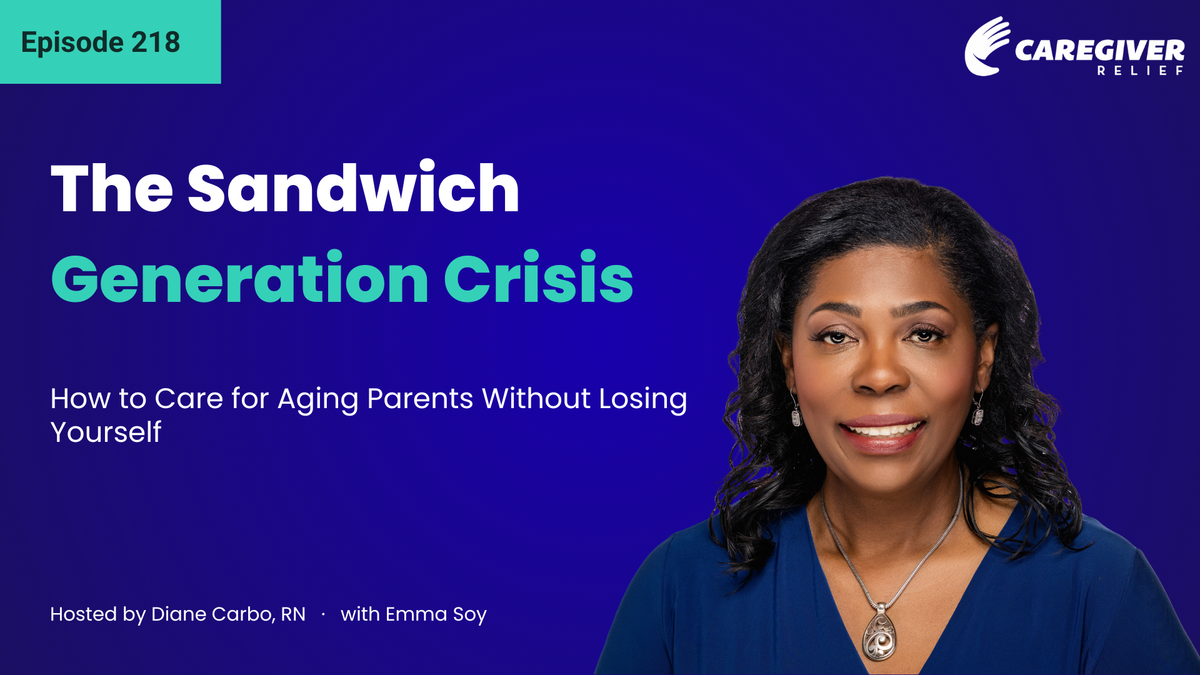
In this powerful episode of the Caregiver Relief Podcast, host Diane Carbo, RN, sits down with Emma Soy, RN, the founder and CEO of Gentle Shepherd Care. With over 35 years of experience in neurological care, Emma brings deep, practical insights into how family caregivers can move from completely overwhelmed to truly supported.
Pop in your headphones, press play, and discover how to navigate the heaviest seasons of caregiving without losing yourself in the process! 🎧✨
🚨 Episode Highlights: The "Panini" Effect
- From Sandwich to Panini: Emma explains why the "Sandwich Generation" is more accurately described as the Panini Generation—because of the intense heat and crushing pressure caregivers face from all sides (managing careers, their own aging health, adult children returning home, and grandchildren).
- The Caregiving Boom: The senior caregiving industry is projected to double in size over the next five years, putting even more strain on the current 63 million family caregivers who are absorbing duties once handled by healthcare professionals.
- The Truth About Assisted Living: Diane and Emma pull back the curtain on assisted living, reminding families that it is primarily a social model, not a medical model, meaning the expected medical oversight often requires extra out-of-pocket costs.
- The Critical 72-Hour Window: The first 72 hours after a hospital or rehab discharge are the most dangerous for an aging adult. Discharging agencies often face shifted reimbursement rates that prioritize physical therapy over skilled nursing, leaving families to struggle with un-reconciled medications and high fall risks alone.
- A Staggering Statistic: Due to severe stress and neglected self-care, 63% of family caregivers become seriously ill or pass away before the loved one they are caring for.
📝 Episode Outline
Introduction to the Sandwich Generation 🥪
Diane introduces Emma Soy, RN, and frames the unique cultural crisis facing middle-aged adults who are simultaneously supporting multiple generations.
35 Years on the Frontlines of Nursing 🩺
Emma shares her journey and explains why she dedicated the later years of her career to helping families bridge the gap between complex neurological diseases (like Alzheimer's and Parkinson's) and real-life home care.
The Rise of the "Panini" Caregiver 🔥
A deep dive into the modern cultural reality: 60-to-70-year-old children caring for 90-year-old parents, while also helping college-aged children and babysitting grandchildren.
Shifting Healthcare Policies & Hidden Expenses 💰
How modern Medicare reimbursement changes roll the burden downhill directly onto the family caregiver, turning complex medical care into unpaid "custodial care" at home.
The Seven Pathways to Wellness 🛠️
Emma walks through her signature framework designed to help older adults move past just "existing" so they can actually thrive.
Decoding the HEAL Protocol 🏥
What happens post-rehab? Emma breaks down how to protect your loved one during risky hospital-to-home transitions.
The Dangerous 72 Hours Post-Discharge ⚠️
Why medication duplication, missing prescriptions, and home setup errors cause discharges to fail within the first three days.
Put on Your Own Oxygen Mask First ✈️
Practical steps caregivers can take today to build boundaries, schedule their own medical checkups, and implement wellness pathways for themselves.
🛠️ Key Frameworks Featured in This Episode
🌟 The Seven Pathways to Wellness
Emma utilizes this 7-part system to slow down the progression of chronic illnesses and elevate the quality of life for seniors:
- Nutrition: Replacing highly processed foods with fresh, tailored diets.
- Hydration: Tracking daily fluid intake to prevent dehydration-related complications.
- Mobility: Actively motivating seniors to get out of the chair and move.
- Pain Management: Targetting chronic inflammation and joint pain.
- Sleep Quality: Monitoring for hidden disruptors like sleep apnea.
- Chronic Disease Management: Getting to the root causes of symptoms rather than just adding more pills.
- Legacy Building: Helping seniors find purpose and pass down their stories.
🏥 The HEAL Protocol
A specialized transition framework for post-hospital or post-rehab care:
- H – Health: Looking at the person holistically, not just their surgical site or diagnosis.
- E – Excellence: Providing care tailored to the individual's exact current abilities.
- A – Advocacy: Educating and speaking up for older adults who don't know what resources they need.
- L – Living: Focusing on thriving and enjoying life rather than just waiting for the end.
💡 Connect & Find Support
If you are in crisis or realize you have been trying to manage your caregiving journey without a concrete plan, resources are available to help you breathe easier.
- Visit Gentle Shepherd Care: Learn more about nationwide planning services at gentleshepherdcare.com.
Remember: "You are the most important part of the caregiving equation. Without you, it all falls apart. So please learn to be gentle with yourself." — Diane Carbo, RN
Podcast Episode Transcript
Diane: Welcome to the Caregiver Relief Podcast, where we help caregivers, patients, and families navigate the healthcare system with knowledge, compassion, and hope. I'm your host, Diane Carbo, a registered nurse and caregiver advocate. Today we're talking about something so many caregivers are living through, but few people are talking about it honestly: being part of the sandwich generation, that space where you are caring for aging parents, supporting your own children, and trying to hold your own life together.
Joining us today is Emma Soy, RN, founder and CEO of Gentle Shepherd Care. With more than 35 years of experience in neurological care, including Alzheimer's, Parkinson's disease, and stroke recovery, Emma has dedicated her career to helping families bridge the gap between the healthcare system and real-life caregiving.
She's also a TEDx speaker, director with the National Care Planning Council, and creator of the Seven Pathways to Wellness and the HEAL Protocol. But what makes her work especially powerful is her deep understanding of the emotional and practical realities caregivers face every single day. Today we're gonna talk about how caregivers can move from overwhelmed to supported, and how you can begin to care for others without losing yourself in the process.
Diane: Emma, I'm glad you're here with me today. I always enjoy our conversations because you bring a very practical approach to, our topics, when we meet. you've spent over 35 years in nursing. what first drew you to working with families and caregivers, especially those complex situations?
Emma: Yeah. Thank you, Diane, for having me today. It's always... I always enjoy, definitely, and always end up enjoy our conversations.
Diane: Yes.
Emma: Not only because you are a fellow nurse, you do understand where we are coming from, so I don't have to explain a lot of things. It's just the conversation usually just flows really well.
So that's one of the reasons that I love having this conversation with you. So for 35 years I've been in, done different things. You know how nursing is. One of the reasons I love nursing is because you ha- it's not boring. You have the opportunity to do variety of things, whatever it is that you feel like doing.
And so one of the things that I love to do, that I find myself loving to do, is caring for both end of the spectrum, babies and older adults. And here I find myself at the end of, at the later years of my career, and here I am dedicating those years to caring for the older adults. and especially knowing that those chronic neurological diseases are so prominent among our older adults, and they bring the hardest, the hard of aging for the family caregiver.
One of the reasons that I find that most family caregivers, for example, place someone in an assisted living, for example, is because they are unable to manage the symptoms of, for example, someone living with Alzheimer's and dementia. When they start having this, they can't. They don't have the tools.
They don't have the knowledge to be able to manage the symptom. That's one of the reasons, not because they want to place someone in an institution, but because they don't have the tools, they don't have the knowledge. How do I handle this? Because the disease is like going back to school. So that's one of the reasons that I'm so dedicated, seeing how family caregivers are so overwhelmed.
They don't know what to do. They don't, none of them have plans. And so I see that and I thought, that's a gap that I want to be able to fill.
Diane: Emma, what people don't understand, and I'm gonna say something that's going to insult a lot of people and their heads, make their heads explode, but assisted living is the most dangerous of our medical delivery system.
And I'm gonna, elaborate on that. What the families think they're doing and what they're actually purchasing are two different things.
Emma: Yes.
Diane: It is actually, it is a social model, not a medical model. So you have to be able to direct your care, which doesn't happen in memory care at all. I can't believe that we have memory care in assisted living because it's not working.
But the other thing is the families, have real, it's like paying for independent living with your oversight.
And if you want extra oversight, you have to pay for it. But with home, you have a home care come in, agency come in. Or in my opinion, a lot of people are able to, stay at home.
And the other thing, Emma, why it's so important for people to understand what you do is we are going to double in the next five years the senior caregiving industry. Right now we have 63 million family caregivers. That's gonna double. And, I'm very concerned about not just the family caregiver, 'cause more and more pressure is being put on them to provide care once provided by healthcare professionals.
But I worry about those, the childless couples and the solo agers. Who's going to care for them? So I'm real excited we're having this, conversation because I want people to understand. First of all, I'm gonna start with something silly. You're known as the panini woman.
Emma: Well
Diane: Can you explain?
Emma: You know what? I coin, I coined the panini woman because I notice, everybody was talking about the sandwich generation.
Diane: Yes.
Emma: a sandwich is made with, you have two pieces of bread, and then you have meat, and you have whatever else, you have a meat too.
Diane: Yeah, your filling.
Emma: The reason that I call it, I decided to coin the panini generation or the panini family caregiver is because of the pressure.
Because when you make a panini, you do
Diane: Yes
Emma: without the pressure, the heat and the pressure on both side, you really don't have it. So it's no longer a sandwich, it is now a panini. What make a panini is the pressure.
Diane: Yes.
Emma: And the family caregiver is under that level of pressure.
Diane: they really are.
Emma: when they have to work, okay, when they have to work and they carrying their own issues because let's talk about someone who's, let's say, you have someone who's 80 or 90.
Okay? Their children is at least 70 or 60.
Diane: Yes.
Emma: They have, so if you have someone who's 60 or 70 who's taking for their aging parents who are still in their 90s, for example.
That person is dealing with health issues
Diane: Yes
Emma: themself. They dealing with their own retirements. They dealing with their own, some of them are still working.
Diane: Yes.
Emma: And so they trying to juggle all of that. they still, they have, so they themselves, someone who's in their 60s, they themselves have children in college or grad school or
Diane: Yes
Emma: especially this time that we're living in.
Diane: Yeah.
Emma: And those children are graduating from college, they have no jobs, they coming back home. And so they supporting these young adults.
Diane: That's the reality of our culture right now, yeah.
Emma: This is now. This is what people are doing. So they supporting these young adults, supporting paying their colleges.
Diane: Yeah.
Emma: Paying this bill. And now they have a mother or father who's dealing with some chronic disease
Diane: Yeah
Emma: that they're responsible for.
Diane: Yeah.
Emma: And so the pressure is so real, that's why I call it the panini, because it's beyond sandwich.
Diane: Yeah. You're right. You're right. And a good panini has to have lots of heat and pressure.
Emma: Has to have lots of heat. To make it good. And lots of pressure.
Diane: Yes. and when I think of that, I think of, I have family caregivers whose parents waited till their 40s to have children. And then the women of today also wait to have children in later, Years
life. So you have, some that have teenagers-
Emma: Yeah
Diane: at home.
Emma: Yeah. as,
Diane: and maybe in high school as well as their parent who, I'm 73. My son is 47. Now, he has no children, but yeah, that, shame on him. But I'll have to deny me grandchildren.
Emma: Yeah.
Diane: but that's common in our culture.
Emma: Yeah.
Diane: But, he could have young children. Because he's only been married a short period of time. It's real, and I get emails from people all the time telling me their situations, and it breaks my heart. And many are working. They're not ready for retirement.
They need the income because they are taking care of the, the high schoolers or the kids in college and, or the kids that have, come back from college and haven't found a job. So there's a lot going on, and to take care of a, an aging parent is,
Emma: don't forget, they also could be taking care of grandchildren, because I have family caregivers
Diane: yes
Emma: that are, like, taking their grandchildren to ballgames and helping their own children, right? Helping their own children.
Diane: Yeah. Yeah.
Emma: Taking care of their young, baby, helping
Diane: Yes, yeah
Emma: their children, managing their own children. Yeah. And while they taking care of their parents also.
Diane: Yeah.
Emma: I had a family caregiver, I had a family caregiver come one time who called me, who wanted me to come and help her mom her mom was taking care of her dad who had Parkinson's, and he was declining, and her mom is aging, right? Both of them are aging, and so she's not able to take care of him.
Now, remember I said he has Parkinson's, which means physically he's having some, you know
Diane: Yes
Emma: difficulties. And she's not able to manage him. She's not able to lift him. she's not able to, you know, help him physically.
Diane: Yeah.
Emma: And so she decided she's going to hire us to come and help.
She would not, the mother would not have it.
Diane: Yes. Yeah.
Emma: The mother would not have other people come and help her with her husband.
Diane: Yeah. Yeah.
Emma: She insists that the children help. And she says, "Emma, I can't. Right now it's 2:00. I need to go pick up my grandkids from school because their mom is at," so-
Diane: At work, yeah
Emma: the pressure is on all side for this family
Diane: Yeah
Emma: caregiver who is trying to help manage everybody, trying to make everybody happy.
Diane: There's one external pressure that is also occurring right now that is very frightening to me, Emma, and, it's causing me great concern for our family caregivers. Medicare has changed its reimbursement rates.
Emma: Yep.
Diane: And we're going to, we are in a, a cost-sharing platform so that we now have whatever care you want, you're going to have to pay for it out of pocket, at least a large portion of it. and the thing that's happening is because the low reimbursement, hospitals are closing. Nursing homes are closing.
And it's because it's not sustainable at the levels of, that they were providing, 'cause the skilled benefits. And what is happening is that the Medicare, reimbursement has now put the pressure on the family caregiver. It's like it's rolling downhill, and now the family caregiver is expected to provide care once provided by healthcare professionals.
Emma: Not only that's true, but the real care that family caregivers usually need help with, Medicare has never paid for it. course, that what, this is what Medicare call
Diane: Correct
Emma: custodial care.
Diane: Correct.
Emma: So that is just, that is the real care.
Diane: Yeah.
Emma: Medicare do not pay for long-term care.
Diane: Yes. That's correct.
Emma: And that is the part that put the most pressure in family caregivers. The day-to-day living of someone with, for example, when you have a client living with Alzheimer's and dementia, that's a long-term chronic disease.
Diane: Yeah.
Emma: Physically they could be well. That person could live like this for five to eight years. So the average time that a family caregiver's caring for someone at the end of their age, at the end of their years, is at least, the minimum is five years.
Diane: Yes. Yes.
Emma: So you have five to eight years that this person is, has to, take care of their loved one who's dealing with whatever that disease is.
As I said, dementia and Alzheimer's, the physically that person could be well
Diane: Yes
Emma: but mentally, cognitively, they need 24-hour supervision.
Diane: Yes.
Emma: And the family caregiver don't have the financial support to be able to do that.
Diane: Yes. Yes, and Parkinson's, with the balance and possibly Parkinson's dementia Fall, yes. You just don't know. So I know the families are really being challenged. many caregivers feel guilty taking time for themselves.
And, the thing is, many don't even what I'm concerned is we have to help them reframe how they perceive what they're doing.
And that's why your services are so important. You provide the Seven Pathways to Wellness. Can you walk us through that and how they
Emma: Sure
Diane: support the caregiver?
Emma: Sure. So the Seven Pathway to Wellness, came, I came about that pathway because one of the things that I noticed when I started providing home care, what we call the non-traditional part of home care, now we provide both skilled and unskilled.
But the non-skilled care, what is it? What is it? Usually a family caregiver would request or they inquire about care when they feel Mom and Dad need help, like with cooking, cleaning, getting out of bed. You know, they're declining in that manner. they cannot, no longer drive, so shopping, things like that, doctor's appointment.
So usually that's what the family caregiver would be doing for the mom or dad who's no longer able to do these things on their own. So that's when they usually call a home care company. But one of the things that I noticed when we started to do that, Diane, you had a lot of older adults living that way, but they, we would just I would just watch them decline.
So they would come, and we watch them decline with whatever the chronic disease that they have. Most older adults are taking at least minimum of five pills.
Diane: Yes.
Emma: And it all has to do with some kind of chronic disease. But one of the things that I noticed, those chronic diseases, we don't focus on helping to slow down the progression of them.
We give people pills. For example, when someone is diagnosed with hypertension, you give them a hypertensive pill. When that no longer works, you add another hypertensive pill. You keep adding. So but it's not going to it's not taking care of the problem. It's not looking at why does this person have hypertension?
What is the root of the issue? So we're not looking at that. So that's just an example that you just watch people decline. And so one of the things that I noticed that would make a big difference in the life of older adults where they could thrive is looking at those seven things, very important.
Number one, nutrition Most older adults continue to eat the same way that they used to eat or worse. For example, because they live by themself, they're no longer doing things from, fresh food. They're no longer eating
Diane: Yeah
Emma: they're no longer cooking you know, from scratch because it's too much work anyway.
It's especially when they live by themself.
Diane: Yeah.
Emma: So you find a lot of older adults, they just eating a lot of highly processed food. that is, that's making their chronic disease, whatever it is, worse than what it is
Diane: Yes
Emma: because they're not eating properly. So they continue to eat that, the highly processed, nutrition, and so that's making whatever, the diabetes, the hypertension, or the cholesterol really worse.
So I looked at that. So I thought, "We could do something about that." So one of the focus is nutrition for the older adults. What kind of a diet does that older adult need to be able to be on so they can actually thrive? And so that's one. The other thing is that hydration. Most older adults are dehydrated.
Diane: Yeah.
Emma: And so when you look at their dehydration, how do we help older adults to get as much fluid intake as possible? If you don't track things, you don't know how well they are. So do you track how much fluid do people take per day? Do you track the effect before and after and things? So you do nutrition, hydration.
The next one is that mobility. Most older adult I just got a call this morning from a son, and he's looking for care for his mom. He says, "You know, my mom is very, my mom plays the music. she's an artist. She does a lot of things. She used to go out and do many things, but now that she lives by herself, she plops in front of the TV.
All she does is watch TV." Ah. So one of the reasons that he want us to come is to able to increase mobility. So mobility, getting that person get up and walk and do certain things instead of sitting down because if that person is not motivated to do things, they're not going to do it. So mobility become part of the plan of care.
The next part is managing pain. Most older adults have some kind of pain. That's the reason why they're not moving. It either is arthritis, joint pain, inflammation. Chronic inflammation is very prominent in, older adults, and that cause pain, whether it's in the joint or wherever it is. And so we focus on that because when you focus on good nutrition, you focus also on decreasing- chronic inflammation.
And so mobility, chronic pain, the next part of it is sleep. Sleep is so important in the older adults. I say sleep is not a luxury for someone who's aging. Sleep is crucial, and it's not just go to bed, but it's monitoring the quality of sleep. Most older adults either having some sleep apnea.
I was recently at a conference last week, and they said women suffer with chronic, with sleep apnea more than men because a lot of times they might be having some sleep apnea, it's not showing up. it's through snowing. It's, or so people live with sleep apnea not knowing. if you're having sleep apnea, you're not sleeping.
You're not getting good sleep.
Diane: Yeah.
Emma: You're not getting quality of sleep. So then we focus on that. So it's the sleeping, it's the mobility, it's the hydration, it's the nutrition, it's the pain management. Finally, it's the chronic disease management. do we focus on whatever that person is dealing with?
Is this a diabetes? what's the root of it? Can we help in any way? We're not curing people, but we want to slow down the progression. Is it
Diane: Yeah
Emma: the Parkinson's, the Alzheimer's? You cannot have someone living with dementia and continue eating sugar, continue having those things that are increasing the how fast the disease is progressing.
Diane: Yeah.
Emma: So the progression of the disease. So those are the, the last thing is helping people to focus on building a legacy. Most older adults, if you can focus, if you can take of all these little things for them, now they have so much to give, they have so much that they can pass on to the next generation, can we help them focus on that?
And that's so they can have a desire to continue to live instead of just exist. So that's our pathway
Diane: That's beautiful. and you know what? It's desperately needed. I have a 90-year-old couple, that, are, very socially isolated, and, I was contacted to get them a caregiver in their home.
They just wanted somebody. 'Cause they're able to do everything by themselves still, God bless them. they want, three days, four hours, and they want someone to take them out to the store, take them out to eat, and that is their lifeline. Their, the little husband said to me that, I need this.
We need this because and if we don't have it, we just want to wither and die."
Emma: Yeah. Yeah. Yeah.
Diane: And it's a very real feeling.
Emma: Yeah. Yeah. the, it's that socialization. And that's one of the reasons sometimes people place, place their loved one in assisted living.
Diane: Yeah.
Emma: Because they believe that they have other people that they can interact with.
Diane: Yes.
Emma: That's the socialization part. Where when someone is aging at home, they may not have that connection.
Diane: Yes. Now, you also have the HEAL protocol, H-E-A-L.
Emma: Yeah.
Diane: Can you tell me about that?
Emma: HEAL protocol is almost like a regular protocol, but it's specifically for people that are coming, post hospital, post rehab.
when they coming back, number one, talk about that HEAL, H stand for health.
Looking at their general health, looking at the person's general health. Not looking at the person holistically instead of just, one part. sometime when the person has a knee replacement, what was the reason for the knee replacement?
How does that knee replacement affect that person holistically, in every aspect? So the HEAL is looking at the person holistically, the E is providing it stand for excellence. It's for excellence. Okay. Anything that you're doing for someone, do it to the best of your abilities, and doing, do it to.
Because I can bring a protocol to you.
But you're not able to do it. So what extent, how much of that can you do? How much of it? Because what I can do is not what you could do. When I talk about mobility with older adults t's not comparing to other people, it's comparing to you.
Diane: Yes.
Emma: How much exercise can you do? So when we talk about excellence is based on where you are and what you do.
Diane: Yeah.
Emma: And then the other part is advocate. the A stand for advocacy.
Diane: Yeah.
Emma: To be able to advocate. a lot of older adults don't, they don't know what they need
Diane: Yes. They don't. They don't.
Emma: Family caregivers, when they call you, they don't know what they really need. They don't know that they need, a seven pathway to wellness.
Diane: Yes.
Emma: They don't know that. They don't. They have to be educated to the benefit of having the seven pathway to wellness, and, all of that costs money.
So people may not, they, sometime they just need that bare minimum. They just need you know, after, even after you explain to them the seven pathway, they're like, that's good. It's very nice, but how much does that cost?" And they start cost comparison. "Oh, I'll just take that." So they need to be educated about
Diane: Yeah
Emma: what is that good for, what is the value of having this instead of that? So it's to be that advocate for that older adult, because they don't know that's what they need. They don't know that's what they need. And then the L stands for just living.
Diane: Yeah.
Emma: Do you want people to exist, or do you want them to thrive as they live?
Diane: Yes.
Emma: Most older adults, if we don't do wellness with them, they're just going to exist. People just exist. They don't do anything. They're looking forward to cemetery.
Diane: Exactly.
Emma: And that does, that's not a good way to spend the last few years of your life.
Diane: No.
Emma: And yeah.
Diane: Emma, right now the discharge are, almost, To me, I'm seeing a lot of unsafe discharges to home because they are, because the lower reimbursement, and that's why I thought the Heal Protocol was something that is absolutely needed, because the family caregiver, does, the OT, PT, speech, I'm seeing patients come home with wounds that weren't even documented in the acute rehab because they said you have rights. You can have a right to fall, you have a right to develop, clots in your legs. You have a right to develop wounds. You have a right to all these things and you can refuse this care.
Emma: Yeah.
Diane: And, so I'm seeing families being expected to do so much more, the medical side of things, right after, and, we're going to mobile therapies.
Where it's also going to put more, strain on the family caregiver because they're expected to help the, their loved one do this. That's why I think your kind of service is so important, because, it actually gives families the support and guidance they need.
You can advocate. You can help them when at a time when they're in, in dire need of help and support because that's one thing that we as our medical delivery system does very little to support the family caregiver.
Emma: The family caregiver, the first, after they've been discharged from the hospital, the first 72 hours is the most important 72 hours.
Diane: Yes.
Emma: And, and usually that's where everything fall apart because that gap. For example, even though the hospital discharged the person with home health, but listen, they have 72 hours to do the admission But the first 72 hours is the most important 72 hours. But if the nurse doesn't get there after, until 72 hours later, they just miss that gap, right?
Diane: Yeah.
Emma: The gap, what is the gap? The medications. A lot of time the medication reconciliation, when the person get discharged from the hospital, they come home. What they were at home, the medication that they had in the hospital is not at home, right? And so the reconciliation is not done.
Diane: Yes.
Emma: And so people are missing the medication that they just started them on. They don't have that at home. so if the first 72 hours, if that nurse doesn't get there to be able to identify that and see that, okay, that's one. The other thing is, that person that used to be at home or in a nursing home or hospital where everybody was doing everything for them.
Diane: Yep.
Emma: And now they come home, and all of a sudden even getting out of bed, in the nursing home or skilled nursing facility or the hospital, they don't even dare to get out of bed without help because they don't want them to fall. They have an alarm in the bed. The person is
Diane: Yeah
Emma: at the end. But now that they come home, now you tell them they need to get out of bed without help.
But they spend, whatever, 21 days where you have helping them.
Diane: Yeah.
Emma: So do you see that the 72, the first 72 hours put them at a high risk for fall because now they have to get out of bed without help.
Diane: I'm seeing them not even having the right equipment ordered before they get home.
Emma: Yeah, before they get home.
Diane: So that's why it worries me because having done home care for a long time and, case management for decades as well, I know what they need, and it makes me crazy because we're missing the boat. Those, you're right, those first 72 hours are so imperative to get things right.
Talking about medications, do you know how many times you go into a... And I know you know this. But you, the patient was on all these meds before they were in the hospital. And then when they went in the hospital, they took them off all these medications. And some of them are desperately needed.
And they never put them back on. On back,
Emma: Yeah.
Diane: And the, it's not picked up. So there's all kinds of things that medication reconciliation is so important, and it's missed. they're not taking time, the nurses in the hospital or discharge planners aren't taking the time to sit with a family member and the family member, that's, again, here we go, Emma, we need to educate them.
You need to take that list of medications that they had to see what, how it compares to what they're taking now, because a lot of times even there's duplications of medications.
Emma: Yeah. Yes. And you have the stop, start, and continue. a process that needs to be done. For example, if they stop a medication, right? If they stop something, they might stop it and start something else.
Diane: Yes. Yes
Emma: In place of that.
Diane: Yeah.
Emma: So when that person come home and they don't know that they either don't continue to take that the old medication they used to take because it's been replaced with something else
Diane: Yes
Emma: So you don't have that.
So that person come home, they have all these meds in their cabinets, they're like, "Oh, I've always taken this."
Diane: Yep.
Emma: They start taking that.
Diane: Yeah.
Emma: But then it was not reconciled that, no, don't take that anymore because you're taking this instead.
Diane: Yes. and it's a very real situation.
And, the other thing that concerns me is people that are on new medications, the nurses. I had a client, actually my neighbor, who had seizure medications ordered for the first time. They didn't even send a nurse out for the first four or five days, and I'm like, and I had to call and insist because nobody was monitoring her for, her explaining to the family what she needs.
And Emma, she was having multiple seizures, had been in, the hospital. They literally gave the husband a filled syringe of medication and said, "If she starts having seizures one after another, status epilepticus Oh, dear give her this injection." Yeah. Now, they didn't tell him what the med was or how to give it.
Emma: Yeah.
Diane: Like, he didn't know how to give an IM injection.
Emma: Yeah.
Diane: So- I... It's oh, my gosh.
Emma: So do you... You know, one of the things that I notice that they doing now discharging people from the hospital
Diane: Yeah
Emma: they're more prone to do PT, OT evaluation more than do nursing.
Diane: Yes.
Emma: Okay?
Diane: Yes.
Emma: they order PT eval, PT and OT eval.
Diane: Yep.
Emma: They don't order nursing
Diane: Yep
Emma: because they don't order nursings. Because I've seen so many people come home, and they don't have skilled nursing
Diane: Yeah
Emma: part of their discharge plan.
Diane: Yeah.
Emma: And I'm asking why. The reason is because of the reimbursement.
Diane: Yes.
Emma: Because now they get reimbursed, this
Diane: Yeah
Emma: lump sum.
Diane: Yeah.
Emma: Because the home care agency get reimbursed with this lump sum, the less service you provide, the better.
Diane: Yes. And that's where we're at.
Emma: The less things you provide, the better. Why would you want to have a nurse? In my old days, we used to have nursing was the number one thing.
We'd go in there, and we noticed that the person need a PT and OT eval. Then we asked for an order to get PT, OT eval.
Diane: Exactly. Yes.
And then- And now it's the complete opposite
Emma: now if they order PT and OT eval, they don't order any nursing.
Diane: Yeah, but nursing isn't reimbursed, and that's why I'm worried for the family caregivers.
That's why it's so important for people to know about organizations like yours that can help them, because the, family caregiver has so much placed on them, and it's very frightening, the stress of it all, and they're not supported. At least if they had a nurse in the home, even if she was there for an hour, she would be able to identify what you're going through, what you need, what needs to be done, and educate you.
And that's one thing that we no longer do with our patients, or their families. We don't take time to educate them on what their needs are, and we are at a very critical stage in our healthcare system where it's at a dangerously high level, and it's, going to continue that way.
And that's why it's so important that I try to make people aware that there are organizations like you that they can, you can reach out. people are gonna have a sticker shock, Emma, but I want to tell you now that with our cost sharing plan that Medicare is doing, and they're pushing even traditional Medicare into
Medicare Advantages as much as they can. They're moving that way, so that they can, we will have to privately pay for, for healthcare. In fact, a Medicare Advantage plan for skilled care or acute rehab can be as much as 200 to $400 a day co-pay.
Can you imagine that, Emma? No. who can afford that?
So somebody who has a stroke, we used to have, and they still say this, ha, tongue in cheek that we have 100 days of, skilled. Per year We do not.
Emma: No.
Diane: We do not, because they are not giving it to us. The facilities have a higher level of reimbursement for not providing therapy.
And that's where we're at. So I really think it's important that, your organization, Gentle Shepherd, is You can reach out to people and help, and you also have an You're an advocate, a fierce advocate for what is needed, and, that's me as well.
Diane: Yeah. Yeah.
Emma: But you have the organization to support these people. now for caregivers listening right now who feel completely overwhelmed, and I'm sure there's a bunch of them and there will be a ton more, what is one small step they can take to regain their, sense of control?
Emma: That one small step is to put on their, own oxygen.
Diane: Yes.
Emma: One more step is acknowledging where you are and what's going on with you. If
Diane: Yeah
Emma: you don't have to do everything, because if you don't take care, family caregivers don't take care of themselves. If you don't take care of themself, it is almost impossible for you to be able to be available to take care of this other person that you are with.
Not just that person. Remember all the stuff you got to take care of.
Diane: Yeah.
Emma: You got your work, you got your family, you got your own, you got your own health, and you got Mom and Dad. So the first person that needs to be, that needs to be cared for is you, because when you take care of yourself mentally, emotionally, spiritually, and physically, then you can be healthy enough to be available for these people.
Don't wait until your body fall apart for you to know that you need rest. Make that part of daily. Like, acknowledge that I have all this stress, I need some time. I need some time to do my own health assessment. Go get your doctor's appointment, get your mammogram done. Get your own yearly, checkups done yourself.
Go, put in the books, up, in your daily, is it weekly? Do I go to workout three days a week? Put that in the books no matter what happen. Do I need time daily for my own mental health? Time for meditation. Do I do that for myself? Even those seven pathways, do I apply those to my own life?
Nutrition
Diane: Yeah
Emma: hydration, mobility, my own seven. Apply those same pathways that, for your mom and dad, apply them to yourself, because that is wellness to you.
Diane: Exactly. You know, 63% of family caregivers become seriously ill or die before the person they're caring for, Emma.
Emma: Yes.
Diane: And that's up from 50%, from 15 years ago.
Now, here's my concern. I think with what the pressure and expectations we're putting on the family caregiver, we're gonna have 100% that are gonna be seriously ill.
Emma: Ill, yeah.
Diane: That's why it's really important that they, I want to make my caregivers and, seniors aware that you need to take steps so that the caregiver can take care of themselves.
And, Emma, you offer a service, and that people need, and they, where can they reach out to you, Emma?
Emma: They can always reach out to me. call our office at 704-209-5040. We work with people nationwide. you can go to our website, gentleshepherdcare.com. Send me an email, emmasoy@gentleshepherdcare.com.
Either way, get in touch with us and find more information about us, and I'm available. I'm always available even for, to ask questions, if you have a question about anything, mom is coming out of the hospital. On a weekly basis, we do a webinar where we teach about topics, every topic about, aging care.
So get on our YouTube channel, find some of the topics that we're offering. This is all free. And then at any time, I help families to set up a plan. Most family caregivers, the reason that they are in crisis is because they have no plans.
Diane: Exactly. Exactly
Emma: start with a plan. Come, give me a call. have a plan done.
Diane: Yes. Emma, thank you so much. You know I enjoy your, our conversations because you have the pulse of what's happening in home care right now, and, I'm like the little chicken saying, "Hey, pay attention." "It's happening. It's happening." Yeah. we're really in a stressful time in our industry right now, and we need to, make people aware so that they can provide, better care and take care of themselves.
So I tell you To my family caregivers out there, you are the most important part of the caregiving equation. Without you, it all falls apart. So please learn to be gentle with yourself. Practice self-care every day. Call Emma. She'll be able to help you.
Emma: Yes.
Diane: Because you are worth it.
Caring for a loved one can be overwhelming — but you're not alone. If you have questions, big or small, our expert team is here to help.
👉 Click here to Ask the Expert
Our Resource section can help you find the information and tools that you need. We have courses, videos, checklists, guidebooks, cheat sheets, how-to guides and more.
You can get started by clicking on the link below. We know that taking care of a loved one is hard work, but with our help you can get the support that you need.
Click here to go to Resource Section now!