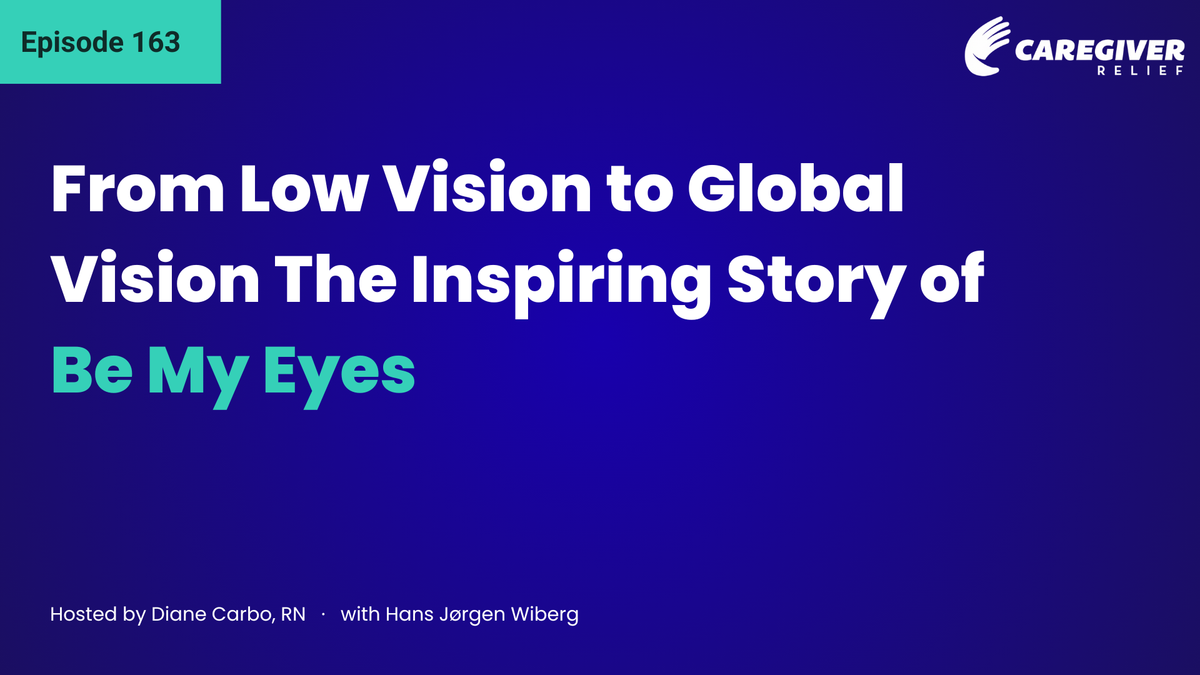
From Low Vision to Global Vision The Inspiring Story of Be My Eyes with Founder Hans Jørgen Wiberg - Episode 163
How do you maintain independence when faced with vision loss? What if, with a simple tap on your phone, you could connect with a volunteer anywhere in the world to help you navigate your day?
In this episode of the Caregiver Relief Podcast, I am honored to sit down with Hans Jørgen Wiberg, a Danish craftsman and the visionary founder of Be My Eyes.
In This Episode, We Explore:
- The Origin Story: How Hans turned his personal experience with low vision into a revolutionary, free app that now supports millions of people in over 180 languages.
- Human Connection in a Tech World: Hans shares the "pivotal moment" when he realized that remote, visual assistance could bridge the gap for those who are blind or have low vision.
- The Power of Volunteers: Learn how the Be My Eyes network operates 24/7, connecting users with sighted volunteers across time zones to handle everything from reading labels to finding lost items.
- The Evolution of Accessibility: We discuss the integration of AI tools alongside human support, and how new innovations—like Meta’s smart glasses—are making independence even more accessible for seniors who may find traditional smartphones challenging.
- A Global Perspective: Hans reflects on how his work has taken him around the world, highlighting the vast differences in accessibility resources and public perception of disability across various cultures.
Why This Matters for Caregivers 💙
Whether you are caring for a loved one with vision loss or simply looking for tools to foster self-reliance, this conversation is packed with hope and practical insights. As Hans emphasizes, technology is rapidly evolving to become more voice-driven and intuitive, promising a future where obstacles are easier to overcome.
"Because caregiving is one of the hardest and most meaningful things you'll ever do, and no one should have to do it alone." — Diane Carbo, RN
Connect with Be My Eyes
Want to learn more about the service, sign up as a volunteer, or download the app?
- Website: bemyeyes.com
- Frequently asked questions: Be My Eyes Help Center
- Facebook: Be My Eyes
Podcast Episode Transcript
Diane: Welcome to the Caregiver Relief Podcast, where we provide essential information, heartfelt support, and practical resources to empower caregivers and seniors in their daily journeys. I'm your host Diane Carbo, an RN with over 50 years of experience. and I wanna offer tools for independence and foster a community of understanding and relief.
Today we're exploring an extraordinary story of innovation and connection with Hans Jørgen Wiberg.
Hans is the founder of Be My Eyes as a Danish craftsman living with Low
Hans turned his personal experiences into a revolutionary app that links people who are blind or have low vision with sighted volunteers worldwide for an on demand visual assistance. Launched in 2015. It attracted 10,000 volunteers in just 24 hours, and now serves millions in over 180 languages, easing burdens for caregivers and promoting self-reliance for seniors with visual challenges.
Diane: Hans, thanks so much for being here. I'm so excited we were challenged to make this happen, but we did.
Hans: We made it.
Diane: Yes.
Inspiration, for those out there.
Thank
Hans: you.
Diane: I'm really impressed and I was so excited that we did finally, get to connect. can you start by sharing a bit about your background as a Danish craftsman and how your own experience with Low Vision first sparked the idea of Be My Eyes?
Hans: Well, that's a very long story, but
Diane: that's
Hans: okay.
Well,I'm 62 years old now, and, when I was born, back in 63, my plan was, and my only dream was to become a farmer. I'm born and raised on a farm in Denmark, and, so I, that was my journey. and I even went to Minnesota in my, practice as a farmer. and when I was around 25, I was, ready and I was back on my parents' farm And at that time we realized that I had this eye condition, the same eye condition as my grandmother. So we kind of knew how it would, progress and my. Parents and I, we realized that it would not be a good situation to kind of, start as a, a young farmer and then know, yes, you are going blind.
so, together with my parents, we decided that. I should do something else. And to be honest, I had no clue what to do. so I went back to school. I took, 10th grade and then I went to university and, ended up, studying, philosophy for, some years. And then I met my wife, and she is doing, upholster story, putting new fabrics on old furniture.
and I was helping her do that. and at the same time I was working for the Danish Blind Federation as a, consultants and, In that job one day I met a young guy, who was telling me, now we are in 2012. and, I, he told me that he was using his, smart iPhone, and he was using FaceTime when he was alone and he needed someone to see something.
And I said, oh, that's pretty cool. and then he said, but I always have to think about who to call. and then I was thinking, oh, maybe we can make a group you can call so you don't have to kind of think who is available. And, did I call my sister yesterday and this year, work now and whatever.
I'm really not a tech person at all, so I had no clue how to make an app. but I knew there was something here. and I went back home actually, and I said to my daughter, hey, FaceTime me. And she did. And then, I said, now you have to guide me around the house, just to kind of try it out,
and I, clearly remember when I was, all the way, around the house, and I had to go back into the house and I said to my daughter, now you have to make sure that my hand grabs the one handle. and she was a little to the left and a little further. Now you have it and, maybe it's not important, but that was kind of the moment I really realized, hey, it is.
Actually possible to guide another human being. Even if you are sitting thousand miles away, if you have the right connection and the camera and the iPhone and all that, then it is possible to, with high precision and, security to guide another person. and I was, kind of.
Imagined about that and, and,it was, yeah, one of those moments you remember. and, I still had no clue how to make an app or anything, but I managed to find some other people and get the process started. and we managed to raise some money and, then, after it took almost two years and all that process, but then in 2015 we could launch Be My Eyes and, coming from Denmark, which, yeah, everybody who knows.
These days, it is a super small country. we are only 6 million people. so you also know that you have to be international because, it doesn't make any sense to make, an app just for blind people in Denmark. That's such a small group. So we decided from day one that it should be a, international app.
It should also be a free service, because we knew that a lot of blind people in this world, they are also, in the low income area. yeah. so we, and especially if, I mean, we have a lot of. People using PBI in India, in Africa, in China, and so on. and we cannot charge them $10 a month for anything.
so, so we decided that it had to be a free service also because it is volunteers who. Take the calls because what you do in Be My Eyes is that you, when you need to see something and you are home and alone, then you pull out your phone and you, tap the screen and, or you can say,to Siri to turn on, be my eyes.
and then we, send out a notification. To 20 volunteers. and the first of those 20 volunteers who accept the call will be connected in a video call. It's a one-way video and a two-way audio. so, it's basically super, super simple. just like a FaceTime call, but only video,one way.
and then, the blind person can point the phone at whatever they need to see, most likely. Something in the kitchen or, they are out and about and looking for a specific, shop or, number or to find the door or, just finding a bus stop or they have dropped something on the floor. A thousand different things that in your daily life, where you just need a pair of eyes, maybe only for, 20 seconds or something.
but yeah, so that's kind of the short story about it. So.
Diane: Yeah, but that's amazing. you talk about the pivotal moment where, you were being directed to grab the, doorknob and you, discounted it as it's probably the most pivotal moment that moved you forward, and
I love two things about this is number one, I love that you felt a need to create this app. I love that. And that you're connecting peoples human to human and you're not using artificial intelligence, which didn't exist in 2015, but, we lack human connection and During COVID, I moved in, with a woman in her late seventies with her husband.
she was losing her eyesight, and her husband had dementia and he was in the early middle stages. And, you know, I've. Cared for blind and, deaf people my entire life, but nothing on a regular basis. And I watched Joanne as she struggled to do things. So we had fun because we looked into.
Apps or tools that she could use, like to even be able to use the computer. And I found it amazing that there's so much out there that those with low vision don't know. And the other thing I love about this is you've made it free because you're right, most people with low vision or. Total blindness, are here in our country, are on disability, which gives them no funds at all for basic needs.
Not enough for basic needs. So it's really a challenge for them to, have, would have this service. So, kudos to you. I'm just so excited. My goal is to bring these types of. Programs or platforms to my growing senior and, caregivers. now, today be My eyes has millions of volunteers supporting users in over 180 languages.
How has the app evolved since inception to handle such scale and diversity?
Hans: Well, I remember especially the scale was a little of an,a, challenge in the beginning, but of course, it's, basically a matter of having, more computers,work for you. so, and we have made.
Super, super simple. So when you sign up, you simply choose what language you would like to, be assisted in or you would like to do, give assistance in, and you can choose. we ask people to select their primary language, and then if you also speak, another language, you can add that as your secondary language.
if you speak English. You don't have to have a secondary of language, but if you speak Danish or greenlandish or something like that, super small languages, then it might be helpful to have a secondary of language because, what happens, if I wake up, two o'clock at night and I wanna,get some assistance for, something.
Then we do not call anyone in Denmark at two o'clock at night, but we try to find someone in another time zone. And that's the huge benefit of having 10 million volunteers all over the globe. Because even in small,languages like Danny's, we do have. Danes who live in Australia or in the US or, and who are also, volunteers at Be My Eyes so I can get assistance in my own language in the middle of the night without disturbing all the, Danish people in Denmark.
But of course if you, have a very small language, then there may not be any volunteers available in other time zone, say Icelandic or something. but then if you have added, hey, I also speak French or English or German or whatever, then we can always find, someone who can assist you, maybe not in your mother tongue.
But if it is a matter of finding something or,most things you can also do in your secondary language, if you speak it, rather well. so that is how we can assist people 24 7 without,disturbing our volunteers 24 7. and that is the. Benefit of, this huge scale we have, achieved over the years.
so we are super proud about that. you said that we are not using,ai. and I may this point you a little bit because we are, oh,
Diane: I know that you must be using AI for some things. Mm-hmm.
Hans: Yeah.
Diane: But you know, my thought was. 2015, you definitely didn't have ai.
Hans: No, no. That that's right.
Yeah. But, it's kind of an interesting, story because, in 2023, after, open ai, they launched the chat tivity and all that. we also, partnered up with Open ai. And now you can choose. and this is, we love our volunteers and they are being used more and more.
but some people also just. Don't like to talk. Maybe they are a little shy or, they find it a little uncomfortable to talk to strangers or something like that. so, so we are so happy that we can offer a, a choice. So now you can choose if you want to take a photo and get an AI description of the photo, and you get some amazing descriptions.
or you can say, Hey, I don't want to talk to a computer. I want a real person. and then you can just click the call a volunteer button. and, we can see that the AI part is being used more than our volunteers, which is perfectly okay. As long as it is your choice. You can choose whether you want to do, the one thing or the other thing.
and we don't really care. service you are using. so, but yeah, just to say that, thank you. Mm-hmm.
Diane: I love that you're staying on top of technology and you're evolving. Now, I'm curious because AI can translates languages now and, you know, while you're speaking, I have a set of earbuds, and I watch international, shows.
Like I told you, I love Summerville. Mm-hmm. And,But I laugh because so many languages, so many cultures have, intertwined English with their native tongue. Yeah. So, you know, all of a sudden they'll be going what
Hans: they're saying
Diane: and then they'll go, okay. Or, yeah, I just love it, but I listen and, to the native tongue because I'm lazy sometime or tired and I don't wanna read, the subtitles and it translates for me.
And I found that fascinating.
Hans: It is, yeah, absolutely fascinating. also that it can do it in, of course not, simultaneously, but it's really fast.
Diane: Yes.
Hans: and, of course, it's rubbish sometimes. but maybe the yes conversation is also a little rubbish. I don't know. but, you can get,I mean, you can follow along in the conversation, and, without, Yes, too many, issues and, there might be some, issues with, numbers or places or whatever. but, it doesn't really matter that much. you can, easily follow along and that, it is absolutely amazing. yeah, that possible. That's my personal
Diane: experience as well.
Mm-hmm. Yes. it can be rubbish sometimes I think that doesn't make sense to me when it's. Translating, but Then I look up, I stop the TV and I rewind it and I read the sentence and then I go, oh, that's what they were saying. But I thought, you know, you're right. I get the tone or, what they were saying, but I always check it 'cause I don't trust AI to be a hundred percent Perfect.
Hans: That's right. And speaking of translation, when we launched the ai, one of the things that, we, Got just out of the box was a translation of the description into I think, almost 50 different languages, which is, mind blowing without us having to do anything other than tell. Open ai, Hey, this person, has chosen Danish as the language.
Mm-hmm. And then the description will be in a really, really good Danish, language. of course, if you really look for it, you can see, oh, this is translated. but most often you would not notice that at all. which I think is. Kind of mind blowing, for a such a rather small language.
I mean, English and Spanish and German and French and Italian, they are, I mean, way, way bigger, languages. but you get a really good, description in Danish,as well. So I think that's, also mind blowing basically.
Diane: Yes, it is. Now as somebody with low vision yourself, how has founding Be My Eyes personally changed your perspective on accessibility and community support?
Hans: Well, I of course have been,talking to, one of the great things about, being the founder of Be My Eyes is that I have been invited to, many, many different countries to conferences and giving, a speech about Be My Eyes, and then I just loved. To sit down and talk to people, in different countries and ask them, okay, how is it to be a blind person in the middle of Italy or, Brazil or Japan or whatever?
and. Finding out that, of course I mean, being a blind person is of course different, but it is more alike no matter what country you live in. but the access you have to resources is very, very different. and coming from Denmark where we, like to. yeah. Brag about our welfare system, and then talk to someone who lives in a small country in Africa or something like that.
That's a very different story. and, so I have the deepest respect for, people who have to cope with different, situations and also, a matter of. Public, opinion and, something public opinion is also your family's opinion that is influenced by a negative public opinion about having a disabled person in the family is kind of shameful or whatever.
and some people has to. deal with that I'm so lucky to be in Denmark where, it is, of course accepted, not of course, but it is accepted to, be blind or in a wheelchair, whatever. but that's not the case in many countries. So, and I think that is. One of the things that I have been, how should I put it, blessed with meeting people who tell me about, Hey, it is not Denmark all over the world.
this is how it is to be, in this country, and so on. And that has, made me,very, very, humble and, careful about, how to yeah, address and what I can kind of take for granted. and I really have to remember that, yeah, it is very different from country to country and so on.
So, yeah.
Diane: Well, being a rehab nurse, I, really respect what those with low vision. Or blindness or even with people that are deaf, it's just, they all develop superpowers.
Hans: No, we don't. but we do have to kind of,Sometimes, oh, you can hear whatever when you're blind. no.
I'm also hard of hearing. Yeah. And, but I pay more attention to what I hear. yes. So, and that's a different, you don't get better from hearing when you go blind, but you pay more attention to whatever you hear. So, and that's a huge difference.
So yeah,
Diane: your sense of your surroundings. Stuff is mm-hmm. Always on. it's like you have little internal sonar sometimes. Yeah,
Hans: that's right.
Diane: and I'm a rehab nurse. I'll let you get flustered until you find the right way. I mean, that's just what the way we approach, you know?
Things because some, you know, sometimes you have to build up a little toughness or,
Hans: that's right. Yeah. Mm,
Diane: yes.
Hans: Absolutely.
Diane: to the world. Hans, thank you so much for spending time with me, and I'm glad we finally connected. can you tell people how to find you?
Hans: Yes. that's one thing I would like to mention as well, because I think it can be important for your audience, because,We have partnered up with, meta, the, company that owns Facebook. Yeah. and they have these,smart glasses. and you can use be my eyes on those glasses. And the, the reason why I find this. Interesting for your group is because, when they act hooked up with your smartphone, then the only thing you have to do is say, Hey, meta, and then say, be my eyes.
And then the glasses will make a call to one of our volunteers. and you don't have to do anything at all other than say those words because we have realized, and this is kind of obvious, that. When you go blind, say you are, in the late 17th or even in your eighties or something, then it can be difficult to learn to navigate yes, a smartphone, and use voiceover and use the smartphone in a whole different way and all that.
but putting on a pair of glasses and say, Hey, meta and say, be my eyes, anyone. Can learn that part. and my, big dream that we can kind of see it will happen is that you will have a, voice driven. Interface. and we hope to automate the phone part of be my Eyes voice driven as well.
it may not happen, this year, but hopefully, within a few years I think the whole world will see a but you can choose, hey,make my phone, voice driven, And then you can, simply talk to your phone and it will understand and it will most likely do what you tell it to do. and that will make it. A lot easier for our, yeah. even older than me,blind people,
Diane: like somebody
Hans: like
Diane: me, Mike. It's happening with seniors. We're growing older but not healthier and
Hans: Exactly. Finding,
Diane: you know, obstacles to life at times. Yeah. Yeah.
Hans: Mm-hmm.
Diane: Like my neighbor that, was going blind.
so Hans, thank you again so much for sharing your app and your knowledge and your time with us today.
Hans: Hmm. Yeah. And you asked about where to find me and,you don't really need to find me, but, if you go into. Be my eyes.com. Then you can find, the, the place where you can download and read about,be My Eyes.
And, you can also find a little bit about me. and then, yeah, you can just, if you want to send me an email, you can do that, on the web, page as well. Otherwise, it is just hands@bemyeyes.com. That's my mail and you're welcome to, to, to email me. So thank you so much.
Diane: Thank you to my family caregivers out there.
You are the most important part of the caregiving equation. Without you, it all falls apart. So please learn to be gentle with yourself. Practice self-care every day because you are worth it.
Caring for a loved one can be overwhelming — but you're not alone. If you have questions, big or small, our expert team is here to help.
👉 Click here to Ask the Expert
Our Resource section can help you find the information and tools that you need. We have courses, videos, checklists, guidebooks, cheat sheets, how-to guides and more.
You can get started by clicking on the link below. We know that taking care of a loved one is hard work, but with our help you can get the support that you need.
Click here to go to Resource Section now!