Does Medicare Cover an OB/GYN Wellness Visit? Why Women May Get Surprise Bills with Helen Jonsen - Episode 236
A woman’s routine OB/GYN visit turned into a surprise bill. Helen Jonsen joins Diane Carbo, RN, to discuss Medicare wellness visit confusion, women’s health advocacy, and what to ask before care.

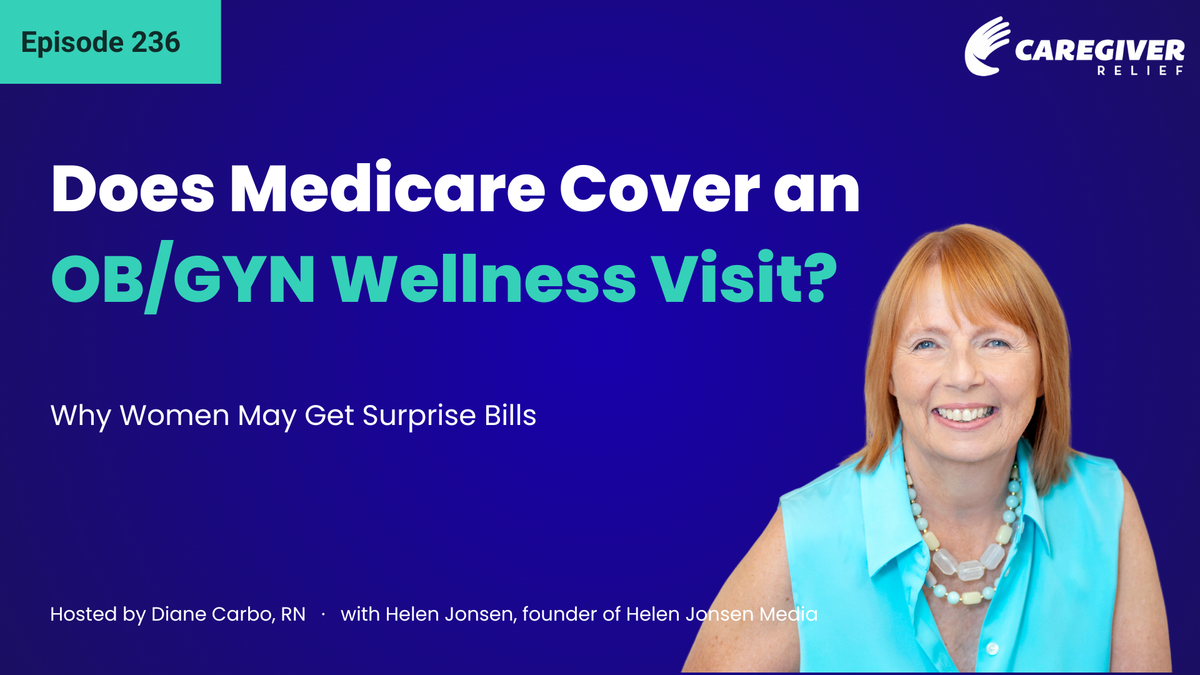
In this eye-opening episode of the Caregiver Relief Podcast, host Diane Carbo, RN sits down with veteran broadcast journalist, media advisor, and author Helen Jonsen to uncover a hidden issue in healthcare: Medicare’s confusing billing practices around women’s preventative care. 🎙️✨
Many women assume that entering Medicare means their routine annual OB/GYN visits, Pap tests, and screenings remain covered just like standard private insurance. That isn't always true! ⚠️ From misapplied billing codes to changing coverage guidelines, these administrative disconnects can leave patients and family caregivers with surprising out-of-pocket bills—and may even discourage women from getting essential preventative care. 🛑
📋 What You’ll Learn in This Episode
💡 The Reality of Medicare & OB/GYN Care: Why a "yearly wellness visit" under Medicare is not the same as a traditional, full routine physical exam.
🗓️ Coverage Timelines: How often Medicare actually covers Pap tests, pelvic exams, and screening mammograms.
🧾 Helen’s $300 Surprise Bill: How a routine exam turned into a billing battle—and how Helen used persistence (and a viral LinkedIn post!) to get it resolved.
🎗️ The Preventative Health Dilemma: Why regular screenings for cervical, breast, and pelvic cancers remain vital after age 65.
🔍 Dense Breast Screening Changes: Important updates regarding Medicare coverage for breast ultrasounds alongside mammograms.
🗣️ Self-Advocacy & Caregiver Tools: The exact questions you or your loved ones must ask your doctor’s office before care is provided to avoid financial surprises.
📝 Key Questions to Ask Before Your Next Visit 🙋♀️
To protect both your health and your wallet, Diane and Helen recommend asking your provider’s billing team these crucial questions before your appointment:
- 🩺 How will this visit be coded and billed? (Is it a Medicare Annual Wellness Visit, a diagnostic visit, or a routine physical?)
- 🗓️ Am I currently eligible for a Medicare-covered preventative screening (e.g., Pap test, pelvic exam, or mammogram)?
- 💰 Will any part of this exam or additional testing produce an out-of-pocket bill?
- 🔔 If a service isn't covered by Medicare, will I be notified before it is performed?

📌 Episode Timeline & Outline
- Introduction: The misconception of Medicare’s "annual" OB/GYN coverage.
- Why preventative care after 65 still matters for cancer prevention.
- Introducing guest Helen Jonsen.
- Helen shares her personal story of getting a unexpected $300 bill.
- Navigating the complex web of doctor coding, billing departments, and supplements.
- Public advocacy: How a viral social media post forced accountability.
- The widespread challenge of medical billing for aging adults and caregivers.
- Important updates on breast ultrasound screenings for dense breasts.
- Essential takeaways: How women and caregivers can go to appointments informed.
- About Helen’s upcoming book This Kaleidoscope Career & closing thoughts.
🔗 Connect & Resources
- Host: Diane Carbo, RN
- Guest: Helen Jonsen — Learn more at helenjonsen.com

💬 Have you or a loved one ever received a surprise medical bill after a routine doctor's visit? Share your experience or questions in the comments below! If this episode helped you, please like, share, and spread the word to someone who needs it. 💖
Podcast Episode Transcript
Diane: Welcome to the Caregiver Relief Podcast. I'm your host, Diane Carbo, RN. Today's conversation is about Medicare, women's health, and the surprise bills that can happen when no one clearly explains what is covered before care is provided. Many women believe that an annual OBGYN wellness visit will be covered once they are on Medicare.
That is an understandable assumption. For years, women are encouraged to get preventative care, annual exams, screenings, and checkups, and that care still matters after 65. But Medicare does not always work the same way private insurance does.
Medicare's yearly wellness visit is not a routine physical exam, and if extra services are done during the same visit, there may be out-of-pocket costs. Medicare also covers Pap tests and pelvic exams to check for cervical and vaginal cancers, usually once every 24 months in most cases, and Medicare covers screening mammograms once every 12 months for women age 40 and older when eligibility rules are met That confusion matters because this is not just about a bill.
It's about whether women feel safe continuing their preventative care. Breast cancer, uterine cancer, ovarian cancer, cervical cancer, vaginal cancer, and even vulvar cancer can still affect women after 65. The American Cancer Society notes that more than 20% of cervical cancers are found in women over 65.
And the NCI SEER program identifies breast cancer as most frequently diagnosed about among women ages 65 to 74. So the message today is not, "Don't go." The message is, "Go informed." Also, ask how the visit will be billed. Ask what Medicare covers. Ask whether you are due for a Medicare covered Pap test, pelvic exam, breast exam, or mammogram.
Ask whether any additional test, exam, or service may create an out-of-pocket bill before it happens. Today, I'm joined by Helen Jonsen, a veteran broadcast journalist, strategic media advisor, speaker, author, and founder of Helen Jonsen Media. Helen is known as a speaker's speaker and a language architect who helps people and organizations communicate with clarity, confidence, and impact.
But today, Helen joins us with a personal story, one that raises larger questions about Medicare, women's preventative care, billing transparency, patient advocacy, and the right every woman has to understand her financial responsibility before she receives care. This episode is about empowering women to protect both their health and their pocketbook.
Diane: Welcome, Helen. Thank you so much. When I heard about your story, I was glad that you were willing to share it with my listeners.
Helen: Thank you, Diane. Yes, this all came about because I posted on LinkedIn after getting a surprise bill. And I posted that, and I said in the very beginning of the post, "This is about empowering women," because our healthcare is important at every stage and every age in our lives.
And I felt it wasn't just my story because as you so brilliantly outlined in this open, we have assumptions about what is covered and what is not covered, and how that can surprise us, and it can surprise our caregivers who may be helping with insurances and other care for, people who aren't just caring for themselves.
Diane: Again, Helen, right now what I'm seeing is we are, traditional Medicare is rationing care, and, Medicare Advantage is just making you pay out of pocket for so many things you were unexpected to pay for. So can you walk us through what happened when you scheduled your OBGYN visit?
Helen: Absolutely.
Had nothing to do with the scheduling, in the sense that I scheduled a visit for what I thought was an annual visit, and I must admit that annual visit was many years in coming. So there was a gap, so it's not like I had gone the year before. So it was a new provider, and it was a very basic physical in that it was, as you say, you have the three components, right?
You have the pelvic exam, the breast exam, the cervical exam.
Diane: Yeah.
Helen: I chose not to have a Pap test because according to all guidelines, the ASCCP and ACOG, if you have a perfect Pap test for most of your years, you are a monogamous person or someone who is not sexually active, your Pap test will not, your Pap report will not change because it's only testing for cervical cancer, which I like to remind people is a sexually transmitted disease.
It's not something that happens in your body magically. So it was a reasonably short visit. We talked about hormone replacement. We did the basic exam. Said, "Thank you very much," and I left I never received a bill. I assumed it would be a co-pay. It didn't arrive. So fast-forward six months, I've made an appointment to go see my provider, because of a small issue I wanted to have checked out, and, I get there and the receptionist says, "Oh, you have an unpaid bill."
I said, "Oh, that's interesting. It's probably a co-pay. What is it?" She says, "$300."
Diane: Oh. Oh, Wow.
Helen: I said well, I only had one visit here. How could I have a $300 bill?" She says, "Well, here it is," and she prints it out for me. And it says... Now, I wanna say that I have, I'm on Medicaid, but I have Medicare, but I have the AARP United Healthcare supplement, okay?
Standard traditional supplement.
Diane: Yeah.
Helen: So I look at the bill, and it says that AARP supplement has been paid, about half the bill, but nothing has been paid by Medicare, and it basically has the code that says, "We don't pay this bill," you know, "We don't pay this bill. This is not covered."
Diane: Yeah.
Helen: I said, "But that's really odd that Medicare isn't covering this annual exam that's not annual that was not annual, or wellness exam."
So I took the bill home, and I did some research what Medicare pays and what my EOB was.
On the Medicare websites, it showed about the new guidelines, newer guidelines that say a Pap test is every two years, that what's covered. So I also went to their chat and got a real person on the chat and asked a few questions, and the person put in, "This is what's on the Medicare website," because I was on the UnitedHealthcare chat.
"This is what's on the, Medicare website, and this is how it's covered. It's covered every two years, and it's this, and it's that." I'm thinking... So then it said, "And there is a code for annual wellness visits." And it's something like G101. It's a very simple number. So then I call the Optum provider, which is the regional healthcare office that I had gone to, which is a subsidiary of UnitedHealthcare, by the way.
Just so you know, it's all the same company. So I call, and the billing person says to me, "No, that's correct. You owe $300." And I said, "Well, I'm wondering, can you tell me what code was put in? What, what was missing in this, visit?" And she said, we code it differently than Medicare, and they know that, so if they don't pay it, they don't pay it."
Basically, that was
Diane: Oh, my lord
Helen: the summary. And I said, "My goodness. That doesn't sound right at all. Please resubmit this bill. Maybe you could use this code." "No, it doesn't work like that," she said. I said, "I'm sorry. I'm getting a little frustrated here." My voice was probably going up, I admit to that, because she was dismissive that I felt they should be resubmitting this claim.
Finally I said, "Look, there's gotta be something. Can I speak to a supervisor? Can I speak to somebody else in billing?" "I'm the supervisor," and she hung up.
Diane: Oh, my lord. Oh.
Helen: Now, I admit I was probably getting a little testy at this point, 'cause I kept asking the same thing and she kept saying, "No, no, no."
So that's when I took to LinkedIn, as you saw. I explained what happened on LinkedIn, that I was very concerned for everyone because here I'm someone who can advocate for myself, and I was getting nowhere. So on LinkedIn, 35,000 impressions later, Diane people were reading this, but somewhere before 20,000 I will say, Optum, the corporate name on LinkedIn, said, "I will DM you.
Can we DM?" I said, "Okay." So there was a woman at the other part of it, and she said, "I'd like to call you." I said, "That'd be great." So she was from the regional office. I'm in the New York area. She was in New Jersey. Obviously covers New York, New Jersey, maybe New England. And she said, we're concerned with what you have here."
And she answered a few questions. She said, "I'd like you to talk to our regional billing office." there's another name for it, but that's basically what it was.
Diane: Yeah.
Helen: "I will have so-and-so call you if that's okay with you." I said, "That would be great. Why don't we set up a call?" So this gentleman calls, and he's very kind, and we walk through what they see as the issue.
Tell me that however the provider wrote the notes did not meet the basic code that the billing office needed to bill for.
Diane: Oh.
Helen: So I pulled up the notes and I said, "I'm very surprised to hear you say that, because it checks off those three basics."
Diane: Yeah.
Helen: "Breast, cervical, pelvic. So I don't understand how this doesn't meet."
And he says, "Well, there basically is no code for that for a well visit for Medicare." And this isn't clear to me why you're saying that, but there must be a code for that kind of a visit since
Diane: Yes
Helen: women are told to get their annual visits, including GYN So he said, "We will go back and we will due diligence and see."
And I said, I have a couple other questions. Why did this take me four months to see that you were going to bill me $300?" And he said, it seems like in the records we did send it back once to the insurers, and we got the same answer back." I said, clearly there's a disconnect between your organization and how you're filing this."
He said, we're gonna take another stab at it." I said, "Okay." So again, time, a little bit of time goes by. They do take another stab at it. They also connect me with the woman who is head of research, an expert on codes, and she comes on to explain to me why that G101 or whatever it is not the right code She was very nice, and he was on the line too.
And I said, "I'm sorry, this has not been explained properly. I don't care what that code is. All I care about is what you put through to the insurance that's supposed to work."
Diane: Yeah.
Helen: "Did anything go through to the insurance that's supposed to work?" And he says to me, we did resubmit, and, it has been cleared.
You now only owe a copay." And I said, how did that magically happen?" I said, "Is this because I raised my voice?" And he said, "I'm sorry, I don't know what you're talking about." I said, "The woman who put you in touch with me didn't tell you that there is a LinkedIn post out there with 35,000 or 25,000 impressions on it?"
And he said, "No." And I said, here's part of the problem. I have never heard from Medicare, I've never heard from AARP, and I've never heard from UnitedHealthcare."
Diane: yeah.
Helen: I've only heard from you, the local office." And I'm pushing this barrow because I can't be the only one who's gotten a surprise bill like this from your organization from a woman who hung up on me instead of helping me find the right answers.
I said, "This is very concerning still to me. I'm very happy that you put this through. I'm happy it's been recoded. I'm happy I don't have a bill for $300, but why isn't there clarity?" And he said, "Well, you know, our offices," and the woman had said this to me earlier when I first called, "Our offices have signs that say not everything's covered necessarily, and you have to agree to pay it."
I said, "But it doesn't tell you
Diane: Yes
Helen: that your assumptions are all wrong."
Diane: Yes.
Helen: And he said, we do need to do a better job of communicating that, and obviously some internal work we need to do." And I said, yes, and yes." Said, "Why isn't there more communication about Medicare?" And he explained this, so I will explain it.
He said, "The problem is people are on multiple kinds of insurance, so we don't wanna tell women, 'Don't get your paps every year,' because Medicare says don't get them every year. Because some of their supplemental insurance, or their company insurances, or their spouse's insurance, or their long-term retirement insurance based on whatever company or organization they worked for might pay it.
So if we tell everybody Medicare isn't paying it, they can be confused because they might be the ones who will get it paid."
Diane: Unbelievable.
Helen: So I tried to explain that I didn't think that was a good enough reason.
Diane: Yes.
Helen: But I also tried to explain tried to get an answer, how is this now magically recoded?
Why didn't your people, whoever puts in submissions, know how to look at their own GYN notes and come up with the right answer? Or are your providers not trained properly to put their notes in properly to get the right code?
Diane: Good question.
Helen: And he said, I don't have answers for that, but we do have internal discussions about that."
So in the end, in the EOB, I was down to a $20 copay, at which point he said, "You will not even see that on your bill." He said, "For all of your trouble, you will not even see that." And I thought, "Okay, I'll take the 20 bucks."
Diane: Yeah.
Helen: But this shouldn't go away based on that.
Diane: Yeah.
Helen: And I still have not heard from UnitedHealthcare or AARP or Medicare.
I didn't expect to hear from Medicare necessarily, but it really falls down to the regional office of the healthcare provider.
Diane: This is a problem. The proper code for anything makes a huge difference. And, I have to tell you, I've worked for the insurance companies. I worked for UnitedHealthcare at one time, and I, they're notorious for not paying things in a timely fashion.
I also know that through my decades of nursing that the hospital, or the physician's offices, I just went to my pain management doc the other day, and they're telling me I had $169 co-pay and, or a payment due. And I'm like, first of all, I have Supplement F, which I don't have co-pays, so what is this?"
And here it is, this is June, and in January, I was seen by them, and it was my, part of my deductible, the, the yearly deductible. I never got a bill for it. They didn't send it to me. And doctor's offices, I don't know how they stay in business because they are not consistently, keeping up with their billing.
And I'm very good about trying to pay my bills as I go along because I don't wanna,
Helen: give no surprises.
Diane: Yeah, no surprises. Right. Yeah. So, you know, here it is, like five months later, and they're telling me I had a co-pay. That shocked me. But it's physician's offices are being overwhelmed with, the government.
We have so many loopholes. You have to have the proper code. You have to be, And you are diligent. You're an intelligent woman who took the time to work through this. And it takes a lot of time and energy. I think that a lot of people just go ahead and pay it or don't pay it and, or pay it off every couple dollars every month with these surprise bills because they don't have the time, energy, or the information to work on processing this.
Your doctor's office should have had the right code. That, they've, that failed you there. But then the Medicare or the supplement people, the Optimum people, I mean, they should have been able to say, "This is the right code," to the doctor's office and they should have... The doctor's office and the coding people should have worked together.
But I want you to know, I also get hung up on by these providers and when I've followed up on insurance. and I right now, I would have gone to, I would have contacted the regional manager right away of Optimum.
Helen: Well, absolutely.
Diane: Yeah.
Helen: And I did the step of the public call first before
Diane: Yes
Helen: the regional manager.
And you were...
Diane: yes.
Helen: But yes, that's true. But then I think about all the people, Diane, all the women my age or older who either their health is not good enough for them to continue
Diane: Exactly
Helen: this sort of thing.
Diane: Yes.
Helen: English as a second language.
Diane: Yep.
Helen: Or they're people that, I can think of my mother years ago, a person who would not have questioned authority
Diane: Yes
Helen: in a sense.
Diane: That's huge.
Helen: So it's very hard to advocate for yourself.
Diane: Yeah.
Helen: And this is where, caregiver advocacy is so important for this reason.
Diane: Yeah.
Helen: But even then, these are your personal details that you find yourself
Diane: Yes
Helen: having to repeat over and over and over again. We've been through, we've had a family with a lot of health issues.
I have been through more appeals with insurance companies
Diane: Yes
Helen: than I can tell you over the years.
Diane:Yeah.
Helen: Really long, pitted appeals, short of lawsuits.
Diane: Yes.
Helen: And we've lost a few. We've won a few. This wasn't that No And as I said, it wasn't even about the bill, which was absurd to me anyway. It was a $600 visit.
Diane: Yeah.
Helen: The $600 visit with a physician's assistant, not an MD So that, that's a problem to start with, right?
Diane: Yes.
Helen: Yes. But my conversation, my post on LinkedIn was not about that. It was about the fact, beyond the billing.
Diane: Yes.
Helen: It was about the fact, as you stated in the beginning, women have been told, we have been sold a bill of goods, in a sense
Diane: Yes
Helen: that we should have annual visits for GYN, and that should include Pap tests. I was a, a consulting journalist on the initial guidelines for HPV Pap when they were released in 2000 with physicians from Columbia University and the National Institutes of Health who were the authors of those first guidelines involving HPV.
Diane: Ah.
Helen: I helped write the media that announced to America that cervical cancer is a sexually transmitted disease. That was a shock, and it was something the gynecologists were worried about saying, because they were worried women wouldn't come in for Paps, worried that they'd have to tell their husbands or their partners that they had cervical cancer, meaning, "I have a sexually transmitted disease."
These were real and true concerns. We were able to start the process of having that normalized as a conversation in America, and now we have the HPV guidelines. But what that's done is those guiding bodies, the ACOG, ASCCP, these are all part of the, gynecology and pathology, groups that rule the guidelines, right?
It's not a national guideline. It's their guidelines. And their guidelines have spread out the guidance for a long time. Now, they, the guidance changes based on your personal history. So if you haven't had a bad Pap in two or three years, you, or even five years, you don't need a Pap, technically, for another two, three, four, five years, depending on how you read the guidelines, and depending on your age, right?
Diane: Yes.
Helen: Most women don't know this. This is very confusing. Their doctors don't take the time to explain this. But then you hit a wall when Medicare changes how they pay for those things, and that's what's happened.
Diane: Yeah.
Helen: Medicare has spread it out. They've changed how they pay for things. And because of that, there's a huge amount of confusion.
Diane: Yes.
Helen: And it's not acceptable.
Diane: Yes. Well, what I'm seeing with Medicare, 'cause they have moved to a cost-sharing platform, and, what I'm seeing is with traditional Medicare, they're just rationing the care. I am being limited to, like you say, you know, how many pap tests, when you can have a pap test or mammograms.
They're limited to how many, how often you can have them unless you meet certain guidelines. And how do we find out what those guidelines are? Do our providers know those guidelines? I don't think so. I think our doctors' offices are overwhelmed with all the changes. First of all, doctors are making less than they did 20 years ago because, of all the cuts and lowering of reimbursement.
They are also required to have triple the amount of staff they used to have, and there's, one's doing pre-ops, one's doing... If you have a doctor like an OBGYN, will have people in the hospital. They have to have somebody do length of stay reviews with the hospital nurse, discharge planner. Then they have to, then they have to do the appeals and denials.
The right hand doesn't know what the left hand's doing half the time, I don't think. And, the billing, I think that a lot of these physicians' offices don't, keep up with the billing. I have patients calling me all the time that they have Medicare Advantage, and they went in to have a surgery, and now they've got these huge co-pays too, because the anesthesiologist wasn't part of the network for their Medicare Advantage, so they had to pay out of network.
But I'm very concerned that, that what worries me about the surprise bills, will it cause women to delay or avoid preventative care?
Diane: Correct.
Helen: And that's where, I'm concerned, and you're concerned, and how do we educate women? What are the right questions to ask so that they don't get those surprise bills?
Helen: I think the questions to ask, and I would ask going forward, is what part of this visit is covered? How is it covered? Is this an annual exam? Is that such a thing
Diane: Yeah
Helen: under Medicare billing? I don't think the office will be able to answer you those questions.
Diane: I agree. I absolutely
Helen: I don't think they'll be able to answer it until they submit the billing.
Yep. And that's where you're left holding the bag.
Diane: Yes. That's exactly what I'm talking about. There's so many different people in the office doing different things, and each, the fact that they didn't, couldn't find the right code for a wellness visit even though, in your doctor's notes met the criteria for an annual visit, but the insurance company didn't see it.
And I also have an issue with a person hanging up on you. How unprofessional is that?
Helen: It was. It, yeah. Now admittedly, I was pushing. But again, there was no reason why she couldn't have said, I could give you a number for your regional office."
Diane: Yes. "
Helen: Would you like to find out more?"
Or, "Let me get back to you."
Diane: Yes, yes.
Helen: None of those things happened.
Diane: Well, I've dealt with the military medical delivery system. I had a son with a severe pain condition.
And I know the lengths that you have to go to fight to get the proper amount of care. So I have dealt with that, and I have learned that a little Jewish man, a friend of mine used to tell me, "Diane, why go to the ass when you can go to the head?" So, I know that's rude and crude, I've learned that if somebody like her is not able to help, you ask for their director, their regional manager. You just keep going up.
Helen: Well, I did on the call.
Diane: Yes, yes, yes.
Helen: I did on the call.
Diane: And she obviously said, "I am the-"
Helen: I asked for someone above her.
Diane: Yeah.
Helen: I asked for someone above her.
Diane: Yeah.
Helen: I mean, but there are a number of other little surprises out there that I think women should know. Again, it has to do with Medicare screening. So many women with, and again, I'm not a doctor, right?
I'm a journalist by training, and I'm a constituent.
Diane: Yes.
Helen: I'm a user of healthcare, right?
Diane: Yes.
Helen: The other thing that has changed is in the annual mammogram screenings. It's not the mammogram itself. They are covered.
But for many women with cystic breast disease or dense breasts, they get, on a regular basis when they get their mammogram, they also get an ultrasound of their breasts, and the reason is the mammogram does not get through the dense tissue.
Diane: Yes.
Helen: The ultrasound can pick up things that the mammogram does not Usually when that is first requested by the radiologist, the technician, after that it's part of the woman's notes that each year when they schedule their mammogram, they would schedule their ultrasound hand-in-hand, both would be paid for.
About a year ago, correct my dates a little wrong, Medicare changed it. They will no longer honor the ultrasound.
Diane: Yeah.
Helen: You can have a mammogram, and then if there is a finding on the mammogram, the ultrasound can be requested and then it will be paid for. The problem with that is the reason you do the ultrasound is because the mammogram cannot pick up
Diane: Yes.
Yeah
Helen: the issues that mammogram... mammogram is missing issues-
Diane: Yes
Helen: and the ultrasound was picking it up.
Diane: Yeah.
Helen: But if you've now said, well, you can't have the ultrasound unless there's an issue-
Diane: Yeah
Helen: this is like one of those things does not go together, right? Because the ultrasound was preventative.
Diane: Yeah.
Helen: It was not a second step.
Diane: Yes.
Helen: It was preventative to begin with. It is no longer covered unless you pay out of pocket. And according to Clear Health Costs, I don't know if you've used that site, but Clear Health Costs That range for what that could cost out of pocket is anywhere from $150 to I think I saw $2,500.
Diane: Yes. Yes.
Helen: Depending on where you live, depending on the providers. So how does a woman know that when she walks into the office and they say, at least my provider said, "That's not covered" but you could have it anyway if you're willing to pay for it," how does she know what that looks like?
Diane: Exactly.
Helen: And what is the value in that?
Diane: Yeah. What I am seeing, Helen, is that our government policy makers are trying to cut costs as much as they can and put the onus on the person that needs the care, the consumer. And I'm seeing it in so many avenues, not just in women's health. a perfect example, pain management.
I used to have several treatments a year. Interventional pain management is to be used to get you off your medications or eliminate or decrease the amount of medications a person's on. And now, our government policy makers have determined that it needs to... you have to ration how many times you can have certain procedures.
So the very procedures that are supposed to help you to get off medications or eliminate medications, it, they're rationing that. Well, while they ration, the, Like I can't take pain pills, so I have to look at alternative methods. But those that need pain pills aren't given them because their doctors are afraid to write a prescription for a pain med.
And this is the same issue. We are seeing they, they're not looking at the whole picture. We no longer have holistic approach to care. It's very compartmentalized and- I think
Helen: that's been for generations, Diane, frankly.
Diane: Yeah. it has, but it's worse with the advent of managed care, it all changed.
It all changed And I saw it, how it changed in the '80s, and now we're at a point where, instead. And then Obamacare brought us to our knees. It totally did us in because it is based, it mirrors the Medicare guidelines as far as payment. And what started with Obamacare as all preventative services were going to be provided,to be proactive in your healthcare choices, is now no longer even offered.
They can't provide those because they can't afford to provide those preventative services. And what's happened is they've taken away choice, and, competition out of the healthcare market with, with the advent of managed care and, Obamacare. So we have, we're seeing a rise in costs because there is no competition, and
Helen: I would argue with you that saying Obamacare caused this is a mistake because it's the insurance companies that have gutted the national policies.
Diane: Yes Absolutely.
Helen: So it's not Obamacare. The concept of Obamacare was to bring more competition into the marketplaces. It's the insurance companies who chose not to play, not to provide the care based on those levels.
Diane: Yes.
Helen: So I would argue that- Saying that it's Obamacare that has brought us to our knees is absolutely incorrect.
It is the insurance companies themselves, who were not making enough money through the marketplace, that they would not stay in the marketplace because they were not making enough money.
Diane: Well, they thought the mandatory, payment, you know, you were going to get a fine if you didn't join Obamacare, and when that went away, that they couldn't force them, mandate them, a person to join.
Helen: It's the marketplace. It's not
Diane: it is the marketplace
Helen: Obamacare is a bigger
Diane: Well, the concept
Helen: bigger thing
Diane: yes, yes. But the concept, it, whatever happened with managed care and Obamacare, it's failed our country, and we have, shortage of doctors, we have hospitals closing, we have skilled nursing facilities closing with nursing homes because the reimbursement for everything is so low, and we are at a critical time in our country, which is very dangerous.
I'm seeing more unsafe discharges to home. But Helen, your story has, there's a bigger message here. We need to talk about women's health, cost transparency, and speaking up for ourselves, and women are really bad about doing that. And as a, a 73-year-old woman myself, who has helped so many caregivers, they're worn out, they're tired, and so many people, and the women are taking care of children and their elderly.
They don't have the energy all the time or the time to f- take the step. It took a lot of energy and time for you to work through this process to win that little battle. But how do we help women get over that and move forward?
Helen: We'd like to say education, right?
Diane: Yeah.
Helen: But who's providing that education is the question.
Diane: Yeah.
Helen: But I think when it does come to just on this one level, GYN care, women need to understand that on Medicare, your visit is not an annual visit. That is not what is covered. It is every other year. So despite what's been told to you
Diane: Yeah
Helen: you may not be covered if you're within the 24 months of your last visit, and I think that's really important to remember.
It's also important to remember to talk to your provider about your breast exams and what they feel is absolutely necessary for your survival, right? That's the most important thing.
Diane: Yes.
Helen: And I think it's worth women having a conversation with their providers and say, "Well, okay, so what does a Pap test really do, and why have these guidelines now stretched it out?
What is the safety in that, and what is, with my particular health history, where do I fit in to those guidelines?" Because they should be able to tell you that, "Well, you had a questionable lesion, you know, two years ago, so you now should have a Pap test every two years or every one year or whatever."
That's a very personal question that a woman has to have with her doctor. I don't think the doctors are necessarily having the time to offer that unless you ask the question. The technicians, the front desk, the receptionists, they can't answer those questions.
Diane: Absolutely. Absolutely. So to reiterate, you want to tell the consumer that they should, they want to know how this visit will be billed.
Is this a Medicare-covered preventative screening?
Helen: Correct.
Diane: A Medicare annual wellness visit or a routine physical or a diagnostic visit? Am I due for a Medicare-covered Pap test, pelvic exam, clinical breast exam, or mammogram? And will any part of this visit create an out-of-pocket bill? And I, and as you said, I know no office is going to know that upfront until after, they put the bill in.
Helen: It's still worth asking.
Diane: I know. 'cause we have to educate our providers. And then the important thing is you wanna know if Medicare may not cover something, will I be told before the service is provided?
Helen: Correct.
Diane: Yes. So that's what our listeners need to take away from today. Helen, I'm very impressed that you, got the response you did via LinkedIn.
That was a very, awesome thing you did. I know, I saw your... that's how I got you on the show here today because I read your, post and I thought, oh. Because I have dealt with this in many avenues, not with women's health, but in other different issues.
Diane: Yes.
Helen: And I thought we really have to make our consumers aware of what's happening, especially our females.
Because, I have three friends right now in their 70s who are all dealing with a form of breast or, uterine cancer. And, it's shocking what has happened and the treatment. I have a good friend, and I didn't know about the ultrasound, and I'm gonna have to inform my girlfriend 'cause she has, she goes for mammograms, every, year because she has very dense breasts and, she, and she just got on Medicare.
So I'm gonna have to inform her that, you know, the ultrasound may not be covered or won't be covered, and your doctors... She needs to be proactive about addressing that with her doctor ahead of time.
Helen: Now, Diane, I've just written a book called This Kaleidoscope Career, and it will be out in September. And a lot of what we address is the ages and stages and health complications in women's lives that very often force the changes in their careers.
And it's not only their own health, but it's the health of their children, the health of their spouse or another loved one, which forces them into caregiving responsibilities, elder care responsibilities
Diane: Yeah
Helen: and changes how we work and how we live. And part of this complication with dealing with insurances
Diane: Yeah
Helen: the time and the energy sometimes is enough to push it over the edge, right? To make you say Right ... "I can't do it all at once. I need to step back, step down, or take a break from the kind of work I've always done, or change the work I've done because of this." And that's what I say all of this plays into more women than I would say men go after a kaleidoscope career because they see the need to change how they do things based on, as I said, those ages and stages of their lives and the lives of the people around them.
Diane: Helen, how do people find you?
Helen: I can be found very simply at helenJonsen.com or at thiskaleidoscopecareer.com. I'm also active on LinkedIn, and I have a Substack newsletter, but it can all be found through my website at helenJonsen.com.
Diane: Jonsen. J-O-N-S-E-N.
Helen: Correct. Thank you.
Diane: I just wanna make sure that p- my listeners can find you.
To my family caregivers out there, you are the most important part of the caregiving equation. Without you, it all falls apart. So please learn to be gentle with yourself. Practice self-care every day, because you are worth it.
Caring for a loved one can be overwhelming — but you're not alone. If you have questions, big or small, our expert team is here to help.
👉 Click here to Ask the Expert
Our Resource section can help you find the information and tools that you need. We have courses, videos, checklists, guidebooks, cheat sheets, how-to guides and more.
You can get started by clicking on the link below. We know that taking care of a loved one is hard work, but with our help you can get the support that you need.
Click here to go to Resource Section now!