Dementia Activities That Actually Work: How Creative Engagement Reduces Caregiver Stress with Meredith Eden - Episode 237
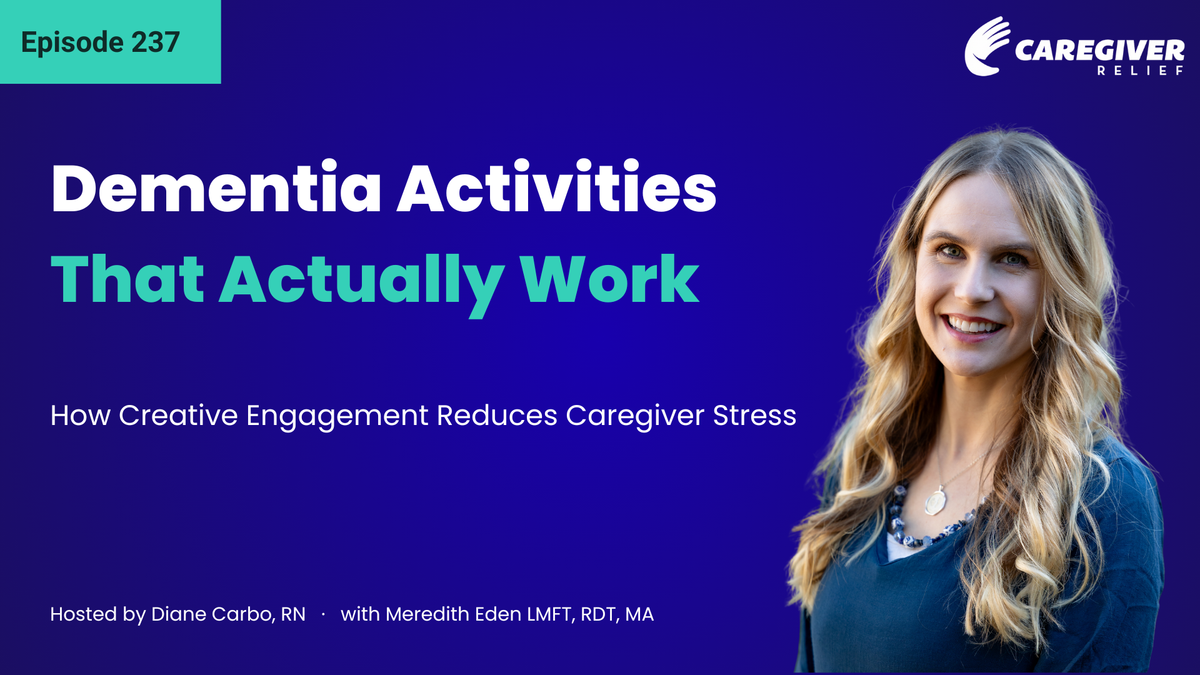
In this heartwarming and deeply practical episode of the Caregiver Relief Podcast, host Diane Carbo, RN sits down with Meredith Eden, Manager of Hummingbird Project Services! 🌸✨
Together, they break down why traditional "busywork" fails and reveal how personalized, flexible engagement can drastically reduce caregiver stress while bringing joy, purpose, and connection back into your daily routine! 🥰👇
💡 Key Takeaways & Podcast Highlights
- Filling Time vs. Meaningful Engagement ⏳Stop trying to pack the calendar! Meredith shares why scheduling rest and downtime is just as important as planning activities. Learn how to discover what truly makes your loved one feel purposeful rather than just "busy".
- The 7 Domains of Wellness 🌈Discover the holistic framework used by the Hummingbird Project to evaluate physical, spiritual, environmental, creative, and emotional needs. It gives burnt-out caregivers a tangible tool to try new engagement avenues without feeling overwhelmed!
- How to Master "The Pivot" 🔄What do you do when a tried-and-true activity fails on a random Tuesday? Learn to let go of guilt, avoid taking refusal personally, and keep flexible "Plan B, C, and D" options in your back pocket!
- Avoiding "Infantilization" & Embracing Failure-Free Roles 🎨Seniors don't want to feel like children. Discover how to introduce meditative art, adult coloring, or even playing the role of an "art critic" to encourage self-expression without the fear of failure!
- Tapping into Muscle Memory & Past Vocations 🧺Activities like folding a box of mismatched socks, sweeping, or flipping through the morning newspaper lean into lifelong routines, fostering a sense of accomplishment and productivity!
- Creative Expression Beyond Words 🎭When words fail due to aphasia or late-stage dementia, body language, facial expressions, movement, and music offer deep moments of connection.
- Virtual Engagement & Legacy Projects 💻Learn how virtual programs help seniors write books, record life review stories, build personal websites, or go on interactive virtual travel logs—giving both the senior and their caregiver continuous, tailored support!

📝 Episode Outline
- Introduction 🎙️
- Host Diane Carbo introduces the common pitfalls of standard dementia activity lists.
- Guest introduction: Meredith Eden from the Hummingbird Project.
- Reframing Dementia Engagement 🧠
- The difference between filling time and providing meaningful purpose.
- Why scheduling rest and downtime is essential for respite.
- The 7 Domains of Wellness Framework 🌿
- Being a "detective" to uncover a senior's holistic needs.
- How caregivers can use the framework without adding extra stress.
- Handling Refusal, Frustration, and Pivot Strategies 🔀
- Accepting that moods change and letting go of self-blame.
- Shifting focus to textiles, scents, and process over product.
- Dignity, Useful Roles, and Daily Routines 🧹
- Avoiding infantilization through adult-appropriate art and tasks.
- How household chores (sweeping, folding laundry) preserve dignity and usefulness.
- Communicating Beyond Words 🎶
- Utilizing gestures, music, drama, and movement when words fail.
- Using virtual programming for legacy projects, storytelling, and web design.
- 3 Simple Activities Overwhelmed Caregivers Can Try Today ⚡
- 📻 Playing favorite radio tracks or records.
- 🍽️ Elevating mealtime presentation (adding berries, using nice cups).
- 🛋️ Changing the environment (eating dinner in a different room or at the table).
🌟 3 Quick Activities You Can Try Today!
If you're feeling overwhelmed, low on energy, or short on time, try these three simple tweaks right now:
- Music & Nostalgia: 🎶 Put on an old record or play their favorite radio station.
- Elevate a Meal: 🍓 Garnish a meal with fresh berries or serve tea in a special cup to spark connection and improve nutrition!
- Switch the Environment: 🛋️ Eat dinner in a different room or at the kitchen table together instead of in front of the TV to change the mental scenery!
🔗 Connect & Resources
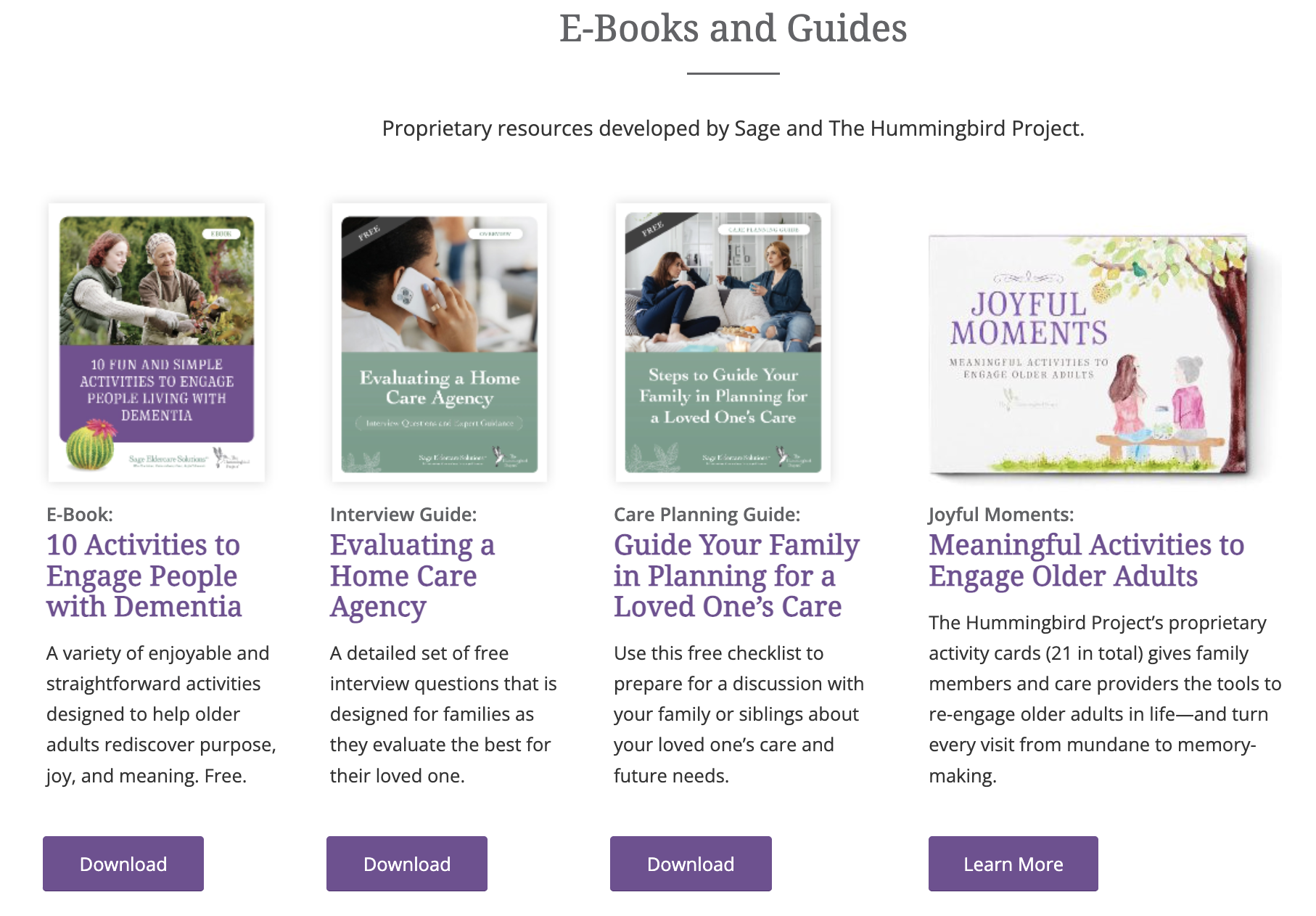
- Hummingbird Project: Visit thehummingbirdproject.net to book a free consultation or join their free Let's Get Away Together virtual series every Tuesday at 1:00 PM Pacific Time!

Podcast Episode Transcript
Diane: Welcome to the Caregiver Relief Podcast. I'm your host, Diane Carbo, RN. One of the most common questions dementia caregivers ask is, "What can I do with my loved one today? "Caregivers are often given a list of dementia activities, but many quickly discover that an activity that looks wonderful on paper does not always work in real life.
The person may refuse to participate. The instructions may be too complicated. The activity may feel childish, unfamiliar, or frustrating. The caregiver may spend more time preparing the activity than the person spends time enjoying it. Those unsuccessful attempts can leave both the caregiver and the person living with dementia feeling discouraged.
Meaningful engagement is different from merely keeping someone busy. The right activity should reflect who the person is, who they have been, what they enjoy, what they can still do, and what helps them feel safe, useful, and connected. My guest today is Meredith Eden. She's the manager of Hummingbird Project Services for its virtual and Sacramento programs.
For more than a decade, Meredith has helped lead teams of quality of life engagement specialists. I love that term. Her work uses movement, creativity, life review, script writing, familiar roles, and interactive virtual programming to create meaningful experiences for older adults. Today we will discuss dementia activities that actually work, not because there is one perfect activity for everyone, but because successful engagement is personalized, flexible, and responsive to the individual.
Meredith will also introduce us to the seven domains of wellness and explain how caregivers can use them to support the whole person.
Diane: Meredith, This is one of my favorite topics, and I'm just loving what the Hummingbird Project is about, so I was excited to be able to have you come join me today.
So welcome.
Meredith: Thank you. Thank you. It's so nice to be here.
Diane: Caregivers are often told to keep a person living with dementia active or busy. So what is the difference between simply filling time and providing meaningful engagement?
Meredith: Okay. This is such a good question. I think when we're thinking about filling time, we're thinking that is gonna be the solution to having someone feeling fulfilled, and it could be.
There is some people, just like, as we walk through life, there's some people that feel purpose and meaning and engagement with a full calendar, with having lots of social plans. they are always busy with work. Maybe if that was the way they lived their life, that would be something that's gonna be fulfilling.
But we're missing a key element here that for not, that's not for everyone. it doesn't make sense for everyone to have a full schedule. And it also changes as we age. We should be allowed to have more space, and if we're also navigating a dementia diagnosis, the idea of a full calendar doesn't always necessarily leave room for what's really needed or what's gonna give some respite.
So I think really we want to go back to the beginning around w- what, what's gonna make someone feel purposeful or engaged in the day versus feeling full in the day. I always say, and we say at Hummingbird, is schedule the rest. Schedule the downtime, because that is just as important as the activities, and we need to think about the full day, not just the activities that we want to get into the day.
Diane: I like that, schedule the rest, because, I know people just don't do that. They don't think about that, but that's just as important. And, I think of dementia activities or activities for any senior is really important to be personalized, but also, engage them in something meaningful so that there's a connection between them and the other person or the world.
So before choosing an activity, what should caregivers learn about the person's history, personality, and daily routines or even their occupation that could help give them a clue to what might, they might be like and do?
Meredith: What we use is our seven domains of wellness that you kind of alluded to and that's on our website. It's, if you really think of it as a tool, it's not a way to compartmentalize the individual. It's more of a philosophy to make sure that we're really being detectives. Are we thinking of this person as a holistic individual with different needs that are always changing?
And there's gonna be moments where someone's feeling really connected, let's say, to their spirituality. And that's a place where they're spending a lot of their day to day. They might need an ally or someone to help coach them around, what about your en- the environmental needs, or what about our physical wellness, or what about that creative side of you that we haven't tapped into in a while?
We can still connect to the spirituality side, but maybe we're coming at it from a different way and we're doing something a little bit more hands-on. So if we use the framework of the seven domains of wellness, I always feel like it's something tangible a care provider or a caregiver can hold onto.
And when we're burnt out and when we're doing a million other things like managing doctor's appointments and making sure that we still keep our house up to date, all of the things that you've already been holding, now you're adding caregiving on top of that, it's so easy to be like, "Gosh, one more thing I have to do, plan an activity for the day?"
Diane: Yeah.
Meredith: So it can give, it gives us something that we can hold onto to go, "Oh, okay, there is an area where maybe we could try something new. Maybe we try to find something in this category." and then that way we're still always trying to think of the holistic person, but you're not adding an extra job for yourself.
Diane: Oh, I like that. Why do activities that appear appropriate sometimes lead to refusal, frustration, boredom, or agitation?
Meredith: Oh, I love this question. And I also, I just, I have so much empathy for this question because even as someone who's doing this all the time, going in and gosh, the flower arranging activity has worked every single week for three months.
We do it once a month. It's something that she loves, and it's the tried and true. All of a sudden you go in on a random Tuesday and the flower arranging is not interesting. It's no, it's something that's unexpected. I... what? This always seems to work. The pivot. The pivot is key. To not take it personally
I think is always the hardest thing, especially when you're connected and you have, we wanna do well. Yeah. We want someone to feel engaged. Gosh, all of a sudden this isn't working, it must have been me. I must have not presented it well or I must... To let go of all of that, that sometimes it's just not gonna work.
Diane: Yeah.
Meredith: There's days where I don't wanna do something that I love to do. And I think giving yourself that space to feel it's okay, and to have that pivot, to have your other things in your back pocket, it might not look the way we had planned it to look, but you know what? Let's go for a drive instead.
Let's go for a walk. You know what? I'm gonna put on some relaxing music for a minute, John, until we can, until we can go to the doctor's appointment later. Whatever the thing is, having something in your back pocket that's a little maybe more passive, but is still something that can feel, like it's a transitional to something new.
So you don't have to feel like all of a sudden everything I had just planned is not working today.
Diane: Yeah. Always have a plan B.
Meredith: And C and D and all of the alphabet.
Diane: Yeah. Oh, yeah. Especially when you're dealing with seniors. I don't care if you're a well senior or a person with dementia, you know, when we just get in our mood sometimes, and we have a right to.
We've been around a long time. And, if I like something, One thing I learned the other day is for me, I was watching a turtle, a box turtle. He was in outside and, on the patio, and with a dog, and Maddie goes over and sniffs and I tell her to get away, and this turtle takes off, and I've never seen a turtle do this.
He burrowed into the garden mulch. And he hid in there so he, she couldn't find him. And I had never seen that, and all of a sudden I thought, "I need to learn about turtles."
Meredith: You're like, "Here's another direction I can go." Oh, exactly. Just follow the interests. There's so much
Diane: Yes
Meredith: so many different things out there.
And that's a good point actually, because We have someone, sometimes we start with clients and it's very structured on how we're introduced.
Diane: Yeah.
Meredith: We're introduced as someone who's going to help you relive your travels, or someone who's going to help you write your book. Someone who, is also interested in trains.
Whatever the interest in, that's just the opening.
Diane: Yes.
Meredith: And then we're always listening and looking for the moments where we can expand or to connect to a part of someone who, "Gosh, I haven't thought about this since I was in college." those kind of conversations are always fun to re-ex- discover.
Or someone who, let's say, has a really long career in art and they always did pastels or watercolor.
All of a sudden now wouldn't it be interesting to learn more about sculpture work? Because all of a sudden now we're not comparing ourselves to what we used to do. yeah. We're also able to express our creativity in a way that is a little less,
It could be failure-free in the way that it's approached because it could be more focusing on the textile and the feel of it and the exploration of something new, instead of us feeling like we have to compare our art pieces that were on the wall that we had done 10, 15 years ago.
Art's gonna always transition, and that's the same in any career. Anything you did, you might want to interact with it in a different way later on.
Diane: Yeah. Well, I find some seniors are hesitant to do, try something new. They have this in the back of their head, "I don't do, art very well."
Well, you know, how do you know? And it doesn't have to be perfect. And, they don't even want to go to the paint by number, things that they have at the stores, where you paint. and I'm thinking, relax and enjoy, you know?
Meredith: I go- That brings up so many points for me that I think this is also- This is the thing.
We don't get the clients, and usually people seeking out, it's not, they're not seeking it out when the person is going to the community center
Diane: Yeah
Meredith: and engaging in activities and has a robust social network. We typically see the clients seeking and asking for support when there isn't those things in place.
Diane: Yes.
Meredith: And so resistance and apathy and maybe a dementia diagnosis and depression, anxiety are kind of showing up. And then how do we then bring in a kind of can counterbalance that, that those things that you're saying. It's "Oh, I've never done art." It's like, yes, we've never done art, so the in might not be art.
That's not where we're going to start.
Diane: Yeah.
Meredith: What I always say is like people have opinions. opinions are everywhere
Diane: Absolutely.
Meredith: You know, let's look at art and share with me if you like this type of art. Is this and I always say, let's lean into when they don't like it. we take for granted the good opinions and we always discount the negative opinions, but
Diane: Yes
Meredith: I think we need to foster sometimes that, is like, if that's the way that someone's feeling confident and comfortable to share yes. it's not about their care needs, it's about art. So let them express those things in the, through the art and get that out of them. "Oh, I hate this piece. Gosh, this is awful art." Yeah, tell me more about it. what don't you like about this piece? Because they're sharing and they're engaging, and that's the that's the whole point. The
Diane: Yeah
Meredith: point isn't to go sell a piece of art on, in an art gallery.
It's to express themselves, and expression doesn't have to be a paintbrush on a piece of paper. It could be you're an art critic, and let's experience being an art critic. That's a new role for you. Let's see how that goes.
Diane: That would be something that some I could see some people enjoying, But just, the, you were talking about the different textiles and the feels and stuff and, I'd even be I have fun with, little kids doing finger art and stuff, painting and finger painting. And, I know, seniors see that as a, childish thing, but I see it as something fun.
I love bright colors, so anything you want to see, I, want to do is going to be bright. You're going to have to wear sunglasses to look at it.
Meredith: Yeah, you're talking about, infantilization, which is, real. Like
Diane: Yeah
Meredith: we never wanna bring in something that's gonna make someone feel infantilized.
Diane: Exactly,
Meredith: Yeah. And where we can kinda lean, and where the listeners can lean into is the research behind adult coloring and adult meditation. There's so many... There's so much new, and this is actually a field that's just continuously expanding
Diane: Yeah
Meredith: around, there's so much scientific backing and research around doing meditative art as an older person, because we're doing it more for process versus product.
And if someone is more, connected to that side of things, like, "Oh, I don't do that," or, "What's the point?" Actually giving someone an article about how it could be beneficial to help cut down on anxiety, depression, isolation, those type of things, that might also be an in, is just the science alone.
Is, okay, a prescribed art. We have a couple clients who are prescribed, right? The self-prescribed, but they self-prescribe them, every day I'm gonna do a doodle. And just doing that every morning has helped. And they may even take a picture of the doodle and send it to a friend.
Diane: Yeah.
Meredith: Or they send it to us, and there is then that moment of connection and that accountability, and that can sometimes be a way to make it feel less, oh gosh, I'm I have a coloring book."
Is that's not the goal. The goal is to sit down, maybe put some nice music on, and do it as a process.
Diane: Yeah
Meredith: And then share that, share on that process if that's the piece that feels, that social element of it would feel, supportive.
Diane: I like that, putting the music on and feeling, you know, going through the process, because that's so much music can help us too to relax and calm down and maybe connect with ourselves, and that's important. I just had a friend tell me they took up bonsai trees. And I thought, wow, that, that to me is, that's really a commitment, but it's also a way to learn about, bonsai, and it's good for your cognitive status, and it's good for you to just figure out how to not kill that tree and keep it small.
Meredith: Right, yeah. the spectrum there is quite large, right? Like how to engage in, just outside nature, but then also the in could be meditative, but it can also be like being in the dirt again and touching sand. And so for someone who, let's say they were a gardener, or they always kept a lawn and now they're in an assisted living, or they're in a memory unit, or gosh, even a SNF unit. They're not
Diane: Yeah
Meredith: having access to that outside in the same way. So we have to be really intentional around the way that we bring that in to them to make it an in, to make it, accessible and to make it feel like there's...
The, what's the important piece of it? It might not be the actual flowers or planting. It could be something else. So we're really just trying to get to the root of why that was an important hobby or why that was something that was meaningful. And that sometimes takes time, and we go back to what we said in the very beginning, give yourself all the credit for trying.
'Cause if you're just being a detective and you're putting your curiosity hat on, you're ahead of the game when you're trying to engage with your loved one.
Diane: Yeah. And, it's important that your loved one feel useful or needed or productive, even if they have dementia. So it's nice to present them with opportunities where they can experience those feelings or emotions.
And I know people feel challenged many times because, especially in the early parts of dementia, the, individual that's, been recently diagnosed or has not been diagnosed yet, they have a hard time initiating something. So you may have to encourage them and think of things for them.
You know, I, did they play music? Do they still want to play music? Do they want to learn a new instrument? that's a whole not her ballgame, and I have people that are starting I just did a, podcast with a young woman who works with seniors, teaching them to play the violin. And I was so fascinated by that.
And she has a 90-some-year-old man that she's known since she was 12 years old that they play together. She taught him and worked with him all of her life and he's still playing, and he does shows at the local. He's a caregiver for his wife now, so he's not as active, but he actually does presentations at the local JCs or whatever, you know, clubs.
So I thought that was pretty impressive.
Meredith: Yeah. And just exactly, like reengaging into the community in a different way.
Diane: Yeah.
Meredith: And sometimes you need support, and sometimes you then, if you're the caregiver Get, letting yourself have those moments where you also learn something new and you also are engaging in life, I think it makes us better caregivers when we're able
Diane: Yeah
Meredith: to have our own hobbies, our own interests, however small. Like, setting some time aside for yourself, because right, like that old saying, put your osc- oxygen mask on first, like it's so real. When I've had some, and I'm in the sandwich generation currently where taking care of young children while also helping support, the generations above is, you got no...
Either way, we're showing up for someone else, and when you show up for other people, it can deplete. And so when you're taking those carved moments, however small, putting your favorite songs on in the car when you're driving around, or, scheduling a time where you're gonna have a mocktail.
You might not have the cocktail anymore, but you're gonna have that mocktail. Like those moments that you can carve away for yourself even if you can't actually physically step away.
Diane: Yeah.
Meredith: We always talk about that. And sometimes you physically can't leave. It's a safety concern, right?
Diane: Absolutely.
Meredith: But how you can create the environment to still feel like you're getting respite in the moment.
Diane: Yeah.
Meredith: And it could be that, gosh, we're gonna eat dinner in a different room tonight. We do the same thing every day, and sometimes the monotony, yes, it's easy. It's, you're just doing it. you're in the mode.
It's survival. Whereas if you step out of that environment and go into a different room, it's gonna change your thinking. It's gonna change the way that you navigated the day. Hey, you might even end up asking or it, it might help open a window into your loved one where you are feeling more connected
Diane: Yeah
Meredith: in a different way. So the environment is one of those domains that I feel like sometimes gets overlooked. and it could be a big game changer.
Diane: Yeah. I had a client, she was going blind, and her husband had, the middle was in the middle stages of dementia, and he had lost his ability to communicate verbally.
He had, he was like Jim Carrey. He had a very expressive face, so you knew what he was thinking. And she loved to bake. and cook. And every day she would bake something, cookies or whatever. She included him in it. He, she would give him the flour, he would put it in the bowl. He, she would make him mix.
She had a hand, she had a big, Kitchen Aid mixer, but she made him hand-mix everything, and he loved it because they were doing things together. And, another activity that she used to have him do is sweep the floor with a broom. Because it, their floors were not carpeted, they were, wood floors.
So she and he just would walk around the house sweeping. He, it made him feel productive. And I know, I have, I've worked in senior behavioral health, and we always have the little old ladies, especially the ones from different countries, that they, cleaning is their thing all day long. They're cooking, cleaning, doing laundry, and making sure that everything's running, the household's running.
And, they want to go around and they want to clean. So you give them a rag and let them do whatever they want. And families would get so upset about that. "Why, she's not meant to clean here. She's" You know what? It made her feel productive.
And I was a director of nursing of, an assisted living and we had a memory care unit, and one of the activities, that we did often for some of the older women in the middle stages of dementia was have them fold clothes.
Meredith: Yes. That's what I was thinking, is
Diane: Yeah
Meredith: give a big box of socks that are mismatched.
Diane: Yeah.
Meredith: Give some shirts and towels. I mean, it's that muscle memory, and how nice does it feel to sometimes be like, "Gosh, I just did such a good job on something."
Diane: Yeah.
Meredith: And that's the feeling. That's the feeling of being able to be the structure, right?
We have to present it in a way that I think is honoring, is, "Oh, gosh, Jenny, I need some help with this. We have all this extra laundry. If you're not doing anything, do you mind helping me for a little bit?"
Diane: Yep.
Meredith: And all of a sudden you've enrolled someone as a helper. You've not then, there's an empowerment to that way that it's being presented that I think's really important, that goes very similar. They're almost hand-in-hand with in, not infantilizing. You're really, it's about the way that it's being brought in.
Diane: Yes.
Meredith: And that could be the moment that it makes it successful.
Diane: Yeah, and caregivers often don't, family caregivers don't often consider that as a thing that they should be allowing their family member to do, when in fact it's something they've done their whole life.
You know, they have cooked for the family, they have, they've always kept a nice house and kept things nice and, they're. So it's okay. I had one little lady, she was so cute, and all she wanted to do was go around and wash windows. And she didn't have the process. All she did was wipe, with a rag.
So she went around all, you know how, in the, in the hospital units every room has a window in it. She would just go up the hallway and just clean everybody's window, and it made her happy. And she would, when she was bored she would act out, so it gave her something. And, it, people would go, "Oh, thank you."
Or one of the staff members would say, "Hey, would you like to..." And they'd bring her into the activities room, and there were a lot of windows in the activities room, and we would try to get her to do another activity, but if that didn't work, she would go right back to her, her washing the window. But, you know, people don't understand that is also an activity.
It's not a negative thing. It's just something that they're used to doing.
Meredith: Exact- And it's like going, it's not fighting against the vocational side. And vocation looks so different depending on the person.
Diane: Yeah.
Meredith: And so it's again, it goes back to who are we talking about? What's appropriate for someone might not be appropriate for someone else.
Diane: Yeah.
Meredith: The way that we introduce, I think makes a big difference. And then also I think giving some space for it to fail. I mean, it might not be that she's going to wash them in the same way, or she might not be the newspaper is a good example of this, is gosh, Mom took the newspaper her whole life, but now she's not reading it.
Should we still take the newspaper? I'm like, do not fix... don't break what's not broken. Like
Diane: Yeah
Meredith: give her the newspaper. Put it in front of her. "Mom, got your coffee, your newspaper. Okay, I'll come back in a minute." Because even if we're just leafing through the pages, there's again, that muscle memory, that feeling of accomplishment. It's the routine and the ritual of it.
Diane: Yes.
Meredith: It might not even be the words. So still having books and items in front of them, and then not, we never wanna test or we never want to come up against the moment of discomfort. "Mom, what did you read today?" That's not necessarily the question we wanna come to.
Diane: Yes.
Meredith: "How was the paper today, Mom?"
Diane: Yeah. "
Meredith: Anything interesting?" You wanna keep it open-ended. You wanna keep it feeling like it's gonna still be a supportive engagement versus testing and feeling like there has to be a quiz at the end of reading the book or looking at the paper
Diane: Yeah
Meredith: or watching the documentary, whatever the activity is that you set up.
Diane: Yeah. Now you use movement, drama, script writing, and creative expression in your work, with the Hummingbird Project. Can you give us an example how these approaches can engage a person who has difficulty communicating?
Meredith: Yeah.
I think for us, communication looks so different, and this is a good maybe philosophy to adopt, if you haven't thought this way about it, is using our words is one way of communicating. And at The Hummingbird, we think, great, if we can use words to communicate, but sometimes words fail us.
Sometimes words aren't quite what we're trying to say. Aphasia is something that we sometimes are navigating. And so using language and this, and speaking as one way in, but body language and facial expression that you mentioned earlier are sometimes much more true to what they're actually feeling.
Diane: Yeah.
Meredith: And so someone telling me they don't wanna do art as they're curiously looking at what I'm doing, and holding the pen, and poking around at my materials, to me that's an in.
Diane: Yeah.
Meredith: They might be telling me, "No, I don't do art," or, "Oh, I don't dance," but if all of a sudden every time we go through the coffee shop I see shoulders kind of bobbing, or if we're in the car and I always hear like a humming along- I'm gonna lean, I'm gonna lean into that. I'm never gonna bring up, "Oh, you're singing now." I'm just gonna go with the moment. I'm gonna go with what we're giving. It's an offering. There's an offering
Diane: Yeah
Meredith: and there's a moment of connection, and we're gonna lean into it and see where it takes us.
And so something like movement or dance and art that historically sometimes make people feel very, closed off we're gonna use the actual behaviors as the in, and the gestures and the moments, instead of the language, where sometimes language gets in our way.
Diane: Yes, it really does.
I wanna talk about script writing, 'cause you, talk about script writing for life review. How can storytelling help a person with dementia reconnect with their identity and life experiences?
Meredith: Oh, in so many ways. And this is a great way to talk about our in person but also our virtual programming
Diane: Yes
Meredith: because this has been something that has been very successful virtually. Getting someone in front of the computer and having just natural conversations and being able to look in one place, and they can see the words, they can see it all kinda coming together has been a great way to kinda help the focus.
Whereas maybe dementia is starting to make it difficult for that executive functioning or keeping the project moving forward, if they can just come on and answer a question today, as open-ended as it is, or pull up a photo of their loved one and we just reminisce about this moment then they're in process, they're in conversation, they're in connection.
They're not worrying about the actual writing process.
Diane: Yeah.
Meredith: Leave that to the person who's organizing that side of things. So whether you're working with an organization like Hummingbird to help write a legacy project, or you're a loved one trying to help someone write their legacy project, I think it's really about how to make it bite size and tangible.
Diane: Yeah.
Meredith: And that's what we're always trying to do is it's about the experience because
Diane: Yeah
Meredith: then it's twofold. You got to have a great hour of a visit with a friend.
Diane: Yeah. Yeah.
Meredith: You got to maybe learn something new or move a muscle in your body or your brain that you weren't, that you hadn't been doing.
They might leave with a thought or an idea, even if it's very, general. Today, try to go outside for a minute and reminisce about being outside and things you liked to do outside as a child. so it's planting a seed for things that are not necessarily homework, but something you hope will linger into the rest of the day. And when it comes to the actual engagement and writing process, you're able to then have that as a finished product if that's something that the family's interested in. But that's kind of a byproduct of having good engagement, good experiences, good days, good weeks.
A good hour can make a huge difference in someone's life. Because what we're noticing, and what I've noticed over the last 10 years, is even with someone with later stage dementia, they might not be able to tell their husband everything that we talked about eating lunch, 'cause they were
Diane: Yeah
Meredith: they were out and about, and they were physically out in the community, or they were physically doing something. Or we woke up a side or a conversation sparked a memory that's gonna put a pep in the step. And not being able to tangibly say what it is, but those are those things that are kind of in the air, and how we can maybe just move the needle a little bit towards joy
Diane: Yeah
Meredith: could make a big difference for someone.
Diane: Tell us about the Hummingbird Project. talk how, what does the pr- virtual program look like?
Meredith: So the virtual program, I mean, really, like even our in person, is it's all about first talking with the responsible party or the loved one around, "Hey, what historically has your mom or dad or husband or wife or partner been interested in?"
We kind of get a baseline. and then explaining more about the program to decide together if it's a good fit. In person it would be setting up programming where we would be going out into the community or coming into the home and providing that tailored engagement from start to finish.
So if we're the ones recommending an art experience or an outing to the museum, we're then also the ones carrying out that, and we're carrying that out over the weeks, over the months, over the years to have that consistency and continuity of care and to be able to then adapt that as someone ages and as maybe a prognosis is gonna change.
So we are following someone through their journey from start to finish, and I think that's a powerful, approach because they're not then. One person's not recommending and then someone else is trying to decide if it's working or not. From start to finish, it's really part of the program, and it's really created around them.
And the virtual is just an extension of that. Either they're in person and it's another touch point throughout the week. it can also be a way to help coach or support a paid caregiver- ... or even a loved one around, "Gosh, I don't know what to do in the afternoons. The afternoons are so much harder."
Diane: Yeah.
Meredith: Maybe we come in and we do a virtual session with a care provider on getting us back into that mindset that's productive, or moving that needle that we were talking about and then leaving, leaving a project that they could do- or having some accountability for the next week.
"Oh, were you guys able to finish the model car that we started last week?" It gives that paid caregiver or that support person a little bit, of an outside consultation person to kind of bounce ideas back off of. But if we have our standalone virtual clients very similar to the Hummingbird in-person sessions they look so different.
So we have some clients that we're designing websites for and with because they really wanna still participate in their writing, or they've got, right, going back to those opinions, a lot of opinions they want to share. It's a great outlet for still feeling connected to the outside world in a more tangible way, if we're in an assisted living or if we're in maybe a rural area where there is not that community setting.
So doing, websites, writing books is, I think, an easy one to suggest right off the bat because a loved one can understand what that is. Like, why am I meeting with this person? Oh, we're gathering, your great stories. I want this for the grandkids. This is so important that the kids have these stories, and that could be a great in.
Someone who's traveled their whole life and due to circumstances are not traveling anymore, I say instead of, "Oh, we don't want to talk about that because that's a sad, because we're not doing it," I'm like, how can we redirect that, that it's something that's empowering? It's like, we might not be doing that, but I've never been to Japan.
Can you tell me about what it was like to be in Japan?
Diane: Yeah.
Meredith: And be curious and, there's so many travel log and travel, webinars, and YouTube is even a great resource for this, where you can pull up travel experiences. What sometimes that's missing for the person is the interconnection ness.
So if I'm watching a video, I could easily be distracted or not feel
Diane: Yeah
Meredith: connected to it because it's over there. It's a video. I didn't go to that place. I didn't see that one spot. Oh, wait, what did she say again? Whereas if we can slow it down and make it curated for the person, then we bring up Spain, and somehow in Spain, we, they, we start talking about baskets, and now we go off on the baskets and that's, oh gosh, no, but there was this one store.
Can we find that one store and find that one basket? And we're gonna then go down that pathway. So I think that's the journey. That's really the travel log when we talk about travel logs. It's not going to this one place and doing this one thing. It's how can we make the trip similar to how you would've traveled, and everyone's traveled so differently.
Diane: Yes.
Meredith: And so that's the virtual program that, that's really just not out there that I've seen, is that it could really follow a pathway. You know- And lifelong learning. I just think lifelong learning Oh,
Diane: Absolutely. And we have such-
Meredith: The last component
Diane: senior isolation and, depression is very real, and because there's lack of connectedness.
And what a wonderful program to have for those that, are still able to live alone and have interaction with others if they have limited interaction with people during the week. So I just love this platform, and it can be so helpful. The other thing I love is caregivers never feel supported And I can see how, a caregiver would just love to have somebody guide them as they're caring for their loved one, to help them maybe connect on a different level, with support and help from people that know how to do that.
So I really, I really like that. There's so many, things. And we are going to double our senior market in the next four or five years. The oldest of the baby boomers are gonna hit 80, and the youngest of the baby boomers are gonna hit 65 and start retiring. So that's why I think the Hummingbird Project is so important, because, there's so many seniors that are going to need to reach out.
We don't have enough youth to support our seniors, and our seniors are going to have to find, ways to look for, seek support and on a lot of different levels. Social, physical, emotional, and spiritual wellbeing will be very different because, we lack the physical support. And I just love this program, so thank you so much for sharing it.
If there's one thing that, an overwhelmed caregiver who has very little time, money, or energy, what are three simple activities they may want to try today?
Meredith: Oh, that's a good question. Well, I think we can kind of use it as our summary because
Diane: Yeah
Meredith: we talked about some really good ones today.
Diane: Yeah.
Meredith: I think that music, we know, in practice but also in research that music is just such a good in. So putting on a, the radio even. So even if we don't have access to streaming services, just putting on a radio or an old record, is a good, good one to start.
Diane: Yeah.
Meredith: I think, food. Food is something that's a basic need.
Diane: Yeah.
Meredith: We're all eating. Most of us are eating.
Diane: Yeah.
Meredith: most of us are, not all of us but most
Diane: And you're talking my language there, girl.
Meredith: Yeah, right? It's and so use what you're already doing and just
Diane: Yeah
Meredith: elevate it. So maybe it's
Diane: Yeah
Meredith: eating but presenting it in a little different way.
Diane: Yeah.
Meredith: Putting, making sure the plating of it is nice and that's quality of life. Like that's-
Diane: Yeah
Meredith: different between eating a bland porridge
Diane: Yes
Meredith: to putting maybe a couple berries on it or a little flower- Yes ... or using the different cups
Diane: Yeah
Meredith: could really just spark someone. And it, and then at the same time, it's helping with nutrition.
Diane: And I love the idea of eating a meal in a different room. if you're at home all the time, people sometimes are, don't even sit in their kitchens anymore. They actually sit in front of the TV. So, you know, maybe we go into the kitchen and sit.
Meredith: Yeah, we actually sit at our table.
Diane: and have a conversation, while we're, while we're eating.
I mean, there's so many things. And I want my listeners to know that seniors are more likely to eat more and eat better when they have interactions with others around them versus eating alone.
Meredith: So- 100%, yeah. So even if you're not hungry, put a snack in front of you, too, and all of a sudden now
Diane: Exactly ...
Meredith: it's an activity, and it's so true.
And we just tend to pick it up and not be,
Diane: Yes
Meredith: thinking about it as much.
Diane: Yes. So true. Exactly. Well, I thank you so much for your time today, Meredith. I've been waiting for this for a long time. I wanted to share The Hummingbird Project with my listeners because it is definitely activities are one of the most overlooked, tools in a toolkit that you can use with your seniors, whether they have dementia or not.
And, that's really awesome that you have a, I love the virtual Plan program for those that, even a senior who lives alone can reach out and say, "Help me. "I love the creating websites. That's awesome with their stories. that blew me away. I have to tell you shocked me, 'cause I'm thinking, "Wow."
But, you know, there are seniors that are doing, Wow ... want to write, and they want to be active, and they want to be in the know. some of them want to be the cool grandparent. So I can see them getting into building a web page or writing for a web page. that's really cool. So thank you so much for your time today.
I appreciate you.
Meredith: and I always say, too, why not try? And we also do, I do free consultations. So if someone's like, I don't know," we just talk it out at first and see if it's a good fit. So everyone's always welcome to reach out via our website, and I'll be connected, as a virtual
Diane: Tell them how to reach, how to find you.
Meredith: So we're thehummingbirdproject.net, and you can reach us out. And Diane, I'm pretty sure you'll put that information under the
Diane: It's gonna be on the
Meredith: Yes
Diane: on the page
Meredith: I create.
Diane: Yeah So
Meredith: an easy clickable that you can click and find us there.
Diane: Yes.
Meredith: That's the best way to reach us, through that. We also have, a pretty updated resource page where there's, our free Let's Get Away Together series that we host, almost every Tuesday, 1:00 Pacific time, and that's a great thing that people can try out, if they're interested or just want to see what the virtual world is all about, if it's their first time kind of going into that world, first time Zoom. and then, from there they can always, schedule that consultation with me.
Diane: Great. Well, thank you again for your time. To my family caregivers out there, you are the most important part of the caregiving equation.
Without you, it all falls apart. So please learn to be gentle with yourself. Practice self-care every day, because you are worth it.
Caring for a loved one can be overwhelming — but you're not alone. If you have questions, big or small, our expert team is here to help.
👉 Click here to Ask the Expert
Our Resource section can help you find the information and tools that you need. We have courses, videos, checklists, guidebooks, cheat sheets, how-to guides and more.
You can get started by clicking on the link below. We know that taking care of a loved one is hard work, but with our help you can get the support that you need.
Click here to go to Resource Section now!