Caregiver Costs and Burnout: New Survey Reveals the Hidden Crisis of Unpaid Family Care with Mica Phillips - Episode 243
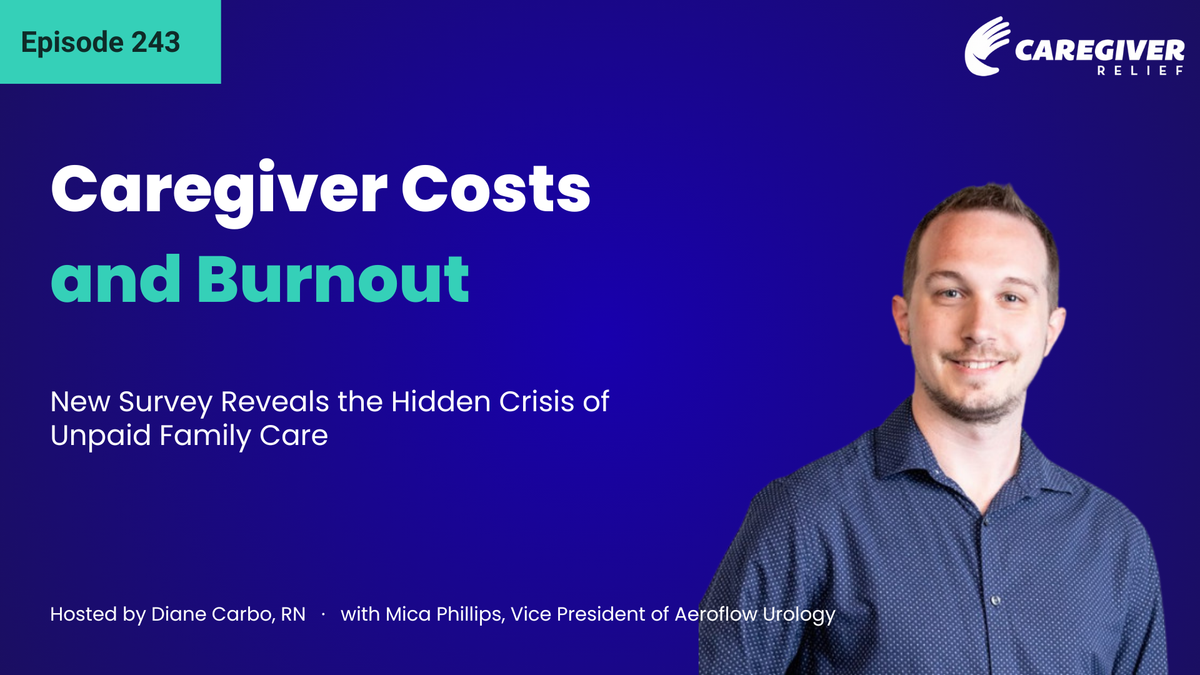
In this episode of The Caregiver Relief Podcast, host Diane Carbo, RN, sits down with Mica Phillips, Vice President of Aeroflow Urology, to dissect a eye-opening new survey revealing the true physical, emotional, and financial costs absorbing unpaid family care.
From hidden over-the-counter costs like $500 monthly incontinence supplies to missing income from reduced work hours, the journey of a caregiver is rarely short-term. Tune in to discover why 90% of caregivers experience mental health struggles, how to navigate insurance for critical medical supplies, and how to build a support team so you don't have to do it alone. 🎧✨
Key Highlights & Episode Outline 📌
- Introduction to the Caregiver Crisis 🎙️
- Host Diane Carbo highlights the stark realities of unpaid family caregiving.
- Key findings from the Aeroflow Urology survey reveal that 77% of caregivers feel financially overwhelmed and 90% report stress, anxiety, or depression.
- The Reality of Long-Term Care ⏳
- Guest Mica Phillips explains why Aeroflow shifted focus to supporting the caregiver ecosystem.
- A shocking 73% of caregivers provide unpaid care for over five years, turning care into a permanent lifestyle shift.
- Over 63 million family caregivers provide $1.1 trillion in unpaid care annually, often risking their own health in the process.


- The Hidden Financial Costs & Supply Expenses 💸
- Beyond medical bills, hidden costs include specialized food, home modifications, utilities, and transportation.
- One in four caregivers spends more than $500/month out-of-pocket on over-the-counter care supplies, especially incontinence items.
- Over half (57%) of caregivers reduced work hours, and 11% quit entirely—severely impacting future Social Security and retirement benefits.

- Mental Health, Doctor Visits, & Preventable Complications 🩺
- Systemic gaps leave 90% of caregivers suffering mental health strain with little support from overworked doctors during 15-minute visits.
- Diane and Mica share tips on recording visits or checking AI patient portal transcripts to track care plans.
- Using cheap or improper supplies leads to serious complications like pressure ulcers and UTIs, a major cause of senior hospitalizations.
 Terms and Conditions
- Navigating Insurance & Aeroflow Resources 📑
- Many families don't realize secondary Medicaid plans often cover incontinence supplies.
- How caregivers can work with physicians on letters of medical necessity to overturn insurance denials.
- How Aeroflow Urology simplifies supply reordering, tracks benefit schedules nationwide, and connects families with resources.
Caregivers should not have to carry their stories in silence. Share your caregiver story with Caregiver Relief and help another family caregiver feel seen, heard, and less alone.
Listen to the Full Episode 🎧 Don't navigate this journey alone! Click play on the audio player above to hear the full conversation and gain actionable steps to protect your finances, health, and peace of mind.
Podcast Episode Transcript
Diane: Welcome to the Caregiver Relief podcast. I'm Diane Carbo, RN, your host. Today we are talking about something millions of families are experiencing, but too few people fully understand the true cost of unpaid family caregiving.
Caregivers are often described as strong, devoted, and selfless, but what we do not talk about enough is the financial cost, the emotional strain, the physical exhaustion, and the hidden expenses that come with caring for someone at home. A new survey from Uroflow Urology reveals just how serious this crisis has become. According to the survey, 77% of caregivers report being financially overwhelmed by the cost of caregiving.
More than half have had to reduce their work hours, and one in four caregivers spend more than $500 a month on caregiving supplies. The survey also found that 90 percent of caregivers experience stress, anxiety, or depression, and 89% wish more assistance and resources were provided by their doctors.
Joining me today is Mica Phillips, Vice President of Arroflow Urology. Mica has spent more than 10 years with Arroflow Health and has worked closely with families navigating insurance, incontinence supplies, and access to care. His mission is to help simplify a system that often feels overwhelming for patients and caregivers.
Today we're going to talk about what this survey reveals, Why caregiver costs are reaching a breaking point, and what families need in order to safely care for their loved ones at home without losing themselves in the process.
Diane: Mica, thank you so much for joining me today.
I really appreciate it. Before we get started, can you tell us a little bit about what led you to, join, focus on this, study?
Mica: Yeah, absolutely. As you said, having worked in direct patient care and helping get, people supplies through their insurance for 10 years, we have always considered ourselves, for a medical supplier, being one of the most attuned to who our customers are, who our patients are.
We often refer to our customers as patients in recognition of the fact of how many complex medical issues they're dealing with.
And so we've always prided ourselves on having a deep understanding of who our patients are, but it's only in recent years that we have recognized that just as much as our patients are who we're supporting their support system as well by the services that we're providing to those that are our actual patients.
And so we set out and said, "Let's understand and be just as much of a resource to those who are like us, taking part in the care of people experiencing incontinence issues, and help be a resource to them as well, more than we already are beyond just providing those supplies to their loved ones." So I've really been incredibly heartened by the response that we've gotten to this survey so far, and I think it's gonna lead to a great deal more focus on us understanding and digging into the support that we can offer to caregivers.
Diane: Now when you reviewed the results, what findings stood out to you the most?
Mica: I think by far the thing that struck me the most was that 73% of caregivers are providing unpaid care for more than five years. I think a lot of times when we think about caregiving, we think about recovery from acute illness, post hospitalization, things like that.
I even working in this industry for a long time was surprised that many are caring for more than five years. And I mean that, that is not a short-term disruption, that's a long-term lifestyle shift that forces a caregiver to reevaluate everything in their life from their employment, to their housing setup, to their monthly expenses, long-term budget planning.
It was amazing to me that many people reported that long of a caregiving period.
Diane: I want my listeners to understand there are 63 million family caregivers out there today, and they provide $1.1 trillion in unpaid care a year. And 63% of them become seriously ill or die before the person they're caring for because of all the stress.
And people think that when they start caregiving, it's just going to be a short-term thing, and the average journey is five years, but some are so much longer. And if you're shorter, you're blessed because the five years are, as you said, becomes a lifestyle change in so many ways.
Now, the survey found that 77% of caregivers, are financially overwhelmed by the cost of caregiving. What are some of the expenses families are struggling with most?
Mica: I think a lot of people think about the, the normal medical costs, so to speak, the actual doctor bills, the co-pays, the prescriptions, any sort of larger bill resulting from a hospitalization, from a home health episode.
But people forget about increased or different grocery costs, specialized transportation, home safety modifications, increased utility bills from laundry and running medical equipment. With an average household income under 75,000 a year, it doesn't take a lot of extra expense to really significantly shift the balance of financial wellbeing in a household.
And so if even one or two of those things become true because of your specific caregiving expense, it can, really shake things up in a way that is very difficult for people to bear.
Diane: That, you know, I want my listeners to understand that Medicare has moved to a cost sharing plan platform, so everything is going to be, what, whatever you need is going to, require you privately paying for things.
Right now we have Medicare Advantage plans that if you're in skilled care or rehab, are charging 200 to $400 a day co-pay, which nobody can, afford that just for rehab, and we're supposed to be able to have coverage for 90 days. So you're telling me about, a side of the caregiving that I did not have the information about as far as the amount of money they are spending out for products and stuff.
I didn't look at it that way, but you have a lot of things. So I want to talk about the,Oh, the one in four spending more than $500 a month caregiving supplies, that shocked me. What kinds of supplies are often overlooked when people talk about the cost of care?
Mica: So broadly, I think anything what I'd call over the counter gets overlooked, right?
Diane: Yeah.
Mica: If you can go down to CVS or you can go to a big box store and purchase something, people, a lot of times I don't think they even think of it necessarily as a medical supply. It's just a, it's a thing that you need to buy when you buy all your groceries and everything else.
Diane: Yep.
Mica: People don't realize what diapers and incontinence products [00:08:00] and underpads for chairs and beds, gloves for changing, skin protecting creams, cleansing wipes, ointments, any of those kind of things, people don't realize how quickly the cost of those items adds up.
It's not unusual to spend $500 a month for someone who's chronically incontinent as a result of chronic illness or, dementia, things like that. And I think people, they think about, "Oh, it's..." You go to the store and you spend 20 or $25, but when you're doing that every couple of days, or you're doing that times three every two weeks, it really adds up quickly.
And in many cases, unfortunately, those conditions are only liable to worsen as people age or as their chronic illness becomes more advanced. And so that cost can just go on indefinitely, unfortunately.
Diane: How do incontinence supplies affect a caregiver's daily routine, stress level, and financial burden?
Mica: I think the first and foremost effect that incontinence has it's a condition with a lot of shame around it, right?
I think for both the person experiencing it as well as the person who's caring for a parent, a sibling, a child, whoever that may be, who's dealing with, an inability to control your bodily functions. I think there's a huge psychological toll to that. I think that even just from a logistical standpoint, working with a person who may be cognitively impaired, who may be in a wheelchair, who may be bed bound, who may, experience episodes of confusion, those episodes of confusion often taking place at night.
If the actual act of changing a product itself, leaving aside the psychological toll, is physically exhausting, leading to sleep fragmentation for the caregiver in many cases. you're worrying about skin breakdown. You're worrying about, am I getting that product changed often enough? it's a very draining activity for everybody involved
Diane: And I will tell you, so many family caregivers have, feel very challenged and very uncomfortable when they start dealing with incontinence, and, they have a hard time.
And the other issue is, they have no idea what products to get, what product... And when you talk about skincare, most of them don't even know that they should be worried about skincare and protectants and stuff. I understand that's really a big challenge. As a care... I've done home care, I've been a care manager, and I think one of the biggest things that I find challenging right now is our healthcare system, is putting more and more pressure on the family caregiver, to do procedures, wound cares, ostomy care, taking care of a family member with, incontinence, with no education or training or support.
So, I appreciate that your organization has stepped up and at least is educating us on what is happening out there. I had no idea the cost could be as high as 500, probably even more for some, a month. That's astonishing. more than half of caregivers said they had to reduce their work hours because of caregiving.
What does this tell us about the long-term impact caregiving has on a family's income and stability?
Mica: I think our survey revealing 57% of people had reduced their work hours, that's a shocking number. More than one in every two people. A further 11% having to quit their jobs entirely.
Diane: Yeah.
Mica: I mean, you think about how many homes, because of other factors, are already a single income household.
When you're increasing the number of single income households because of people having to quit their job entirely or go to part-time or extremely reduced hours to become a caregiver, you're talking about, something that's going to have a long-term financial implication beyond just the life of the person they're caregiving for, but likely for the rest of their life as well.
It's going to affect your paying into Social Security. That's going to affect your benefits when you're aged and retired. It's going to affect your 401contributions. It's going to affect your ability to effectively pay your mortgage and housing costs. And so it's something that, again, like we said earlier, I think it just, this, this one event happens and it radiates out into the future in ways that wouldn't necessarily be apparent to someone who's not actually experiencing that in their own family.
Diane: Another thing that, we, that a statistic is that the chronic stress of caregiving, the impacts of that can be felt as long as six to seven years out after the caregiving journey ends because the stress is real. and it impacts the body in a negative fashion. Now, the survey found that 90% of caregivers experience stress, anxiety, and/or depression, or all three.
What do you think caregiver mental health is still not... Why do you think caregiver health is not, still not being addressed early enough?
Mica: I think broadly one of the largest gaps in the American medical system is mental health, right?
Diane: Yep.
Mica: Like most, most therapists they don't even accept, insurance first off.
And so
Diane: Yep
Mica: if you want to pursue mental health of any kind, you're very likely going to pay out of pocket. even if you're just going and seeing the doctor for your loved one, the entire conversation is happening in the framing of your loved one and what their needs are that you're caregiving for, and that's of course the most critical thing, but there's probably not any conversation being had about, "Hey, how are you, the caregiver, managing?
How, what, what challenges are you experiencing? What advice could you use?" I think that it puts a lot of the onus onto the caregiver to know what the questions they need to be asking are in a way that, again, for so many people who are experiencing that, it's the first time that you've experienced that.
There's no playbook for how to handle it. Of course it's going to create gaps and, that's not to denigrate the physicians or people who are, they're overworked. They're trying to see a lot of patients in a day. They're trying to address the scope of exactly what that person's health issues are.
It just highlights the gaps and fragmentations that exist in the medical system.
Diane: Well, our medical system is terribly broken, and right now, I can understand why the family caregiver is overlooked, because Medicare only reimburses for a 15-minute appointment, and in that 15 minutes, the doctor is supposed to see you, assess you, address, what you're going through, order, tests and diagnostic, measure, take diagnostic measures, write the scripts, document everything, and move on to the next patient.
And most family caregivers, they're not even they're ignored. They're not even included in the conversation, although I encourage my listeners to make your needs known. But in that 15 minutes, you wanna utilize your time, so put those questions on a list, and take that, take a clipboard with you if you have to.
I even encourage my listeners, ask the doctor if you can record the conversation, because what you, what they're telling you and what you hear can be two different things, and then you'll be, also be able to share that information with others in the family. I call it a care team group. And they can actually
Everybody hears something differently, so over a period of time they can talk about what's going on, make their plans, and educated decisions based on information that they have, agreed to as a unit. And it doesn't always happen. I mean, When I was a kid, I'm 73, we used to play this thing where you'd whisper in somebody's ear, and you'd go to, and they'd whisper, you'd tell a story.
You know, like mom went to the grocery store today, and by the end of it goes down a line of everybody's whispering something else. By the time, mom went to Canada . So it just changes, so you really have to be specific. And if the doctor won't let you take, a recording, take good notes, and ask questions.
Mica: I agree completely. I think what a lot of people don't realize, more and more, doctors are using AI transcription and so forth as part of the visits.
Diane: Yeah.
Mica: And I think what's nice about that is that if your doctor or hospital system has a patient portal,
Diane: Yeah
Mica: as long as you're able to go and log into that patient portal for you or your loved one, you can actually find, in some cases, really good transcripts of those conversations that can be a good reference point, later, which a lot of people don't realize, and can also be really useful for supporting information to get the supplies and things like that you need, through information, which is, or through insurance, which is obviously a logistical challenge sometimes to
Diane: Oh
Mica: prove need and deal with authorizations and things like that,
Diane: Absolutely. Now 57% of caregivers reported their loved one suffered, a more severe complication because they did not have enough resources or assistance. That's not a surprise to me. What kinds of complications can happen when families do not have the right supplies or support at home?
Mica: Yeah, I think, in an effort to keep the cost as low as possible, we see things like people, purchasing out of pocket the least expensive incontinence product they can, which of course is gonna come with lower, absorbency.
Diane: Yeah.
Mica: We see issues with people not sizing the product appropriately.
Because look, there's a height and weight chart, but everybody's body is built differently.
Diane: Yeah.
Mica: A person's actual build can affect the fitment of the product and whether they have leakage significantly. People can be trying to stretch products. They can be leaving someone in a product too long, not because they mean to do them any harm, but because they go, "Gosh, I've only got a couple of packs left to get me through the week. I guess I'll be okay for just a few more hours." Well, that leads to things like dermatitis, pressure ulcers. It can even lead to UTIs, and UTIs of course are known to be one of the largest reasons, especially in the elderly population, for hospitalization, and can lead to much more serious side effects.
So people don't think about leaving somebody in an incontinence product for a couple hours too long actually can lead to a UTI and can really lead to really serious complications down the line.
Diane: A caregiver tip. If your family member is, has an unusual confusion or more irritable than normal or acting out in some ways, the very first thing you should think of is a urinary tract infection, and get it tested right away.
Because if you wait, it can cause serious harm and damage to the body, and, I've had family members wait so long, or even facilities wait so long that the persons is, goes into septic shock.
Mica: Yep.
Diane: And that's ugly. Very ugly. So the survey also found that 89% of caregivers wish doctors provided more assistance and resources.
What should healthcare providers be asking caregivers before they leave the office, hospital, or clinic?
Mica: I think things like who's helping you at home? Do you feel safe performing the tasks that you have to, perform to help care for your loved one? Are are you managed to, managing to get more than four hours of uninterrupted sleep?
Diane: Good.
Mica: Things like not getting enough sleep or even, getting a certain number of hours of sleep, but that sleep being fragmented every two hours or so can mean that, you even as the caregiver are not as sharp. You are... it's hurting you in your own career if you're working part-time or full-time.
It's hurting your ability to recall the information from that last doctor visit like we just talked about. So it's really easy to just gloss over that, but the reality is it makes a huge difference in that person's wellbeing to just ask those questions and might open the door to realizing that maybe home health and support is needed.
Maybe, some other sort of support is needed, and the caregiver doesn't even realize that because they're thinking, "I'm just getting by myself as best I can. I'm by myself," Just the feeling of not being by yourself is a powerful thing.
Diane: Sadly, Mica, I want you to be aware that home care visits are also being cut, and they no longer pay for the nurse to go out. They're not... the company is not reimbursed for, sending out a nurse to the home, which is really traumatic, I did home care nursing, so I really find it offensive because that's our last frontier. That's the last source for a family caregiver to have for resources and to ask questions.
And now the, insurance companies and the government policymakers have removed that, and I'm seeing unsafe discharges to home more than ever before because of the lower reimbursement. And, you know, when we're expecting the doctors to offer us more assistance and resources, they're already swamped.
Mica: Absolutely.
Diane: And we're really in a true public health crisis, and it's just going to get worse as the baby boomers are going to be hitting 80 in the next few years, and the youngest of the baby boomers are going to be hitting retirement age. And, we are not prepared at all to take care of our elderly.
Mica: I completely agree with you. It was actually a core mission for Arrow Flow Health when we kind of set out as an organization to say we believe a core value of public health is that people should be able to receive quality care in their home.
Diane: Yeah.
Mica: While we don't typically offer in-home services such as, nursing and so forth, we do
Diane: Yeah
Mica: make sure to get people insurance covered, supplies they need for various conditions shipped directly to their home, and we believe that much of that care is best provided in the person's home. And so I completely agree with you. Any and all barriers that can be removed toward giving people care in their home, not that there's not plenty of quality facilities out there, but I believe there's many, many studies out there that just reflect that if care can be given at home, it is just better for families, it's better for the individual in many cases.
And I agree with you, it's challenging that there have been so many barriers and cuts that have made it more difficult for that to happen.
Diane: They are moving to hospital in the home.
Mica: Yep.
Diane: And I... While it's a wonderful concept and it's all about saving money, it doesn't provide nursing.
So while they're talking about it, they're just pushing more and more onto an uneducated, untrained family caregiver that is already overwhelmed, and it's- I just I don't know what we're gonna do, 'cause we're, for the first time in, in our history, in our- globally, we have more seniors than youth.
The low birthrates have dramatically and negatively impacted, our whole culture. Our youth of are our workforce, they're our tax base, and without them, the cost of everything. That's why we're having to pay more and more. Unless you can privately pay for the care recommended, you're not going to get it.
So now you did bring up an important, point. What should caregivers know about getting incontinent supplies, incontinence supplies covered through insurance?
Mica: I think the biggest issue we see helping get people incontinence coverage, one, I will say that typically coverage of incontinent supplies is just limited to Medicaid plans.
Obviously while there are tens of millions of people on Medicaid, there are also many more tens of millions of people who are not. So that's the largest coverage gap related to incontinence supplies, is just the benefit being restricted only to Medicaid plans. What a lot of people don't know is that if your loved one does have Medicaid as their secondary insurance, in many cases they can still qualify for incontinence supplies.
If you zoom out to people with Medicaid as a secondary benefit, that does increase the audience, significantly, and that's one of the biggest knowledge gaps we see around knowledge that just because your loved one has, say, Medicare as a primary but also has Medicaid, they can receive coverage.
The other that we see is just, I mentioned it earlier, it's the stigma and shame around incontinence because I think it's often accepted as just a natural consequence of aging or of being chronically ill. You'd be amazed how often we get those clinical records from a person's doctor, and the patient is saying to us, "Hey, I'm experiencing incontinence," and we send a request for medical records to their doctor and their doctor says, "I don't know anything about this issue.
I'm gonna need to see the patient to discuss this." And so I think with the supplies being available over the counter at, your pharmacy or grocery store, it's happening and either the person or their caregiver is just buying the product, they're dealing with it, and they're not even speaking to the doctor about that being one of the symptoms they're experiencing, either out of shame or out of realizing that, hey, it's actually important for that to be a part of the overall conversation.
And so just making sure that is an element of the conversation with your loved one's, doctor is absolutely critical and the very first step in them trying to facilitate getting those supplies through insurance.
Diane: Again, that 15-minute doctor visit misses so much, that we're so limited. And, doctors in the olden days used to take time to assess you, talk to you.
You had more time to express what was going on. Now, I don't know if you're aware of this, you probably are, but doctors are making less now than they did 20 years ago, and they're required to have triple the amount of staff. So, they're out there trying to make a living, every 15 minutes they want to get moving on to the next patient or they lose money.
And so much gets missed because they're not taking a holistic view. They're only addressing the issues that need to be addressed at that moment, and not looking at other things. Now you were talking about caregivers paying out of pocket because they do not what know what may be covered.
What is one thing you wish every caregiver understood before spending their own money on supplies?
Mica: I wish every caregiver understood that, with about 80 million people on Medicaid, one in five people in the United States does have some form of Medicaid. And so if your loved one has Medicaid as a primary insurance, which if there's a permanent disability is a possibility, or even if they're Medicare age, they have a secondary Medicaid, that you can receive incontinence, products through insurance.
So coming to a company like Arryflow Urology, we have a, a form that you can fill out online, submit your insurance information, and we will give you a very quick answer as to whether your ins- you or your loved one's insurance qualifies you for incontinence supplies. We're actually seeing a few encouraging trends, even of some non-Medicaid insurances beginning to cover incontinence supplies.
There are a few select Blue Cross Blue Shield plans in a few states, a few different marketplace Affordable Care Act plans that we're seeing starting to have coverage. And so not making the presumption that's a product that you have to pay for and buy over the counter. And then also you can engage a specialist medical supplier who is, has staff that's trained in pro- appropriate product sizing, selection, to help you navigate something that, again, it's not just intuitive to say, "Oh, my mother needs a medium."
It may appear that way, but in reality when you look at the fact that she's having leakage and whether that's at her waist or her legs, that is something that people just try to navigate as best they can with no training. Engage a medical supplier that is expert in the product and can help be, even if it's from a distance, be support to you since, as we've said so many times in this conversation, there's just not enough support there in the home, obviously.
Diane: Oh, not at all. Now, what can family caregivers do when insurance, supply coverage, or paperwork feels confusing or overwhelming? And that's all the time. It's all the time. What can, what, how do you help them?
Mica: The biggest way to help that burden, there's a couple of things. As we said earlier, having a detailed conversation with your loved one's physician about incontinence.
The more detailed their medical record is, the more likely that they are in a position to have the documentation necessary to receive that benefit through insurance. Some in- some Medicaid plans have incredibly specific requirements, like documenting not just that your loved one is incontinent, but is it stress incontinence?
Is it nocturnal incontinence? Is it functional incontinence? These are technical terms that your average person doesn't know. We often run into a lot of people who don't even know that incontinence is the broad term for bladder or bowel leaking.
Diane: Yes. Yeah.
Mica: The more detailed and specific the conversation with the physician, the more likely that those medical records are going to meet the requirements that a company like Aeroflow has as far as being able to meet the requirements we need to get you that benefit through insurance.
If you're working with a quality medical supplier, they're actually going to know the guidelines for your loved one's specific state or insurance, and they're going to be able to provide you detailed information on if you've been if we've been provided the medical records and there's something missing there, ask questions about, what is it that's missing?
What do I need to incorporate into that next physician visit with my loved one to make sure that it gets entered into the medical record? A good supplier will give you as much information as possible so that you, your loved one, your doctor can work together to meet the requirements of the insurance company to get them the supplies they need through their benefits.
Diane: And I want my listeners to know there's some times when you're going to be denied the first time, and it's just getting more information. Be patient. Don't give up. They don't give up. Keep trying. Work with your doctor, work with your, medical supplier, such as Arrow Flow Urology, to help you get it covered.
And it's just sometimes a piece of information that's missing or the wrong code is used. I've seen this for decades, and, the normal response is, "Okay, I accept that denial." "Okay, I'll just have to take the hit." And I'm telling you right now, nope, nope, nope, nope, nope. Keep trying because don't give up, because it's important to you financially that it's covered, and you have that coverage available to you.
Just use it. But again,
Mica: Don't take - I couldn't agree with you more. Denials are an unfortunate reality of our healthcare system.
Diane: Yeah.
Mica: In fact, for many insurance companies, they are a cost control mechanism, unfortunately.
Diane: Yes.
Mica: A good physician too is an incredible asset. A physician where you go to your physician and say, "Hey, my mother was denied these benefits.
Would you be willing to write a letter of medical necessity that
Diane: Yeah
Mica: clearly states that you believe these products are medically necessary?" That can even overcome frameworks where some insurance companies don't have traditional coverage for an item.
Diane: Yeah.
Mica: But a quality supplier can in some cases take a letter of medical necessity like that and actually file for a special prior authorization dispensation, and actually get coverage when it's been denied or when normal coverage doesn't exist.
And so a good physician who will take that care, and also you just advocating and saying, "Can you go into greater detail about why my loved one needs these supplies?" Can actually make all the difference in the world, even if you've been denied before.
Diane: Yeah. This is why the, doctors now have triple amount of staff they used to have, and they're feeling challenged.
Now, what role can companies like Arrow Flow Urology play in helping reduce caregiver burden?
Mica: I think as I said earlier, I think product expertise is one of the biggest ways. But the other one is it's a little bit more simple. It's When you begin to run out of supplies, do you get more supplies every month, every three months, every six months?
Believe it or not, if you have a CPAP, if you have a continuous glucose device, if you have incontinence products, all of those through insurance, the refill schedule of those products could be one, three, or six months, depending on the supply that you're talking about. So just think about if you've got a loved one who's dealing with multiple of those issues, how do you remember if this is the month that I refill the CPAP or this is the month I refill the incontinence supplies?
So a good medical supplier will actually proactively be reaching out to you and saying, "Hey, it's time to reorder your mother's incontinence supplies. Is she experiencing any issues? Is the thing that we sent her last time still meeting her needs? Is it absorbent enough? Is it fitting her correctly?
Is she having any kind of skin integrity issues?" They're going to be helping prompt you, helping make you aware of your benefits rather than you having to remember among the 70 other things you need to do this month, "Oh yeah, and I also need to call that company and get more of her diapers shipped to us."
Diane: You know what? You, that is priceless right there. family caregivers are having to worry about medication management and getting the refills at this, at a good time. you lift the burden so much off of worrying about what the where their supplies are and when they need to reorder again, and, that is huge.
That's providing a customer, good customer service that is so lacking in so many companies. I will tell you right now, they just don't have it. now what would better caregiver support look like from your perspective?
Mica: A lot of better caregiver support requires a real structural and systemic overhaul.
It requires greater
Diane: Yeah
Mica: degrees of paid family leave direct financial compensation for family caregivers. There are, in some cases, pathways to financial compensation through, say, a Medicaid for a caregiver, but as far as I'm aware, very profound disability and great degrees of documentation need to be met, and I'm sure it's still a benefit that would only be available to a fraction of the overall people that are needing to actually caregive.
And so it's expansion of those sort of benefits and a recognition of, like you said earlier, the downstream economic impacts of someone not participating in the workforce of fewer people having children, of fewer people owning homes, and realizing, yes, this is an increased expense to support these caregivers in a bigger way, and it's a significant increased expense.
But what are the benefits of that to society and to individuals that echo out, and how does that improve our public health in total?
Diane: I'm working with a group of people right now. We're trying to advocate for healthcare reform in long-term care. we absolutely have to. The family caregiver is the single largest pillar of the long-term care industry, and without them, it all falls apart, so we are really feeling challenged.
For the caregiver out there listening today who feels financially overwhelmed, emotionally exhausted, and unsure where to turn, what would you want them to know?
Mica: I'd want you to know that you're not actually alone, even though it may feel that way sometimes. there are companies, organizations, people thinking about you and thinking about your needs and realize the pressure that you're under.
Your exhaustion is valid. Admitting you can't do this alone is not a failure, and reach out and advocate for all the resources that you can for yourself and your loved ones. There are systems that exist, and you may not be aware of those systems. There are systems that exist, and you may have been denied access to those systems in the past, but, as we said just a few minutes ago, don't take no for an answer.
Continue to fight and continue
Diane: Yes
Mica: to advocate, which is difficult to do sometimes when you're in the degree of exhaustion and overwhelm that you are, but persistence is required. And engage good physicians, good medical suppliers, good nonprofits, case managers, whoever you can to help, As you said, I really like the concept about forming a team.
Diane: Yeah
Mica: get a good team around you.
Diane: 100%, we need to do that right now. I'm promoting caregiver relief groups, and it's a way to help the caregiver, not do take the journey alone. And it's like having a group of advocates, all for every and you're all and I also encourage that, somebody in the support team support the family caregiver.
Make sure they're getting taken care of, they're getting their sleep, and eating right, that kind of thing. Mica, thank you so much for joining me today and, for helping bring attention to the hidden cost of unpaid family care.
Could you tell people, my listeners out there, how to reach out to you?
Mica: Absolutely. The very best way to check on coverage of incontinence supplies for your loved one is to go to our website, aeroflowurology.com. We have a simple interest form that you can fill out with you or your loved one's insurance information, and you can receive an answer in minutes as to whether their coverage for their benefits exists.
Even if there's not a coverage for benefits, we can try to connect you with other local resources like community diaper banks or, private pay websites that can help fill that gap even if the insurance coverage doesn't exist. You can also reach us at 844-276-5588. We have a few hundred, US-based customer service representatives who are standing by to take calls and to take care of both our active patients and those that are not patients today, but have a loved one or themselves that has a need for incontinence of product.
We pride ourselves on being the absolute leader in this industry of providing quality patient experience and understanding insurance benefits, and we are very, very proud to be able to support not only the tens of thousands of patients that we support across the US, but also their families, caregivers, and loved ones as well.
Diane: And it's nationwide. You cover nationwide, correct?
Mica: That's correct.
Diane: Yeah.
Mica: We have some degree of Medicaid coverage in all 50 states. Of course, it can vary from state to state as to whether we have in-network coverage. One of the things that I also pride us on is that even if we cannot assist you, we can often recommend, an, a network insurance company in the state or plan that you have that we cannot service.
So even if we're not in a position to be able to be that provider for you, we try to, again, just do little things like connect you with, a company who may be able to assist your needs based on your specific insurance.
Diane: Do you have VA coverage?
Mica: VA, unfortunately, has to be received through the VA delivery mechanism.
It's one of those things that
Diane: 'Cause I know many of my listeners have
Mica: we hear that request often.
Diane: Yes. yes and it's frustrating because, I've dealt with the medical delivery system and, the military medical delivery system, and, personally. And, I just know the challenges.
I want to thank you so much, first of all, for doing the survey. It's incredibly important that we get this information out there because we are in a severe public health crisis that's only going to get worse, and the sad thing is every generation after the boomers has not replaced themselves in numbers.
So this is a problem that's not going away, and whatever changes are made in the healthcare system, we are going to be, the younger generations are gonna be taxed beyond what is even reasonable to be able to provide services for you as you get older, and people don't realize that. I want to thank you for your time, and, to my family caregivers out there, you are the most important part of the caregiving equation.
Without you, it all falls apart. So please learn to be gentle with yourself. Practice self-care every day because you are worth it.
Caring for a loved one can be overwhelming — but you're not alone. If you have questions, big or small, our expert team is here to help.
👉 Click here to Ask the Expert
Our Resource section can help you find the information and tools that you need. We have courses, videos, checklists, guidebooks, cheat sheets, how-to guides and more.
You can get started by clicking on the link below. We know that taking care of a loved one is hard work, but with our help you can get the support that you need.
Click here to go to Resource Section now!