Aging in Place Help: How Tuktu Connects Families With Trusted Local Caregiver Support with Rustam Sengupta - Episode 238
Rustam Sengupta, founder of Tuktu, shares how his family dementia caregiving journey inspired a community-powered care platform that helps families find trusted local support for aging parents, companionship, errands, transportation, and aging in place.
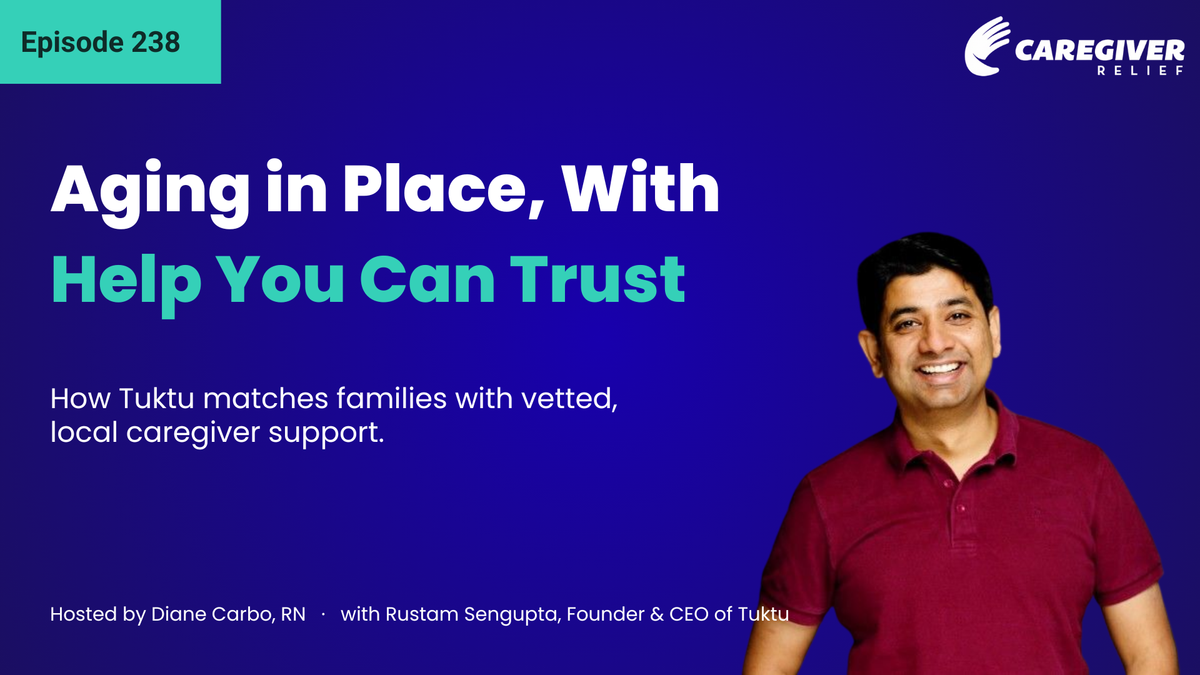
In this moving and practical episode of the Caregiver Relief Podcast, host Diane Carbo, RN sits down with Rustam Sengupta, founder and CEO of Tuktu 🤝.
Together, they dive deep into how we can restore a true sense of community, defeat social isolation 💙, and bring flexible, trusted, and affordable support right to your front door.
💡 What You’ll Learn in This Episode
- The Personal Story Behind Tuktu 💔➡️❤️: How Rustam’s personal journey with his father’s dementia diagnosis inspired him to help families find reliable, local care.
- Rebuilding "The Village" 🏘️: Why modern society has lost its intergenerational connection and how community-powered platforms are bringing neighbors together again.
- Community-Powered Care vs. Traditional Agencies 🔄: Why on-demand, flexible errand running, companionship, and driving services are filling a massive gap that high-cost agencies miss.
- The Power of Culturally Matched Care 🌍: How matching helpers based on shared language, personality, hobbies, and cultural background dramatically improves mental health and quality of life.
- Safety First 🛡️: How background checks, location matching, and review systems ensure peace of mind for families allowing new helpers into the home.
- A New Generation of Companions 👵👴🎓: Why over 50% of Tuktu companions are active early retirees giving back, alongside younger students seeking meaningful connection.

📝 Episode Outline & Timestamps
- Introduction: Host Diane Carbo highlights the vital need for practical, everyday help for caregivers.
- Rustam’s Story: From clean-tech director to caregiving innovator after a life-changing call from his mother about his father's dementia.
- The Broken Village: Discussion on how multi-generational homes faded and why we need to rebuild community trust.
- Neighbors Helping Neighbors: Reframing senior care away from institutional labels and toward mutual, dignified community connections.
- Overcoming Guilt & Personal Ego: How outsourcing logistical chores (like technical support or fixing appliances) helps adult children form better, richer relationships with aging parents.
- What is Tuktu?: The origin of the name (Inuit for caribou 🦌) and how community-powered care works.
- Smart Matchmaking: Using tailored technology to align helpers with seniors based on language, culture, and shared interests.
- Vetting & Safety Protocols: Background checks, SSN verification, local reference checks, and training.
- Reasons for Hope: The role of active retirees, fighting social isolation, and technology easing the burden on caregivers.
- How to Reach Tuktu & Closing Thoughts: Where to find the platform in the US and Canada.
🌐 Connect with Tuktu
If you're looking for trusted, flexible support—or if you'd like to become a companion in your own neighborhood—get in touch with Tuktu Inc. (San Diego, CA) today:
- Website (US): tuktu.us
- Instagram: @tuktucare
- LinkedIn: Rustam Sengupta
- Watch Video: 🎬Tuktu Customer Video
Podcast Episode Transcript
Diane: Welcome to the Caregiver Relief Podcast. I'm your host, Diane Carbo, RN. If you are caring for an aging parent, helping someone with dementia, trying to support a loved one from a distance, you already know this truth: Love is powerful, but love alone does not do the grocery shopping, drive someone to an appointment, sit with a lonely parent, or give a burned out caregiver a few hours to breathe.
Today's conversation is about the kind of help families often need most: trusted, local, practical support. My guest today is Rustam Sengupta, founder and CEO of Tuktu, a community powered care platform that connects families with vetted local helpers and companions. Rustam is also a son whose own father's dementia journey helped him understand how overwhelming it can be to find reliable help that truly fits the person, the family, the culture, and the moment.
Tuktu is now entering the US market beginning in Vermont with a model built around local support, flexible help, and matching based on needs, preferences, language, culture, and connection. This is not just a conversation about technology. It is a conversation about dignity, belonging, caregiver relief, and how communities can begin showing up for one another again.
Diane: Rustam, thank you so much for joining me today. As I was telling you before we started, I'm really excited and proud to be able to share this platform. But before we talk about Tuktu, can you share a little bit about the personal story behind your work?
Rustam: Absolutely. And I'll first, like to thank you, Diane, for inviting me to the podcast. You're an amazing person who supports, entrepreneurs and innovators like us. Ad for that, I'm really obliged, and thank you. My name is Rustam, and before starting Tukto, I was working for the Canadian government in their clean tech fund. I was, director of the fund, and I was managing a lot of, funding for startups in the clean tech space.
And that's where my background was, till the point then that I got a phone call. I remember it clearly. It was about four and a half years ago. And my parents live in Singapore, and my mom called, and I could hear her voice kind of shaking when she said, "I need you guys to come back home." and I was caught off guard, right? I go, "What do you mean, Mom? Why?" She says, "You know, your dad has dementia, and I've been trying to take care for him, but I can't do it anymore. it's too much."
Diane: God bless her.
Rustam: And I could hear in her and I could hear in her voice the
Diane: Yeah
Rustam: the pain and the fact that she's loved this man for 47 years of her life, but- Yeah she's just at her wit's end. She's at the end of her physical, and mental, and spiritual capacity.
Diane: Yes.
Rustam: And, you know, it was a very dark day for me because, when y- when you have kids and they're in college or they don't have money, they stay with you. The moment they do well, they leave, right? and I'm- guilty to that, and I felt really bad. And I think what really happened, and I went to the church, it's called Our Lady of Perpetual Help Church in Vancouver, and I was sitting there and it's probably my face showed and the pastor, he walked up to me and he said, "Hey, you know, what, what's wrong?
I mean, do you need help? What's going on?" And I poured it out on him that, "Look, my dad has dementia and it my mom is struggling to find people for him, to find caregivers, and to find, to manage his, sort of support structures." And, he gave me a one line answer. He said, "Look, I understand you feel guilty." And you feel you can't do anything to help them, but you can do something. I have 1,400 people here who are exactly like your parents. If you can't help your parents, maybe help somebody else's. And it was so profound and that, that little interaction with them was so profound because I realized that is what I could do.
And, and this is in 2022, right before Christmas, we started a small group of people doing errands. we did it in a way that it's not full volunteership, but it's also not professionals. It's neighbors helping neighbors
Diane: Yeah
Rustam: So that we could get more people excited and interested. And in fast-forwarding that to now, we've got over 10,000 families that are in the network, getting the benefit of, companions and, service providers from their neighborhood, and we have over 300 companions and service providers doing that.
And it's an interesting group because these companions initially we thought are all gonna be younger students or people who want to do a gig work, but you know, 50% of our companions are actually retirees themselves. They've retired at 65, but they're, you know
Diane: Oh
Rustam: stronger and fitter than I am. And they're like, I was of I mean, one of the gentlemen, he's John, he was the head of the fire chief. He was the fire chief of Vancouver. He was like, "For all my life I've been told to be reactive to people's needs, and now after 65, they want me to sit at home and watch TV. I can't do that."
Diane: Yeah.
Rustam: " I've gotta, I've gotta go out and make a difference." And it's, so it's very interesting that the platform has now about 50% companions who are themselves early retirees and that's the future we want. Sorry it was a long answer, but that's-
Diane: No
Rustam: our origin story.
Diane: No, Rustam, you actually get to the core of what I am seeing, and I'm gonna make a comment on our world. We have gotten away from a sense of community. When I grew up, there were multi-generational households, And we were all around family. We did everything. I cared for my mom at the ages of 17, 18, and, my grandmother, at 16 and 17. So I have to tell you, at a young age, I didn't feel like I was missing out on the fun things that kids were doing because I had a commitment to my family.
And we no longer have that. We have adult children that don't wanna help take care of their kids because it's an inconvenience. And we also have the issue right now, Rustam, of people not wanting to have babies. But the, the childless couples and the solo agers, they have no idea what's going to happen to them when they get older. And so I really love that you are, promoting a sense of community because we need to get back to those roots.
Rustam: Absolutely. And then thank you for bringing that out so well. You articulated it so nicely that we have to rebuild the communities, or I would say rebuild the villages
Diane: Yes
Rustam: right? The villages have broken. I remember when I was young, I used to walk to the neighbor's house and for five bucks or maybe one buck at that point, I would shovel, like, shovel snow or mow their lawn or do an errand. And, I was obviously fairly entrepreneurial, there was a level of trust that there was between the, the communities. But I think, Dan, the villages have broken up in the last 40 years.
Diane: Yeah
Rustam: they've broken because families have moved away from each other.
Diane: Yes.
Rustam: They've broken because, like you said, a lot of, folks chose not to have kids or chose to stay away from family. A lot of times it's also been money has just gone out of the system. People are doing two jobs.
Diane: Yeah.
Rustam: And so I don't blame them as well. I mean,if you're doing two jobs and you're tired, how do you take care of... To take your mom to the doctor's appointment is getting harder. And if you see the kind of- progress we've made in other technologies. You know, 40 years ago, for us to talk like this would have been impossible. We would have picked up a phone and dialed a number.
Diane: Yes.
Rustam: Remember, rotated something, and now we are speaking to each other live real time. I can see your beautiful face. but in the 40 years, home support has not changed at all. It's still the same way. It's still somebody picking up the phone, calling somebody, going there and helping out. So I think that's where we have to take, focus in, and I think you're absolutely right. Rebuilding communities is the way to go. So beneficial for everything.
Diane: Absolutely. And many caregivers tell themselves, "I should be able to do this. I don't need help." that's with if they have a family member, that they're providing care. And adult children, and especially the sandwich generation, they feel so guilty for asking for help.
Rustam: Absolutely. I mean, nobody needs help. Like, if you know my dad Even now, he's, my dad is funny. Even when I go back to Singapore now, he's so proud, and he need. He remembers me once in a while, and he comes back. He has his moments of clarity, and he'll take a $5 from his wallet and give me gas money, right? So it's, it is. So I think we have to change the way we think of it.
Diane: Yeah.
Rustam: We have to stop offering help. We rather have to offer community And Diane, it's not that, I'm helping you out. it's the fact that this interaction between you and me has benefits to both of us.
Diane: Yeah.
Rustam: And I think we have to be able to clearly articulate that. For people living alone, we have to articulate what the benefit is of not being lonely or socially isolated.
Diane: Yeah.
Rustam: And it's also the benefit of, everybody coming together. I think it's... we have to stay away from, words, and sometimes it's as simple as that, that are triggering and that are, lower in dignity. Words like I even stay away from seniors. Words like even stay away like, you know, you're an aging adult, and you could be 65 or 95, doesn't matter, or you could be 55.
But you're, you don't need help. All we are bringing to you is a community. All we are bringing to you is an extra pair of hands. And we've been very careful to not position ourselves to be a senior care company. We've positioned ourselves as neighbors helping neighbors, and you could help as well.
We've got, a sizable number of people who themselves, you know, provide a service. they go to a, they go in their neighborhood, and they probably do companionship. And in return sometimes they're also getting a housekeeping done. They're getting a tech help done.
So I think that's the future for me. It's not that we are trying to help anybody. It's also for young people, students who've come into the network to meet some wonderful folks. Diane, it would be so lovely if, some of the young people from UAM get to meet you and talk about your experiences, but they wouldn't have that opportunity.
Diane: Yeah.
Rustam: So our goal is by allowing communities to be created and having some kind of a transaction that can be priced and organized, you are effectively getting people together, and I think there's value in that, and there's importance of communicating in that way.
Diane: Helping neighbors helping others, other neighbors is priceless. And I will tell you I have many seniors won't wear their hearing aids. They won't use a walker. They don't wanna because they look old, and they're in their 80s. I literally had an uncle, my dad's twin, he, his wife passed, and he always was a very active man, so in his 90s he decides he's gonna go to a senior center. And at the senior center, he lasts one day and goes home and says, "They're all old people. What do I need to go there for?"
Rustam: And that is the truth, right? That is the truth.
Diane: Yes. is it. Yeah
Rustam: isn't the pursuit of the fountain of, youth the, the thing that drove people to, go and colonize huge continents?
Diane: Yes. Yes.
Rustam: It is what we all want. And I think that's why it's very important that we, we basically label it as neighbors helping neighbors
Diane: Yes
Rustam: so that it doesn't feel... And also, like, for those folks who are, older adults, this is a good way to meet new younger people and have fresh exchange of views and ideas. So I think, yeah, it's an effort that we are trying to put in to create these pe- connect people together, ensure it's a safe space by doing background checks and everything.
Diane: Yes.
Rustam: But, but the objective is that you shouldn't feel that, you have to, you don't have a peer group, right?
Diane: Yes.
Rustam: And the peer group could be an 18-year-old for a 80-year-old. I mean, that's completely fine.
Diane: Yeah. And I love the fact that you, Well, I will tell you, my mother-in-law, 40 years ago, my ex-mother-in-law, she's passed now, in her 80s, was going to sit with a 95-year-old's bec- And she would say, "I'm going to go babysit." She sat with a 95-year-old
Rustam: Absolutely
Diane: at 80 because she wanted to give the, the lady that was the, the family caregiver a break to go get her hair done or whatever.
Rustam: Wonderful one.
Diane: So yeah,
Rustam: And isn't that beautiful?
Diane: Yeah.
Rustam: That's so beautiful.
Diane: It is. And you know what? We really need to get back to that because there's so much social isolation with our seniors.
Rustam: 100%.
Diane: Yeah. So what did you learn from your own family experience that you wish every adult child knew earlier?
Rustam: So to- I would say three things, three vital things. Number one is it's What I learned is we have to get over our own personal ego and belief in
Diane: Yes
Rustam: asking when we need when we need support, right? And I think once we cross that, we realize that it improves our relationship with our parents because it takes away a lot of logistical conversations and a lot of back and forth about stuff that doesn't add value to the relationship. So let me give you an example.
So I used to talk to my mom quite often, before, and most of my conversation would be about how to set up Zoom, how to set up her computer.
Diane: Yeah.
Rustam: It would be about, the lady who comes to fix the washing machine because it's not working. And I would say 80% of our conversation did not add value to our relationship.
Diane: Yeah.
Rustam: They were logistical check-ins. They were also burden in my mind because later I'm doing something else, I'm thinking, "Oh my God, the washing machine doesn't work in my parents' place. If the guy doesn't show up, I'll have to go on Saturday." And that's not of value, right?
Diane: Yes.
Rustam: Compare that to where, to a situation where I have access to a bunch of people, an ecosystem of helpers around my parents.
Now I outsource it to them, and they figure it out. In both cases it was costing me time and money. But in the second case, I, when I'm speaking to my mom now, I'm not talking about, "Oh, is the washing machine fixed? Did your ... Is your Zoom working?" I'm talking about, "What do you like? How was your day?"
Diane: Yeah.
Rustam: And tell me what ... And it's so much better. So I think it's, one of the things that like from my personal usage and even from the, thousands of people who are using Tutu is that this is important for children or for people who are managing care for someone else- To, to take this for ourselves, not for the person who's the care has been, but for ourselves
Diane: Yeah
Rustam: to build a better relationship, to take the stress out of these, logistical challenges that family caregivers face. And I think that's important. The second thing I'll bring out, which is also what I've realized is that when I employ somebody who is from my community, they're often one degree or two degree, it builds this kind of harmonic goodwill for me, I my life in that community. Because I'm now helping my neighbor's nephew, And I see him
Diane: Yeah
Rustam: at the check-in counter, and now he comes home, he helps out. And I suddenly have so much. And to your point about social isolation, I suddenly find myself being a part of the community. I know George's son. He drives my dad to the doctor's appointment. And I feel there is an increase in trust in the whole space
Diane: Yeah
Rustam: that I'm in, which has so much better outcome. and the third, very easily I save a lot of money. You know, I don't wait till it's reactive. I don't wait till my dad has a fall. I don't wait till my mom runs out of groceries. I'm so much more proactive now. And it saves me a lot of money. So I think those are the things I've realized are the true benefits of having a community around you.
Diane: and as I was we were talking before, we have lost the sense of community. 100%. And when you belong to a community 'Cause I grew up, I'm 73 years old, and when I was growing up, I actually I walked four houses down a whole summer and sat with a lady in her 70s who couldn't be by herself. And I got paid, you know, it was probably a dollar an hour or something, But Yeah it was money for me. But I sat there and I enjoyed her. And, I didn't find that a burden, but I ... 'Cause I had grandparents, I had,
Rustam: Absolutely
Diane: aunts and uncles. So we grew up with multi-generational, love and commitment to one another, and a sense of community so that if something was needed, somebody in the community needed something, we stepped up to help them.
Rustam: 100%.
Diane: And now parents feel like they don't want to be a burden to their children. But if you have a sense of community, it's not a burden.
Rustam: It's not a burden at all. And I just want to reinforce that what you said, Diane, so well, and you're by far the coolest 73-year-old I know now. But, you're such a awesome podcaster. But I would say like, what I want to reinforce is that a lot of younger folks are actually don't have an opportunity anymore to have these intergenerational relationships, which is so important. My son is 12, and I make it a point for him to know the aging adults in his locality, in his community, in our neighborhood. And that's because there's so much wisdom and experiential knowledge that he can gather from them, which he can't get from me, and he can't get.
Diane: Yeah.
Rustam: And often we are complaining as, parents like, "Oh, the kid is on the phone." If you don't want him to be on the phone, then find him something somewhere else to be.
Diane: Yeah.
Rustam: And I think that's the value. So for a lot of folks who don't want to burden their kids or their grandkids, you're not actually burdening them. I would say that you're giving them an opportunity for a enhanced learning experience by sharing your time, right?
Diane: Exactly.
Rustam: And I think if we have to start taking... Like, you know, having a chat with you, I am so delighted. I was... The morning I woke up, I told my wife I have this podcast. I'm so excited to be on it because how often would I get an opportunity to talk to somebody who has a breadth of experience and knowledge? I only talk to my peers, and that's the problem we've had nowadays
Diane: Yeah
Rustam: is every generation has been horizontally communicated and connected, but not up and down.
Diane: Yeah.
Rustam: And I think, so please stop thinking that you're burdening anybody. It's not a burden. I would think it's you're giving an opportunity to young generations, young folks,to get experience and also to make some money. I mean, life is hard for a lot of the younger folks. They are this is gonna be the first generation, if you're between 18 to 25, who's gonna be worse off than the previous generation. You are not gonna be able to afford the houses you're gonna be in. And it's, this is a job that gets them dignity, and it's so much better than a $16, $17 retail job. They're making 22, $23 and talking to you. and so you're giving back to the society also in some ways.
Diane: Yeah.
Rustam: And I can tell you a lot of providers, from our side, especially the younger folks, look forward to these services because in a way it's a job that they enjoy, and they make 22 bucks an hour as compared to standing, at Walmart counters. And nothing against that, but making 17 bucks, 18 bucks with a lot more physical exertion or being a FedEx loader. So for older folks who are listening in, I would say it's not a burden. It's an opportunity that you're providing the younger generation to have some fun with you.
Diane: Oh, I always I love dealing with seniors. I always have. And now that I find that I'm a senior myself, I enjoy dealing with the younger children, younger adults now because I like to tease them and give them, you know, tell them, "When I was this age."
Rustam: And that's wonderful, right? It's fun. And
I'm sure they have a great time.
Diane: I just have fun with them. You have to have a sense of humor. But
Rustam: Absolutely
Diane: first of all, I wanna know, what... does Tuktu have a meaning?
Rustam: Yes, it does. In the Inuit word, it means a caribou or a reindeer.
Diane: Okay.
Rustam: And, we started in Canada, and the caribou in the Inuit communities has a good connotation. It's a bearer of good news. It's a good animal. It's an auspicious animal.
Diane: Yeah.
Rustam: and when we started, we got the blessing of the elders, and we started. And, it's a great name because I get this question a lot. And it's also if you think of it on the lighter side, when we started in 2022, just before Christmas, we would say it's Rudolph the Red-Nosed Reindeer coming to bring cheer.
Diane: I know you were gonna say that.
Rustam: So it was good marketing for me as well, right?
Diane: Yes. Yes. Yes. Now you are community-powered care. That is extraordinary to me. What does that mean, and how is it different from the traditional home care agency model?
Rustam: Absolutely. So traditional home care agencies, Dan, are extremely good for people who need a lot of intimate personal care, where you need help with bathing and incontinence and, and you're kind of physically, not mobile enough, right?
Diane: Yeah.
Rustam: They tend to provide long hours of care. They tend to provide nurses or personal support workers, and it does fill, fill, fill a bucket, right? It's important.
Diane: Yeah.
Rustam: But often enough we find there's a lot of folks, a lot of folks, and I'm not just talking about aging adults, I'm talking about, even people with disability. I'm talking about
Diane: Yes
Rustam: people who had a baby who need just a little bit of help occasionally on demand.
Diane: Yeah.
Rustam: They don't need, they don't need... They wanna- they don't wanna sign a contract for like $4,000 an hour.
Diane: Yeah.
Rustam: They don't need a personal support worker. They don't need help with bathing. They don't need... They just need maybe a guy to go shopping with because they can't lift the heavy bags. They just maybe need a guy who will drive them back from a colonoscopy because
Diane: Yeah
Rustam: they're gonna be mildly sedated. They just need somebody to sit in with their mom when they can't visit the care home themselves, right? And we cater to that group of people. It's on demand. You don't have to sign a contract. So you pick when you want the person, and who you want. Second, it's far more affordable because we work with community members. We don't, we don't mandate, people, to be nurses or PSW license holders to work with us.
These are anybody who can, who's around and goes through our training and background checks can become a part of the caregiver pool. So these could be students or like I said, retirees themselves, but they're often at a much lower cost per hour than a professional. And we also have some robust technology tools like apps and stuff where you can look at these people, you can familiarize yourself, you can get matched with the right ones.
So I think it's catering to a different market, I would say before or around the home care agencies, before or around the Medicare and Medicaid, agencies. and it's catering essentially for folks who want it on demand. And that's also our goal and our hope that this kind of a model allows people who wouldn't be able to afford a traditional home care be able to get at least some respite and some, some help from, from the community.
Diane: I love that. Now this is, unique for anybody is you're matching families with helpers based on language, culture, personality
Rustam: Oh, yeah
Diane: and preferences. What does ... That matters so much, especially for the aging senior. can you talk about how you do that? That's incredible.
Rustam: Yes, absolutely. And then this came also from us, doing a lot of research with a couple of PhDs who, who gave us some time, in really building and understanding on what actually makes an engagement quality improve, right? So Diane, you and I are talking, the fundamental layer of our communication is the fact we speak the same language. And then I love your smile and, you know, we are both high energy people. And then there's certain other triggers. We have certain common topics that we talk about. So a goal for us when we do the matchmaking is to train a system, to train a technology on each person to have a different character features that we define for each person.
So we know Diane speaks this language, she has these allergies, she prefers these kind of hobbies and all these. She likes doing this in a part-time. This was her past experience. Once we know that, for both the provider or the companion as well as for the person who's requesting care or the person for whom they're requesting care, we can We, our algorithm sort does a matchmaking and it's done through an AI model. It's very smart and, and it finds the right fit. And it's very important because it can increase the engagement quality. That was the long technical description then, but, the easy way is to think of a dating app, and it uses- the same kind of matchmaking like a dating app, but instead you're being matched, with a companion, for a companionship and not a date.
Diane: I have cared for seniors or people my whole life that have come from other countries and, they settled here, but the older ones, the family, older family members didn't assimilate the, into the language. I've dealt with the Italians, the little Korean ladies and Chinese ladies. You know, and I felt so bad for them when they were in the hospital and stuff because they don't have the language. Now you can use a, an app and just translate stuff.
Rustam: Oh, yeah.
Diane: Yeah. But when they have dementia and they're confused, it just broke my heart.
Rustam: Absolutely And then it's beyond sorry, it's beyond the language. it's actually
Diane: Yeah
Rustam: cultural markers.
Diane: Yes.
Rustam: Like
Diane: Yes
Rustam: if you've been, you obviously seem to have worked with Koreans, right?
Diane: Yes.
Rustam: And Koreans have a, such a strong culture.
Diane: Yes.
Rustam: And to, to be able to have a really good experience or to able to feel really happy about an interaction. If the cultural markers can be aligned well, you know, if the bibimbap or the kimchi that they're eating has the other person has an acknowledgement of what they're eating
Diane: Yeah
Rustam: is so important. And, there's a tragic thing that has to happen. in a, with a Korean family, for example, kimchi has a wonderfully different distinct smell.
Rustam: Yes.
Rustam: And you know that, and one of our Korean companions went there, and she obviously knew about kimchi, and she was like, "Oh, this is such a nice, best-smelling kimchi." And the older lady made it herself, and immediately she felt like, "I met my grandchild," right?
Rustam: Yeah.
Rustam: So these, these cultural markers improve engagement quality. They improve mental health. and language is one of them. What you eat is another of them. The places you visited is a big conversation starter. Hobbies. And I think all that goes into the matchmaking, and it's so important.
Diane: Yeah. when I was younger, my oldest son was a Korean linguist, so he read
Rustam: Wow
Diane: and he was very smart. He's no longer with us, but
Rustam: Sorry
Diane: we learned about Korean food. Oh, I love Korean food. So, you know, and we've traveled, so we've had different food cultures. But, if food is such an important thing. The boys used to tell me, "Hey, Mom, can't you bring home one of your, little Indian ladies to cook for us? A gram- Indian grandma to cook for us?" or a little Korean mama.
Rustam: Yeah. And now you can.
Diane: Yeah. I'd like to go in there and let them cook for me while I'm taking care of them.
Rustam: There you go.
Diane: Oh, it's just, you know, you have to have fun and enjoy life. And I embrace the different cultures. I grew up in Pittsburgh, Pennsylvania, where we had the, we had a Jewish section, we had a Polish section, we had our Italian section, we had our Russian section. And we would go into those different places to have different cultural experiences. And I grew up what I thought was diversity. And it's funny now when I talk to some young people that now come from Pittsburgh, they didn't think that was a cultural, diverse place at all. And I'm like, "Oh my gosh."
Rustam: I- Yeah, it's,
Diane: Yes. Now
Rustam: I think it's the spicy part of life, right? The more diversity you have.
Diane: Yes, it absolutely is. Now, for some families, allowing someone into the home feels very scary. I've dealt with this as well. What should caregivers ask before trusting a new person with their loved one?
Rustam: Yeah. So we are very, very heavy on safety. That is paramount, right? and, we could get a second chance in anything that we do wrong, but not safety.
Diane: Yeah.
Rustam: And we would, I wouldn't do this if I couldn't make it safe because I think of my dad when I do it. I think, so every provider that comes to the platform first has to go through a criminal background check, which goes through an SSN check, goes through the criminal check, goes through a sexual harassment check, and all these checks come in.
If they, we only take them through the gate if they are clear with these checks, and then we double down and do something called a reference check as well. And which is that we try to really verify the location that they will be serving. Because often enough, safety is a factor of location, right? So I'm in South Burlington. I would feel more confident if people are coming to my place who are from South Burlington necessarily
Diane: Yeah
Rustam: rather than coming from, let's say, a distant place because that increases my safety. And for bigger cities it's even, even crazier, right?
Diane: Yes, it is.
Rustam: If you think of a place like Boston, every neighborhood has a different risk profile. So I think we do that, and then we put them through a training program, which is online, but it's gives them training on the different aspects of, or the softer aspects of how to care for a person who needs help, and how to talk to them, how to, what are the basic things, the best practices that they can do and stuff like that.
And then we allow them on the platform. And as they do the services as well, we have a very robust, or I would say ratings and reviews mechanism. So people who get a bad review multiple times, they get weeded out of the system. People who get, mixed reviews are given training programs that they are forced to go through before they can come back on. And of course, people who do get good reviews are given reinforcement messages about what they did well, and it shows up on their profile as well. So for families, we do try to do as much as possible to ensure that the person who's coming to the inside their house is safe and is someone who knows what they're doing.
Diane: Rustom, when you look at the future of senior care, what gives you hope?
Rustam: I think two things give me hope. The new seniors give me a lot of hope for the old seniors. Like, it's people like you, Dan. I think you're the first generation of folks, I would say between 65 to 80, who are super productive and are contributing more than other generations in senior care. And I wanna really, really acknowledge you and, folks like you for that. Like I mentioned on the Tooku platform, 50% or more of our providers, our companions are, you know, in that bracket. So I think that gives me hope because it means that the real intimate care portion of our society is now, like, mostly people above 85 or 90, and that's...
The second thing that is, it's also giving me hope is there is a grassroot acknowledgement about social isolation and loneliness that was kind of debunked. Even when we started four years ago, people were like, "Yeah, you're just providing a service," But lately, I would say, and since, the last few years, I mean, we've started seeing people acknowledge that there is a strong impact to, to fighting loneliness and social isolation, both on the mental health of an individual, but also on the cost of managing healthcare at a broader national sense.
Diane: Yeah.
Rustam: And I think that, that is going to be profoundly important and a big driver because every time a senior is happy at home or an older aging adult is staying at home, it's saving money for the entire economy.
Diane: Yeah.
Rustam: The less visits they make to the emergency, the less phone calls they make to 911
Diane: Yeah
Rustam: is impacting positively, the treasury, right? And it's such a solvable, easy problem, Diane. By sending somebody over to somebody's place twice a month, you solve the isolation problem to a great extent. So that gives me a lot of hope. And the third, I think gives me hope is if you look at campuses now, versus a few years ago, you see a lot of younger folks who are choosing to not, blindly pursue a job and, you know they want to actually do a socially beneficial thing for their community. And whether it's working for, working for the environment, whether it's working for health, or whether it's working for senior care, there is a impetus of a lot of new talent which looks at it and going forward. So it is hope.
I'm hopeful. I'm also hopeful that technology has reached a certain place that we can take a lot of the overhead burden away from folks, so that if you were on the Tuktu platform, you don't have to manage your own scheduling or your own payments or your own tax forms. Everything's done for you. And, and that takes away, a lot of stress that you would otherwise have as a independent service provider, and that can be done through technology. So this is, I think a sector that is, we all, hopefully will be able to, build better infrastructure for in the future.
Diane: Yes. Rustam, how do my listeners find you?
Rustam: So thank you for asking that. there are three ways to find us. The easiest is to go to the website, www.tuktu.us, if you are in United States, and www.tuktu.ca if you are in Canada. We operate in both places. the other easy way is to call us, which is, a simple number, 1-866-938-8588. That's 1-866-938-8588. Or the easiest and the coolest way is to download the Tuktu app. You can just go to your App Store, or you can go to the iOS store and download the Tuktu app and, you can book a service, you can you'll get a call back, and you can be a part of our community. So again, super delighted to engage with anyone who thinks us worthy enough.
Diane: Thank you so much, Rustum, for this in- valuable information. I think that our community is lacking a sense of community, and you're going to restore that for the future, and I'm grateful for you to think about it that way. So thank you so much.
Rustam: Thank you so much, Diane, for the opportunity to present myself.
Diane: To the family caregivers out there, you are the most important part of the caregiving equation. Without you, it all falls apart. So please learn to be gentle with yourself. Practice self-care every day. Check out Talk2 because you are worth it.
Caring for a loved one can be overwhelming — but you're not alone. If you have questions, big or small, our expert team is here to help.
👉 Click here to Ask the Expert
Our Resource section can help you find the information and tools that you need. We have courses, videos, checklists, guidebooks, cheat sheets, how-to guides and more.
You can get started by clicking on the link below. We know that taking care of a loved one is hard work, but with our help you can get the support that you need.
Click here to go to Resource Section now!