The Healthcare System Shifted Its Burden Home and Diane Carbo, RN, Says It’s Time for Families to Reclaim Control

For decades, registered nurse and patient advocate Diane Carbo has watched the mechanics of healthcare change. As the founder of Caregiver Relief, she has guided thousands of families through the bewildering realities of long-term care.
In a recent interview, Carbo shed light on a quiet, systemic shift: Healthcare institutions have gradually offloaded operational medical responsibilities directly onto families.
What used to be a role focused on emotional support, visits, and simple household help has evolved into something far more demanding. Today, family members find themselves managing complex medication schedules, wound care, insurance disputes, multi-specialty scheduling, and critical clinical decisions.
“The average family caregiver is now doing the same kind of navigation work I spent years learning to do as a nurse and care manager,” Carbo observed.
1. Caregivers Are the Unpaid CEOs of Healthcare
One of Carbo’s central points in the interview is that the language around family caregiving hasn't caught up with reality. While society continues to label family members as "helpers," they are actually executing high-level management functions.
In fact, unpaid family caregivers now serve as the single largest pillar of the long-term care industry, delivering an estimated $1.1 trillion in unpaid care annually.
“The caregiver has become the healthcare CEO of the family,” Carbo explained, highlighting how a role that starts with simple errands quietly expands into running a multi-stakeholder health operation.
2. The Danger of the "Labor Mindset"
Why do so many caregivers burn out? According to Carbo, most people approach the role with a labor mindset—believing that if they just work harder, sacrifice more sleep, and handle every emergency personally, they can keep their loved one safe.
Carbo argues that modern caregiving requires leadership, not just labor.
No corporate CEO manages an entire company alone, yet families routinely expect one relative to handle every aspect of a senior's medical, financial, and physical needs.
“There comes a moment when the caregiver needs to stop thinking, ‘How do I do all of this myself?’ and start thinking, ‘Who needs to be on my team to help me manage this?’” Carbo noted.
3. Diane Carbo’s Prescription for Families
To prevent caregiving from destroying a family's health and financial stability, Carbo advocates for three essential strategies:
- Build a Distributed Care Team: Divide responsibilities explicitly. One family member handles prescription runs and pharmacy calls, another manages medical billing, and out-of-town relatives contribute financially or handle research.
- Implement Family Caregiver Agreements: Carbo strongly encourages families to put formal, written agreements in place. These clarify expectations, establish clear boundaries, and prevent resentment before crisis hits.
- Get Organized Early: The families who navigate caregiving most successfully aren't necessarily those with the most money—they are the ones who put organizational structure in place early, rather than reacting in emergency rooms.
 Holly Larson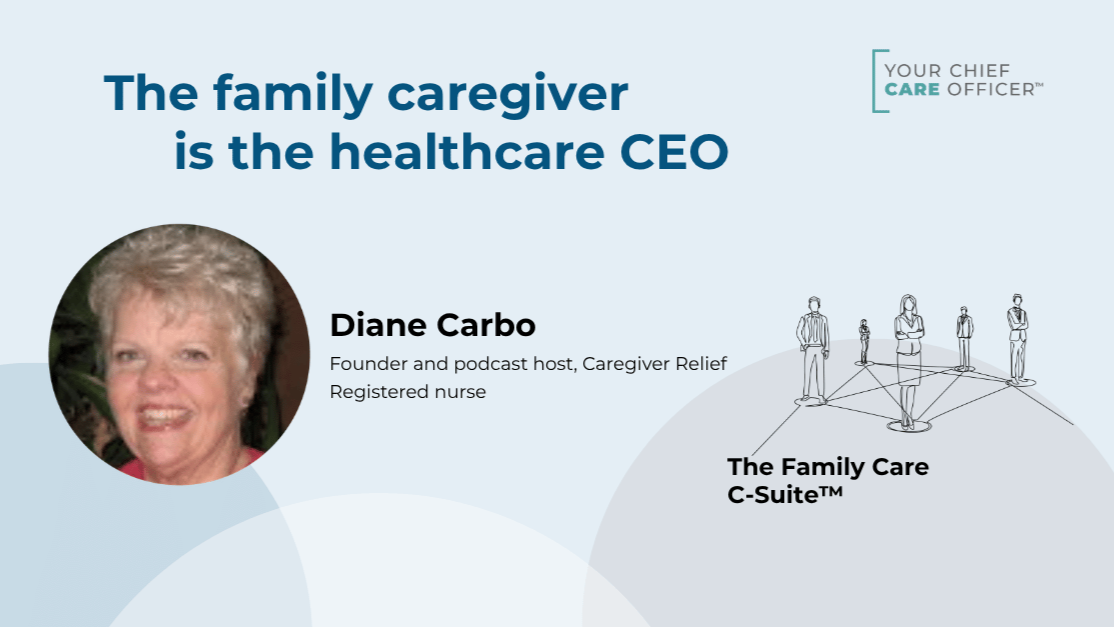
The System's Greatest Vulnerability
Perhaps Carbo’s most urgent warning is that while modern medicine builds massive infrastructures to protect patients, almost no parallel infrastructure exists to protect the caregiver.
When a care system relies entirely on one exhausted individual operating without training or backup, the whole structure becomes fragile.
“Without the caregiver, everything falls apart,” Carbo reminded us. Protecting the caregiver isn't an afterthought—it is the foundation of modern healthcare.