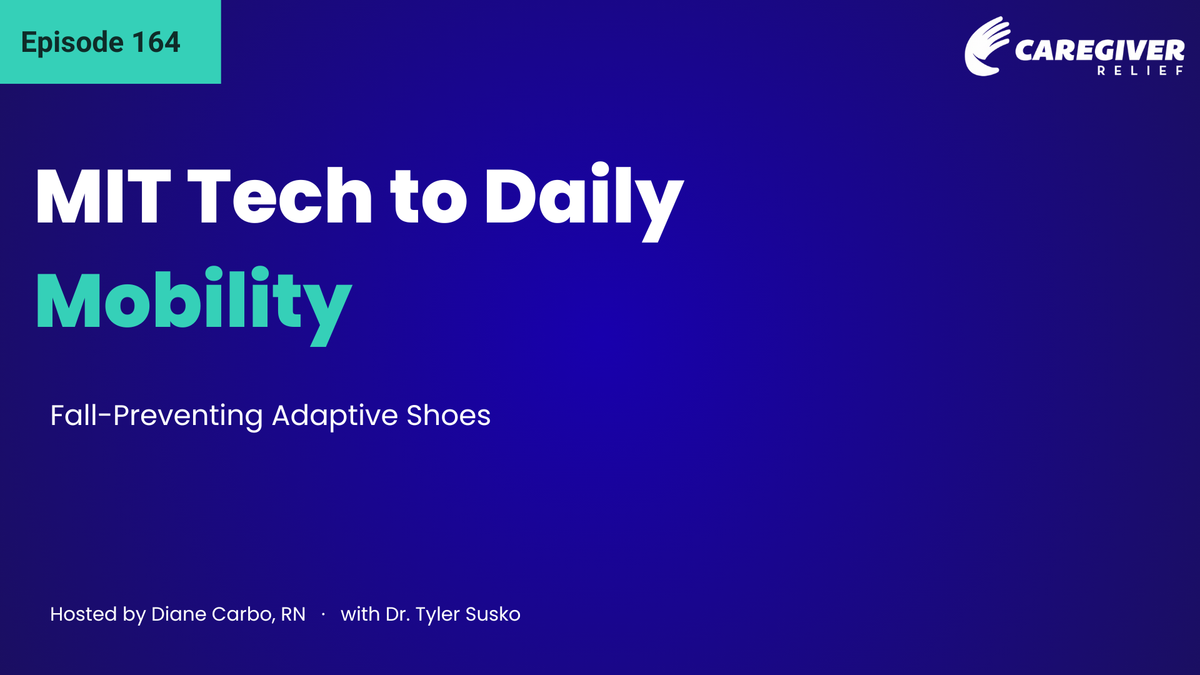
MIT Tech to Daily Mobility: Fall-Preventing Adaptive Shoes with Dr. Tyler Susko - Episode 164
In this inspiring episode of the Caregiver Relief Podcast, host Diane Carbo sits down with Dr. Tyler Susko, a mechanical engineering PhD from MIT, professor at UC Santa Barbara, and the founder/CTO of Cadense.
Dr. Susko shares his incredible journey from designing robotics for children with cerebral palsy to developing Cadense Adaptive Footwear—a revolutionary solution designed to help those with stroke, MS, Parkinson’s, and age-related mobility issues walk with confidence and safety.
🎙️ Episode Highlights
- From Lab to Life: How an MIT-developed "Skywalker" robotic treadmill inspired the creation of wearable, variable-friction shoes that help prevent toe drag and falls.
- A Personal Shift: Dr. Susko discusses his own experience as a caregiver for his father, who lives with Parkinson's, and how the shoes impacted his father’s daily mobility and independence.
- Rehab Reimagined: Why these shoes act as a "home-based physical therapy" tool, potentially reducing the reliance on bulky AFO (Ankle Foot Orthosis) braces for those with moderate mobility issues.
- The "Secret Sauce": A deep dive into how variable friction technology works—providing a low-friction "glide" during the swing phase of a step, and high-friction "grab" once you place your weight down.
- Empowerment through "Tough Love": Diane and Dr. Susko discuss the vital role of caregivers as cheerleaders, encouraging patients to push through the "baby steps" required for long-term recovery.
💡 Key Takeaways for Caregivers
- Don't Overlook Safety: Even "moderate" fall risks can lead to life-altering injuries. Simple tools can make a massive difference in preventing falls.
- Consistency is Key: The most successful users of adaptive technology are those who incorporate consistent, daily walking routines.
- You Are the Priority: Remember, as a caregiver, you are the most important part of the caregiving equation. Please remember to practice self-care; you are worth it!
🔗 Listen & Learn More
Ready to explore how Cadense footwear might support your loved one’s mobility?
- Explore the technology: Visit cadense.com to see the shoes in action and watch the instructional series on how to safely implement them in your caregiving routine.
- Cadense Official Channel: Multiple videos on product overviews, research, and user stories. Browse here


Podcast Episode Transcript
Diane: Welcome to the Caregiver Relief Podcast, where we share heartfelt stories, expert insights, and practical tools to lighten the load for caregivers everywhere. I'm your host, Diane Carbo, on our end that is passionate about supporting those on the front lines of care.
Today we have an inspiring guest whose journey blends cutting edge innovation with deep personal experience.
Dr. Tyler Susko is a mechanical engineering PhD from MIT and a professor at uc, Santa Barbara, and the founder and
CTO of Cadense, his work began over a decade ago at MIT, where he developed the Skywalker Gamma prototype for Gate rehabilitation
Inspired by a study participant with Cerebral Palsy who wished for a portable solution to take outside the lab. This led to ca Cadense Adaptive Footwear with variable friction technology designed to combat toe drag instability and fatigue. Later. As Dr. Susko navigated his own caregiving journey with his father who had Parkinson's disease, he introduced the shoes into his dad's routine, witnessing firsthand how they can improve mobility and independence amid the challenges of the Parkinson's shuffle.
backed by research from MIT and UCS. SB and partners like Shirley Ryan, ability Lab plus ongoing NIH funded trials. Cadense is helping people with stroke ms. Parkinson's, and more walk without limits. So if you're a caregiver seeking ways to enhance safety and confidence in daily steps, this episode is packed with hope and actionable device.
Diane: Dr. Susko, thank you for, joining us today, and it's a real honor to have you here.
Tyler: Absolutely Diane, thanks for having me. And I'm sorry about all the, the letters there.
Diane: Oh my lord. All the ABCs have, it's fall over your tongue. Diane. Dr. Tyler, can you walk us through your early inspirations from your high school service trip working with children who had cerebral palsy to your MIT research?
Tyler: Yeah. so as you said, I'm an engineer. and,but before that, even in high school, as you alluded to, I, did some service trips, one of which was to, a school with children that had cerebral palsy. And these children were in power chairs and, had very little mobility whatsoever.
And that was my first introduction to, people with disabilities. but before that, I didn't see anything, didn't see anything like that. And, I was shocked at the time being 16 years old, being like, wait a second. there's a whole bunch of people out there that don't have the physical abilities that, that I do and I take for granted.
and I was probably about 16 then. then in college, I started working with other people with disabilities through, the Best Buddies program. And,just really enjoyed it. and got a lot of inspiration from those with disability because the thing that, you learn when you work with people that, that have challenges in anything that you don't, is.
That your challenges aren't that hard and,people out there dealing with a whole lot more than you are. so it gives you perspective. And then you also realize from these people that you work with, that you can just gain so much inspiration. So you see somebody that has a lot more challenges than you working twice as hard as you, to do something, that.
you take for granted and it becomes inspirational to your own life, being like, you know what? They're pushing so hard. I'm complaining about something that's so minor in my life. Yep. and so the other thing that I've realized with, in general, in a disabled population is,It's generally such a joy to try to solve problems because they're not addressed.
Diane: yeah,
Tyler: adequately. we, and this makes sense, from a financial sense bus, big businesses look at big markets that serve the masses. There's not as many people looking at smaller markets or,for problems that exist in a choice, select few people's lives.
so there's just so much room as an engineer for innovation because. It's like you just don't have as much competition. so it's a lot of fun there. I got out of engineering school, took a job at,Ingersoll Rand big company, corporation. my first stint there was, designing parts for golf carts, all trained vehicles.
Then I started doing power tools, which was all awesome from a, an engineering standpoint. However, I always wanted to have kind of an impact. I was idealistic as a kid. I'm still idealistic. and, best
Diane: you are where you are.
Tyler: Yeah. And so I said, okay, how can I use these skills to do something that I feel like has meaning?
And then I go back to my experiences early in my life with the children that, that had, you know, difficulties moving or are, and sometimes eating or feeding themselves or, any of the people I worked with in college. And I started to think. that's really where I think I can make an impact here and in a way it's easier because.
There's so much open space here to design because people haven't done it. I started looking around for graduate schools at that point and, just having to stumble on the one at MIT that, that was doing rehabilitation, robotics, and at the time I, I had no experience whatsoever in robotics, and I thought that's really something I would like to learn.
I decided let's go, do a PhD in robotics at MIT working with people with disabilities. It sounds like a good idea. I got there and my first project I got a fellowship, which meant I was allowed to pick my own project and I, started looking at,This field talking with some medical directors at hospitals, and they're like, people are working with, rehab robots now with adults.
They scale 'em down for children. But, what if, the holy grail here is to work on a machine that would start rehab immediately after injury for people with cerebral palsy. And that was at the time of birth. So my first project was actually trying to design, a rehabilitation robot for infants.
but then. Didn't get, further funding on that. And then I switched over to stroke and, stroke and cerebral palsy are effectively. very similar. Sometimes they're the same thing. cerebral palsy can just be a stroke before the age of two. Yeah. so I then got into walking. So the robot that I worked at, on my PhD at MIT was the Skywalker, as you'd mentioned.
And that was a, a split belt, treadmill robotic device, that, was used for people that had a neurological injury as a rehabilitation tool. and through this robot. The cool thing was, is that. We brought, we brought three people in for, we called it a feasibility study,two with cerebral palsy, one with stroke adults.
And, we looked at rehabilitative outcomes and ran them through a whole rehab training program with this robot. But what we really found at the end of the day was that it was just so much easier for people to walk if they didn't have to worry about, coming in contact with the floor as they were advancing their foot forward.
the robot, the way that it worked was I could remove the floor as people were advancing their foot, and then I could return the floor whenever they foot was about to hit the ground again. So in doing so, I get rid of all of the barriers to moving your foot forward. But then restore the floor, which you need to walk, during what we call the stance phase of walking.
but people were like, oh man, it feels so easy and natural to walk because after a stroke or cerebral palsy or a whole lot of different conditions, as you mentioned, Parkinson's or, multiple sclerosis or sometimes weakness as we age, it's difficult to move the foot forward during that swing phase of gait.
And so by removing the floor completely. It's just makes it easy and effortless to walk again. And so we said, after that study, one of the participants said to me in a joking fashion, she goes, it's so easy to walk on that. I wish I could bring it with me when I left your lab. And as you said, that kind of what started everything.
And as luck would have it, luck plays a. Part in our lives. I think everyone's lives. she was moving to Santa Barbara after that study and I got a position at uc, Santa Barbara as a professor. So I said to her, why don't we keep working together? We'll try to figure out a way to bring that robot outside of the lab, which led to first a robotic shoe.
And that was bad for a lot of reasons. robotic shoes. Are heavy, they require batteries and charging software. all the things you wouldn't want. As we start to add weight to the very tip of your leg, your foot, it becomes really hard to move that. And if you're already having trouble getting your foot forward, that's a bigger problem.
So that wasn't a good solution. And then we started to move to all these crazy concepts of how we could simulate the Skywalker experience overground. And eventually, after I'd say 40 to 50 tries, we came up with what we call now the Cadense variable friction shoesthat you've seen.
Diane: how did your personal caregiving experience with your father, who has Parkinson's come into play after developing the shoes, and what difference did you see in his gait and daily life?
Tyler: Yeah, this has been a very cool recent advancement. So I started all of this with no family connection. I had nobody in my family that, that would even require the issues. my grandparents had passed when I was younger in, early high school days. and then my parents. we're pretty able-bodied until now.
but what's been really quite cool is, I'd say as soon as we started shipping these shoes, which was early 2024, so about almost two years ago, my dad was diagnosed about a year before with Parkinson's, and it was a slow progression. It just started slowly. but he started to notice, okay, my, my foot's hanging a little bit more.
I'm not really doing the shuffle gate, but I have to be a little bit. Worried about movement. He started to get the tremors in his hands. and but his mobility wasn't that affected, but we got him in a pair of these shoes anyway. And so he would use these as his daily walkers and he'd go on his walks and with Parkinson's.
if you're familiar with,the care after Parkinson's,the general recommendation is get out and walk as much as you can. 'cause it can slow the progression of Parkinson's. So get out and walk. So I was encouraging 'em, use these shoes, get out and just think of the shoes, walk normally and think of them as a little bit of a, prevention mechanism. If you accidentally contact the ground, your foot's gonna keep on moving and you won't trip. And so he is okay. it was promoting his walking, but he just got hip surgery about. I'd say 10 weeks ago. so he got his hip surgery because he was having a lot of pain in his lower back. but then he got on the, the Oxycontin, drugs for the pain and that really messed with his Parkinson's.
so his Parkinson's started to really take hold after that. And, so much so that he was bedridden for. Like six weeks. So his just atrophy of his muscles and the progression of Parkinson's just kind of skyrocket after that. And so when I went and visited him over,this holiday, the winter holiday here and went down and, he was in the hospital and he was in the rehab hospital at that point.
he went from the ICU to the rehab hospital and then we got him up and outta there. And, the really cool thing about this story is that, I designed these shoes for people with disabilities and all of a sudden it hits really close to home With your own father. Yeah.
Diane: Yeah.
Tyler: so getting him in the shoes and then seeing what it was like from the caregiving perspective, which I never had Before this, was really quite remarkable. once you get him up onto the shoes. He's extremely weak. and so he was using a walker to walk. and we were getting him up and just around the house to start.
But because he was so weak, getting the foot off the floor for him was like, nearly impossible.
Yes. So we just needed to get those legs moving. And we were doing 10 laps around a small circle in the house. that was the original thing. And then we were trying to get him outside. But as a caregiver, what the shoes did for me, and it was interesting for me to be on the other side of it.
I'm just on design usually. Yeah. But being the caregiver while we were walking, I put, the physical therapist gave us this belt that went underneath his arms and I held him from the back, as he was walking with his walker. And,as he was going, I can hear his foot sliding along the ground.
The peace of mind of having the shoes under his feet was really great for me because I knew that if he had a high friction shoe on, he would be grabbing those toes. Yeah. so these allowed him to walk a little bit further with a little bit more confidence. And for me, holding onto that belt, I just felt like I wasn't gonna have to grab him so much.
Yes. But luckily, since then. He's been progressing, he's been doing his walks every day with these shoes. he's been out there with his walker and then he is progressing to his cane. so we're really trying to push the volume and try to get him back up on his feet. But the other thing that really hit home to me was the mentality of what.
I guess it depends on the person that you're working with as a caregiver.
Diane: absolutely. I get
Tyler: And how they're motivated a
long
Diane: time. I understand where you're coming from.
Tyler: yeah. So like my dad has always been like a, just do it kind of guy, like grit it out, like you got this, but when you're suffering for 10 weeks straight, I noticed that mentality changing.
he was much more oh, I can't do it. I can't do it. And for me, like knowing him, because obviously he was my dad, is my dad, I was able to be like, no, come on, get your butt up and let's do this. and giving them a tough love.
Diane: Yes.
Tyler: and it's almost like a just do it mindset.
You gotta get up and push here. 'cause if you don't, you're just gonna atrophy worse. You're gonna be a worse situation.
Diane: Yeah.
Tyler: So we gotta move, we gotta get up and this be has to become your job and your mindset needs to be, I'm gonna get better. Not, oh,I'm not feeling it today. Like there, there's none of that.
Get up and do it. But that would change if it's a different person.
Diane: the thing is. as a rehab nurse, you have to be that way. Okay. You have to be like the little general. What I'm finding, which is very sad, is, because of the lack of reimbursement, the low reimbursement in the, rehab and in skilled facilities, if the.[00:15:00]
Patient says he doesn't wanna do anything, nobody pushes them, right? they talk about these patient rights, but what they're doing is more harm to the patient from what I learned as a nurse, and it makes me crazy. And the other thing we're dealing with is if you're on a Medicare Advantage program, you're coming home within 11 to 14 days after being in the hospital and you're in rehab.
If you are on traditional Medicare, it is 20 days because that's where they get the highest level of reimbursement and that 90 day period they talk about. Is rarely used now because facilities lose money. In fact, we have nursing homes with skilled facilities closing because the skilled facility was the one that kept them going because so many patients are on Medicaid after they, after a while.
So they're struggling and we're at a bad. Place right now. and I will tell you, I recently interviewed Roy Ash. He's the CEO of Senior life.ai, and he has a platform that will address to tell you if you're a fall risk or not.
Tyler: Yep. Yep.
Diane: So I did the test and it was just a short one.
it's free. and I am a moderate fall risk
Tyler: uhhuh.
Diane: So what I did was okay. and they give you some exercises and stuff, but I'm busy. I walk dogs, I don't walk fast anymore. My lower back hurts and I have aches and pains and bone on bone, knees and stuff, but I do walk every day.
I make an effort and I try to walk for a long period of time, but I'm finding, like I told you earlier. before we were on that, my right foot, my dominant foot catches every once in a while and I can feel it. So I've got a pair of your shoes and I'm ordering the sandals because first of all.
They're very nice looking. Well done there. Thank you. Thank you. nobody wants to wear orthopedic shoes because they look so, oh my gosh. Ugly. Yes. And these are incredible . And the sandals, I shouldn't, I do, but I shouldn't wear, flip flops. They're not good for you.
and I need a. the right shoe for, sandal to Sure. Help me walk. I really encourage you, seniors, if you're starting to notice this, it's a good habit to get into and, actually I was surprised at the cost, very affordable. I'm used to, the old rehab where in order to get a patient to walk, they gave them these ankle foot orthotics.
Yes. AFOs. AFOs. Yeah. And, That are they replacing those now? Yeah, so it's a really great question actually,
Tyler: because, so we're doing our four year clinical trial at Shirley Ryan, as you had mentioned. Shirley Ryan is the number one stroke hospital in the country, and we're looking at stroke patients for this one.
And,the standard of care for stroke patient once you have it is, have a stroke and it affects your mobility, is to use an a ffl exactly like you said. These are just for listeners that don't know, ankle foot orthosis is, it could be a ridge rigid or slightly hinged brace that goes on your, ankle.
and it goes up the, the back of your calf, and it straps to your upper leg. And therefore, thereby it can prevent your foot from drooping. so it holds that foot up, usually 90 degrees to get it off the ground. and so we submitted a grant and we won the grant from the National Institutes of Health for $2.3 million to do this clinical trial comparing, our technology, which is this, and maybe I'll back up after this and talk to you about that, what it actually does, our technology to the AFOs, Post-stroke. the idea or the hypothesis being that if you limit that motion, the mobility in the, affected side with an a FO, you're essentially getting rid of all control of, of that ankle. 'cause it's locked, it's just locked in 90 degrees. And if the idea is to get better or to rehab, That's not gonna help at all. so we're looking, our clinical trial is called an A BBA crossover study, which a and B are two different interventions. So you start with one intervention, which could be the Rhu, or it could be the A FO. And then, you see what that looks like, and then you switch to the other one.
So it's 12 weeks with one intervention, 12 weeks with the other, and there's a washout period in between. And so you're measuring. Gait performance before and after each intervention. so we're directly comparing against the AFOs. Oh, yeah. for this. So we have had people tell us, in that trial, that almost universally they prefer these shoes to AFOs.
it doesn't. It's not a direct replacement. Some people are going to need that. A FO, there's just a disability that's so great that they need that a FO and that ankle's gonna be flacid, so that it's just,it is just gonna follow, they're gonna follow. Or if they don't have something with absolute right.
But for somebody that has moderate ability, to, to use that ankle, these shoes are gonna allow you to use the ankle. And then the idea being that you use these shoes as a rehabilitative tool to get you back and functioning. And we've seen evidence of this in some of our early testing.
With the stroke patient, we did a beta test before we went to market, so we had shoes, we put them on people. We would follow these people for up to six months while they wore the shoes, and we would give them this rehab training program. Very simple. And it actually ties in with what you were saying Diane, earlier about, Medicare or Medicare Advantage not covering what is required for physical therapy over a long period of time because it's very expensive if you're in an inpatient physical therapy, situation.
It's also uncomfortable. It was very uncomfortable for my dad being in inpatient physical therapy, but the idea was if you can use this shoe as a home-based physical therapy. Technique. We could increase the volume of physical therapy being done without the physical therapist having to be there.
So what we were doing in our pilot, in our, what we call a beta test, and what we're doing in this new clinical trial is we have people walking in these shoes at home by themselves for at least 30 minutes a day, at least. Five days a week. and if some people can't walk 30 minutes a day, we ask them to break it up into however long you can walk.
Take a break and then do it again. So if you can only walk for five minutes at a time, walk for five minutes, go sit down for half hour, walk for another five minutes, go sit down for half hour, get to 30 minutes a day. and the reason why these shoes are a useful tool there is. Maybe that person would have difficulty lifting their foot forward and actually making that 30 minutes.
So now this shoe allows you to do it. so that's what we're doing directly against AFOs right now with our clinical trial. Our clinical trial will conclude data collection in about a year, and then we'll be publishing results after that. but we're specifically looking for that. One is rehabilitative outcomes after using this home-based.
Care versus home-based care with an A FO. okay, I'll back up one second. Talk a little bit about what the shoe does in case somebody's listening and doesn't understand. Yeah. I was gonna ask you to explain variable friction technology.
Tyler: Yes. Yes. So let's talk about what it does and why it's a hundred percent.
'cause people are probably like, what the hell does this do? Yes. okay. like I said, to start, this was motivated by completely removing the ground during the swing phase of motion when people were trying to make that step. So we completely moved the ground. That was that robot that I was doing at MIT.
But instead of, when
Diane: you say that, that makes me think you, you let the floor fall out from under the,
Tyler: that's exactly what we were doing, but only on one side of the body.
Diane: Oh.
Tyler: So if we think about walking, there's always gonna be one of your feet in contact with the ground.
Diane: Yes.
Tyler: so if you can imagine this when someone is standing on their left foot, but moving the other, the right foot forward, we would get rid of the right floor.
The treadmill would come down underneath the right foot. Oh. And it would fall away. And the right foot would then swing forward like a pendulum.
Diane: Okay?
Tyler: And as soon as that foot got towards the front of the treadmill, the treadmill would come up and meet the foot again.
Diane: Okay?
Tyler: And then now you'd start standing on that foot and the other treadmill track would drop.
And so it was doing a dance with you underneath your body, and it was a pretty complicated machine. I was using cameras that are on each side of the, of each side of the machine, looking at the legs of the person, and as soon as the person initiated a step forward, which I could tell by looking at their hip and their knee, as soon as their foot started coming forward, I could get rid of the track.
And so it would drop, the foot would come forward like a pendulum, and then as soon as it came back up, the monitor, the cameras were monitoring that and they'd send the track back up to meet the foot and it would keep going underneath your body like this.
that's so what we tried to do, and that would, that made it really easy for people to walk.
So what we tried to do is let's get rid of the floor. You can't do that when you're walking around the world, but what we can do is we can change the. Friction that you feel with the ground. So the friction is what's gonna cause you to trip. and that's gonna be that, oh my foot accidentally, just like you said before, Diane, my foot accidentally came in contact with the ground.
Now it sticks to the ground and I trip. Yes. What we want to happen is we want that swing leg to be able to slide back under the body. We need to get out in front of what we would call the center of the mass. If we're thinking about the physics of this, like your body weight, we need the foot to come in front of that body weight.
'cause if it gets stuck behind your body weight. That's when you trip and fall. so we want the foot to be able to freely get forward. So what we did is we have a shoe that can act like a very low friction surface during only that period when you're swinging the foot forward. But as soon as you press down on the shoe, it changes its friction profile.
So it does this by having load friction material, and it's hard if you can't see what I'm pointing out. Look at our website, it'll be very, a lot easier to understand the website. Actually, I have,
Diane: your, video that I will put on our Okay.
Tyler: Cool. Page. Yeah, great. And if you look at that, it'll make a lot more sense.
But essentially what happens is as you put weight on the shoe will then increase its friction. So low friction when you don't have much weight on the shoe. High friction once you put a lot of weight on the shoe. So it, it acts like a ski when you're sliding that foot forward
In that it's just gonna ski over that material, over that ground.
But then when you put your weight on it, we have this, this very unique type of foam that's underneath the low friction material that compresses. A lot more than the rest of the shoe. Then now you get exposure to a high friction tread, like you would see in a normal running shoe. and the more way you put on this, the higher grab you're gonna get.
So on this shoe, I can, jump, now I'm able body, I can jump left to right on this shoe and it grabs quickly. The mechanism happens extremely quickly. but if you accidentally come in, contact you, you grab the ground, your foot can just move forward and it reduces that propensity to trip. So this shoe is not for somebody that just has, if you are just standing and you have balance problems, you fall backwards while you're standing.
This shoe not gonna be the right fit for you. It doesn't do anything other than an Unmoral shoe. Correct? It'll be the same. Same as any other shoe.
Diane: Yeah.
Tyler: But if you're a person, like you said Diane, that has a difficulty sometimes just coming in contact with the ground and your foot grabs, that is an instance where now we can trip.
and like you've said, you've been able to catch yourself
Diane: so
Tyler: far as we age or if people start to develop something like Parkinson's or peripheral neuropathy or anything that slows down the reaction.
The person might not be able to get their other foot forward quick enough to catch themselves and that's where it becomes dangerous.
Diane: Yes. Yes. that to me is fascinating. And I can tell you the other day when I was walking, I hadn't gotten the shoes yet and I'm walking two dogs. Yep. And, I, I. There's a little, it's just a little curved, curb, there's no cutout in the curb. And I went to lift my foot up. Of course I have bad knees too.
Yeah. But they're, I wear braces. Yep. And stuff, but it just caught, and I almost stumbled and I thought, I need my shoes.
Tyler: Yeah. And that's exactly the scenario in which it would be helpful.
Diane: Yeah.
Tyler: my dad too. he wears them and all this stuff. And one day he was, and he was just at his home and he was doing some kind of this is before, like after, right after he got Parkinson's.
he was lifting, he was like 15 pound dumbbells or something. He was doing his workout in his house or something, and he was, Pointed those down, and he was just walking and he caught a toe, and then he fell, and then he really bruised his, tailbone. So he had to sit on this donut pillow for three months trying to, trying to fix that
Diane: pillow so he never heal from that.
They have
Tyler: Yeah. Yeah.
Diane: Removed. Yeah.
Tyler: It's extremely dangerous.
Diane: Yeah. Yeah. Yes. So God bless that. he recovered, but that's a,
Tyler: yeah. Yeah. and yeah. Yeah. but getting back into the caregiving experience with him too,in these shoes, because they are low friction when you don't put much weight on them from sit to stand, we have to coach people to get their feet underneath them, as a caregiver before they stand up with these shoes.
because you wanna make sure that they're able to compress the shoes before they stand up. And if they're not, any rubberized surface turns these shoes into a normal pair of shoes. which is a really useful thing for certain situations. So if you have somebody, a patient that you're dealing with or some, a loved one that you're helping and they're having trouble getting sit to stand, what we recommend doing, we call it a transition mat.
It's just a rubberized mat. It's made of silicone, which is really grabby. and we put that on the floor and it turns off the low friction mode and you can just get up. sometimes people find this to be useful if they put it in a certain spot in the kitchen that they wanted, If they're cooking and they don't want to any kind of slide, they're able to do that.
Yeah. But the shoes really are made for walk-in. so when you're walking,
Diane: these shoes are made for,
Tyler: these shoes are made for walk. That's right. Exactly. A good, that's a good song. I, we should put that on the website. so yeah, the shoes are made for, I'm sorry, I don't
Diane: mean to
Tyler: interrupt. That's a first thing that came to my mind.
That's a great, that's a great, that's a good jingle. We should have that.
Diane: Yes. Yeah. you talk about the Shirley Ryan Ability Lab, and you have this study you're doing. What are you seeing with that study?
Tyler: Yeah, so preliminary data is very preliminary at this point. Yeah. But we've gotten maybe 30 people through this study, which actually is a big number when we consider the amount of time it takes.
It's a six month flunk study. There's a ton of interaction between physical therapists and, and study participants as they come in the, it's like a four hour evaluation before and after. we're looking at everything from gate speeds to biomechanics to the amount of oxygen that somebody's using while wearing these shoes versus others.
We're really trying to understand it. So we've gotten about 30 people through what I've seen is we've had the All stars, the super responders. and then we've had people that, that don't respond. and the All-Star super responder like that, I saw in my beta test this one fellow that had stroke, I think I was mentioning briefly before, he ended up walking three times faster than he did at the beginning while using these shoes as a rehab tool.
Which is phenomenal progress. Yes. And he was 11 years post stroke, so there's no natural recovery. 11 years post stroke. So he was really making huge gains and it was almost linear every week. He was, every month he was pushing up. We've seen the same level of improvement on, other patients doing this at home, at kind of these superstar responders.
but we've also seen people that, that haven't responded and, the, I asked the physical therapist and the clinical team, what do you think is going on there? And I think that the number one reason is they're not pushing it like we talked about before. and, you're training Diane on, people gotta push it.
Yeah. the people that respond really well are the ones that. Say, I'm gonna do this. And they're gonna get in that shoe and they're gonna work out 30 minutes a day no matter what. The people that aren't responding, they think are the people that are putting the shoes on.
Diane: Yep.
Tyler: And they're home and sitting down.
And
Diane: I'll tell you, I actually believe that,I tell this to my caregivers all the time out there that, change your perspective, you change your life. Yeah. And and I have many caregivers that enable their loved one to become dependent on them for everything. Sure.
Tyler: Sure.
Diane: And instead of encouraging independence, And, they think it's cruel or mean, and I'm just saying, Hey, it's tough love and if I can help you get to a better level of, functioning and ability and independence, then we need to strive for that. you have to be like a little cheerleader.
Tyler: That's right.
Diane: And sometimes you have to have a little drill sergeant in you.
Tyler: you do. That's exactly it. But the person absolutely needs to go and actually do it. Yeah. And they need to be pushing it and they need to be, following through the guy that improved so much with me and my beta test, 'cause I was overseeing that myself.
This was pre market, pre everything. And I just wanted to make sure that we had something good that wasn't gonna hurt anybody. And that it was a good thing. so I was watching over these people myself, and we would meet once a month. And the first month, this fellow specifically was like, I'm too scared.
so we've had people in our first study at the university, we found that three out of five people improve their walking speed by 20 to 60% within two minutes with no instructions on a prototype version of this. Wow. So we thought, okay, there's something going on that's good there. But four or two outta those five people did not respond immediately to it.
There was no change for those two people. okay, so this guy specifically did not change his gate speed whatsoever. When he started. he was nervous about it because of the low friction nature that we talked about. That I've found. And since going to market, we find that, about 70 to 80% of the people just get this immediately.
20 to 30% of the people. Don't, and they're scared and they're like, this is a low friction shoe. It's gonna make me slip. How is this gonna help me to not trip because it's slippery. I don't like this. So this was, this guy was like that. so first time he walked in the shoe, his speed was just about identical to, to, without the shoe.
And we said, okay, after a month, he didn't make much improvement. and so I told him. I, he's I'm just nervous about it. And he was walking, he'd been training with ro like an exoskeleton robot, which is it like makes you look like a robot when you're walking.
Diane: yes.
Tyler: And that's what he looked like without the robot.
He looked like up. Forward, down, up forward, down. Like it looked very robotic. And I told him, stop thinking about your gait like that. Use the shoes. Think about your walking as dancing, not walking, not robot. We're gonna dance, we're gonna glide and we're gonna slide. And all of a sudden he started trusting the shoe finally.
Yeah. Like it took him a whole month to trust it. Yeah. And then he started going. Then boom, he just shot up like a cannon. He was like, every month it was just ticking off. faster. Until he was three times faster with our shoes, and then he was two times faster without our shoes at the end. So he, we were seeing a rehabilitative benefit to it.
so it wasn't just that he was using this as a crutch, he was actually retraining his brain on how to walk because he was able to do it without worrying about tripping and falling. People that have this fear of tripping and falling, or have the inability to clear the floor start to develop different types of walking patterns.
One of the most common like post-stroke is gonna be the circumduction gate, which I'm sure you've seen where they pull their leg out to the side and swing it. Where they could hip vault, where they shove their hip forward and slap their foot down. and all of these types of compensation strategies start to disrupt that natural rhythm that you get when you're walking.
And there's a whole bunch of neuroscience we could get into about how walk is encoded in the brain as a rhythmic motion that actually is different than the way that we encode neurally. How, A discreet movement, like a single step is taken. It's different if we approach it like a rhythm.
That's why centipedes can walk with virtually no brain and a hundred limbs that are all moving in unison because they have this rhythmic generator that's embedded in their spinal cord. We do the same thing as humans. So having this ability to walk rhythmically without having constraints, and that's why we say, our taglines walk without limits.
The limit is the inability to clear the floor. We're trying to remove that limitation and let people move. Yeah. Once we see people moving like that and walking. In a rhythmic fashion, we see a much, more fluid gate. So your question again, going back to it was,how's the clinical trial going?
We're seeing responders, people that push it every day, just like that guy that was in my beta test. He pushed it every day and his instructions were walk at least 10 minutes a day. For five days a week and he ended up doing 40 minutes a day. Towards the end, he couldn't even walk 10 minutes at a time at the beginning, and then he started walking 40 minutes.
So he was pushing hard on these shoes and that's how he improved the shoes. If you put 'em on and sit on the couch, aren't gonna do anything for you.
Diane: Exactly. And you know what? And to my caregivers out there, when you have a family member who is anxious or afraid or resistant to change, you have to make baby steps.
Yeah. Ask for gate belt if you don't have one. Yes. and be a cheerleader. Oh, you did this. Set little tiny goals. if yes, let's do it for five minutes.
Tyler: Yes.
Diane: Yes. and those are the things that's the rehab nurse in me, saying We can do this, we just have to break it down.
how do you eat an elephant? One bite at a time.
Tyler: that's exactly right.
Diane: Yeah. So you wanna take those baby steps. And you know what? I don't care if you, if you're a person that's ah, I don't,I don't have the energy to do this as a caregiver to encourage. Make yourself, because you change your perspective, you change your life, and you change the life of your loved one
Tyler: a hundred percent.
And I do wanna say too, if somebody was interested in trying these with a loved one. Or a person that they're caring for. every time someone buys a pair of our shoes, we send a five day series of emails with instructional videos that go over how to take these baby steps. as you're mentioning, so the first days videos are all about safety and putting the shoes on and what to do with it.
And then we go over, okay, what do we do? What's the next step? And then we also have people sharing their stories. Like this one person that improved 300%. I have him and his wife talking about their journey, her as the caregiver, him as the person that's trying to improve together. And they talk about their experience in these shoes.
And then we talk about the baby steps and then the role of rhythm, ethnicity in your walk and how to use these shoes to become more rhythmic and all that kind of stuff. So I do encourage people, if they are gonna try it, to really just watch those videos. They're all short. There's probably two videos a day.
Each one. I've
Diane: gotten them. I
Tyler: know. Okay. You've gotten them. Okay. Yeah, they're short. Yeah. and they're like, two minutes this video, three minutes that video, that kind of thing. Yeah. So it takes you five minutes a day to watch them, but I do think it's useful if you're trying to use these for a rehab purpose.
Diane: Yeah. and I want my listeners, and to make you aware, the family caregiver now is having more and more responsibility for providing care that once was provided by healthcare professionals and with the rehab and things. So that's why I feel it's important for me to get out there and let my caregivers know what's available.
So that they can explore products that may be helpful to them in the future or in the present time with their loved one.
Tyler: Sure.
Diane: So how do they find you? Got fine.
Tyler: So all you need to do is, yeah, go to, our website is cadense.com and, but Cadense is spelled with an S at the end instead of a C. So it's C-A-D-E-N-S-E.com.
And once you go to that website, you'll see all the videos, you'll see how it works. All the things we talked about will make sense.
Diane: Yeah. you know what? It's very user friendly. 'cause I checked it out myself and, I'm ordering a pair of sandals for the summer because I have dogs
That after at the beach, you have to give them a bath, because you wanna get the them clean after the ocean water. And,the garage floor is slippery when wet.
Tyler: Yes.
Diane: And I have done calisthenics trying to keep myself up. That's why I thought this is really important for me to have as a safety measure.
Yes. 'cause I don't wanna take chances of having to break a bone.
Tyler: Yep. Yep. So on slick surfaces though, I will mention any shoe on slick surface, be very careful, especially Absolutely. If you're having trouble with, absolutely. With balance. So we put that now and it's gonna come in all our like instructions for use that come in the box Of the shoes. Beware of wet surface. beware of snowy or icy services. 'cause those times you don't get your traction back. Just wanna make everybody aware of that.
Diane: You know what? One of the big things, as you get older, if you live in the up north with the winters, changing the Yes. Have a fear of going outside in the snow.
Tyler: Yeah. Yeah.
Diane: It's just there.
Tyler: Yeah. That and that makes sense. We don't recommend using our shoes. With ice or snow, get a good high grip pair of boots for that. 'cause you're gonna get your slide anyway.
Diane: yeah, exactly. Exactly. But I just, I wanna make people aware of those things. to my family caregivers out there, you are the most important part of the caregiving equation.
Without you, it all falls apart. So please learn to be gentle with yourself. Practice self-care every day because you are worth it.
Caring for a loved one can be overwhelming — but you're not alone. If you have questions, big or small, our expert team is here to help.
👉 Click here to Ask the Expert
Our Resource section can help you find the information and tools that you need. We have courses, videos, checklists, guidebooks, cheat sheets, how-to guides and more.
You can get started by clicking on the link below. We know that taking care of a loved one is hard work, but with our help you can get the support that you need.
Click here to go to Resource Section now!
You might also like this article:
 Diane Carbo
 Diane Carbo
 Diane Carbo