Is It Really Aging? Brain Fog, Joint Pain, and Bloating: Causes and Natural Solutions with Stacey Roberts - Episode 245
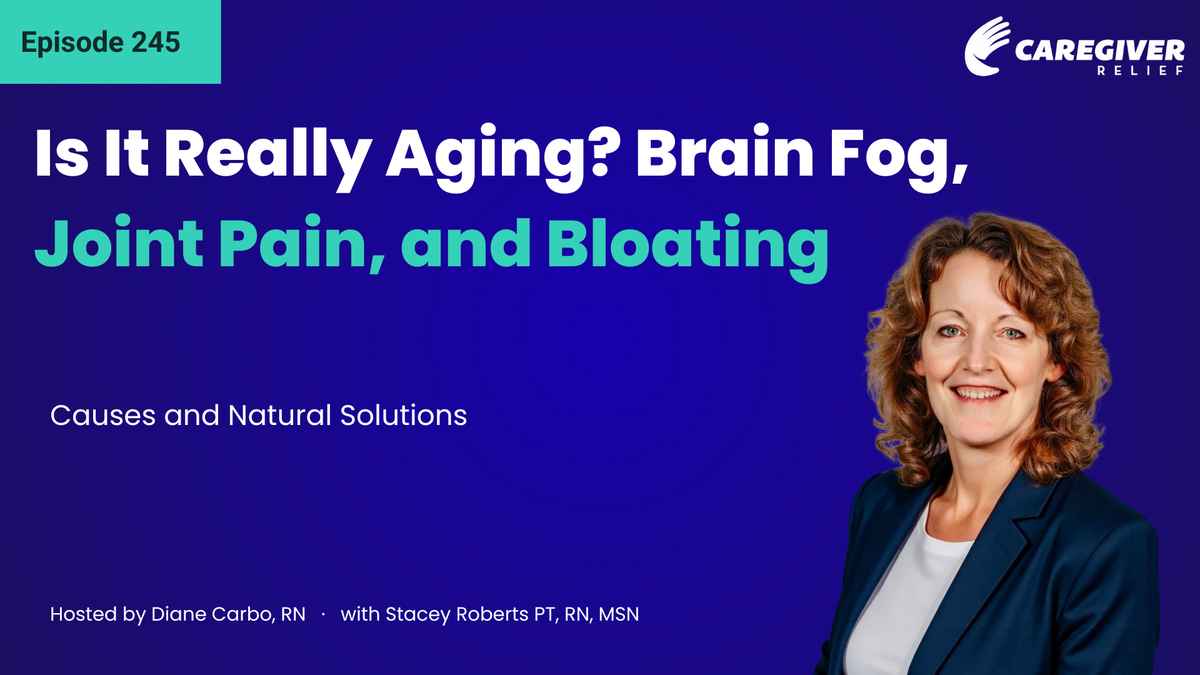
In the latest episode of the Caregiver Relief Podcast, host Diane Carbo, RN, sits down with physical therapist, functional medicine nurse, and author Stacey Roberts to break down why common symptoms like joint pain and bloating aren't inevitable—and how caregivers can start addressing the root causes naturally!
As caregivers, it is far too easy to put your own health on the back burner. But ignoring your body's signals can leave you burned out and living with preventable pain. Tune in to discover actionable, holistic strategies to help you feel like you again! 🩺✨

Episode Outline:
- Introduction & Guest Overview
- Host Diane Carbo, RN, highlights how caregivers often become the "invisible second patient."
- Introduction to Stacey Roberts (PT and master’s-prepared nurse) and her dual background in physical therapy and functional medicine.
- Debunking the "Aging" Myth
- Questioning the narrative that brain fog, joint pain, and bloating are normal signs of aging.
- Why biomechanics, nutrition, and hormone shifts (perimenopause/menopause) impact joint health and movement.
- Root Causes of Pain & Gut Health
- Exploring increased intestinal permeability ("leaky gut") and lipopolysaccharides (LPS) crossing into the bloodstream and blood-brain barrier.
- The role of food sensitivities (e.g., ALCAT testing) and balancing the gut microbiome with probiotics.
- Real-world case study: Resolving brain fog and achieving weight loss by addressing specific food sensitivities.
- The Pitfalls of Quick-Fix Pain Management
- Misconceptions around over-the-counter NSAIDs, long-term proton pump inhibitor (omeprazole) use, and pain medication.
- Understanding pain as a message rather than something to mask.
- Research update: How repeated cortisone injections can contribute to joint degradation and tissue tears over time.
- 4 Practical Steps to Start Feeling Better Today 💡
- Audit your diet: Track symptoms and evaluate common culprits (gluten, dairy, sugar).
- Keep moving: Engage in manageable strength training using resistance bands.
- Invest in proper footwear: Choose supportive shoes with a firm heel counter.
- Partner with the right care team: Work with providers who look at holistic, root-cause health.
- Resources & Closing Thoughts
- Stacey shares insights from her book, The Pain-Free Formula: Solving the Puzzle of Muscle and Joint Pain Without Surgery, Drugs, or Injections.
- Where to connect with Stacey Roberts (The Pain-Free Formula Podcast, New You Health and Wellness).
- Diane's reminder: Caregivers are the heart of the caregiving equation and deserve self-care.



 Barnes & Noble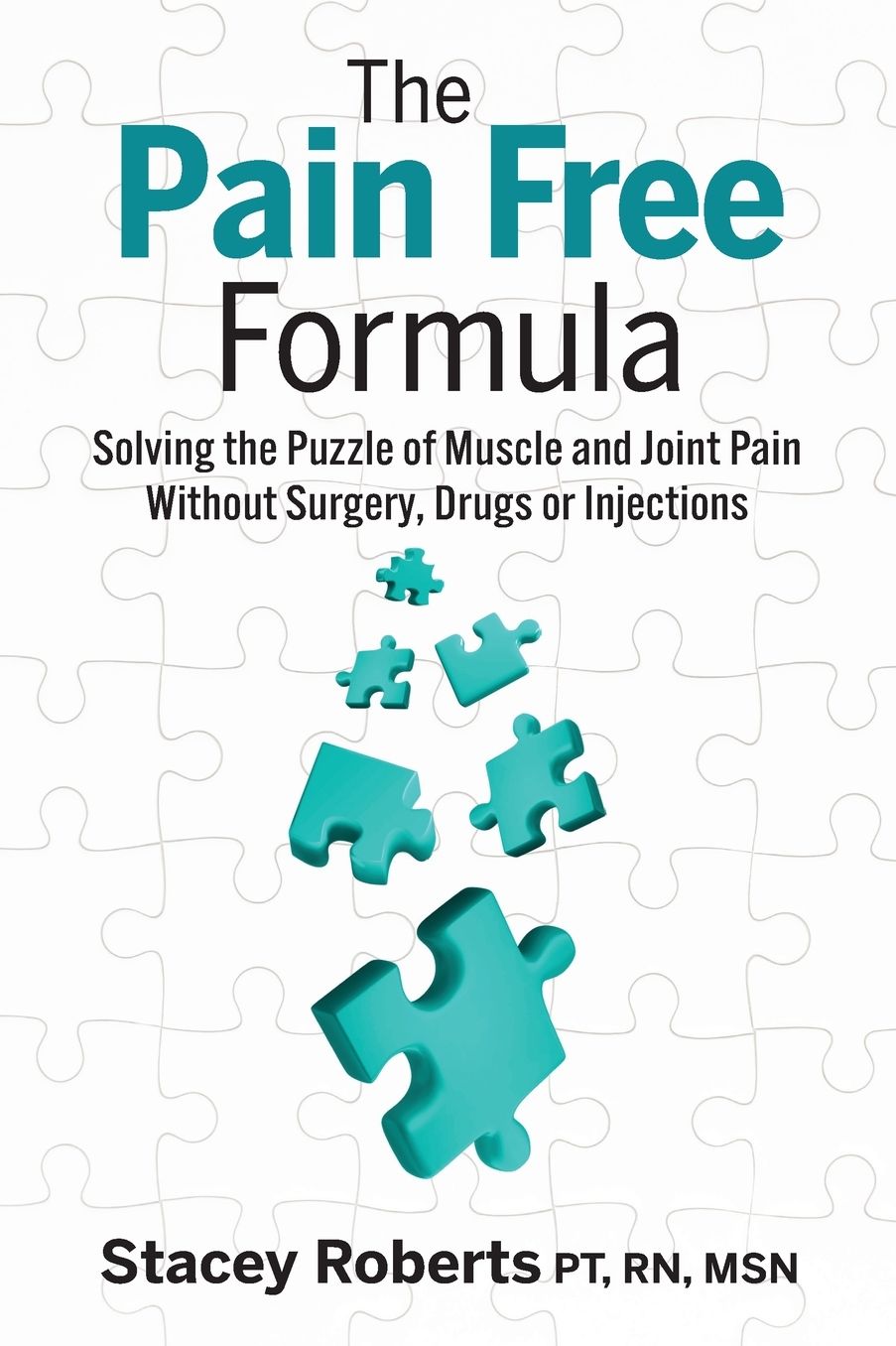
Don't Miss This Episode! 🎧
Ready to take control of your well-being and uncover what your body is trying to tell you? Hit play on the audio player above to listen now!
Podcast Episode Transcript
Diane: Welcome to the Caregiver Relief Podcast. I'm Diane Carbo, RN, your host. Today we're going to talk about something that so many caregivers and older adults hear all the time, "Oh, it's just part of aging." But what if it's not? What if the brain fog, the joint pain, the bloating, the exhaustion you're feeling are not something you have to accept, but signals your body is trying to get your attention?
As caregivers, we often become so focused on the person we're caring for that we ignore our own symptoms. We push through pain, we dismiss fatigue, we normalize not feeling well. But here's the truth: caregivers are often the invisible second patient, and today's conversation is about changing that. I'm joined today by Stacey Roberts, who is a very unique individual.
She's a PT and a master's prepared nurse who brings over 30 years of experience helping people uncover the root causes of pain and dysfunction, often helping them avoid surgery, medications, and injections altogether. This is a conversation about understanding your body, questioning what you've been told, and realizing that feeling better may be more possible than you think.
Diane: Stacey, I've been looking forward to having this conversation with you for a long time because you're a unique, individual. Were you a PT first and then went to nursing?
Stacey: I was a PT first for many, many years, over three decades, and then wanted to expand my scope of practice and decided to go into nursing to do that, so that's where I got my functional medicine part of my functional medicine training.
Diane: Ah, okay. I did rehab nursing, and we're a different breed of nurses.
Stacey: Yeah.
Diane: We look at things differently, so I was really interested in hearing your perspective. what led you to go into, functional medicine?
Stacey: Well, you know, years ago when I first started out in PT, patients were doing everything right and still not getting better, and I was always kind of scratch my head, And we oftentimes can use the excuse that they're not following through or they're not exercising or they're not doing what they're supposed to. But, there were patients who were doing what they were supposed to and still not getting better.
Diane: Yeah.
Stacey: I just started asking questions. And then first it led me down, how the brain changes and stress impacts the brain when you have chronic pain. Then it led me to, And it matched the stages of my life as well too, so as I went through perimenopause, I realized that other, you know, women who were going through that were having difficulty with joint pain as well too, and
Diane: Yep
Stacey: and, women who were having difficulty with, gut issues also had joint pain as well too, and so started to notice that those things were connected and realized that Biomechanics and movement, like what physical therapist specialty is, are a really huge component of helping people with pain, but it doesn't cover all the bases.
So that's what really led me down the functional medicine pathway to see what, what else can be done for these patients as well.
Diane: I want my listeners to know that functional medicine is the last frontier of good quality medicine in our country. It is... It takes a holistic approach. And as we're, Medicare has moved to and Obamacare has moved to a cost-sharing plan, so unless you are wealthy and can afford to pay the co-pays and for the treatments, you're not gonna get the care that you deserve, which I've seen for decades.
Nothing has changed in our system. The wealthy will always be able to pay for things. I have people, I have friends that were in the middle class that sold their house to pay for their cancer treatments and stuff. So I've seen that, and that's gonna continue to go on, and, because doctors only have a 15-minute window, under our present Medicare guidelines to be seen and get reimbursed for that visit.
I love that you're a functional medicine person. Now, I do. it's just, it's fine, it's just you take a holistic approach, and doctors used to do that when I first started nursing. you would look at a person, the, the family doc was a man who knew your whole family, they knew your history, they took time with you, and they got to know you.
And now it's in and out, they don't even know who you are half the time because it's very fast. let's talk about the biggest myths about aging and when it comes to symptoms like brain fog, joint pain, and bloating.
Stacey: All of those things we can have at any age. So it
Diane: Yes
Stacey: it really isn't, specific to aging.
Now, we might, be more apt to develop arthritis and, some wear and tear in the joints over time, but even that is being shown to be related more to gut health than it is to wear and tear, or at least, has an impact from gut health as well too. So it's, we gotta start looking and flipping the way that we think about things, and just that, oh, this is inevitable.
Instead, thinking about what can I do to be as active for as long as possible, and that is exercise. We all know that moving movement is medicine. We all know that. But we all don't realize that what we put in our mouths every day, what we're eating every day, and what we're able to get away with for many decades
Diane: Yes
Stacey: May not be what we can do today, to stay active for as long as possible. and our hormones, as they change for perimenopause and menopause, that has a huge impact on joint and muscle pain as well too. So if we can manage that well, then we also have a great opportunity to, get rid of or significantly minimize joint pain.
So again, we can stay active. We can pick up our grandkids. We can, you know, do the stairs without wincing and/or pulling ourselves up on the railing, you know
Diane: Yes
Stacey: or taking it one, one step at a time. We don't have to live like that, and there's many opportunities. And if you've exhausted all these efforts, there is the opportunity to do surgery or to do other things if that's the case.
But too many times, those are the first line instead of the last resort.
Diane: Exactly. I can't tell... I worked at Sister Kenny Institute in Minneapolis, for years, and I can tell you one of the things I realized, their low back clinic, people that would have back surgeries were coming back and having repeat back surgeries because it, they expected all the pain to go away, and the kind of surgeries they were having done was not relieving the pain to the degree they thought.
So they would go back again and again for surgery, and that was I thought, nobody's ever touching my back.
Stacey: Right, yeah, exactly.
Diane: And I do. Yeah,
Stacey: I feel the same way.
Diane: You know I feel the same way ... I have, back pain, neck pain. I tell people I used to pick up men for a living. Because, it- you did in those days. We did firemen's transfers and of quadriplegics and, you know, we worked with stroke and head injuries.
My young body, I was in my 20s when I was up there, I was strong and, but, one, one day, one little tiny lady with, oh, I can't think of the condition right now, but she was so tiny, 100 pounds soaking wet. She spasmed on me and my back, that was the first in- of my back injuries at- 28 years old.
And I'm like, "Ah."
Stacey: Yeah.
Diane: It is tough. It really is. but I, in those days they told us to lay around for six weeks. How does a mother of two lay around? Well, I'm glad I didn't, I couldn't
Stacey: Right
Diane: but that was the wrong thing to tell us to do anyway.
Stacey: Right. Exactly. They're, we're finding that out now, that movement
Diane: Yes
Stacey: is key. Movement within, your range, that's tolerable.
Diane: Yes.
Stacey: But definitely movement is key.
Diane: Absolutely. So what are the most common root causes behind brain fog, joint pain, and bloating?
Stacey: The most common is, your gut, right? So the foods that we're eating.
And a lot of people say to me, "Look, I've eaten this way all my life. Why now do I have to change?" because of the, that part of the aging process does happen, and we need to start to prepare our bodies for that. So we can't drink as much alcohol as we used to. We can't eat the foods that we used to. number one, they're made differently.
They look the same, but they're made very differently than they were, let's say, 20 or 30 years ago. So the chemicals and things in the foods are reacting to us that our parents or our grandparents were never exposed to, and they may have eaten the same way. so those things will impact the health of our gut, and it will, our gut can become leaky, or the medical term is increased intestinal permeability.
And when that happens, different small food particles can get into the bloodstream that shouldn't be there, and the body has an immune response to that to try to get rid of it. But if that's happening over and over, that can be a big problem with inflammation. Or a substance called lipopolysaccharides, LPS, can get into the system from the gut.
It's not really supposed to be there. We have a minimal amount in our system, but when that becomes elevated, that can get into the joints. That can get into the muscles. That can even cross the blood brain barrier and cause issues with depression, anxiety, brain fog, as you talked about. But the bloating is a huge, indication that there's an issue with our microbiome that needs to be addressed.
So we need to balance out our good and bad bacteria. and a lot of times it's based on the foods that we're eating. So what I tell people is, if you can get a good quality probiotic, about 20 billion-ish in regards to the CFUs or the colony-forming units that says right on there- And it goes away, then you're balancing out that, good and bad bacteria.
But if it still stays and you still have bloating, then you really need to look at the foods that you're eating that might be contributing to that or if you're not digesting those foods the way that you should. So there's so many different things that you can do to maximize. Or, some people don't even know they have things like a gluten intolerance or a gluten sensitivity.
Gluten intolerance can be tested, with an endoscopy as a definitive way where they go down your throat and see if in the small intestine there's any issues. But gluten sensitivity, there's no good test with that, so it's just staying away from foods like gluten. If you notice that bloating goes away or if you notice the joint pain improves, and adding in that probiotic and changing the foods that you're eating.
It's hard. People don't want to do that, but they also want to stay healthier for longer, so we've got to make some changes. we can't keep doing the same thing. What is that? It, if we do the same thing over and over again and expect a different result, that's the definition of insanity.
Diane: Exactly.
Stacey: So the same thing with our foods.
Diane: Yeah. You know, because of my back, I took, ibuprofen or NSAIDs frequently. And of course I knew to take them with food and stuff, but I still developed a duodenal ulcer.
That was in my 40s. And they started me on omeprazole. And they kept me on it. I was on omeprazole for decades.
And I can tell you right now, I had an endoscopy done and my son worked at, Mass General Eye and Ear, and he worked with an ENT guy who said there, that's really bad for you. You know, first of all, it depletes your, magnesium which impacts you so much. But the other thing that happens is it allows you to develop polyps in your stomach.
And that's what I started to do. And one of the things people don't know is not only is omeprazole bad for you, you should not be on it long term, but if you if you've been on it and you have to take, go off of it, it has a rebound effect.
Stacey: Yep.
Diane: And it will cause terrible, terrible stomach issues.
So, I did have the gut issues, and it took me a long time to get over that, and my stomach's still not right. But I'm taking Pepcid now and watching what I'm eating. and it really makes a difference. And I had even a, an issue with, I have a vagal nerve misfiring, and I get nausea and vomiting at times that don't make any sense to anybody.
So I am getting that addressed, but it's just unbelievable. but can you explain the connection between gut health and the symptoms, especially brain fog and inflammation?
Stacey: Sure, absolutely. So if your gut, like I was saying before, if you have a leaky gut, or, increased intestinal permeability, then these substances are getting into your system that are not meant to be in your system and can settle, like that LPS can settle in certain areas.
Like LPS, it crosses the blood-brain barrier, and that can contribute to brain fog. But just general inflammation. There's even foods that you can eat that you might be sensitive to and that you don't know. You might think it's healthy for you. I have many patients that are sensitive to blueberries. We all know that blueberries are healthy, but they're not necessarily healthy for everyone.
So if we're eating foods that we're sensitive to, that increases the general inflammation in our system, so it can cause brain fog. I'll give you an example. A patient of mine came to see me, and she was about 25, 30 pounds overweight. She had brain fog, muscle and joint pain, and she was only in her late 30s, and she's like, "I'm eating really well.
I'm doing everything I'm supposed to, and I can't get rid of these symptoms." we decided to look at, 'cause she hadn't quite gotten into perimenopause yet, so we decided to look at her food first through a food sensitivity test. Now, not all food sensitivity tests are accurate. The one that I use is called the ALCAT, A-L-C-A-T.
You can get it through a provider like myself. And that looks at 25, 250 different foods, takes your white blood cells, exposes it to the food, and sees how the, how your cells actually of your immune system react. And if they react severely, it's in one column. If it's moderate, it's in another. If it's minimal, it's another.
If it's not reacting, it's in another. we found out that white potato, blueberries, and another couple things were an issue for her. As soon as she started to remove those things from her diet, and we also rebuild the gut, we don't just remove things, we add in things that she's not reacting to so that we don't lose the diversity in her gut and we don't minimize the, our, we don't have significant nutrient deficiencies when she's removing these other foods.
And she started to notice almost immediately, along with we did the gut reconditioning program, probiotic, some herbs to help the mucus be created, the healthy mucus be created in the gut, and some fiber, in, for her gut, which we all know works well for helping, just general gut health, but can lower blood sugar levels.
It help with weight loss. Well, the first symptom to go away from, for her was the brain fog. And the first time I saw her after, after we started removing these, she had lost seven pounds without really doing much. And then we started really getting into the gut reconditioning for the longer term, and she lost a total of 35 pounds.
And she, you know
Diane: Wow
Stacey: was really doing a good job from the standpoint of getting back to exercise then, because she finally had the energy to do that.
Diane: Yeah.
Stacey: And so it wasn't as though it was this, she had to exercise till she, fell over. She really had a moderate exercise program where she exercised three times a week, consistently, doing something that she loved, moving.
But really all those symptoms were controlled and were, were gone away along with the weight by just changing some of the foods that she ate and rebuilding the health of her gut.
Diane: That's amazing. you take so much for granted, but when you start having tummy issues and I'm like, oh, my gosh, I just can't, you don't enjoy eating.
You walk around feeling yucky all the time. And
Stacey: Yeah
Diane: the brain fog is very real where, while I have chronic pain, it takes me longer to understand things or read things over multiple times before it sinks into my brain because of brain fog. And, with just some changes in my diet, it did, it improve.
You know of course, I have pain, and as long as I'm not in a, an acute crisis of pain of any kind, I do pretty well, but I still have my moments.
Stacey: Yeah, and A lot of it, it can be related to food. and the problem with, as we get older if we start reacting to certain foods, I have, I've had patients who come in to say to me, "I can only eat six foods," "This is the only things that I can eat."
And they're usually not necessarily the most nutritious.
Diane: Yes.
Stacey: So we work around building the gut so that they can add some of these foods in, and add the foods in that they're not reacting to so that we can, again, diversify what they're having, 'cause they don't know what else to eat. Anything else they try seems to irritate them.
So by doing these tests to see what doesn't irritate them helps to allow them to start, again, broadening their horizons a little bit. And then they start to get more nutrition, and that inflammation goes down. So if you imagine just inflammation like steam coming off the, the water that, inflammation is really creating brain fog, and making it hard for your brain to work efficiently. The lymphatic system around the body also is in the brain.
So if the brain, it's called the glymphatic system, so if the brain isn't able to clear some of the, some of the old, for lack of a better word, old stuff that your body needs to process to get rid of then that can accumulate, and that can lead to not just brain fog, but much more serious disorders as well too, including dementia and things like that. So we want to be able to have that glymphatic system, just like the lymphatic system that controls our swelling in our body, work efficiently because that helps clean up the areas in our system.
It's called autophagy, our body, ability to clean up after itself. And we want to be able to enhance those things by feeding. it's kind of like, you know, we feed our pets really well. We take care of our car. Put good stuff in our car so that it lasts longer. We have to reverse that when we look at ourselves and put the best things in our body for ourselves.
Diane: That's a good point. the majority of the, the average family caregiver, is 50 years old. There's some older and some younger, but the, and majority are women. There are men, but they're mostly women. And what are you doing at that age? You're either starting menopause, or you're, you're, some have had hysterectomies and they've already gone through menopause, but they have all these sign, like the heat, or hot flashes and, the night sweats.
These are, this is what they're going through while they're taking care of their loved one and maybe even have kids in going to college or in high school. And, women just ignore so much of their, the symptoms. What happens when these issues go untreated?
Stacey: Well, it gets to a point potentially where it's almost there's no way that you can treat them, right?
Where it becomes a chronic neurodegenerative diseases or, you can't reverse them, I should say. There's ways to treat them, but you can't reverse them. It just is you're wearing down and wearing down your body until you you don't want to get to the point of no return, right?
Diane: Yes.
Stacey: You want to be able to take care of yourself and manage. Now, you're not going to feel great every day. You're not gonna never feel pain. But that pain is a message to pay attention to whatever, whatever's going on. The bloating that you experience, the brain fog that you experience, it's a message.
It's a message your body's sending you to say, "Hey, something's not right here." And what then potentially can happen are things like the, like I said, the neurodegenerative diseases, but also, things like cancer. And once our immune system is depressed for so long, we don't have the defense against cancer, things like that.
So, things that we... And not to say that, just eating well is gonna magically cure cancer or keep you from getting cancer. I'm not saying that at all.
But if you want to minimize the chances of something happening, that's more of a chronic issue that can't be reversed, you wanna hedge your bet, and your insurance policy is what you put in your body and how you take care of the health of your gut.
Diane: Yeah. And again, it's a mixture. You... I'm loving that you can do this and not have to take GLP-1s, you know the fat drugs. because I have nausea and vomiting, sometimes on a regular basis, I don't know when it's gonna hit, the thought of having to take one of those medications to lose weight, it gives me anxiety.
Stacey: Yeah.
Diane: Because, you know, I've lost weight on my own because I've changed my diet and I still continue to exercise, and, keep busy. I think that's really important. But, I'd like to hear your what are some common misconceptions about pain management that people need to understand?
Stacey: Can I answer something about the GLP-1 first, though, before we get into that?
Diane: Absolutely.
Stacey: Yeah. So I think one of the biggest problems with the GLP-1 is that for someone like you, if you have nausea, you have some issues, right?
Diane: Yeah.
Stacey: And then they start on the GLP-1 without addressing those issues first.
Diane: Yeah.
Stacey: It just makes it you're being set up to fail, really.
Diane: Yes.
Stacey: So if you can address those symptoms first, if you can get rid of the nausea and the, stomach discomfort first
Diane: Yeah
Stacey: and then let's say you need help and assistance with the GLP-1, that's when you're gonna do really well on it.
Then you can, you don't have to increase it so fast to increase those symptoms that you would potentially have because of the history of those symptoms that you know. So there are ways that you can utilize it, but I think people are getting put on too fast without going through some steps first to prepare their body for it so that they can have a better reaction to it.
So I think, instead of just going in and saying, "I can't lose weight, I need the GLP-1," well- Let's walk through these steps first. Let's look at your eating plan. Let's get some, you know, good, make sure the nutrition is there, because nutrition doesn't magically change because you go on the GLP-1.
Right. And the GLP-1 from a pain management point of view, it does help to regulate inflammation, so it can contribute to, improving joint pain, but not if you're lacking the nutrients to support, a good, healthy muscle mass and, good, healthy, sugar response. All those things need to be addressed first.
So sorry, I just had to address that angle.
Diane: No, I'm glad you discussed that, because, one of the things, I have clients that are on them, and they're taking, odanastron Zofran, which is for nausea often during the, the week after they've been on it, even for months, and people aren't doing their exercises.
If you're going, as you get older, and that's one of my biggest worries, is I wanna stay strong, and you need protein. So I'm trying to maintain a decent amount of protein to, so I don't have muscle mass loss when I'm losing weight. And I only need to lose maybe, I can't believe I'm only saying this, but, it's, I only need, 15 pounds.
You know I've been really good. But, I have been overweight, but I've just, because of my gut issues, I'm not able to eat like I did. And you you are forced to, but I'm listening to my body. People just don't listen, or they think that they have to find another quick fix, and it's not that good.
A good, you won't have good results.
Stacey: Exactly, 100%.
Diane: Oh. Yeah. Let's talk about pain management. can you give us some misconceptions that people need to understand?
Stacey: Sure. That the first line for pain management, most people think is a pill, right? So the quickest thing
Diane: Yeah
Stacey: over the counter. They don't realize that even taking one of those can slow down your body's healing ability.
They're also taking the NSAIDs and things to prevent pain, which actually can work against them if they do potentially get injured or even tweak themselves be, tweak themselves while they're playing. what we wanna look at pain is as a message, right? We talked about that a little bit earlier. Your body's talking to you. So we wanna listen, and we don't wanna push through pain unless it's, there, there's certain types of pain. There's pain when you stretch, and that can be a very healthy, pain if you're trying to, increase your range of motion.
But if there's sharp, shooting pain in your joint and things like that really shouldn't be there or aching and numbness and things like that, you don't wanna push through those things. So you have to really learn the differences in what, which pain is okay, and then pain that you wanna avoid and stay within that, that pain free range.
But if we avoid pain completely by popping a pill, it's like taking the batteries out of the smoke detector. That fire's still gonna be going on, and we don't even, aren't even gonna know when it's gonna start. But at some point it's gonna burn you, right? If you don't have the warning to be able to say, "Okay, I need to make some changes here."
So I'll tell you a story of, it, because when I grew up, it wasn't about taking a pill, it was about go outside, and move around. Go and drink some water if I had a headache.
Stacey: Yes. Like that, right? Yes. Eat a banana. But I sought it,
Diane: yeah.
Stacey: Eat a banana. Yeah, that was it. Yeah.
Something like that. but there was a time where I was on a bus. I lived in Australia for a while, and I was coming home from, from there, and I was in Los Angeles, so we had to go from one terminal, international terminal, to a bus to the next terminal.
And across from me was a mother and their son, and I think I just paid attention to them 'cause I'd just left my son at home. he was 10 at the time, and that's, was about the age of the boy sitting across from me with his mom, and I was missing my son. I was coming home to visit my family, and he couldn't come 'cause he was in school. And we, the boy had his head in his hand, and he had his head down, and he was kind of like, "Mom, I have a headache.
My head hurts." And the mom goes, starts shuffling around in her purse, and grabs a pill out of there and says, "Take this." And the boy shakes his head and his hands and, "No, I don't want to." And she said, "Take it." And then he said, "No, I don't want to." And she pulled him, on his coat, pulled him really close and then he looked at her eyes and, when your mom gives you that look.
And she goes
Diane: Yep
Stacey: "Take this." So I just, right then and there I went, "Wow, society has really changed." That would just never happen, you know
Diane: Yeah
Stacey: 10, 20 years prior to that. But we've been conditioned to think, okay, get rid of that pain so quickly. Now, the boy drank some water along with that pill, and I'm convinced that the water probably would have just done it.
His blood sugar was probably low as well too after traveling all that time.
So all those things we have to think about. What are we doing that we're just not thinking? That we are convinced these, these over-the-counter medications aren't having any negative effect on us, but they are.
They're having a long-term effect. And I didn't realize that until I wrote my book, The Pain-Free Formula. It, when I was doing research on all the NSAIDs and pain meds, they actually, if you take them for long periods of time, they can actually make you hurt more. They increase your sensitivity to pain. So if I pinched you, Diane, at one point, and then you felt, "Ouch," and let's say that was a 3 out of 10, if you're taking these NSAIDs or pain meds for a long period of time and I pinched you in the same way, that may be a 7 out of 10 for you that time
Diane: Wow
Stacey: because of that increased sensitivity to pain. And people don't realize that. I think if they did, obviously they would, use them less or not at all.
And then it can also interfere with healing. That's the, also the big thing is it slows down the healing. Most definitely.
Diane: What aren't doctors telling patients about cortisone injections or, other common pain medications?
Stacey: So cortisone injections in particular, over the last five years we found out that they actually are degrading the joint.
So even the American Academy, I think, of Orthopedic Surgeons has degraded, cortisone to only a temporary fix, only temporary pain relief. And they used to give those shots over and over again. But what they now find is that's actually creating more degeneration in the joint, and they really don't get long-term benefit anyway.
Actually, they get a long-term pain or they're more susceptible to actually having a knee surgery. Or if you have cortisone injection in your shoulder for pain, you're more susceptible to having a rotator cuff tear within three to five years. So we're ... If people knew these things, we're supposed to give patients informed consent when they consent to a treatment, and patients should be told these things because we now know they're definitive in the research.
And I was going to an orthopedic one time where, I had hurt my knee and, she asked me, she said, "The only two things I can give you is a knee replacement or, a cortisone injection." And I didn't want the knee replacement because I only had one day that I had pain. I hadn't been issued, feeling pain for a period of time.
And she said, and I said I didn't want the cortisone injection, and she said, "Do you mind if I ask why?" And I thought, I'm just trying to be the, the patient here, not the provider, but okay, the research says X, Y, and Z. And she said to me, "Ugh, it would take 100 of those cortisone injections to do that."
And I was furious because I'm sure she's told that same thing to so many other people. And the data- The data ... the data from her own colleagues, her own
Diane: Yeah
Stacey: research colleagues shows the exact opposite.
Diane: Yeah.
Stacey: So it's really important that people know so that they can make that decision. That doesn't mean that they won't have a cortisone injection.
If you've gotta go on vacation tomorrow, you might wanna have one, but then just not have one again for, I don't know, the rest of your life. But you really wanna be very well-informed before you decide to do these things to your body, because who wants to set themselves up. Nobody would purposely set themselves up for a joint replacement.
Nobody would purposely do things that could potentially tear their rotator cuff, right? If they knew that, at least they can then make an informed decision about whether they want that injection or not.
Diane: Interesting. That's... I've always, I've known the cortisone injections are not good for you. And, I've tried to avoid them. I prefer to have the ablations, so that they can cut the nerves. But Medicare has changed the reimbursement, so they're rationing those. So they force people to take other, alternatives that may not be as good for them. Stacy, what are three simple steps someone can take today to start reducing brain fog, pain, or bloating?
Stacey: Well, take a look at your eating plan, number one. really try to minimize things that, I would say the big three, gluten, dairy, and sugar, right? So really take a good look. Start doing a food diary. Start writing down your symptoms related every day, and just see if there's foods that are connected to when you're not feeling well or drinks, like alcohol consumption, and start making those one cha- that one thing that change for, just a couple months, right?
Then start, continue to move, and you don't have to go and lift crazy heavy weights. You can just go and do some strength training with some bands. Get with a physical therapist or a personal trainer that understands exercise and how to move, and be- get, start to strengthen yourself, right? And then work up to, lifting heavier weights or walking further on the treadmill or walking further outside.
And also really from a standpoint of being active, get good shoes. Okay? Make sure that the shoes are very supportive, that the heel, when you grab the heel you can't squeeze it, right? That you can bend the front of the shoe so that you have the flexibility, but that heel keeps your heel in one spot.
That will help you all the way up the chain, your knee, your hip, your back. Everything will feel better if you've got a good supportive pair of shoes. So those are the things that I would do right away, right now if you're having, pain of any kind to, and try to stay as active as possible. And then the last thing, which is the fourth, is get with somebody that understands the body, understands the movement of the body.
And then also not everybody has the background that I do of the biomechanics and
Diane: Yeah
Stacey: functional medicine. So you might need to see a couple different providers to get the, support you need to get to the underlying root cause. So if you, like you, if you come off omeprazole, you can, what are you gonna do, to replace that?
'Cause omeprazole for years now has been decreasing the stomach acid in your stomach that you need
Diane: Yeah
Stacey: to break down foods, right?
Diane: Yeah.
Stacey: And that, that acid is protective of you as long as it's in a good level. So help, find somebody to help you rebuild that so you don't need to take that omeprazole.
And it's not gonna be, something that's gonna happen overnight. It's gonna take time.
Diane: Oh, it absolutely will. After being on it for 30 years and, you know, knowing about the rebound effect, you really have to be very careful.
I want to talk about your book. Talk about, I think that my listeners would benefit from learning about your book.
Stacey: Thank you. So the book is called The Pain-Free Formula: Solving the Puzzle of Muscle and Joint Pain Without Surgery, Drugs, or Injections. and I wrote it because of my own experience and my own frustration in that doctor's office that I was talking about earlier, and I really wanted to get the message out to people that if you feel like you've done everything, this is the book for you, 'cause it explains how conventional medicine deals with pain and what the downfalls of that might be.
Now, I'm not against surgery or drugs or injections, but those, again, shouldn't be the first line. So we talk about what... The second half of the book talks about what you can do instead of those things. so we look at, how movement, right? We look at something called soft wave therapy, which is a shockwave device that helps with decreasing inflammation or modulating it, we call, and it has a regenerative effect on your joints, so it's not tearing your joints down when you use it.
It's actually helping to rebuild them, right? And then we talk about, besides movement and soft wave therapy, we talk about gut health, we talk about food sensitivities, we talk about hormone balance and the importance there, and we talk about stress and how that can perpetuate pain and the symptoms that you were talking about before.
So it really is a holistic look into what the steps that you can take yourself
Diane: Yeah
Stacey: and in partnership with somebody, that can guide you to really help you be as healthy as you can be for as long as you can be.
Diane: And that's our goal for all of us is to stay as healthy and as well, and having a quality of life for as long as possible.
Stacey: Exactly, 100%.
Diane: Yeah. Stacy, thank you so much. how do my clients find you, or my listeners find you?
Stacey: Sure. So they could, get my book on Amazon, The Pain-Free Formula. They can listen to me on my podcast called The Pain-Free Formula podcast, or they can find me at my clinic called New, N-E-W Y-O-U, healthandwellness.com, where we show all the different things that we help support, and they can reach out to me from that website as well, too.
If they're not local, we could do, telehealth, and I can coach you through some things and help you find some people in your area that might be able to help you. But all those ways, and we're on Facebook and Instagram, LinkedIn, TikTok as well, too. so if you're on any of those channels, you can look us up at New You Health and Wellness.
Diane: To my listeners out there, I just want you to know we put a permanent page on Caregiver Relief with all that information so that you'll be able to find Stacy when you need to, or get her book, or get to her website. So thank you so much for joining me today. I really appreciate your information and knowledge.
It's... And I'm glad we were able to share it with my listeners.
Stacey: Thank you so much for having me, Diane. and I always say at the end of the podcast that I have is pain does not have to be a life sentence. So there's ways out there that you can really, change your life by looking at things a little bit outside the box.
But thank you so much for having me.
Diane: Oh, it was a pleasure. To my family caregivers out there, you are the most important part of the caregiving equation. Without you, it all falls apart. So please learn to be gentle with yourself. Practice self-care every day because you are worth it
Caring for a loved one can be overwhelming — but you're not alone. If you have questions, big or small, our expert team is here to help.
👉 Click here to Ask the Expert
Our Resource section can help you find the information and tools that you need. We have courses, videos, checklists, guidebooks, cheat sheets, how-to guides and more.
You can get started by clicking on the link below. We know that taking care of a loved one is hard work, but with our help you can get the support that you need.
Click here to go to Resource Section now!