Veterans First – VA Care Without the Wait with John Mozdzien - Episode 169
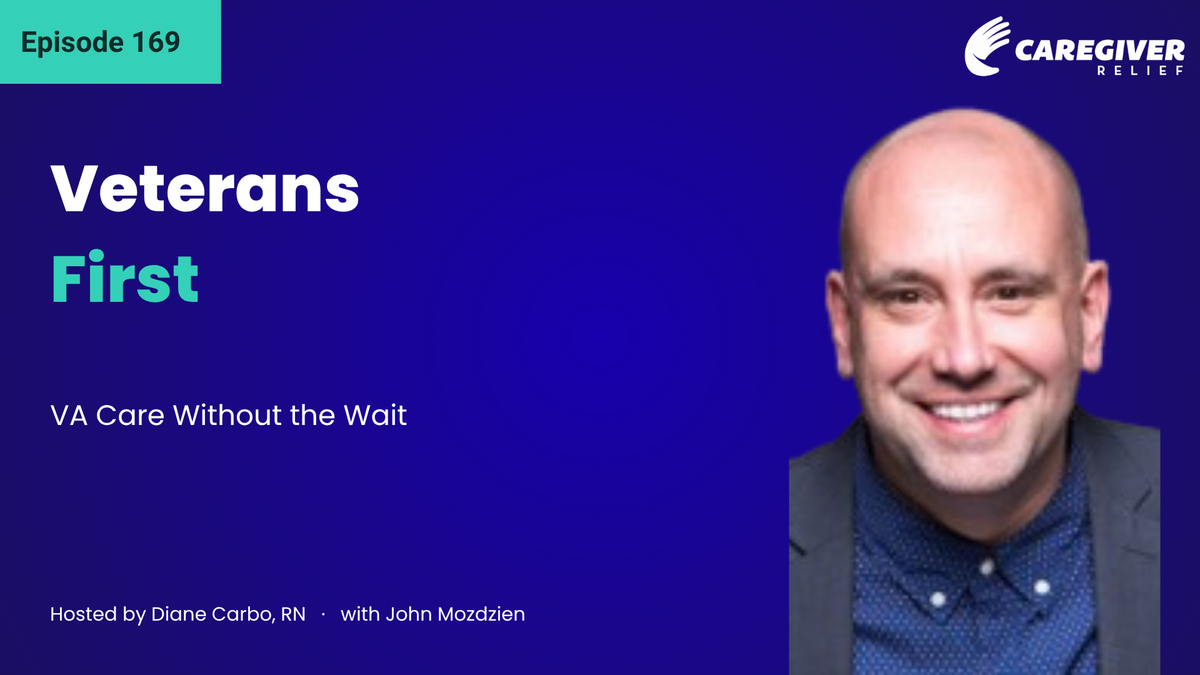
Are you or a loved one struggling to navigate the complex, often overwhelming world of VA benefits? In this episode of the Caregiver Relief podcast, host Diane Carbo sits down with John Mozdzien, a US Navy veteran and the co-founder of Veterans First US.
John shares his powerful mission to change the narrative for veterans and their surviving spouses by helping them access crucial, VA-funded in-home care—without the typical year-long (or longer) wait times. ⏳
🎙️ Episode Outline
- The "Hurry Up and Wait" Reality: A raw discussion about the frustrations of navigating the military medical system and the lack of advocacy for our veterans.
- Introducing Veterans First: How John and his partner founded a company to bridge the gap between needing help and actually receiving it.
- The Secret Sauce: How they provide in-home care immediately while the VA processes paperwork, and how they simplify the "Non-Service Connected Pension with Aid and Attendance" benefit.
- Dispelling Myths: Why you don't necessarily need to have served in combat to qualify, and why there is no "income limit" for this specific benefit.
- Advocacy in Action: John explains how his team handles the daunting, complex, and high-stakes paperwork so families don't have to face it alone.
- How to Get Help: A look at the eligibility process and how home care agencies can partner with Veterans First to expand access to care across 15+ states.
💡 Key Takeaways
- Don't Give Up: The VA process is notoriously difficult, but with the right guidance, it is possible to secure the benefits you’ve earned.
- Understanding the System: It is vital to distinguish between the VHA (Veterans Health Administration) and the VBA (Veterans Benefits Administration)—they often don't speak to each other!
- Proactive Care: Veterans First provides a "boots on the ground" model where they meet families face-to-face to ensure every document is perfect, preventing the common "go back to the bottom of the pile" scenario.
- Support for Spouses: Did you know that surviving spouses of veterans may qualify for aid and attendance benefits even if the veteran is no longer with us?

🔗 Resources & Next Steps
- Learn More: Visit VeteransFirst.us to check eligibility, become a provider, or donate to help veterans who don't qualify for traditional funding.
- Related Episode: Veterans First: Providing Independence for Aging Veterans— Further explore the mission and impact of Veterans First in supporting our aging heroes.


Podcast Episode Transcript
Diane: Welcome to the Caregiver Relief podcast, dedicated to giving family caregivers the tools, knowledge, and hope they need to keep going. I'm your host, Diane Carbo, rn, and today we're shining a light on a real game changer for veterans and their surviving spouses, getting VA paid in-home care without enduring the year long.
Ha ha ha. Or longer delays. My guess is someone who's made it, his mission to change that timeline. John Mozdzien is a US Navy veteran, co-founder and executive director of Veterans First US. Through veterans first. He and his team help eligible veterans and surviving spouses access customized VA funded home care, often starting in just 30 to 45 days.
Diane: John, thank you so much for joining us today.
John: Thank you. Thank you. Great to be here. Diane.
Diane: my experience with the military medical delivery system has been nothing short of hurry up and wait. they delay, and my thoughts are, and many believe this, that they're just waiting for us to die.
And so I'm really excited, that you have such an entrepreneurial spirit and helping our veterans, because when I saw the title, veterans First, that's an unusual title because veterans are never first, they're last on the totem pole. And I've seen it for decades. to kick things off, John, I'd love to hear yours.
Story, what was the driving motivation behind starting Veterans First?
John: Absolutely, Diane. So let me just dive in your comment right away. we thought in 2018, when we are trying to put this all together, what do we name this company? And I remember we sat together in a room and we said, let's keep it very simplistic.
Like Google, like Verizon,
Diane: Uhhuh.
John: And I said, how about veterans first? And it has stuck.
Diane: Oh,
John: from New Jersey to California.
Diane: I have to tell you, I got goosebumps when I saw that.
John: Oh, thank you.
Diane: I really did. Because, my story is both my sons were in the military. They both served in the Army. and, my oldest son was injured, developed a severe pain condition, and I helped him navigate the medical.
The military medical delivery system, which is horrendous. And he eventually committed suicide and died 14, almost 15 years ago. So,I know personally and professionally because I used to help,vets,I worked for a company that had a vocational head injury survivor program, so I would go to, I've been to Reed, Walter Reed, Bethesda Naval.
I've sat in on big meetings trying to advocate for these soldiers that were still an active military, let alone the veterans part of it. it was very enlightening to me at, that, so when I saw that you could do, you turned this around. I'm thinking, oh my God, let me, I have to learn about this.
John: Yeah. Yeah. I'm glad to be here and share some wis wisdom to all your listeners that, that tune in. Yeah. on a regular basis. So I'm, I'll dive right in. yep. We, I'm a service connected Navy veteran myself. I served on the flight deck of an aircraft carrier, back in 1999 on the US Harry s Truman, CVN 75, and my job was to launch aircraft off the catapults.
seen a lot of things, just learned a lot about life, things you can't. In the civilian world. Yeah. Because you really don't know someone until you're pressed up against the wall and you have no other options. Exactly. That's when you really find out who someone is. So transit fast forward some years now.
my, my business partner owns a home care agency. So we're a brick and mortar home care agency in the state of Pennsylvania, and I used to work for a large national company doing similar to what we're doing here at Veterans First.
And my position, unfortunately, but fortunately got eliminated and they made it all telephonic.
So my partner, his name is Eric Sesi, he said, John, you know the paperwork, you know the social workers, you have a good name in the marketplace. Why can't we do this here locally? Now Diane, I didn't know all the paperwork because they had all their trade secrets locked down. But
Diane: yeah,
John: when you fail in life, that's when you learn.
Diane: Yes.
John: And when you get denied on a claim In the military, like a lot of your listeners probably have happened.
You either A, give up,
Diane: yep.
John: B, you keep pressing on.
Diane: Yeah,
John: so we said, all right, we're gonna start this company Veterans First, and we help a veteran or a surviving spouse of a veteran, which is 60% of our census across 15 states that we actively serve.
Wow. We help them. Thank you. We help them obtain what's called a non-service connected pension.
With aid and attendance, because everyone knows about service connected. agent Orange, and you can be rated by 10%, 10, 20, 30, 40, all the way up to a hundred, which is called p and t, but no one talks about this little known benefit that's called non-service with aid in attendance.
So you could have a sweet surviving spouse out there that is 85 years of age that has dementia. And her dear husband, my fellow veteran, served in the Korean conflict, and guess what? She doesn't even know she qualifies. Moreover, her son, her daughter doesn't know she qualifies. Yeah, so we speak, our motto is very simple, but proven.
We speak over the phone to the next of kin to determine eligibility. Reason why we adopted that model in today's society, it's hard to trust people. So we wanna speak to the family member, not the person yearning for help.
Diane: Yes.
John: Yeah. A, after we hear they qualify, we have a team that helps them provide all the supporting documents that's needed to prove that particular case paperwork.
But we know what the VA wants, we know what they don't need, which saves time. Once we have all of the documents, we have a boots on ground model that I am so proud to talk about where in every single state that we are in, we will have an employee go out to meet with the family, face to face, eye to eye, to talk about this particular benefit called A and a aid In attendance, we submit a fully developed claim to the Department of Veteran Affairs.
And like you said before, the militaries hurry up and wait. Capital letters.
Diane: Yep.
John: While that claim is pending for two months, for four months, for 10 months, for 15 months, veterans First bridges that. Gap of time, that desperate time where folks need help right then and there. We allow my fellow veteran and or his surviving spouse to begin home care immediately with one of our licensed agencies that are vetted background check.
All insurances are in place, and when the VA gets around to it, and I say that in a polite manner when they get around to it because they're backlogged. Six months from now, the monetary benefit that the family receives, because it's against the law to go anywhere else, it has to go to either the claimant or the fiduciary if they're appointed one, and they can't manage their own financial affairs, right?
We have a signed agreement that those funds pay veterans first back in a retroactive manner from the date in which it was filed at no additional cost or fees, period.
Diane: Wow. Wow.
John: Yeah. And I, I still get chills talking about that because when I'm in a plane flying to El Paso, Texas
And I'm trying to learn my espanol and I'm sitting in front of just lovely people.
Diane: Yes. Yes.
John: And they're like, why didn't anyone tell us about this? Diane? Diane, and here's the fact of the matter. The VA doesn't have a marketing department.
Diane: Yes.
John: It's not like you're driving down the interstate and you see a billboard. My, my mom needs help. Call the va. It doesn't work that way.
Diane: No, it doesn't.
John: So that's the overview. of this, the qualifications, there's three criteria that they have to fall under. It's military service where the veteran had to serve at least 90 days of active duty service with one of those particular days in a classified war time period. They don't necessarily have to serve in combat.
They just had to be enlisted during that era one day. Medical, we need a signed release from their physician that they need essentially help. The term is called Activities of Daily Living, which is known as ADLs.
Diane: Yes.
John: And then the financial threshold, they're allowed to own one home that's exempt up until two acres.
And they're also allowed to own a vehicle that's exempt, but all of their assets that they have stowed away and accumulated their entire life cannot exceed a little over $163,000 that just went up with the COLA Cost of Living Adjustment and it follow Social Security nine times outta 10.
So that's what we do behind these walls.
We have amazing individuals that are surviving spouses of veterans. Wow. Family members that are veterans and I have the truly distinct honor to keep my naval service current by doing this.
Diane: That's incredible. I had all these questions to ask, but you've addressed them. I have to tell you , I'm, familiar with the ag and attendance program.
only not the non-service provider, but I can tell you that. I've had people wait as long as two years Yeah. For approval in the past. And, I know that many of my clients, and their caregiver, the clients, the seniors have died before the services even kicked in. Sadly, the family was never given any, compensation and they've put a lot of their own money and time in it.
And so that's why I have a very bad taste. For the va. that, but that's my personal experience as well, and I just can't imagine what family caregivers go through. Oh,
John: it's the stories we hear, Diane. it's very sad. and you don't know what you don't know in life until you're reaching for it.
Diane: Yes.
John: Yeah. And one big, not big, but something that. I'd like to share with everyone is there's three separate umbrellas, three separate administrations that the VA has. So when someone says, oh, I'm talking to the va, are you talking to the VHA? 'cause the VHA stands for Veterans Healthcare Administration, or are you talking to the VB Bravo vba?
That stands for Veterans Benefit Administration. And guess what? Those two don't speak to one another.
Diane: Oh dear.
John: So when someone says, I'm getting help from the va. Okay, great. Are you going to your local hospital to get assistance? Because that's great. 'cause Dr. Smith is probably doing a phenomenal job. But what about the benefits that you earned?
Dr. Smith isn't in charge of that.
Diane: yes.
I, I. Was over. We have, I'm here in Myrtle Beach and they have an outpatient clinic for the veterans over here. And I have dogs that I walk over there. It's a beautiful park. Yeah. And they had a be, an outdoor activity for the vet. So I'm walking around and I was asking questions to the social worker.
My, my son that's no longer with us had a terrible pain condition and at the time I was trying to advocate for the military to send him to Germany. To have ketamine comas because it, it was something that a doctor was doing in Pennsylvania. Okay. And, they wouldn't, they of course wouldn't do that.
but it's now the Veterans Administration actually is the reason why. Ketamine has been approved for, treatment resistant depression and PTSD. So they got this FDA approval in a short amount of time because it would help veterans. So I'm here I am at this gathering. I said to the social worker, I said, Hey, do you know there's a ketamine clinic here in the community?
And he goes, yeah. So what? I said,the FDA or the VA worked so hard to get FFDA approved so that veterans would have access to it. And his attitude was one. they have a lot of things they have to do, all the paperwork, they have to do this and I'm thinking strangulating, government regulations.
And there was not one ounce of concern. And at that group, I had met so many people who had lost their
one suicide.
John: I would've walked out.
Diane: Yeah. Oh, you know what? I had the dogs with me. It was an outdoor thing. Okay. And, what I said, I can't repeat here.
John: sure. And that's saying the right thing to the wrong audience.
Yes. I, we can be speaking right now, and there can be people listening to us saying, yes, that makes sense. And there all could be another side saying, no, I disagree. And that's okay too.
Diane: Oh,yes. My experience goes all the way from. Madigan Army Medical Center in Tacoma on a personal level with my son too, dealing with the active,or even the veterans of.
Of, that had head injuries and were trying to get benefits, I learned, you have to, it's an arduous process. You have to go to your congressmen, you have to go to your senators, you have to go to your local council people, and you've got to write and have them advocate for you. I did that with my son and it was horrendous because when a person leaves the political office.
You lose all your momentum. And I didn't realize that, but and I know family caregivers don't know how, they don't have the energy, they don't have the knowledge. I'm an advocate and I'm a mama bear. so when I needed it. Jeff used to tell me, mom, you've got five star generals raining down here.
What's going on? You've gotta stop it. And I said, oh, hell no. Yeah. Yeah. But, I wanna talk more about the, this veterans first because it is growing, John. And I know you had said you really wanna be careful about, you wanna be consistent with the growth because you don't wanna get things out of hand.
Correct. first tell me, how does the actual in-home care begin and how does someone apply through your program?
John: Yeah, that's a great question. So all of our referrals come to us internally.
Diane: Okay.
John: And I'll expand on that. But what I want to say right away is we do not call a veteran or surviving spouse to solicit.
What we do? Yeah. All of our referrals come from home care agencies, hospitals, social workers, discharge planners, and I can keep on going, but we utilize a, an electronic referral link. Our website. That's very easy. Www dot veterans first spelled out all one word, us
Wealth of knowledge on there.
but we have a referral length where we call the family to provide a welcome call within 24 to 72 hours of the date of that referral. That's a soft password. What? Thank you. Thank you.
Diane: Customer service driven. I can't believe it. I'm impressed.
John: it's this, everyone behind us does a phenomenal job behind myself.
Diane: Yes. Yes.
John: so we go over eligibility. Then the following day after that welcome call, we call them again to do a formal intake, and that intake is a deeper dive and then a customized welcome packet. Is sent to the family, telling them exactly what we need based on our conversation. Step one, step two, step three.
Once we have all those documents, we put together an FDC that stands for a fully developed claim. When that claim is all put together, that's when we schedule the home appointment where we go out to meet with the family face to face. We ship that to the va. When we ship that to the va, we send one of our home care agencies, an SOC, that stands for a start of care and a POC plan of care.
They coordinate with the family, care begins, and any it depending on what type of case. Diana, a surviving spouse, a single veteran, a married veteran, two married veterans. They could get anywhere from around six to 17 hours per week. Not per month, but per week. That is fully funded by this benefit. when you talked about how we want to grow efficiently is yes, we look for home care agencies all within.
A certain zip code area, and we want to have at least two or three. So there's overlap. Because if someone, if a, if one particular home care, a agency cannot take that case.
Diane: Yeah.
John: And we have the paperwork that we submit to the va. Now we're falsifying documents because care's not going to be provided.
Diane: Yes.
John: So there has to be a hall hands on deck Go Navy to approach this right now. so when we have a couple home care agencies, then we talk to social workers and discharge planners, and we explain our model because hospital professionals know how daunting this benefit is and how hard it is to get.
Diane: Yes.
John: So when I, myself, and other amazing members of our staff have the.
Opportunity to speak to face about this benefit and all the nuances it has. Yes. That's when folks say, huh, that makes sense. Let's learn more. And then all of a sudden we're in 15 states later, still actively growing.
Diane: I know from my personal experience, of dealing with the different groups of the va, I've had clients call me and say they lost my paperwork. They, they need, they've lost this, or they can't find that, or they need this. And I know that it's, and it may be like you think you're sent in your paperwork and everything's gonna start rolling along like a well-oiled machine.
And meanwhile it's the Tin Man at the, in the Wizard of Oz, whereas you take a few steps and he, it stops and got it, you have to be reboiled again. And it's so frustrating because caregivers are tired and they are, the burnout rate is. So huge and they get so frustrated.
And one of the things I tell 'em, and I really work with them hard on this, don't give up. We just, so I tell 'em, make copies of everything, two or three copies, put it together. so you have it. But what you're doing is making sure they have everything right there in front of them.
the game
John: right there. And it's not a loophole, it's just education.
Diane: Yeah. Yes.
John: it's, that's what it's,
Diane: yeah. and you know what? You make it easy so that the government bureaucrat at the other end has everything there. 'cause there, forgive me, my, my dad was a letter carrier.
I, I know people in the social security. I know government bureaucrats. God bless you. I appreciate you but. they have pa they need paper to paper. They need to have a, they have a little checklist to check, and if one thing's missing, you go to the bottom of the pile all over again.
John: They do.
And then on top of that, they don't call you and say, oh, by the way, you have paragraph one missing. Complete that, and we'll pick right up where you paused. They send a letter? yes. And it's called an IRN, immediate response needed. Yeah. And you have 30 days to respond to that letter, like the IRS, so when people get busy
Diane: Yep.
John: Those get pushed on the coffee table on the side.
Diane: Yep. Yep.
John: And it falls to the wayside. So that's what we do. We advocate the letters. When they come, they send the letters to us. We write a statement of support for them.
And like you said, we know exactly what the verbiage is and.
Diane: That makes all the, that's why some people go two years without any support because,they miss maybe a little sentence, one little paragraph or something.
They get a letter sent to them, which takes. weeks to get there by the time they generate the letter and get it right, then when the veteran or his caregiver gets it, they could be in a medical crisis. They could be doing so, have issues that they can't get the mail. So they do, they put it aside thinking absolutely, oh, it's okay.
I'm in line again. What they don't realize is until they respond or if they don't get to respond in a timely fashion. It's all back to the beginning again.
John: And that veteran or surviving spouse goes without that warranted care.
Diane: 100%. I've seen it. that is something, so I love your program, I love your platform.
Now and I know you want it to grow slowly, but how do home care agencies contact you to become a member of veterans First?
John: So on our website, again, I wish we had more avenues, but again, www dot Veterans First us, there's a link on there that says to become a provider.
Diane: Okay?
John: That comes right to our office.
We want home care agencies to have a minimum. Of three years doing business. It's unfortunate, Diane, but a lot of home care agencies go up and then they close their doors. It's not, they do an easy business to manage.
Diane: yes.
John: So we look for qualified agencies and all of their agencies have to have employees that are background checked levels of insurance have to be even slightly higher than state minimum requirements.
And I'm proud to say that. Because I know my fellow veteran or their surviving spouse is getting the best Absolutely. Care that they could. Yeah. As opposed to no disrespect to someone starting the industry, but they're just not ready yet.
Diane: Yes. Oh. I will tell you right now, one of the biggest things that I tell any of my caregivers that have in-home help is you always have to have a plan B.
Yeah. You need to have more than one home care agency involved. And they're like, why would I do that? Yeah. Because. Lack of staff, it, it happens. And we do, we have, and we're in a public health crisis right now because we have more seniors than youth and we don't have, our youth are our tax base, they're our workforce.
And we don't have enough of our youth to go around to provide care. So we really are in a dire situation right now. So you have to have more than one. and I love that you want three. I think that your, that is imperative because, with the aging population, it's here, and as their needs grow, home care is going to be overwhelmed.
John: Correct? Correct. and I'm not sure of what type of viewers you have on this, but from a business standpoint, a home care agency
This allows them. To build their book of business.
With someone that is not normally able to afford their private pay rate.
Diane: Yes.
John: And moreover, when someone calls and they're a surviving spouse
Diane: A surviving spouse cannot get home care from the va. It's only the veteran, either he or she. So what's, what they call is the homemaker program with Optum?
Yes.
John: and a home care agency can be a VA provider. That's great. But that's only for the veteran, either he or she. That's not for the surviving spouse.
But again, like I was talking about, there's a difference of VHA.
Diane: Yep.
John: Va,
Diane: yeah.
John: VBA can help surviving spouses.
Diane: Yeah. And again, it all comes down to the government. yeah, they have it set up. Nobody's talking to anybody else.
you said
John: it. You said it.
Diane: Oh, I've lived it. I've lived it and I know it all too well, and
John: Oh, you do?
Yeah,
Diane: I do. I've sat in on big meetings, here. Plan meetings and, there's this huge table with all these military dressed individuals, and not one of them can take responsibility for anything they say, we have to check with the higher up and every single meeting, and that's why things don't get done.
Correct, and correct the higher ups are afraid to make decisions, not when it comes to this stuff, because. I learned this was under the Obama administration. They were getting bonuses, administrations were getting bonuses for not providing care. So they were delaying, delaying, delaying to. That's awful.
That's awful. Yeah. and I've seen that. In fact, when I reported,I got Jeff to have care outside. Madigan Army Medical Center into Cleveland Clinic. And I'll never forget the Lieutenant General at the time, his, I'll say George was his name. he called me back and Diane, he says, you have just blew my budget.
And I'm like, oh, my GI said to him, George, what's really pathetic about that? My son's one soldier. You have millions of them. Yeah. and just in your building alone, you have several hundred. What in the world does that say about our government not putting money aside for our injured soldiers?
John: yeah. That's just. Disgraceful.
Diane: Disgraceful though. now John, how do people, support veterans first with donations?
John: So I'll point back to our website. Once again, we have a donation tab on there and I am proud to say, I'm glad you brought that up, Diane. When someone does not qualify. Let's say for example, they served during peace time after Korea, before Vietnam, we'll say 57 to 59.
But they still have dementia.
Diane: Yes.
John: And they're still under the asset threshold. Yes. We use a hundred percent. 100% of donations to pay a licensed agency. To go out to provide care to that person that doesn't qualify.
Diane: God bless you.
John: Thank you. God bless you as well too, ma'am.
Diane: I just, I, that, that touches my heart because,I know personally how many caregivers have been, totally given so much, and then they get that notice that they're waiting for a benefit and then they get it.
you didn't qualify. Yeah. and sometimes it's just one day, and they're like. Oh. and sometimes the, threshold for finances, they may be like $5 over. Sure. And they get nothing. And the def they are totally deflated. And I love the fact that, that you're helping them when they unneeded.
John: Thank you. Thank you. I wanna make a very important, vital comment here. Because I spoke about the asset limit. Yeah. Of 163,000. But I never said anything about income. The reason why, and this is so important for everyone to remember here, Diane, the reason why is there's not. Capital letters.
There's not an income limit for this benefit. If you go to ww.va.gov and look for income limit for aid and attendance, you're not gonna find one. The reason behind that is it's not about income, it's about quote, reoccurring monthly medical expenses. End quote. Wow. What you mean by that is you have to prove, let's say veterans first is not in the equation here right now.
And let's say there's a listener that is a strong advocate that says, you know what? I'm gonna do this myself and I'm gonna get it like I am.
Diane: Yeah. Yeah.
John: So you have to prove that your dear mother is paying higher reoccurring monthly medical expenses than she's receiving in gross monthly income.
Now, if you think about that for a minute, that's upside down. There's no possibly way. yes. You can do that. Yes. So the reason why we help so many people is being that we veterans first is paying for the care upfront.
Diane: Yes.
John: That becomes a quote, reoccurring monthly medical expense. If we did not do that, Then Mrs. Smith would have to pay for the care herself. All upfront, son or daughter can't help do pay for it because it has to come out of her portfolio. Yeah. So that's truly, and again, I wear my heart on a sleeve here. That's truly our secret sauce. Yeah. Is we are paying for that care upfront and we know how the system works.
Yeah. And you don't see a lot of companies doing this because it's so risky. Yeah.
Diane: Yeah. Yeah. It is. It is. And and that's when,I think that our government kicks the vets to the curb once again because they, yeah. They disappointed them and God bless those that serve and allow us to enjoy these freedoms and God bless that.
I'm sitting here and I can complain and bitch about. sure. Also, I think that you have an. Incredibly awesome platform. one last thing before you go, John. What states are you in right now?
John: without looking at an Excel spreadsheet? Diane? I know it's Pennsylvania, West Virginia, Ohio, Tennessee, Georgia, North Carolina, Alabama, Florida.
Texas, California, Illinois. Wisconsin and I'm leaving a feedback right now.
Diane: Good. That's okay. But you know that, that's okay. That's good. thank you so much for your time. God bless you for what you do. And for those, my listeners out there, you are the most important part of the caregiving equation.
Without you, it all falls apart. So please learn to be gentle with yourself, practice self-care every day because you are worth it.
Caring for a loved one can be overwhelming — but you're not alone. If you have questions, big or small, our expert team is here to help.
👉 Click here to Ask the Expert
Our Resource section can help you find the information and tools that you need. We have courses, videos, checklists, guidebooks, cheat sheets, how-to guides and more.
You can get started by clicking on the link below. We know that taking care of a loved one is hard work, but with our help you can get the support that you need.
Click here to go to Resource Section now!