Turning Heartache into Hope: How ZinniaTV Supports Dementia Patients and Their Loved Ones with Allyson Schrier - Episode 170
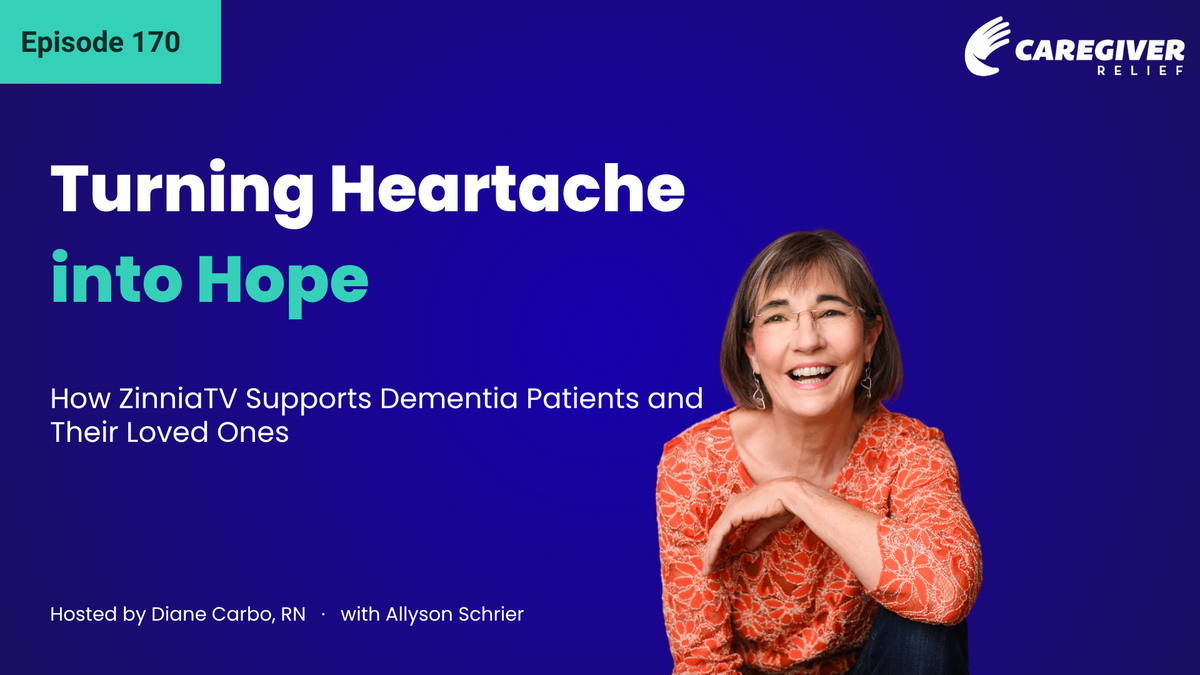
Caregiving for a loved one with dementia is often called "the long goodbye," but it doesn't have to be a journey of total isolation and stress. In this episode, host Diane Carbo sits down with Allyson Schrier, the co-founder of ZinniaTV, to discuss a revolutionary, medication-free tool designed to bridge the connection between caregivers and patients through the power of "gentle" media.
Allyson shares her deeply personal story of caring for her husband, diagnosed with frontotemporal dementia at just 47, and how that experience led her to create a visual tool that restores dignity and calm to the daily caregiving routine.
📋 Episode Outline
- The Genesis of ZinniaTV: Allyson’s transition from a family caregiver to a "Visionary Caregiver of the Year."
- The Problem with Modern TV: Why standard television is often chaotic and anxiety-inducing for those with dementia.
- The Power of "Visual-Verbal-Touch": How to use visual modeling to make activities of daily living (like showering or eating) easier and less frightening.
- Research-Backed Benefits: How ZinniaTV helps reduce "sundowning," soothes agitation, and promotes dopamine hits through interactive quizzes.
- Building Your Village: The importance of "respite with"—finding ways to enjoy time with your loved one rather than just seeking time away.
- Free Caregiver Resources: An overview of ZinniaTV’s educational series, including topics like anticipatory grief and preparing for end-of-life care.
✨ Key Takeaways for Caregivers
- 💡 A New Way to Connect: When conversation becomes transactional, use slow-paced, beautiful imagery to spark memories and emotional connection.
- 🧘 Alternative to Medication: Discover how specific video content can be a "first course of action" to soothe anxiety before reaching for pharmaceutical interventions.
- 🧠 Continuous Learning: Just because a person has dementia doesn't mean their brain stops being capable of processing new, interesting facts.
- 🏡 Preparation is Peace: Learn why educating yourself on long-term care and hospice before you need it can save you from secondary trauma later.

🎧 Why You Should Listen
If you’ve ever felt the sting of a "glazing over" look in your loved one’s eyes, or the exhaustion of the 4:00 PM sundowning hour, this episode is for you. Allyson and Diane provide practical, low-tech solutions that bring hope back into the home. 🌷
"Educated caregivers are better caregivers—and educated caregivers live longer, happy, healthier lives." — Allyson Schrier
🔗 Connect & Learn More
- Visit ZinniaTV: ZinniaTV.com to explore sample videos or start a free trial.
Podcast Episode Transcript
Diane: welcome to the Caregiver Relief Podcast, where we provide support, education, and inspiration for family caregivers just like you. I'm your host, Diane Carbo, a registered nurse with years of experience professionally and personally in caregiving. Today I am thrilled to have a truly inspiring guest.
Allyson Schrier is co-founder and president of ZinniaTV. Allyson turned her personal journey as a caregiver for her husband with dementia into a career dedicated to helping others. She's a dementia ed educator. A recipient of the 2020 Mods Award for innovation in Alzheimer's Care and was named Visionary Caregiver of the Year by caregiving.com.
She also sits on the Health and Medical Subcommittee of the Washington State Dementia Action Collaborative and Facilities Support Groups for spouses of people with dementia. Allyson,
Diane: thank you so much for joining us today. I'm really excited about sharing, ZinniaTV with my listeners because I've been following you for a while and I signed up and I get your emails all the time and I'm loving what you're doing.
Allyson: Oh, thank you so much. I'm loving what I'm doing. So that's two of us anyway.
Diane: I'm finding a trend that the. Most of the people that I have interviewed for, my website have been, spouses or family members who found a, a solution to a problem they identified, and now they're sharing it with others.
So this is exciting. I'd like you to share your personal story of that led you to co-found ZinniaTV.
Allyson: Sure. Happy to do that. and my experience, by the way, is the same, that most of the people who I meet who are in the dementia space have really compelling stories that, the genesis of which is their own journey through being a caregiver, to a loved one with dementia.
So my husband, Evan. Was diagnosed with frontotemporal dementia, behavioral variant when he was 47 years old, and my kids were just 12 and 15. So I went through this stuff that every new caregiver goes through, which is complete and utter disbelief that this is happening. And, com feeling completely, ill-equipped to take on that task.
And yet, there you go. You've gotta figure out a way to do it. So the what led to Zinnia was,a couple of different things coming together. I guess the first is that I, when visiting my husband, once he'd moved into long-term care, recognized that our connection was getting thinner and thinner.
We were unable to, talk because he was nonverbal. And the communication that we had was basically me paddling on about meaningless topics. So the conversations became more and more transactional. And by that that. I would just talk about the things that had transacted that day. gosh, you should see the price of gas.
And oh my goodness, boy, Tess is really having a hard time with whatever. And Huh, Ari is gonna be doing this in school, I wonder. And so there was really no, Depth to the conversations. So around that time, Diane, I had started thinking that maybe I needed to pivot my career because having been a stay at home mom for 15 years with a background in technology, there weren't a lot of technology companies who were waving their hand and saying, pick me, come up the best woman with obsolete skills.
Yeah. yeah. I, was leaning into like, how could I give back to the dementia community? I had started taking classes, I was studying, doing the Teepa snow certifications. I love her. And one of the things that I learned in my Teepa snow training was this concept of visual verbal touch. That when I'm going to support a person living with dementia, that I first visually describe the thing that we're about to do together.
Then I verbalize it. And then we actually do the thing. So for instance, if it's brushing hair that I will first brush my own hair. There's the visual.
The verbal is let's brush hair. Yeah. And then the touches that with their permission, I brush their hair. So I recognized through my training that ability to, connect with a person visually is really powerful.
And so what I discovered when supporting my husband is that if I wanted to talk about a topic. It would be helpful for him to engage if there was a visual component. So for instance, if we're going to talk about, I might bring something that was part a belonging of his Maybe a hockey glove.
Maybe we'd look at a magazine. Of, hockey or a catalog of hockey gear. Maybe I would bring in something that had to do with whitewater rafting because that was a passion of his. If somebody was going to talk to me, they'd be well advised to bring in flowers, for instance, or maybe my favorite pruners, right?
Something that I can really connect with. And so I thought, gosh, this ability to be able to actually see something really. Really promotes a deeper connection between the person giving and the person receiving care. So one of the things that I used to do with my iPhone is I would make little videos using apple's.
Apple has their memories product and everybody's who has an iPhone is familiar with the idea. These little videos pop up sometimes. Where Apple has in the background stitched together photos into a little video that is set to music. It's slow pace. And you can create them yourself. You can say, I wanna take all of the photos in my album that are dogs and I wanna stitch those together and I wanna set it to music.
So that's what I was doing, and we were able to pause with each photo, have a conversation about it. The fact that it was set to music was soothing. And the where Zinnia came from is that I reached out to, friends. Who were working at Apple and said, I need to talk to somebody who had something to do with this product that I'm using to create videos because I need more content.
all I have are pictures that I took. Of stuff like plants, my kids, my dog, but I would love to be able to stitch together little beautiful videos about hockey or about whitewater rafting or hiking the Pacific Northwest. How do I get more content on my phone? I was not looking at creating a product to distribute to other people.
I thought maybe I could share my videos with o with like other people in my support group. But anyway, the fellow that I chatted with had recently left Apple, and it turns out he was the designer of the product that I was using on my iPhone. And he said, oh my gosh, this is a use case. We never thought about the fact that these slow paced gentle videos could actually be compelling conversation starters when supporting people who are living with dementia.
Where do you live? I said, Seattle. And he said, I'm in Vancouver. Let's get together. Oh. So we got together and we talked and we said, let's do this thing. Let's create something to support caregivers. And so that, that was the genesis of Zinnia.
Diane: Wow, that's incredible. why do you believe ZinniaTV is effective in supporting both patients and caregivers?
Allyson: Yeah, sure. that's a really great question. So I'm gonna start by just telling you, a little story that will lead into the answer to that question.
Diane: Okay.
Allyson: So in the spring of 2025, I was invited to. Facilitate a panel at a conference hosted by the Michigan Assisted Living Association, and the title of my panel was Low Tech and No Tech Solutions for People who Are Living with Dementia.
The audience was people like me. They were caregivers, both professional and family caregivers.
The panelists were all people living with dementia. Wow. as you can probably imagine that if these people were able to. Get to Michigan
Diane: uhhuh,
Allyson: be on a panel, have effective communication, respond,They pay attention. Obviously they weren't that, they were not people who we would consider late in their, dementia journey.
So you would think that they could, they can handle day-to-day stuff. So I asked the question, what do you all like to watch on TV these days? And Diane, all but one of them said the same thing, which was, I don't watch tv.
I can't Exactly, yes. I can't watch TV anymore. Yes. They said that if I walk into a room and the TV is on, I turn it off. Yeah. Or if I'm in a room, or I leave. Because I have lost the ability to have audio and video that are coming in at speeds that are intended for healthy. Brain. Yeah. To meet in my head and make sense.
I cannot track the plot. I can't keep, I can't follow the characters. I am driving my partner crazy because I ask so many questions. It's just best for everybody. if I don't watch tv, and it feels like just. Chaos inside of me there is the anxiety of the, like I can't pay attention to this, but there's also the anxiety that's produced by the fact that once I could, and now I can't, and it's a reminder and it makes me feel bad and I've lost something that my partner and I used to really enjoy doing.
After dinner, we'd go watch a show. To relax now it's not relaxing at all. So we don't do it.
Diane: that's funny you should say that. 'cause I tell my family caregivers of those with dementia, keep the TV off because it's just too much of a stimuli and definitely don't leave the news on.
Allyson: Oh my goodness. Yes. And for a lot of people tell there are television programs that still work. I was just on a call yesterday with a guy. Who is a big Zinnia TV fan. he watches it with his wife and he said, we watch it now more than we used to. And he said, because we used to be able to still watch game shows, or we'd watch concerts or we would watch favorite shows that she knew the characters because she'd seen them so many times.
And he said, but even that is not working anymore. Whereas Zinnia really works. Like the benefit to then, which is really what you had asked about to, to caregivers and the people that they're supporting, because we consider this a caregiver tool that is simply routed through the television. So we have done lots of research.
We were extremely fortunate out of the gate before we even had a mechanism for delivering the videos. We were developing content and we were testing that content for two years at the University of British Columbia in conjunction with Vancouver General Hospital. And the findings that came out of that two years of research and six published papers were those benefits.
So number one. Zinnia videos are a great tool to promote connection and conversation between the caregiver and the person that they support, so it normalizes something that had once been a big part of their life, everyday conversation, and now there's a way to get back to that. It is a phenomenal tool for reducing and soothing agitation.
So somebody, we have caregivers who say, every day at about four, my wife starts to really break down. So at three 30
Diane: Sundoing. Yep,
Allyson: exactly. So at three 30. I put on ZinniaTV and we sit down together and we watch the flowers videos or the sea videos or whatever it might be, right? Whatever is appealing to her.
we also have people who, we have wonderful testimonials from people who describe the way that they have been able to in thees of anxiety. Pop up a video that is compelling and use Zinnia as a first course of action instead of instantly going to medication to soothe a person. Who is, struggling with, reactivity and high anxiety.
So that's the second use case is the soothing and reducing of agitation. And then the third use case from these studies is the ability of Zinnia to help with adherence, to activities of daily living. So if we go back to that idea of visual verbal touch, right? If I. and want to offer somebody a drink of water, maybe what I would do is I would pick up a glass of water, I would drink it myself, and then I would say, let's drink water.
And then I had them a glass of water. So I am modeling the thing that we're about to do to avoid any confusion about it, and also to have it be an invitation, not an instruction. So we have videos. Called, let's shower, let's use the toilet. Let's take medication. Let's drink water. And the idea is that we simply, if we're about to take a shower before we even to move towards the shower, we sit down together and we watch a video that is other people showering and enjoying it.
Dogs getting bathed. Babies getting bathed, right? Yeah. So that by the end of that video, it is not surprising or confusing when we then move towards taking a shower.
Diane: Brilliant. That is brilliant. and I like the fact that one of the things I really, I have caregivers, and you know this as well, that deal with, they struggle with giving that antipsychotic medication or sedating medication because then they become like zombies. They're unable to interact or, function on a normal level because they're sedated so badly and we lose. Our loved ones more and more as we use those medications. So I love the, approach of, and it's, this is a simple approach, that you use to calm people, before,and sundowning is such a challenging, difficult, situation for families to deal with day in and day out.
Yes. And they get, they're worn out, they're tired, and, It's hard to deal with people that want to wander or, and as they get agitated, they get abusive. Oh,
Allyson: yeah.
Diane: They, and aggressive. And it's very hard. I dealt with, I worked in many different arenas in the nursing industry and I did do, work in senior behavioral health and have dealt with.
Many dementia patients that have been violent, sexually aggressive, in a variety of different types of dementias. So I know how hard it is to, and the first thing you even the medical industry wants to do is the first thing they wanna do is sedate you.
and I hate that. I hate it. I hate it.
I do too. And so I love that you have an alternative to medications for managing challenging behaviors, and I think that's awesome. Kudos to
Allyson: me. I, yes, I do too. And things are like, the Center for Medicare and Medicaid are really making it more, Onerous on, for instance, in skilled nursing communities for, to use, they're making it more punitive.
Like they're, yeah. If you use, oh,
Diane: I
Allyson: know. Yeah, you get punished and so it's
Diane: important. Yeah. I have to find ways worked in. Yes, I've worked in long-term care, I've worked in senior behavioral health, I've worked in assisted living, and what I find is the government policy makers make these decisions like you don't sedate them.
You don't, restrain them. You don't do a lot of things and or you get zinged in your state surveys and stuff, right? What I find challenging for having been a caregiver, a professional caregiver. we get hit, we get attacked. people are aggressive, right? and are sexually inappropriate.
And it's really a hard to, challenge and family caregivers deal with this as well. And the problem is that, the government policy makers don't offer solutions like. Here's exactly one example. If they don't, they offer no solutions. And for an example, they, a lot of facilities, assisted living won't use fall alarms, bed alarms or chair alarms because,they just made that a policy.
So how do you know if the patient's getting outta bed? But they're also not willing to put them in a low bed, close to the floor where they can just roll out if they need to and be safer than to, to jump out of bed and fall and hit their heads and stuff. there's so much going on and what I see is you have a tool to address a lot of issues in a very simple, simplistic manner.
We do.
Allyson: Yeah, I agree. I agree. Yeah. Can I tell you about some of the content that we're developing now that I'm really excited about?
Diane: Absolutely, please. Yes.
Allyson: Yeah. last year we created, Some content that is quiz content. Now this is the little backstory here. So remember I had those little boys who were 12 and 15 when their dad was diagnosed with dementia?
Yeah. one of those little boys went on to do his master's degree in computer science. And this is a terrible time for people who are just out of college. Yes. To be looking for jobs in computer science. Yeah. So thankfully we have been able to have him work for us at Zenia, where he started off by creating an engine that would allow us to quickly produce.
Using ai. I know some, for some people that's don't say anything else, but it's worked really well for us to create
Diane: yeah,
Allyson: content that is this sort of quiz content where we will very have a beautiful image appears on the screen, and then a question with three answers, and then we slowly remove the wrong answers.
So all that's left is the right answer. These have been hugely popular, especially in long-term care settings, but we get families,writing testimonials about them as well. Because first of all, it creates an something for the caregiver and the person they're supporting to do together.
Yes, it's actual, it's an activity, although I would argue like every video is an activity if it promotes connection or maybe incites some activity, right? if we're gonna go for a walk, let's watch the dogs video first. And now when we go for a walk, we can see how many dogs we count. But anyway, so with the quizzes.
we just have such great testimonials from people who talk about the dopamine hit on the person with dementia, who's I got it. Yeah. Or people who were, they thought were nonverbal and yet they're shouting out the answers to these quizzes. So based on the success of that, we then created another body of content, which is called this Day in History.
And we create 365 videos, one for every day of the year. That is a like 15 minute or so video. That is an image from some iconic thing that happened today in history with a slow voiceover reading about that thing. Wonderful opportunity for a pause. And reflection. so do you remember this?
What were you doing the day that this happened? So tho those we just love. And then the newest thing that my son is, his name is Ari. The newest thing that he's creating for us are dementia friendly documentaries.
Diane: Cool.
Allyson: And I think that those will be really fun because the format will be, facts.
let's learn together, right? Because you know what? Yeah. You've got dementia and so your brain is losing neurons, but your brain is still capable of growing neurons. Yeah. So we want to continue to give people things to think about. Yeah. Things to process, things to talk about, and that is the goal of these documentaries.
Diane: Allyson, one of the biggest things that caregivers miss is the benefit of activities. that is the last on their list. They think it's fluff, it's unnecessary, and they really don't understand that if you get involved that your loved one And Into any activity that gives them a respite for even just a few, an hour, a 15 minutes, whatever, to just have a breather while they're having, doing an involved in the activity.
And, yes. it is the long goodbye for a reason. And one of the things is when you're doing something with your loved one, I saw this, I experienced this with my seniors in senior behavioral health,you're. Doing something with them and you can see the light go on behind their eyes and you have that mini minute or minutes of connectiveness where you say, oh my God, you're getting this.
And it just touches your heart, gives you hope that there're still there. And then later you see the glazed eyes again and they're no longer with us, mentally. And I love that, the types of activities you are providing, increase the opportunities for those moments of connectivity to occur.
Allyson: I do too. I do too, because I was there, right? Yes, I remember.
Diane: Yes.
Allyson: I remember how hard it was to find things that we could do together. there's this concept that I promote, which is the idea of respite with. So respite away from, we're all familiar with like I take my loved one to adult day and that way I get four hours to myself respite, or I have somebody come hang out at the house with them and I get time to myself.
But I think it's also important to. For there to be, respite that we do together like that we can do something that is restful. Yes. Yes. That is, that makes us feel normal. Yeah. That makes us appreciate each other. And so we need to look for those opportunities as well. How do we spend time together?
Diane: Yes. and you know what? That is so important and caregivers are so burned out and they keep trying different things and they really do ignore the benefits of activities. Yeah. And I love the fact that you not only provide them with a regular way of. Activities that will suit them and their family care, family member with dementia.
but you're also offering them, like I said, many respites where they're not having to worry is dad going to jump and hurt me, or is he going to, are we going to be launching and worrying about him wandering,or being aggressive 'cause you're doing it combing and it becomes fun. It becomes enjoyable and it gives caregivers who usually dread as the day goes on, the what they're gonna face.
You've actually addressed that and help them maybe not have to have that negative feeling of, oh my God, nights come it, Oh my gosh, it's nighttime's coming. Yeah. oh my gosh. I have to be, and they get all worked up and agitated and they're eating badly. they're, some drink, or pop, antidepressants or, relax muscle relaxants or benzodiazepines to calm themselves.
To deal with this family member. And yes, you provide a format and platform that, it's medication free and it's a beautiful solution. So I really love that.
Allyson: Oh, thank you. I'm proud of the fact that 80% of the, survey respondents, who are subscribers to Zinnia Report that Zinnia soothes their own stress.
Diane: yes.
Allyson: That, yeah.
Diane: And yes, and I don't know if, I'm sure you know this, but 63% of family caregivers become seriously ill or die before the person they're caring for does.
Allyson: Yeah.
Diane: And that is because of the chronic stress, the lack of respite, the lack of affordable respite on an ongoing basis. And it
Allyson: absolutely.
Diane: And it's really challenging. The other thing I like is I encourage my caregivers to create a care team partner group, where they have people come in and help you. Provide practical assistance, shopping or something. But I always encourage them, Hey, if you know somebody that has likes activities and will keep, do things with your loved one for an hour or two while you go off to the doctors or whatever, you need to incorporate that into your plan of care.
ZinniaTV makes it easy for anybody who wants to have an activity, to find a solution that works so that. Maybe somebody who isn't great at activities can cover for that person so that the caregiver can go off and do things that they need to do.
Allyson: That's exactly right. We have people who have Zinnia say on an iPad, for instance,
Diane: uhhuh.
Allyson: it runs on TVs or iPads, but
Diane: yeah.
Allyson: so that they will, for instance, take it when they're traveling and they have it in the airplane lobby. They will take it when they go to the doctor's office.
Diane: Oh,
Allyson: and when their sister-in-law comes to spend time, they can give them the tablet and say, here, this is how you use it.
It takes two seconds to figure out if he starts getting worked up. He really likes the fly fishing video. it makes it super duper easy. And also people in long-term care. Long-term care communities who keep iPads on hand so that when families show up to visit, they take an iPad with Zinnia into the visit.
Diane: that's a beautiful concept and it's encouraging families to reconnect with their loved one. And yeah, that's, that doesn't usually, and I can tell you from personal experience, when you're coming into senior behavioral health or you're coming into long-term care where you have a patient that is, not responding or getting .
It Gets sundowning and agitated. The first thing the families, families stop coming during that time because the nurses are saying, help take care of this. Whereas you provide a solution to, for both the caregiver and the their loved one.
Allyson: Yes.
Diane: and that's great. And it gives them an opportunity to have those, that connectedness again.
what resources does any a TV offer specifically for caregivers? I understand you have free education series or suggested resources.
Allyson: Yeah. Thank you for asking about that. So first of all, within zenia there are, there's a caregiver education channel. So there are lots of caregiver education videos, and these are based on, My experience. So what wound up happening, I mentioned that. I was like, I need to get a job. What am I gonna do exactly? and I talked about how I started doing tepa snow certifications. I then went on to, get certified in Washington State to teach the classes in dementia and mental health full day classes.
Each of them that are mandated for anybody who works in long-term care. And so for four years I was in long-term care communities, teaching professional caregivers how to support people who are living with dementia. I then went to the University of Washington. There's a group called the Memory and Brain Wellness Center, and I worked there for three years, helping them launch, and then I managed and another education program.
But this one, the students were doctors and they were coming in to a virtual classroom with dementia experts to learn more about how to support. Detect, diagnose and support their own primary care patients who are living with dementia. All of this to say that I have a deep passion for education, so we created our own education channel in addition.
Yeah, we have a monthly caregiver education and support, series where it's just a zoom call. We have, I have guest speakers. It's the same format that we use when I was at the University of Washington. Where there's a guest speaker who does a, anywhere from a 20 to 40 minute, presentation.
And then the room is opened to q and a. And the q and a out of the gate is related to the discussion topic.
After that, it's whatever, like what's working for you, what's not working for you, and we really rely on each other, on other people in the room to say, ah, I know what you're talking about.
I just experienced this with my mom. This is what we did about it. But what I really like about our educational series is that I am. Putting energy into creating topics that are not everywhere else. And there are things that I think are really important. So for instance, we just had a lecture that was about anticipatory grief.
Diane: Yes. Yes. It's very real, especially with dementia.
Allyson: Exactly. Exactly. And then there's like secondary trauma that goes along
Diane: With Oh, absolutely.
Allyson: So that's what that lecture was about. we have, our next lecture is going to be a person who is an expert in long-term care, who's going to talk about, how do you know?
When it's time to start thinking about long-term care, like there are many people whose attitude is, I don't need to know anything about long-term care because my dad is never moving outta the house. We made him a promise.
Diane: Yeah, we
Allyson: made him a promise that we would always keep him at home. But what happens when the caregiver gets sick?
But what happens when dad's needs. Exceed the caregiver's ability to take care of him. So I think that everybody needs to at least be aware of what does it mean to move into long-term care and what should you look for if somebody's moving into long-term care after that. Diane, our next session after that is gonna be one that I wanted to put on because it's a place, there are many places where I feel like I fell short as a caregiver.
We all feel that way. Yes. And this is about how to be with a person who's actively dying. I didn't know, the hospice, there was morphine and I was told to use the morphine. Like I, okay, I am so unqualified to do that, and yet there I am suddenly in charge of helping a person pass. And I did not know thing one about it.
and I remember when my husband like, was actively dying. I was thinking I should have read a book, right? I bet there's something I could have done to prepare for this moment. And I, hold that in my heart as something that I could have done better. And so it's really important to me that we offer an educational opportunity to caregivers.
You might be years away from that time, but it's, you need to know a little bit about it, or at least I highly recommend. Yeah. So anyway, yeah. So we offer these once a month. They're free. they are, on our website way, way down, and it's zinnia tv. Zinnia like the flower, Z-I-N-N-I-A. Tv.com and way at the bottom, there's a thing called support, and if you click on the support link, there's a link to register for all of our, classes.
Diane: One of the things I think you're addressing is our medical delivery system is broken, and we only have Medicare reimburses for 15 minute visit. And in that 15 minutes, our, the family caregiver or the senior. Has to tell them what's wrong. The doctor has to assess, document and, write an order or prescribe or a treatment or, continue to follow up.
But in that 15 minutes, they don't get to assess. They're not doing the many mentals like they should be. They're not doing things, to address advanced. Directives and we miss that. Yeah. In fact, I can tell you I've had, patients who have, or family caregivers who have their loved one that is wandering or, just unstable, but they keep getting up.
And one of the things, that the, primary care physicians, don't address is, what things that you can do to calm them. they're just like saying, oh, it's, they don't know what to do, the primary care physicians and or the nurse practitioners. So it leaves the family to fend for themself.
And right now we're in a situation where family caregivers are expected to do. Procedures, treatments, services, everything. Oh yeah. That was once provided by the healthcare professional.
Allyson: Right.
Diane: And it's having a big toll on them. So I love, that you have the resources because I can tell you right now, the resources, will help you as a caregiver know what's going on with your loved one.
At least learn about it. And then you'll be teaching the doctors because they aren't dealing with it on a day-to-day basis like you are.
Allyson: Yeah. yep. one of our lecturers was a doctor who came in to talk about how should you prepare for a doctor visit. what should you be looking for?
What should you bring with you? What are the questions you should ask? Yeah.
Diane: And that's, those are very important. I know I have a bunch of resources, free resources on my site, and one of the things is a question, eight questions you can ask the doctor when you get a new diagnosis. there's just things like that the caregivers don't know that we have to help them with.
Allyson: Yeah.
Diane: Now Allyson, for listeners who are just starting their caregiving journey, what's one piece of advice you'd give them to turn heartache into hope?
Allyson: the first thing I always suggest is building your village. You You just so yeah. Need to recognize outta the gate that you cannot do this alone.
That you need to have people supporting you. And they really, I so try not to use words like need and should, but in this case, I don't stop myself. You need to find. People who are going through the same thing that you're going through because your sister-in-law, you know your mom, your best friend, they have the best of intentions, but they don't understand what it's like to be in your shoes.
Yes. And so I always recommend that the first thing that people do is find a support group, and the second thing that they find is a reliable source for education because the educated caregivers are better caregivers and educated caregivers. Live longer, happy, healthier lives. Yes. 'cause if I'm able to skillfully
Diane: Avoid irritating my loved one with dementia, and if I'm able to skillfully bring them down when they are starting to escalate, my gosh, right there, you have saved yourself tons of anxiety, stress. Health issues. Yeah,
100%. Allyson, how do people reach out and find you?
Allyson: I always am open to email. I'm Allyson, which is A-L-L-Y-S-O-N.
At ZinniaTV.com. That's Z-I-N-N-I-A tv.com. Our website is ZinniaTV.com. people can watch sample videos there. They can download a, they can do a free trial. you do have to give a credit card, but you have 14 days to cancel it. So there's an opportunity to try it out Yes. And see if it works for you.
And Zinnia is, we have very intentionally made Zinnia, kept Zinnia affordable. So for family caregivers it's just. $70. It's 69 99 a year. So that's like less than $6 a month to be able to use ZinniaTV. And we work with organizations like New York State gives Zinnia a way for free to people who in certain regions.
the organization, hilarity for charity, Seth Rogan's, Alzheimer's Disease, like they give away Zinnia. So there are ways to find it for free if that is still too much.
Diane: Yeah. to my family caregivers out there, you are the most important part of the caregiving equation. Without you, it all falls apart.
So please learn to be gentle with yourself. Practice self-care every day because you are worth it.
Caring for a loved one can be overwhelming — but you're not alone. If you have questions, big or small, our expert team is here to help.
👉 Click here to Ask the Expert
Our Resource section can help you find the information and tools that you need. We have courses, videos, checklists, guidebooks, cheat sheets, how-to guides and more.
You can get started by clicking on the link below. We know that taking care of a loved one is hard work, but with our help you can get the support that you need.
Click here to go to Resource Section now!