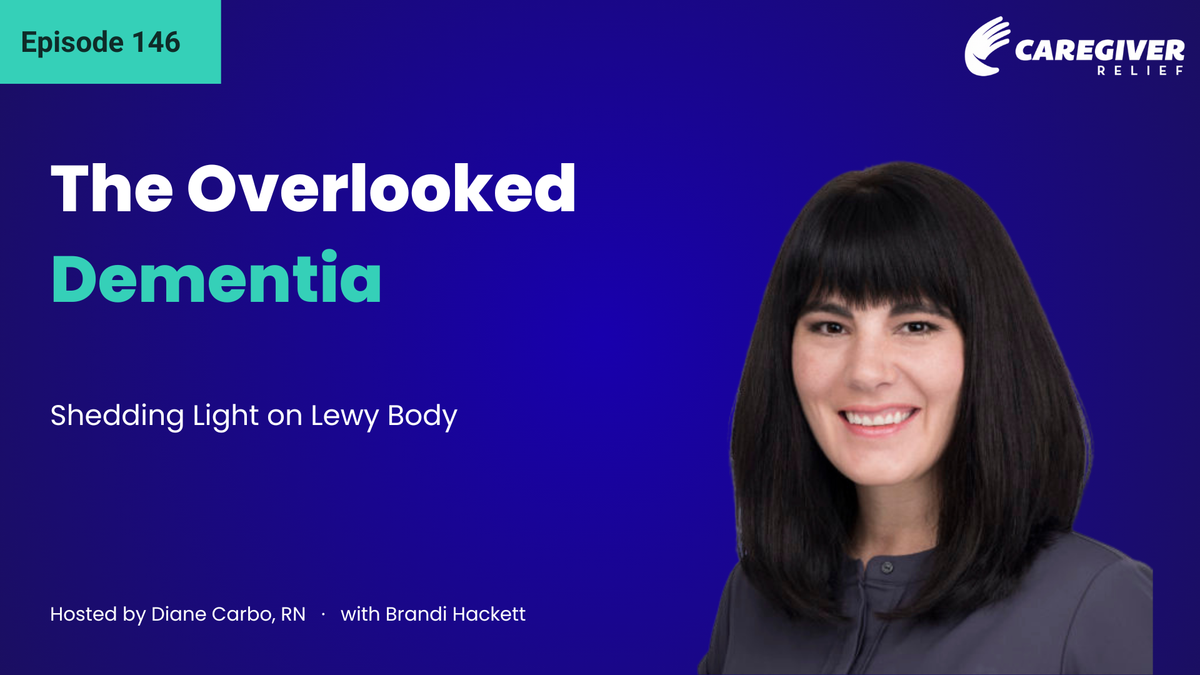
The Overlooked Dementia: Shedding Light on Lewy Body with Brandi Hackett - Episode 146
Have you ever heard of a dementia where memory loss isn't necessarily the first symptom? 🧠
In this powerful episode of the Caregiver Relief Podcast, host Diane Carbo sits down with Brandi Hackett, a Senior Manager of Support Services at the Lewy Body Dementia Association (LBDA). With over 20 years of experience in geriatric social work, Brandi helps us unravel the complexities of Lewy Body Dementia (LBD)—a condition often called the "overlooked" or "misdiagnosed" dementia.
If you are navigating a diagnosis that involves sleep disturbances, hallucinations, or movement changes, this episode is a must-listen.

🎧 Why You Should Listen
Lewy Body Dementia is complex. It is often described as an "umbrella term" covering two main conditions: Parkinson’s disease dementia (where motor changes come first) and Dementia with Lewy Bodies (where cognitive changes come first).
Because LBD involves so many different body systems—from digestion to sleep to movement—families often find themselves bouncing between cardiologists, sleep specialists, and neurologists for 12 to 18 months before getting a correct diagnosis.
In this episode, Brandi shares vital insights on:
- Early Warning Signs: Why acting out dreams (REM Sleep Behavior Disorder) can be a symptom appearing decades before a diagnosis.
- The "Ologists" Problem: Why it is so hard to get a diagnosis when symptoms are scattered across different medical specialties.
- Medication Sensitivity: Why standard anxiety or agitation medications can actually make LBD symptoms worse.
- Compassion Fatigue: Moving beyond "burnout" to understand the profound fatigue of the caregiver-patient dyad.
"It's a marathon, not a sprint. Individuals... are living many Tuesdays and Thursdays and Fridays... there is a lot of life there. There is a lot of purpose there." — Brandi Hackett

📝 Key Takeaways from this Episode
1. It’s Not Just About Memory 🧩
Unlike Alzheimer's, memory is often maintained longer in LBD. Instead, early signs often include executive functioning issues (trouble multitasking or strategizing), loss of smell, or vision changes.
2. Handling Hallucinations 👻
One of the most challenging aspects of LBD is visual hallucinations. Brandi advises against arguing with the person's reality. Instead, focus on the emotion:
- Don't say: "There is no bear."
- Do say: "I can see you are scared. Let's go to a safe place." The goal is to make them feel loved, safe, heard, and understood.
3. The "Diamond Lewy" Guide 💊
People with LBD have unique sensitivities to medications. The LBDA provides a resource called Diamond Lewy, a medication guide designed to help families and doctors navigate which meds are safe and which to avoid.
4. Support is a "Dyad" Issue 🤝
Fatigue doesn't just affect the caregiver; it affects the person diagnosed, too. Brandi highlights that support groups are available not just for caregivers, but specifically for individuals living with the diagnosis, allowing them to share their own journeys.


📢 Listen to the full episode now to get the tools you need to advocate for your loved one!
Podcast Episode Transcript
Diane: Welcome to the Caregiver Relief Podcast. I'm your host Diane Carbo, a registered nurse, and today's episode is titled The Overlooked Dementia Shedding Light on Lewy Body. I am honored to be joined by Brandy Hackett. She's a licensed, certified social worker. She's a senior manager of support services at the Lewy Body Dementia Association.
Brandy brings 20 years of experience in geriatric social work and a background in skilled nursing. Case management, end of Life Care and insurance navigation. She is a published author in the Journal for certified senior Advisors on the subject of compassion fatigue. And she regularly educates caregivers and professionals through workshops on dementia sensitivity and Lewy body dementia awareness today.
Brandy will help us understand what makes Lewy body dementia unique, why it's often misdiagnosed, and how families can find the resources and support they need.
Diane: Brandi, thanks so much for spending time with us today. I'm really excited. Before we dive in, into Lewy body dementia, can you share a little bit about your journey into geriatric social work and what led you to the, Lewy Body Dementia Association?
Brandi: Yeah, I'd love to, and thank you so much for having me. it's, wild. I've been a social worker now, for 21 years in May postgraduate, and I'll be honest, when I was in graduate school, I really thought I was meant to work with, Children and teenagers and, ended up, my internship supervisor actually placed me in a nursing home environment for an internship and I, fell just head over heels of love with, the advocacy, the care, the.
Our lack of care, the wisdom that was in that space in working, with older adults. And so I've really never looked back, since those moments I've spent the last 21 years, what I like to say in the mud with individuals in their families, as they are facing, Issues related to aging. for the Lewy Body Dementia Association, I just celebrated five years here in September.
Congratulations. Thank you. Thank you. and it was actually, my very first. Job in the nonprofit space. I have spent my entire career as a social worker in for-profit healthcare. Okay. so this was my first and ended up, being introduced to this job, through some colleagues. And, next thing I know, I'm sitting in the chair and, I've been very honored to be here for the last five years.
Diane: we're very blessed to have you in the Lewy body Dementia, association is very blessed to have you too, with that kind of experience. For our listeners who may not be familiar, what exactly is Lewy body dementia and how does it differ from Alzheimer's or Parkinson's?
Brandi: Yeah, that's, it's a deep question.
We could spend about two hours talking about it. I know. I'm gonna, I'm gonna give you what I like to call a rough summary. so Lewy body dementia, Many terms that we'll say is an umbrella term. So in the same way we'll say dementia is an umbrella term, Lewy body dementia really encompasses two different conditions.
Yes. One is, I'm gonna say the easiest to explain, so I'll start there. So one is aversion of Lewy body dementia called Parkinson's disease dementia often. So the person has an established diagnosis of Parkinson's and then later develops changes to their thinking and memory. Or as we know, dementia, and so sometimes that's called Parkinson's disease, dementia.
So Parkinson's first, dementia later. The other version is a little bit more complex, typically referred to as DLB or dementia with flue bodies. And that's when the dementia changes come first. And then alongside that, a person may have changes to their movement. Or ability to get around.
and so sometimes it's called motor difficulties or motor changes. so those can happen alongside or after, sometimes those changes are called parkinsonisms, which means it looks and acts like, but it isn't necessarily diagnosed as. so it's as one of our great, key doctors calls.
It's a little bit of a chicken and egg. Depending on the type, that you're seeing, but we at the LBDA take care of both types under that umbrella. So regardless of what type, we meet those families where they are.
Diane: So why is Lewy body dementia often called the overlooked or misdiagnosed dementia?
Brandi: I think for many it's because it hits so many symptoms. Yeah. we're looking at, Levels of complexity that we find are often followed by what I call different ologists. So you may have a GI doctor and a cardiologist, and a sleep specialist and a primary care
And you may throw in a neurologist at some point. Yeah. But sometimes it's hard for all of the doctors to come under. The same idea or concept, that this is due to one sort of central change of condition. And so sometimes it's the, trying to get all the ologists on board or all of the, consensus on board and we know that no diagnosis is in a vacuum.
And so often if a person has any other co-occurring conditions, it may be complicated. we also know that one of the key factors in this dementia are what's called fluctuations. And so it can be hard for any of us if we feel symptomatic at one point and then later in the hour, the day, the week. Have less symptoms.
And so you and I and everyone else wanna justify that to say, oh, I just didn't get enough sleep last night. Or, oh, this must be menopause, or, this is part of normal aging. Or, we could go all day, but we wanna justify the low. As anything other than this is an underlying neurocognitive change that will progress over time.
And I think even physicians don't wanna give that kind of news unless they're more certain that this is what's going on. So there's a lot of exclusion. Let's see what it's not, and let's see what it possibly is, and a whole mix of all of that. And so we see. There was a study done over a decade ago. It's usually 12 to 18 months for diagnosis, and we still see that it can take some time.
to really clarify, we're having symptoms to, this is the why behind those symptoms.
Diane: And I think the other challenge we have is Medicare has made it impossible for physicians to take a holistic approach. And you only get, they only get reimbursed 15 minutes for a visit. So in that 15 minutes, they have to see the patient, a address their issues, diagnose and treat.
And so I can see why it would take, 12 months. 12 to 18 months to get an adequate, diagnosis because there are so many different symptoms.
Brandi: Yeah.
Diane: I have a lot of compassion
Brandi: for physicians in this space. we're complex human beings and, what we're dealing with in general is so complex too and layered.
Yes. And, again, there's a lot of, I say this with love denial, like very few people wanna, raise their hand and say, this is definitely what I'm dealing with, or
Diane: Yeah.
Brandi: but it's, it's a lot on the shoulders of everybody. it's a lot on the shoulders of the Absolutely. Individual, the care partners and the physicians.
Diane: Absolutely. so what are some of the earliest signs families might notice that could point to Lewy body?
Brandi: Can just like anything, be a little bit of variety, but a couple of key things that we see sometimes decades before others would be changes to sleep. So there's a condition called rem, sleep behavior Disorder, where a person starts acting out dreams.
And that doesn't mean like literally, it's not like you could watch from the outside and you'll go oh, he's dreaming about A, or she's dreaming about B, but it's. When we dream, the brain is very active, but the body is intended to be still. We've got like the switch in our brain that keeps us still, even though our brains like it's awake.
unfortunately the switch for people will not work as well, and so they'll start moving, calling out. We've had people get up. I'd have, I had one individual unfortunately punch a mirror in the middle of the night. Oh dear. And Hit a bed partner. Lots of violence to the bed partner, of course, unintentional 'cause they're asleep, but it's, so sometimes that can be a very early symptom.
some people will have a loss of, smell, and other complicated, changes to, Sort of their brain's ability to interpret what their senses are telling them. so that includes smell. And we have other people that have changes to vision. so again, these aren't, when we talk about dementia, these aren't things that people are like, go, oh, this must be a dementia.
Yeah, because we talk about memory loss. if you ask anybody on the street, what's dementia, they'll say it's when people can't remember. Yes. And with our dementia, that's typically not what we see first, often. Memory is maintained a lot longer. It's a lot of the thinking issues that are more complex.
So it's sometimes issues with things like multitasking, strategic thoughts around certain activities. Sort. You'll see sometimes depending on age issues with, job performance. So you'll have somebody that's never had an issue all of a sudden on a performance improvement plan. and so there's difficulties in terms of some of the management of that day to day Executive functioning is the formal Yeah.
Title of that. But, we see that's often what people will start seeing first and then that's mask in these fluctuations. So that is not. Necessarily a consistent issue, but an issue that's surfacing and it seems out of nowhere. And again, like anything else, we're comparing to that baseline of the, of that same person.
So it's a change to the individual compared to how they were before.
Diane: you talked about the hallucination in vivid dreams that people can act out, unintentionally. can you, explain how a caregiver should respond when this occurs?
Brandi: Oh, we have an entire webinar on sleep changes in Louis, so please check that out if you want some real doctor's guidance.
it's awesome, wonderful webinar. But,there the REM Sleep Behavior Disorder is, something that happens of course when they're sleeping. visual hallucinations can also happen when somebody is awake, and so a lot of the strategy is, This is real to the person in the moment that they're experiencing it.
so a lot of the strategies aren't, a little less focused on reorientation or correction or, because the truth to them in those moments is very different. Yes. they're experience and so often what I tell care partners is, if we think about. The triangle of cognition, our thoughts, our behaviors, and our emotions all tied.
I just say in those moments, imagine the biggest hammer and the biggest nail in. Thought and cognition and imagine that's the part you can't change in those moments. So if you, if those parts were stuck, what could you change? And that's often sometimes a behavioral management in terms of how we respond or how we emotionally respond and take care.
so if you came running to me and thought you were being chased by a bear, and I said to you, there's no bear. But your brain is telling you otherwise. Yes. we are. We are already at a stopping point. yes. But if I were to acknowledge the fact that it's obvious that you're scared, it's obvious that you're concerned.
My guidance is typically we as humans all want to feel loved. Yeah. And safe and heard and understood. And those are two different things. and so listen to and understood. And so if we can as care partners take a step back and say. The reality isn't the reality I'm experiencing, but what would I need if what you Diane were experiencing was what I was experiencing?
Or what do I think you Diane would need in those moments to feel loved, safe, heard, understood, and then position the response from those seats. I tend to see that being, I'm gonna say a space of the least amount of frustration. It's frustration in general, but a, at least a space to start from.
Diane: I worked in senior behavioral health and I have dealt with people in, with the hallucinations and the vivid dreams and, I know families get upset, like, why aren't, you're feeding into their delusion, but it's not, I, if somebody came to me and said there was a bear, I say, Let's go find someplace safe space to be safe. Absolutely. and families go, why would you do that? Because they don't know. In their mind, they're actually seeing what is occurring. And and if we say no, they're gonna go on somewhere else. They're saying, get away from me. You don't.
You're not helping me. And the goal is to try to calm them and get them to a place where they feel comfort and safety. And, will interact, continue to interact with you until that hallucination, has resolved in their little brains. yeah. So it, it is challenging and, families, often argue, with the patient, oh, that's not there.
No, it is in their mind. Yeah. Even if it's for them. Yeah. Inclusion. Yeah. and that's really important that people,respond in a way that's kind and caring, because otherwise sometimes it can escalate into some very ugly, negative behaviors.
Brandi: Absolutely. Absolutely. And the other piece is I think a lot of people assume that hallucinations cause fear that a person is scared.
and yes. We have supported a number of individuals that experience realities in their mind that cause fear, paranoia, and sometimes they cause what would be what I call a normal reaction. So I often will say to care partners, they're often responding appropriately to what they think is true in their brain.
Yes. if I thought. I was getting a knock at my front door and I went to open it and no one was there and I heard a knock again, and I went to open it and no one was there As a human, I'm gonna feel annoyed. I'm gonna feel other feelings. Yeah. It may not be fear necessarily, but I'm gonna feel real things.
And so often as we're thinking about solutions or supports, trying to really remember that, the feelings behind. What any of us do to relate to the reality that our brain tells us is true, are real. Whether you're experiencing that reality the same as me or not. Yeah. and so I think, again, just remembering that often, if they're reacting appropriately.
And I have a number of individuals that will flat out tell me, I know this is, I know you can't see this. Yeah. But this is what my brain is telling. So sometimes there's even an awareness Yeah. That what they're experiencing is not the reality of other people, but it's still, again, real to them in those moments.
Diane: Yes. Yes. and it that's a rarity. In my Personal exper experience, but I ha I do know people that I have seen that where they say, I know this isn't real. But,and it's hard for them, and it's just having someone to listen to them and talk them through it.
Sometimes it, and it is just all they need, to get through that moment. Yeah, for sure. now movement symptoms in Lewy body dementia resemble Parkinson's. So how do they present and what makes those movements unique?
Brandi: I think they resemble or they are Parkinson's depending on the type of dementia that we're, supporting.
So often they are very similar. And again, I hate to quit referencing our webinars, but we do have another hour on movement changes. So do know we're gonna hit, very shallow dives into things that can, people can talk an hour over. But often when people, I think in the same breath, when people think about dementia, they think about memory loss and they're limited.
I would say the same with Parkinson's. A lot of people think tremor. And so they'll say, oh, they must, and or they'll say, no, they don't have any Parkinson's symptoms. They don't have tremor. Tremor can be a part. But what I would say I see more from my seat would be, issues with gait or walking, balance related issues, stiffening of muscles, sometimes flattening of a one's facial expression so the person isn't as expressive through their face and again.
Just like anything else that could be a real source of miscommunication. Yeah. If I'm telling you with my mouth I'm happy, but my face says otherwise. it's hard to judge, or if I say I'm excited that I look flat, that's a different, way that we're judging how people really feel as opposed to what they're saying.
So sometimes it's flattening a facial expression, shuffling gait, sometimes issues with posture, whether it be a lean or a stoop. again, issues with short steps, sometimes freezing. so it's bigger movement changes under that umbrella, not just tremor. but we do have individuals that have all of those, changes and sometimes again, with the fluctuations.
Both dependent on meds and otherwise.
Diane: Again, this is why it's so difficult to diagnose. Absolutely. And it's, and I recommend that caregivers, if you're starting to see symptoms, start documenting them and keep a list of what you're seeing and when, times of day and stuff. 'cause that will help the doctors also.
Give you a proper diagnosis. And I think that's really important. Yeah, for sure. Sure. And it help you advocate for an accurate diagnosis, sooner rather than later. Brandy, oh, I'm sorry. Go ahead.
Brandi: no. I was gonna, sometimes with families I'd describe that it's almost like buckets of symptoms and so you have movement, sleep, cognition.
Neuropsychiatric, which is not normally the label families call it, but it's what you and I will call it in terms of hallucinations. Delusions. Delusions, yeah. and then we've got autonomic, which a lot of people don't think or know a lot about the autonomic changes that can happen in terms of blood pressure, dysregulation, issues of swallowing, et cetera, et cetera, that some of the spacial issues that happen so often, the treatments and the techniques of support are attached to the bucket.
So for example, the cognitive changes in thinking and memory and otherwise may have medications that are attached to that bucket or treatment or supports or techniques, whether that be what the care partner can do or other professionals can do, such as physical, occupational speech, et cetera. But often they're attached to the buckets, which makes it a really hard and complex thing to understand.
as well as to explain, I have a lot of people that are diagnosed and their care partners try to explain this to other people, and they're like, but, because again, often they're thinking about Alzheimer's dementia. Yes. Other dementias. So it's just very different.
Diane: One of the things that I've seen, over the decades is, I have clients that, or patients that, because they have delusions or they ha or, and or have anxiety or whatever, they're treated with medications that are supposed to be calming.
And, improve their, help them alleviate their symptoms. And many of the medications that are normally giving to individuals, if you have Lewy body, you're having the opposite reaction. And sometimes that is when, the doctors realize, oh my, this is not, so when you have a para, like you're giving, somebody has anxiety and the doctor gives them Xanax, or I don't even know if they do this anymore because.
the benzodiazepines, but they give them medications to calm them. And the opposite works. they have agitation, increased agitation. it, they get real aggressive at times, and it's only because of. If Lewy body responds differently to Absolutely. Medications, absolutely.
Brandi: Not only a response, but a sensitivity.
Diane: Yes. And that
Brandi: may be a new sensitivity. They may have taken a med before and had no issue and then later have an issue. We have a beautiful resource that was, originally out of the UK that was, reformulated for here in the United States called Diamond Louie, and it is a medication guide that can provide some guidance for families as well as those conversations with their, medical doctors to look at again, the buckets of symptoms.
You'll see the guide, it's really split into the different buckets, but it talks about what medications are typically used, what research shows, what anecdotal evidence shows. Meds are typically used, and then meds as well to be, more cautious with, or to be concerned with. But it gives a little bit more guidance specific to Louie compared to others.
Diane: Now you've written about compassion fatigue and I love that 'cause people don't understand what that even means. how is this, especially Im impact the caregivers of those with Lewy body dementia? Oh.
Brandi: Compassion fatigue, in my opinion, is a better, word than burnout. and so I like the concept of fatigue because I think all of us can be tired.
Burnout feels like an end result or like a stopping point, which definitely care partners can experience a lot of pressure and reach those points at times, but I find. Most caregivers that I support, and also most individuals that are. Dealing with the change in symptoms also are fatigued.
They're tired. They're tired of the changes, they're tired of the ask. they're tired of what I call pivots. they're tired of the misunderstandings. They're tired of the advocacy needed. They're tired of not getting the support they feel they need. They're tired of having to ask for specific things that they assume people should just step in and do,dot.
There's a lot of fatigue in this, and I think. Looking at the word compassion is really,the love and care that I find most people intend to give. I feel that in many circumstances people are really doing the best they can, both the individuals that are absolute supporting the diagnosis and their care partners.
And so I look at that through the lens of compassion as opposed to through any other lens. Internally here in support of staff as well as what we walk individuals through and their care partners through, is more of that self-compassion. Really looking at the fact that, this takes a lot of love and care for everybody involved.
It is a period of change. It's a change to experience. It's a change to support, and it's often looking at it from different angles. I like to remind people sometimes the care partners are supporting and preparing for the lows and the person diagnosing are. Plotting and living for the highs. And so sometimes you're looking at the same situation from a different lens.
and so it's, it's a tough shift and I think a lot of people are surprised by how. How much we also talk about the dyad as opposed to just the care partners. I love care partner support and we do a lot of that, but we lead groups specifically for those that are diagnosed as well.
those with our dementia have. Ability for an extended amount of time compared to some of I'm gonna say the public's perception of them. Yes. which is very unfortunate. But also,I think a lot of people are shocked, but what we find is this is a dyad issue. and it's dyad fatigue.
It's not just fatigue at the care partner, even though that is very much a part of this, but everyone is really tired and so giving as self-compassion says a lot of grace.
Diane: To figure
Brandi: this out, alone and together. a lot of space to be learners and to teach And to be teachers and, just a lot of forgiveness because I think, like I said, in the majority of situations, we support it is, people doing the best that they can with what they know.
Diane: over the last 20 or 25 years, the baby boomers have been re, retiring and we're seeing more and more people diagnosed with the different types of dementia. And one of the things that's coming out of it is those that are diagnosed often want to share. Their journey and what they're going through with others online.
And, you're right. I love that, there are groups now for people with the different types of dementia Such as Lewy body that they can get together and share their experiences. Because we as a, healthcare providers, not just the, and the community learn so much more when.
The people that are have been diagnosed share their symptoms, their experiences with us, because it just helps us be better all around in regards to specific dis dementias.
Brandi: Absolutely. I feel blessed and privileged to have a seat at their table that they allow for that. Yes. That they give me. A view into the reality of the change.
Yes. that they're open and vulnerable and honest. And even if it's tough, they're willing to share and to lean on each other. It's, it's been really beautiful to watch. And, I will continue to advocate for those spaces because I think it also, it's the trickle effect when care partners are better supported.
They provide better care and when people that are themselves diagnosed feel better supportive, that it is, I'm not gonna say easier on the caregivers, but it helps that dyads stress level. we are, we have certain situations where we have, both the care partner and the person diagnosed or in support groups.
They both have Louie buddies, they're both on Facebook pages, they're on together things, they're on separate things, and they all go to webinars together. it's just incredible. Really looking at that whole system. it isn't just the individual. It's those that love and support them and those who professionally support them, and it's this huge ripple effect that can happen if good information and support is provided.
Diane: I agree 100%. I follow several survivors that have been, gone, are working through their journey. Not the just the caregivers, but the people diagnosed, with a specific type of dementia. It always impresses me. Some I, I've been following for years and, when they have bad days,
they still are able to share it when they get out of that period of whatever they're going through, or the caregiver or the person they're care that's caring for them will get on and say, Hey, so and so is being challenged today. These are what's going on, and we'll get back to you about what's happening, in when we can.
And I think that's really. Important too, that we can see that there are good and bad days and sometimes the, good days outweigh the bad. And that's important too because I think everybody needs to know that it can be cyclic for a long period of time.
Brandi: Oh, for sure. I tend to say this is comforting to some, not as much to others, but I tend to say it's a marathon, not a sprint.
Diane: I, that's, those are my words too. Marathon, not a sprint.
Brandi: and one thing that we focus on, and even our support group for those diagnosed our Facebook page, for those diagnosed, we call it, living with Louie, individuals living with the diagnosis is a point in time when they receive the label of the y of the changes they're experiencing.
That's a diagnosis. Yeah. yes, they have been diagnosed to be a part of this. Club, we'll call it, the space. however, they're living many Tuesdays and Thursdays and Fridays and Saturdays and birthdays and anniversaries. Holiday celebrations and there's a lot of life there. There's a lot of purpose there.
and so what we wanna do is give them tools and empowerment and education and support to live better with this because there is a lot of living with this beyond the label.
Diane: Thank you because people miss that. They miss it. There's still a lot of living to do and it doesn't mean that you're doomed to, to not have a better, a quality of life for a period of time.
And it's up to you and your caregiver to make that happen, by embracing all the good days.
Brandi: for sure. And it's not an absence of acknowledging the hard, I never wanna get to a space where it's, as I sometimes call sunshine and rainbows. there's real hard to this.
Diane: Oh, real
Brandi: hard.
Hard. And so when we sit with individuals, we don't want to take, shift the weight off of that. we wanna acknowledge the fact that this is hard. It is hard. To have a certain viewpoint of yourself and a lot of that change, it is hard to need to do something and have to come up with a creative new way to do it.
'cause your body doesn't do that anymore. It is hard to want an intimate relationship with your partner and have to make modifications because of shifts that are happening. It's hard when your care partner is able. Because they're dealing with their own things to have to pivot alongside you. There's a million ways that this is hard, but there are so many ways to find purpose and connection and love and support, and that's really what we wanna stay as focused on as we can, because it does.
I think sharing that hard makes it a little bit lighter. it's if I had 10 pounds to carry and I gave you five of those pounds, we're still carrying 10 pounds, but we're carrying a little less each person. Absolutely. So that's the hope in this
Diane: brandy, what resources and services does the Lewy Body Dementia Association offered to families?
Brandi: We have so many and I'm so proud. We are a small organization based outta Georgia and cover the us but we have so many rich and wonderful resources. I tend to forget. So I wanna start with them first. So I don't this time. we have a wonderful research team. They, help, the research community in supporting those, that are in the space as professionals that are doing research specific to Louis, but also help facilitate connections for individuals and their family caregivers to set research often as interpreters, as connectors.
Helping people to connect from A to B. often people have heard of research through and including brain donation, but they may be unsure, is that for me or is there something in my area? And so we have tools like our Louis trial tracker that can help people understand about research. We have great resources on our website to help people understand what studies are recruiting, et cetera.
So our research team does a beautiful job. Education team. I've bragged on them a few times already with our webinar series and a host of things, but we have so many platforms of both, individual education and professional education. we have a wonderful platform for our webinars called L-B-D-A-T-D on YouTube.
That has all of our past webinars and we are constantly providing new webinars. we offer once a month and you'll see all of those posted as well as how to register for those on our website. we also have different platforms such as Flix, our Louis Learning Center, as well as the YouTube page. and then we have lots of different other vehicles of learning such as our.
Again, our website, which is wonderful and constantly improving our, monthly newsletter that can give highlights and updates. And so just a rich way to have lots of touch points. we also have social media pages where people can keep pretty current. That's a great place to hear live updates on a lot of things.
and so that's a lot of the education department and our marketing department. and then here in support, which I am so honored to lead. We offer our helpline, which we call our Louis line, and I'll provide that information in case anyone wants to reach out so they can reach out to us through our helpline, our Louis line, or our support email, or through our contact us page on our website.
It'll all come here to support, and we respond Monday through Friday, nine to five. We also have our Facebook pages that are closed, which is a little complex. I hate that word 'cause it feels if it's closed, how do I get into it? But closed just means you have to answer some questions and be admitted in Yes.
But we currently offer four different closed Facebook pages. One just for care partners, actively care partnering. One just for those diagnosed. Through their own Facebook page and profile one is, which is a dyad page, which means care partners and or the person diagnosed that are new to the diagnosis within the first two, two or three years.
And then our last page, we just started a couple years back, which is for bereaved care partners. So those that have lost beautiful, a loved one, yeah. With a Louie diagnosis. And so we have all of those. We have. Goodness about, 90 or so support groups, virtually offered some in person, some hybrid, but most remain virtual in this space, that are state specific and ran by volunteers.
we have, our Lewie buddies, which is a mentoring program where we in support, can help connect care partners or individuals that are diagnosed with others that are either on this journey or have been on this journey to be telephone buddies so that they can. Get to know. and a lot of people, again, are shocked that we have individuals that are diagnosed that perform in that role.
Which is such a beautiful gift. Yes. It's to be able to allow someone to feel less alone. Yes. 'cause often they don't know anyone else. They've never even heard the term, much less know anyone in their community. I feel like I'm missing one other thing. Oh, and I talked briefly. We do have, the resources specifically for those that are diagnosed. So we have, multiple support groups as well as the Lewy body, program for that.
Diane: I'm going to share a little secret, our story with you. I started my first website, it was called Aging Home Healthcare, and I was doing research on all the dementia groups. And it's about 20 or 25 years ago I called your office.
Oh, and you guys were just starting out. So I have watched over the 20 or 25 years how long it is. Grow and expand and provide amazing services. this is, it's really awesome. I'm really excited and proud how you have, you guys have grown to such a degree and provide so many services.
To those in need because we do have,a silver tsunami here. Yeah, sure. And so many are going to be, needing your services. So if a family listening today suspects Lewy body, what are the fi first steps they should take to get support and guidance?
Brandi: Yeah. so I would recommend reaching out to the helpline.
so our Louis line, they can call and leave us a message and we will respond as quickly as we can, depending on the volume of the day. and I'll give you that number 1-800-539-NINE 7 6 7 is that number. They can also reach out to us at support at the word support, S-U-P-P-O-R-T at. lbda.org, which is our website tagline as well.
So support@lbda.org. Both of those come straight to our support team. we have a small team and one of us, myself, Mia or Jennifer, we'll get back to you guys and just, Meet the family where they are. So if they are symptomatic, not diagnosed, if they're,just trying to figure out where to start.
If they're looking for connections, if they have certain symptom questions, we can't provide medical guidance, but we can point them in the right direction. Make sure to email them content to start with. Help them find a good starting place. And again, we stay involved. So I have individuals that I just responded to, a wife today, talked to her about three weeks ago through email with a separate question.
And so we stay available and so we have a lot of. People that call us back to say, Hey, we talked two years ago, now this is going on. What do we do now? Or, Hey, you mentioned this and now I'm ready for that connection. Can you help me with that? And just like most conversations on a one time thing.
It doesn't have to be with us. So we invite people to continue to engage with our support team as well as, keep up with the webinars, stay involved and connected in other ways because things are changing and growing, like you said. if you had called us 20 years ago, it's a very different space than it is right now.
Oh, it really has in five years. It's been different in five years. So it's,yes. It's, some incredible growth and change as well as the research is progressing. So it's a great way just to know what's coming, what's happened. If you would've called three years ago, we might not have had Diamond Louie to give you, but now we can.
And so it's good to continue to stay connected so that you can know what's in the up and coming. and there's just so many great and exciting things that are happening day after day.
Diane: Brandi IC. When we're done with our podcast, I create a page, a permanent page on caregiver relief.
Oh, thank you. So all this information will be there for forever, so I will have links to the D, various things, and the telephone number. Don't change it. No. I'll send you a cheat sheet that has it all listed out so you'll have all that
Brandi: together.
Diane: Yeah, I think I have one platform or one PDF you sent me, but if you wanna send me that, that'd be great.
Sure. Because I can put that information on that permanent page. Sure. Thank you. Thank you so much for taking time out of your busy schedule to share your valuable information. I really appreciate it. Aw,
Brandi: thank you. And thank you for this opportunity. We really appreciate it as well.
Diane: To my family caregivers, you are the most important part of the caregiving equation.
Without you, it all falls apart. So please learn to be gentle with yourself. Practice self-care every day because you are worth it.
Caring for a loved one can be overwhelming — but you're not alone. If you have questions, big or small, our expert team is here to help.
👉 Click here to Ask the Expert
Our Resource section can help you find the information and tools that you need. We have courses, videos, checklists, guidebooks, cheat sheets, how-to guides and more.
You can get started by clicking on the link below. We know that taking care of a loved one is hard work, but with our help you can get the support that you need.
Click here to go to Resource Section now!