The Hidden Hormone Connection: Understanding Chronic Illness Through a Functional Lens with Dr. Debra Muth - Episode 162

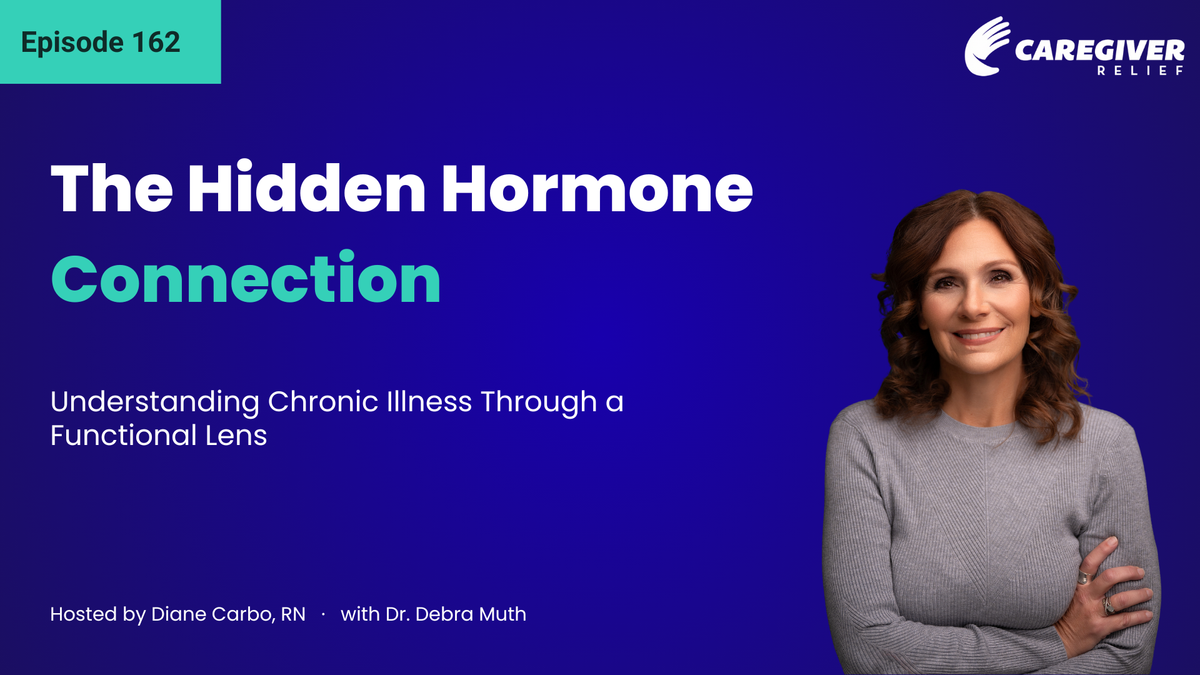
In this eye-opening episode of the Caregiver Relief Podcast, Diane is joined by Dr. Debra Muth, a pioneer in functional medicine and the author of Seen at Last. Together, they pull back the curtain on how hormonal imbalances—often dismissed as "just stress" or "part of aging"—are frequently the hidden drivers behind chronic illness, fatigue, and emotional burnout.
Whether you are navigating your own health journey or are a caregiver struggling to keep your energy up, this conversation offers a roadmap to understanding your body’s internal messengers.
📋 Episode Highlights
- The "Invisible" Misdiagnosis: Dr. Debra reveals that roughly 75% to 80% of the thousands of women she has treated were initially misdiagnosed with anxiety or depression when the root cause was actually hormonal.
- More Than Just Menopause: Hormones are not just for reproductive health; they are messengers that "tag on" to every cell in the body, influencing everything from brain function and Alzheimer’s risk to how we regulate pain and sleep.
- The Caregiver Crisis: Why caregivers often "crash" or become seriously ill after their caregiving duties end, and how chronic cortisol depletion plays a role.
- The Environmental Impact: A look at how "endocrine disruptors"—like household cleaners, perfumes, and even 5G EMF—interfere with our natural hormone production.
📑 Episode Outline
1. The Power of Hormone Messengers
Hormones are the body's symphony. When one "violinist" (like progesterone or cortisol) is out of tune, the whole orchestra suffers. Dr. Debra explains why losing hormones like estrogen can lead to a decline in brain function and higher risks of neurological diseases.
2. The Testosterone Myth
It’s not just for men! Dr. Debra discusses the protective benefits of testosterone for women—including bone health and libido—while warning against the dangers of "overdosing" via social media trends that lead to irreversible side effects like voice deepening.
3. Stress, Cortisol, and the Caregiver 🏃♀️
Caregivers often live in a constant state of "fight or flight." Dr. Debra breaks down how this burns through cortisol, eventually leading to a metabolic "flatline" characterized by extreme fatigue and weight gain that feels impossible to shed.
4. Healing Through a Functional Lens 🌱
Restoring balance isn't about a "fast fix." Dr. Debra outlines the pillars of recovery:
- Restorative Sleep: The #1 priority for hormonal repair.
- The Clean 15 & Dirty Dozen: Choosing organic foods to avoid hormone-disrupting pesticides.
- Natural Support: Using adaptogens like Ashwagandha and L-Theanine (nature’s Xanax) to calm the nervous system without addiction.

💡 Key Takeaways for Listeners
"The body is resilient. It is not meant to attack itself... it can still rejuvenate itself, it can still heal." — Dr. Debra Muth
- Track Your Symptoms: Even if you are postmenopausal, tracking your "cycles" of mood and energy can help identify patterns for your doctor.
- Check Your Labels: Switch to clean cleaning and body products to reduce your toxic load.
- Seek a Partner, Not Just an Expert: Look for functional medicine practitioners who treat the whole person, not just one isolated symptom.
🔗 Resources Mentioned
- Venaari: Dr. Debra’s upcoming AI-driven functional medicine platform (venaari.com).
- EWG.org: For lists of the "Clean 15" and "Dirty Dozen" foods.
🔗 Connect with Dr. Deb:
- 🌐 Website: www.serenityhealthcarecenter.com
- 🎙 Podcast: Let’s Talk Wellness Now – Available on all major platforms
- 📱 Instagram: @serenityhealthcarecenter
- 💬 Facebook Group: She Knows Community (formerly Seen at Last)
Podcast Episode Transcript
Diane: Welcome to the Caregiver Relief Podcast, where we bring you real conversations to support caregivers and families navigating the challenges of health, aging, and wellness. Today I'm joined once again by Dr. Deb Muth. Founder and CEO of Serenity Healthcare Center, host of Let's Talk Wellness Now podcast, and an author of Seen at Last, uncovering Women's Misdiagnosis and Reclaiming Health.
Dr. Deb is a pioneer in women's health, functional medicine, and regenerative therapies. In our last conversation, we explored how functional medicine provides a holistic approach to chronic illness. This time we're diving deeper into one of the most. Overlooked influences on our physical and emotional health, our hormones.
Today we'll talk about hormonal imbalances, can fuel chronic illness, impact mood, energy, and weight, and what you can do to restore balance naturally. Whether a woman struggling with fatigue, brain fog, or inflammation, or a caregiver supporting someone else who is this discussion will empower you with practical tools and hope for hearing.
Diane: Deb, thank you so much. And welcome back to Caregiver Relief Podcast.
Debra: Oh, thank you Diane. I'm so glad to be here and I'm glad we're having this conversation about hormones. It's one of the most misunderstood and overlooked aspects of chronic illness or just aging in general, especially for women, and it is my most favorite topic to talk about.
I love talking about hormones.
Diane: Why last, because the last time we did a podcast and we're talking about functional medicine. You were so excited. You lit up and I had to contact you. Say, could you do another one there? Let's talk about those hormones. Yes. And as a 72-year-old postmenopausal female, I love to hear about this and I really wanna let my listeners know.
Dr. Deb, that functional medicine is the last real frontier of our healthcare delivery system. you're the doctors that look at a holistic approach. You're the doctors that look,that take time for patients when those covered by Medicare. Are treated within 15 minutes, you get a 15 minute appointment and so I'm really excited to have you back.
Debra: So yeah, thank you.
Diane: Can, before we get started, can you share what first inspired your focus on hormones and their connections to overall health?
Debra: Yeah. you know, I started in hormones over 25 years ago when I was a young nurse. I had the luxury of working with a fertility specialist and, we manipulated hormones to help women get pregnant and help sustain pregnancy.
And I got to be at the forefront of that and really see. How hormones played a role in, in just that in general. And as I learned more and more about hormones, I, I just loved it. Like, it, it was every part of a woman's being. and so that's where I really got my spark and understanding of it all. And, went on to become a women's health nurse practitioner.
And from that very time in the, this was in before 2000, I was an advocate for women and using hormone replacement therapy using natural hormone replacement therapy. And really just looking at our bodies as a whole and saying, yes, our, our hormones are supposed to be optimized, and yes, we can use hormones to prevent us from getting pregnant.
Everybody's happy about that. But there's also that piece of us saying, okay, when we're done with that part of our lives, or when that part, we don't have to worry about that anymore. What do we do to fix the hormones that got messed up from us doing that? And unfortunately today, what do we do about fixing the hormones that have been messed up because of the environment, because of all of these environmental estrogens that are around us, all the EMF, all the chemicals, the disruptors that have really taken a huge toll on our hormones, and nobody wants to talk about that.
They just wanna talk about, oh, well, you know, it's just part of aging and it's really not it. It's really becoming a big problem now.
Diane: It, it really is. I, I'm hearing it from my clients a lot. many people think of hormones only in terms of menopause or reproductive health, but they affect every system in our body.
Can you explain how hormones truly influence our physical and emotional wellbeing?
Debra: Absolutely. So hormones are really the messengers, right? And when no one's listening to them, the body doesn't have a voice anymore. And so we have what's called hormone receptors in every single part of our body. And, and the best way to describe this is when we're in menopause.
If a woman had a hysterectomy, if she had her uterus removed. The doctors will tell her she no longer has to use progesterone if she wants to use estrogen, which is the craziest thought to me because we had progesterone from our entire life, and now all of a sudden, because we don't have this one organ, somehow we don't need this anymore, and that doesn't make any sense at all.
And so these hormone messengers go to different parts of our bodies and they tag on. To every cell. So every cell that makes our blood vessels, makes our nervous system, you know, makes our brain function, makes us who we are, how we feel, how we think, how we sleep, how we regulate pain. All of that is necessary to have the right amount of hormones, sending signals where they need to.
We know there's plenty of research out there that shows that as a woman ages and loses estrogen. Sh. Her brain function declines and there is a higher incidence of Alzheimer's disease and dementia when women don't supplement with estrogen after menopause and neurological disease, Ms. Parkinson's, all of those kinds of things are impacted when we're not optimizing our hormones.
Diane: I have a question. I have a lot of girlfriends that have gone through menopause or are, are going through menopause. Mm-hmm. Are now. Testosterone.
Debra: Yes.
Diane: That's really a big thing here, and I, I, that wasn't available to me. I'm 72 mm-hmm. As it is now. Can you talk about that a little bit? Mm-hmm.
Debra: So much like men have testosterone, they also have estrogen and progesterone, and women do too.
We have estrogen, progesterone, testosterone, pregnan alone, cortisol. We all have the same hormones. It's just at different levels, right? Mm-hmm. And so as a woman ages, she loses testosterone, like she uses estrogen and progesterone, and we used to think. That as a woman ages, she just made a lot more testosterone.
And for some women that is true, but most women, they lose their testosterone and testosterone's extremely protective for us. So it is really great at building bone. It's very safe and effective and helps prevent breast cancer. There's been some studies done that shows if women have higher levels of testosterone, they have lower.
Incidences of breast cancer. Of course, it's great for sex and libido and all of that. More importantly though, our muscle building, our muscle mass, our metabolism, our bone health, our motivation drive, energy, creativity, all of that is driven by testosterone. And so when we have the right amount, we feel great when we try to.
Push our levels, much like a man, that's not such a great thing. And there are a lot of people out there doing that these days with pellets and injections. And that's going to give women some side effects eventually that they don't like. And it's gonna be a big challenge when they have to try to get that excess testosterone out of their bodies.
So you wanna be careful and dose physiologically to women, not try to have us be men 'cause we're not men.
Diane: Yes, I, I have a, a girlfriend, a good friend who is getting the testosterone and she's getting all this facial hair. Yes. And, her, her and her sister have, have a pact that when they're in nursing homes, they have to shave each other's when the other one can't.
Yes, you have to make fun of it. I mean, what else can you do?
Debra: Absolutely we do. You know, and one of the things I see quite often when women get overdosed with testosterone is a deepening of their voice. And once that occurs, it never resolves. Like once your voice deepens as a result of using too much testosterone, it will not go back to the way it was, even if we get the testosterone back in line with where it should be.
So we do have to be really cautious about these hormones that we're giving. How much we're giving, and I wanna encourage your listeners. There's a lot of Instagram and TikTok people out there talking about hormones and they don't know what they're talking about, and so you have to be really cautious with who you're listening to.
I had a patient come see me this week and she said, I don't understand why men are given estrogen. And I said, well, they're not, they're, they're given anti-estrogen products because if they get too much testosterone, it can convert to estrogen. And she's like, no, no. This Instagram person said, we're giving testosterone and estrogen.
And I said, no, that that's not how this works. She had no clue what progesterone was, and she had been on hormones with me. She thought she was taking estrogen and testosterone. Because of the color of the containers, and she wasn't even educating herself properly on what's going on with her own body. But she was listening to this Instagram person who was telling her all the wrong information about estrogen and progesterone and in this anti-estrogen movement these days.
I had to, you know, nicely try to educate her, but I really wanna encourage people that if you're gonna follow someone on social media, make sure you're following somebody with credentials. Don't just follow somebody that thinks they know something about it, because you're gonna get a lot of misinformation.
Diane: Yeah, and we're seeing a lot of that. We are.
Debra: Mm-hmm.
Diane: You know, people are looking for a fast fix or a fast result, and they go, instead of looking to the experts, they just take, go by some Jane Doe on the internet that has no clue, probably can't even define what a woman or a man is. Those are, that's a whole nother issue.
Debra: Yes, it is.
Diane: Wow. So what are some of the most common signs and symptoms that someone might have? a hormonal imbalance.
Debra: Yeah. Especially
Diane: those that often mistake for stress aging or normal fatigue.
Debra: Yeah. Right. So hormonal imbalances actually start quite early for us as women. It starts around age 35, we will start to lose progesterone, which is your very calm, euphoric hormone, makes you just kind of go, ah, whatever.
Who cares? I can roll with things, right? And that's when women are gonna start to be. Labeled with anxiety, depression, insomnia. They can't sleep. They have a lot of broken sleep at night. a lot of women get heart palpitations and heart racing. they'll get jittery because they don't have enough progesterone.
They're, they've got plenty of estrogen until they're about 45 or 50. But that progesterone dip makes them estrogen dominant. And so they start getting these kind of symptoms. they feel perimenopausal or, or PMS. All the time, like they're irritable, they're moody, they're snapping at the kids. They're getting this weight gain around the midsection that they can't get rid of.
They're not sleeping well, they're not thinking well. They're irritated by people all over the place. And so what happens? You go and you complain to your doctor about that and they give you an SSRI an antidepressant, and they say, you're just. Stressed, you've got the kids, you know, take this SSR, and then we create a whole lot of other problems because we're not really looking at what's happening to the woman.
And then when we do labs, if you're working with a conventional doctor. They're just looking at the labs inside the normal range. They're not looking at your age. The ratio between that estrogen and progesterone, are they balanced properly? Where are you in your menstrual cycle? That makes a huge difference When you're testing hormones, are you in the beginning?
Are you in the middle, are you at the end? We always wanna test in the end, like that week, just before you get your period, because that gives us a good idea of where that balance is. And some women will even start to see some irregular bleeding at that point. They'll be skipping periods, or their periods are really heavy, then they're light, then they're early, then they're late, then they have more PMS and less PMS.
So it really becomes a trying time for that about 10 years between the onset of this and the onset of menopause.
Diane: You've spoken about how misdiagnosis are common among women. Mm-hmm. How often do you see hormonal issues being dismissed or misattributed to anxiety or depression?
Debra: Oh, a ton. Like I've treated thousands of women in my career.
We've treated over 15,000 women in my practice, and I would say a good guesstimate, 75 to 80% of those women were misdiagnosed and it was really just a hormonal issue that was causing their symptoms.
Diane: You know, just off topic for a moment, I'm watching some old, TV shows in from English British shows.
Yeah. And, in olden days, we were always crazy. They would put women in psych hospitals.
Debra: Yes.
Diane: Because they, you know, they were crazy. And it's like, are you kidding me?
Debra: Yes, my great grandmother was institutionalized. I found this out when I was doing some genealogy quite a few years ago, and they institutionalized her at about 48 years old.
And I looked at my aunt and I said, you know, that was just menopause. And she's like. Yeah, but they didn't know what to do with them back then, and so they just put them away because they couldn't deal with them. And that is so sad.
Diane: I see. It's a common thread in a lot of the old shows and I'm like, Lord have mercy.
How awful for those women. Yeah, and they were fine. They just had. Hormonal imbalance. And nobody knew about it.
Debra: Nobody knew about it. Yeah.
Diane: And a lot of men got rid of their wives that way when they got tired.
Debra: That's true. That's true.
Diane: Natural.
Debra: Mm-hmm.
Diane: Can you explain how hormonal imbalances contribute to chronic illness such as autoimmune disease, thyroid disorders, and metabolics?
Debra: Oh, absolutely. So one of the problems that we see today that I've not seen before in my career is young 20 and 30 year olds having hormonal issues. Like I see young men in their twenties when their hormones are supposed to be at their peak, which would be right around 800 for a guide, right?
I'm seeing those men with levels of about 200 to 300, that of what I would have seen in the past. Of a 70-year-old man, and for women as well, when we get ill with a chronic illness and, and these are people that are healthy, they're, there's something wrong with them. They're just having low hormone levels.
But when your body's in a chronic illness state, it's gonna burn through these hormones faster to try to correct the metabolic imbalances. However, when we don't have enough hormones to start with, which we're seeing because of our environmental issues, right? All of this estrogenized food. We're putting steroids and things into our animals to produce larger qualities of milk and bigger mass and all of that.
It is disrupting the hormone. So I think it's twofold, actually. I think we're starting out as young people without enough hormone, which is creating chronic illness. And then you have the chronic illness. That you're using up all of those hormones to try to get your body to do what it's supposed to do.
So it becomes a double-edged sword, and is really problematic. We're seeing much more autoimmune disease these days, and as a result of that, then we're seeing hormonal imbalances occur. And trying to get those hormones back for those young people that are so sick is really a challenge, because you have to really push those levels high enough so that they don't end up with bigger problems down the road.
Like a 30-year-old that has low hormones, that's when they're supposed to be having all their good bone growth and laying down of good bone between like 15 and 30. And so when they don't have those hormones there to begin with, by the time they're 50, 60, or 70. They're going to have more bone loss, they're going to have more problems.
They're going to have less estrogen in the brain for women. They're gonna have less testosterone on their muscle mass and their bone structure, and we're gonna see much earlier age related things happening because they never had the hormones to start with.
Diane: Now, cortisol, insulin, thyroid, estrogen, and progesterone.
Yeah. All play critical roles in our bodies, but they also interact with one another in some way, right? how one hormone being out of balance impact the rest of the system?
Debra: So think of a very fine tuned orchestra or symphony when you're missing your key violinist. You're off key, right? It doesn't play the same.
Hormones are exactly the same way when one key hormone is off. The rest of them are trying to work to balance that out, but they're not able to do it. A, a good example of that is cortisol, right? Cortisol is our friend. We need cortisol. It reduces inflammation. It gives us energy. Motivation, makes us get up in the morning and be like, yeah, I'm ready to go.
Now too much cortisol's not a good thing. It creates too much insulin. It makes us have weight gain. It keeps us up at night. It makes us anxious and jittery and wired. And so that's a bad thing. And you tend to have a overabundance and under, under utilization of that hormone throughout your life, right?
So when we're in a stressful situation back in the day, right, you'd, a tiger would come out, you'd fight the tiger. You'd go back to the cave and you'd retreat. You'd get cortisol to fight the tiger. You'd go back, you'd rest, you'd retreat, and that cortisol would settle back down again. The problem in today's world is we are in that constant state of fight or flight.
Our young people are burning the candle at both ends. They never get a chance to rest. College kids, they're working, they're in sports, they're in school. They're trying to keep up with their friends. They're doing all this stuff. From five in the morning until midnight. They're getting not enough sleep to rejuvenate themselves.
And then we think that's the American way. And it has been for, you know, a long time, but they don't know any different. And now they go into young adulthood and they're in college and they're pulling all nighters to study and same thing. And so they're burning on all this cortisol for a period of time, and it's getting them through.
Until the body just says, you know what? I've got nothing left to produce for you. So then the cortisol falls and we have just the opposite problem. Now we're fatigued. Our brain's not working. We kind of are presenting like we're depressed, but we're not. We're just really burnt out, and now we're gaining all this weight.
And we can't lose any weight. Our metabolism is off. We wanna sleep all the time. And so now we've got that problem. And so we're kind of up and down with this cortisol piece, and everybody's saying, cortisol's a bad thing, so suppress your cortisol. Well, if you don't have any cortisol left to suppress and we suppress it more, you're gonna feel worse, not better.
So all these hormones have to be in alignment with one another, or you're not gonna feel like yourself.
Diane: I wanna explain to my listeners out there, caregivers often live on chronic ongoing stress to the point where, they're really out of whack. Mm-hmm. 63% become seriously ill or even die before the person they're caring for, they neglect their own health.
Yeah. They don't understand why they're eating, gaining weight. those types of things and it's because of the cortisol.
Debra: Absolutely. Absolutely. We see a lot of caregivers in our practice too, and they're more stressed than the sick person they're taking care of. And if they have to take care of somebody for four or five years and, and I've dealt with women in this position where they've taken care of mom or dad or both, and they thought it was gonna be a year, and it ended up being five or six years.
Lived with them in the house and mom and dad is up all night wandering. They're getting out of the house. They're turning the stove on in the middle of the night. They're afraid they're gonna fall, so they're always listening. They're never really asleep. They're always just listening for them. When that person finally does go to be with the Lord.
Their bodies, the caregiver's body just, it gives up. It's just like, whew, I'm done. And they are so flatlined that they really now think there's something seriously wrong with them. And it's really just that they're exhausted, they're burnt out. We have to rebuild them, we have to rejuvenate them, and they need time now to rest and repair and heal.
And it's really important that caregivers do that because otherwise you will develop some kind of illness that will require somebody to take care of you if you don't take care of yourself.
Diane: I actually lose two to three caregivers a year.
Debra: Wow.
Diane: Or serious illness, and they can no longer provide care for their loved one.
Yeah. So it's very real.
Debra: Mm-hmm.
Diane: Now in functional medicine, Dr. Deb, you focus on root causes rather than symptoms, first of all. I love that. Mm-hmm. what are the most effective lifestyle changes or interventions for restoring hormonal balance naturally.
Debra: Sleep is number one. We have to get people to sleep.
So, and, and not just laying in bed and thinking we're asleep, right? We need that good restorative, deep REM sleep. That is first and foremost, and then really. Feeding the body, giving the body, nutritious food, not fast, quick on the go. Food that kind of fuels us for the moment, but doesn't fuel the body for what it needs.
Nutritious whole food that's really important. organic whenever you can, especially in the things that are really bad. So I always tell people, you know, organic is really expensive to do all of it. If you follow the Clean 13 and the Dirty Dozen, I think it's now the Clean 15, but, EUW.org.
They have a list of the dirtiest whole foods that you wanna stay away from or buy organic if you can. And, those are the ones that I tell people, spend your money on those organic foods. The other ones that are pretty clean, we don't have to worry about so much, but that's really important to get yourself that hydrate, hydrate, hydrate.
We need hydration. Most of us are dehydrated. That's really important to, to make sure that we're getting that. And then I would say after that, then you wanna really feed your adrenal glands. Your adrenal glands are key. They're the two small nickel size glands. They sit on top of your kidneys and they give you that fight or flight response.
They produce the cortisol, the DHEA, some other hormones, but they need to be regulated, especially as a caregiver because. When you're burning the candle at both ends and you're constantly giving to somebody, whether it's a child or an elderly parent, you need to fuel yourself. And this allows you to be able to kind of burn the candle at both ends without completely depleting yourself, and it'll maintain those hormones for a longer period of time so you're not crashing out.
Diane: Fascinating. Now, what role do environmental toxins and endocrine disruptors play in hormonal imbalance, and how can people reduce their exposure to those?
Debra: It's huge. So all of the artificial chemicals in our environment. Are considered endocrine disruptors. Some are just dirtier than others, so think about all your cleaning solutions, all the things that we plug into the outlets that make our houses smell better.
The lysols, the sprays, the floor cleaners. Our perfumes, our chemicals, we put on our bodies to smell better. Those are all chemicals that disrupt the endocrine system. And if we disrupt that endocrine system too much, we're creating thyroid problems. We're depleting the progesterone, the estrogen, the testosterone.
So those are all big major players. Secondarily to that would be EMF electromagnetic field, and when that electromagnetic field, so your cell phones, that we keep in our pockets. That we keep on our bodies, those things are gonna disrupt the hormones as well, unless you have a case on them called a safe, safe case that helps block that.
EMF. Don't ever put your phone on 5G. Always use the lower level because that 5G is really, really bad for the body and it's disrupting every cell in the body, and it is a known endocrine disruptor. And so when we have those things present. We're not only moving the hormones in levels that we don't want them to, but we're also triggering different autoimmune conditions as well.
And that's why we see a lot of thyroid issues, a lot of other autoimmune conditions that affect the hormones themselves. So really important to have clean cleaning products for yourself and clean body products that you're using.
Diane: I can't stand smelly stuff. I, I, you know, I, as a nurse, I was a student nurse at Children's Hospital in Pittsburgh.
Mm-hmm. We had an eight week rotation. You know how it goes.
Debra: Yeah.
Diane: And, I saw a student nurse, go into her patients. Room and he went into asthmatic, mm-hmm. An asthmatic attack. Yeah. She left and to get somebody, and it's to settled down a little bit, but was still, you know.
Mm-hmm. She came back in and it got worse again. I mean, so, you know, that's when I learned you don't wear perfumes, you don't wear anything smelly. Not even, and it was hard not to wear hair spray or anything. Yeah. Because, you know, we do, we put stuff in our hair, you know, I was blonde until I stopped coloring it.
Mm-hmm. so I have to ask you. A lot of my caregivers. Want something to help them sleep. So they want sleeping tablets. How does that interrupt, their health in any way?
Debra: It does. So it gives them an artificial sense of sleep. It's not giving them that good restorative sleep. It's turning off their mind and allowing them to get to sleep, but it's not restorative sleep.
So we can use natural things, things like ashwagandha, magnesium. L-Theanine is really great for your, your caregivers. I mean, L-Theanine is nature, Xanax, so it's not addicting. It doesn't make you sleepy, just kind of takes the edge off. You can use it up to 800 milligrams a day. So you can use a lot of it and it just kind of helps to calm you and make you not be so anxious or worried about things.
It helps you turn your brain off at night so that you can get some sleep. 'cause as caregivers and as women, we worry about everybody, right? And as soon as it's quiet. Our brain tends to take off and start thinking of all of our to-do lists and the people we need to think about, and that's what keeps us up a lot of times.
So that can be really helpful. Ashwagandha is really amazing 'cause it's an adaptogenic herb and so if the cortisol gets too high, it brings it down. If it gets too low, it brings it up and it is very calming and soothing and helps you sleep as well. So it is a great thing to use before bedtime as well.
Diane: That's, I use magnesium, but I'm gonna get some ashwagandha.
Debra: Yeah,
Diane: I'm gonna try it. Well, I, I, I actually am very blessed. I sleep pretty good. I have chronic pain every once in a while, you know, I move and it, the pain wakes me up. But, I'm definitely, I'm very blessed at 72 to still have, the majority of my nights are good sleep.
Good sleep. That's, yeah. Not everybody can say that. No. We women, we have hormonal changes through our different stages of our life. Mm-hmm. Puberty, pregnancy, perimenopause, menopause, post menopause.
Debra: Yes.
Diane: How do women prepare for or better manage these transitions?
Debra: Oh, I love this question. First and foremost, people need to understand that hormones are not stagnant.
They fluctuate moment to moment, day to day. So your symptoms can fluctuate like that as well. And I like to have women track their symptoms with their cycles. And for a lot of women, this seems kind of odd, but. Once you're postmenopausal, there are some women that will still say, I feel like I'm cycling.
Like right around the time I used to get my period, I still feel like I'm doing a little bit of this. And I think there is some reality to that. 'cause your hormones, even though they're lower, you still are making. You're just not making as much because your ovaries aren't producing them and the adrenal glands are trying to kick in.
So tracking your hormones is really great. You can get an app or a calendar and just write down some of your symptoms and look for patterns when your menstruating of when your symptoms are occurring in your cycle, because that tells you a lot about which hormone is being affected. So when you have your period, that first three days, we have very little hormone present at all at that point.
And then after about day three, the estrogen is gonna start to rise until mid cycle. So if you get a period every 28 days, about day 11 or 12, there's a hormone called LH that's gonna start to rise, and that's what's gonna make you ovulate. And that one goes up and comes down really fast. And then progesterone really doesn't kick in until after you ovulate.
So for the first, about 12 to 14 days of your cycle. You're pretty dominant in that estrogen side. Progesterone's very low. Once ovulation occurs, progesterone comes up and actually stays up until just before you get a period and before you bleed, and then it kind of shoots way down. And so when you're tracking your cycle and you're tracking your symptoms, you can start to see patterns of what's happening with those hormones, if you understand where that is, and especially when you start to enter that perimenopause.
Phase as well. Your cycles are kind of all over like they were in puberty, and so knowing where you are and knowing what your symptoms are can help A lot of women when they're perimenopausal, they'll start to get hot flashes and night sweats just around the time that they're getting their period. A couple of days before their cycle, they'll get hot flashes and night sweats and they'll be.
Covers on, covers off, leg out, leg in, and they don't get the full flushing, but they get those kind of symptoms that occur. And so understanding that that's happening can give you more information that you can take to your practitioner and have that conversation with them about exactly what's going on for you.
Diane: Yeah, I have girlfriends that have these awful hot flashes and hots and get and sweats, and they have to actually get up and move to another bed or a, or change the bed in the middle of the night. I never had one hot flash. I, I, I don't know why, but my body, but I had great pregnancies too. I never got sick.
I felt great. It was afterwards the babies came that it was hard.
Debra: That's for sure. You know about 13% of the population of women will have hot flashes for the rest of their lives. They will never go away.
Diane: I did not know that.
Debra: Yeah.
Diane: Wow. Wow. How, what an awful thing to live with.
Debra: Oh, it's terrible for some women.
Really terrible.
Diane: Mm-hmm. Yeah. For my listeners out there, Dr. Deb, who are living with chronic illness, what message of hope would you share about the body's ability to heal and find balance again through a functional medicine approach?
Debra: Oh, that's a great question. I love that question. You know. The body is resilient.
It is not meant to attack itself. It is not meant to betray us. Our environment has created that part for that to happen. But if you can get with the right functional medicine person that's looking for the root that caused this illness to occur in the first place, and you can get appropriate treatment for what's happening.
The body can really repair itself. It can take time, and we usually say for every decade you are sick, you're gonna need at least one to two years for the body to heal. So it's a slow process. It's not a quick process, but nonetheless, the body can still rejuvenate itself. It can still heal. There are studies that show if, if a appendix was removed but it wasn't removed in its entirety, the body can start to regrow that organ again.
Oh wow. We know the liver can rejuvenate itself and heal itself with the Right supplements, I'm not gonna say medication. The right supplements, the liver can start to actually repair and create new healthy liver cells. So the body is amazing at what it can do, as long as we know what's causing the insults and we can find the right thing to get it to heal itself.
So don't give up, you know, just you have to find the right person to work with.
Diane: Deb, can you give us a, an example of what a right, a good functional medicine doctor, what you would look for in them?
Debra: Mm-hmm. So I would say first and foremost, it is individualized. you want a functional medicine practitioner who is going to listen to you, someone who is gonna partner with you, and someone who understands.
And accepts where you are at first and foremost. I think those are key. Secondarily, I think you need to have a functional medicine practitioner who truly understands your disorder. Not every functional medicine practitioner has been trained the same way. They don't have the expertise, so you don't wanna take a, let's say a Lyme disease.
Person. You don't, if you have Lyme disease, you don't wanna go see somebody who only treats the gut or only treats thyroid. You. You don't want that. You are looking for a functional medicine person who is truly holistic. Somebody as a whole, they're gonna look at your body as a whole, because the last thing we want is another expert in one particular thing. We already have that in conventional medicine. Right,
Diane: exactly.
Debra: You've got your pulmonologist, your radiologist. Your endocrinologist, your GI doc, your, you know, we've got all of them, but you need somebody that's gonna look at your body as an entire whole, and that has an understanding of all of those aspects from the functional medicine standpoint.
Diane: You know, that's one of the things that, the biggest thing that I've noticed is the change in the specialization of our physicians because mm-hmm. When I went into nursing in the dark ages, I did orthopedics when I first got out. Mm-hmm. And. An ortho pot, an orthopedic surgeon would do any bone in your body and they would take care of you.
Now you've got somebody for the hand, somebody for the hip, somebody for the shoulder, and it goes on and on and, you really miss a lot of things. In fact, I have, when I go to my pain management doc, I have to ask them, 'cause they'll say, you know. Rate your pain. Mm-hmm. Well, I need to know what pain you want me to rate because, you know, is it from the last treatment or what I'm experiencing today?
And it's very confusing because they, they'll, I've been told some pain management docs, so I don't wanna learn about, know about that pain right now. This is the one I'm focusing on and I'm like, are you kidding me? Right. It makes me crazy, so,
Debra: yeah.
Diane: Yeah.
Debra: It's really a challenge that, you know, nobody's putting all of this together.
So if you've got shoulder pain and hip pain and arm pain and neck pain and lower back pain, do we not think they're all somewhat connected, but why do you have to see an individual specialist for each one of those? Those parts of your body. It's ridiculous.
Diane: It is, it is. And it frustrates me. Mm-hmm. As, as, as a nurse that does, he helps people through the medical delivery or delivery system, you know, navigate it.
And I'm a care manager and you know, I know what they should be doing and I, it makes me crazy when the physicians. Refer to somebody else instead of addressing it right there. So we really have lost, that's why I think functional medicine's the best way to go for anybody right now. I agree. Dr. Deb, how do my listeners find you?
Debra: So you can find me on social media, Deb Muth or Dr. Deb. I also have a, Facebook group called Seen at Last. It's a free Facebook group for women and, and men can join too. But it's primarily a women group of women who feel like they haven't been heard and they're looking for their tribe of people where they can communicate and share and we can whine and complain and support each other and do all the things and that we need to, to help each other out.
if your listeners are looking for ways that they can learn more about these. Things. I'm really excited. I have a new platform coming out in the next couple of months called venaari, and it is going to be a platform where much like chat, GPT, but my knowledge base, my education, my protocols, all of the things that I've learned over the last 25 years have been trained in this app where you can ask a question about your healthcare, you can ask a question about your symptoms, and you'll get a completely functional medicine approach to how I would deal with that.
And so you will be able to utilize that and get any answers that you want about functional medicine from that app. And I'm super excited to have that launch. I have a website called venaari.com. If you're interested, you can sign up as an early adopter or get more information when it comes out. but I'm really excited because this is gonna put functional medicine in the hands of people who don't have access to a functional medicine practitioner.
Yeah. Can't find one in their area. Can't afford one. You're going to be able to get access to one of the best in the country. And all of the information that I've learned and all of the people who've been so gracious to train me over the years, you know, all of the big names. And so I'm really excited to be bringing this out.
Diane: And spell Ari for my,
Debra: yes, it's V-E-N-A-A-R-I.
Diane: Okay, I will put that in the, in the show notes and on the permanent page we create, thanks Deb for your time and your sharing. I appreciate this. I've learned some things that I didn't know in my 50 years of nursing, so I really do appreciate that to my family, caregivers out there, you are the most important part of the caregiving equation.
Without you, it all falls apart, so please learn to be gentle with yourself. Self practice, self-care every day because you are worth it.
Caring for a loved one can be overwhelming — but you're not alone. If you have questions, big or small, our expert team is here to help.
👉 Click here to Ask the Expert
Our Resource section can help you find the information and tools that you need. We have courses, videos, checklists, guidebooks, cheat sheets, how-to guides and more.
You can get started by clicking on the link below. We know that taking care of a loved one is hard work, but with our help you can get the support that you need.
Click here to go to Resource Section now!