The Crisis in Home Care: How Medicaid and Medicare Advantage Are Failing America’s Most Vulnerable with Arya Rashidian - Episode 134
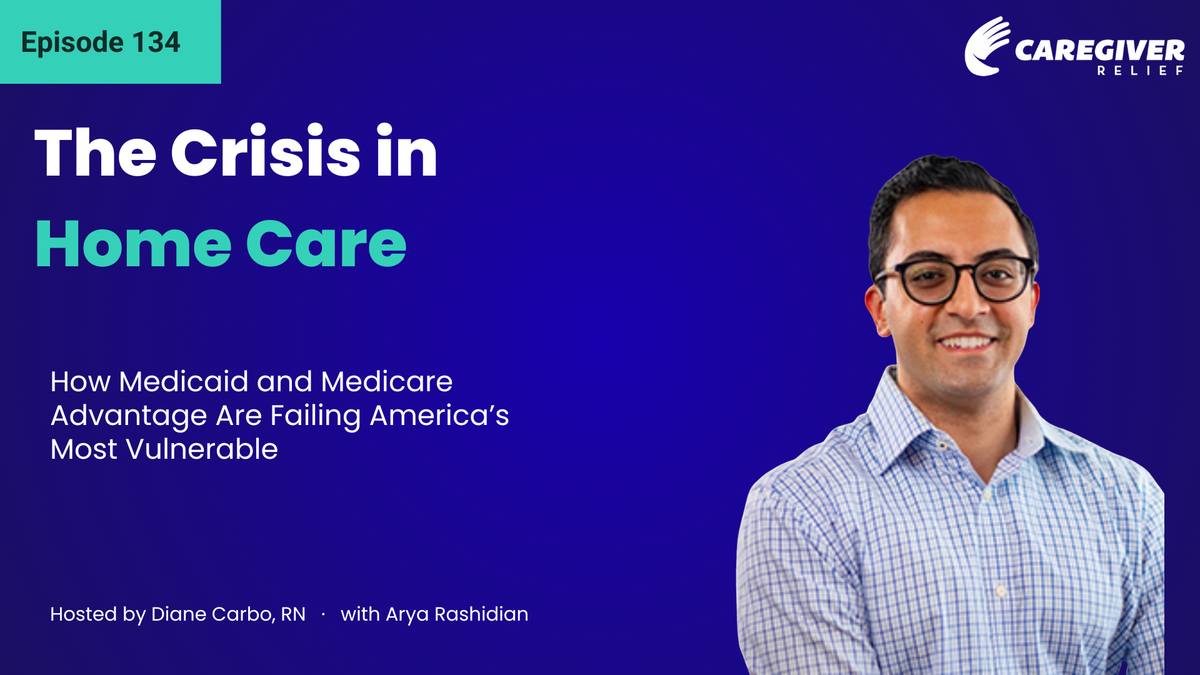
The latest episode of the Caregiver Relief podcast tackles a critical and escalating crisis in the home care industry. Host Diane Carbo, RN, speaks with Arya Rashidian from Arya Home Healthcare to unpack how systemic policy failures, specifically regarding Medicaid and Medicare Advantage reimbursement, are pushing the system to its breaking point and transferring an immense burden onto family caregivers.
This episode is a must-listen for anyone involved in healthcare—from providers and agencies to the family members holding it all together.

📝 Episode Outline & Key Takeaways
Here is a look at the major themes and alarming realities discussed in this crucial conversation:
1. The Growing Crisis and Unpaid Care Burden
- A Systemic Collapse: The crisis is fueled by years of continuously lowered Medicare reimbursement rates and the shift to cost-sharing models by Medicare Advantage plans.
- The Shocking Cost of Unpaid Care: Family caregivers now provide an estimated $1 trillion in unpaid care each year, highlighting the staggering time, energy, and sacrifice being transferred from the system to families.
- Caregiver Vulnerability: Many family caregivers struggle with low wages and depend on shrinking support programs like SNAP, which are further at risk during government shutdowns.
2. Understanding Home Care Services and Funding
- Defining Services: Arya provides clarity on the different types of home care:
- Skilled Care (e.g., PT, IV therapy, wound care): Mostly covered by Medicare and private pay; generally not covered by Medicaid, though waivers apply.
- Personal Care: Usually offered by Medicaid through its waiver process, or privately funded. Eligibility for Medicaid waivers is becoming more stringent.
- Palliative Care: Specialized care usually done by a nurse and Medicare-funded; not offered by Medicaid.
- Virginia's Model: Virginia does pay family caregivers under Consumer Directed Services (CD) or Agency Directed Services (AD), though reimbursement rates differ, and not every state offers this benefit.
3. Financial Pressures and Quality of Care 📉
- Reimbursement Cuts Impact Quality: Quality of care is directly related to funding. Ongoing cuts, particularly in state-level Medicaid funding, are expected to significantly reduce rates, especially affecting providers in rural areas.
- The Volume-Based Model: Skilled nursing (nurses, therapists) is a fee-for-service/volume-based business, meaning providers are paid per visit (ranging from $20 to $200) rather than hourly. This forces them into a cyclical fashion, seeing many clients quickly to make ends meet.
- The Unfair Truth for Nurses: Nurses who perform critical duties like opening a case, doing six-month evaluations, recruitment, training, and complying with MCO/state requirements do not get reimbursed for this legwork; their salary comes out of the general reimbursement left after expenses. This creates a disincentive for quality assessments and follow-ups.
4. Administrative Burdens and Provider Survival
- Electronic Visit Verification (EVV): This mechanism was introduced to mitigate fraud by requiring GPS-enabled clock-in/clock-out tracking for Medicaid-funded services, replacing the old paper-based system.
- Managed Care Organization (MCO) Delays: New administrative requirements and the transition to the full EVV model are causing significant delays in reimbursement from payers, forcing small agencies to rely on loans and cash reserves to make payroll and pay vendors.
- Caregivers at Risk: The professional caregivers who often rely on SNAP and other federal/state subsidized programs to meet their needs are the first to feel the impact of government shutdowns and delayed funding.
5. The Bigger Picture and the Path Forward
- Government's Role: The co-hosts agree that government involvement, including the shift towards national healthcare models and partisan gridlock, has ultimately damaged the healthcare system, leading to higher costs and lower quality of care for most Americans.
- Managed Care as Gatekeepers: Tax dollars are funding MCOs (Managed Care Organizations) to act as gatekeepers, which for Medicaid, is often a "loss business" for the MCOs since any unused funds must go back to the government. This lack of financial incentive means MCOs focus on making their Medicare (commercial) models more lucrative.
- The Ideal Provider: Arya stresses that this industry is only sustainable for those who are dedicated and committed to building and maintaining quality of life, not for those solely focused on a for-profit business model.
🎧 Listen Now!
Hear the full conversation to gain an in-depth understanding of the legislative loopholes, administrative burdens, and financial realities threatening home care for America's most vulnerable.
Because caregiving is one of the hardest and most meaningful things you'll ever do, and no one should have to do it alone.

Podcast Episode Transcript
Diane: Welcome to the Caregiver Relief podcast. I'm your host, Diane Carbo, rn, and today we are addressing a growing emergency that touches every corner of our healthcare system, from agencies and providers to families and caregivers who hold it all together.
While the current government shutdown has captured national attention for its immediate impact on Medicaid, Medicare, and social Security reimbursements, the truth is this crisis didn't start last week. It's been building for years. We are facing an ongoing collapse of home care fueled by Medicare lowered reimbursement rates, and the spread of Medicare Advantage plans that have quietly shifted to cost sharing model.
That means patients, many on fixed incomes are now being told they must pay for recommended treatment services and therapies themselves or go without, and Medicaid has cut reimbursement to unsustainable levels. As a result, more and more families are being forced to step in and provide services that were once handled by trained healthcare professionals.
The burden of care is no longer shared by the system. It's being transferred to the family caregiver. Recent statistics revealed the staggering scope of this hidden crisis. Family caregivers now provide an estimated $1 trillion in unpaid care each year. That astonished me 'cause that is a new stat out there.
Yeah, $1 trillion of time, energy, and sacrifice. While many of the same caregivers struggle to support and survive on low wages, shrinking support programs like snap, which are now at risk during of the ongoing shutdown, family caregivers who have no affordable respite care available and depend on home care services to support them as much as they can.
Joining me today is Aria Rashidian from Aria Home Healthcare, one of North Virginia's most trusted home health agencies. Aria has his hand on the pulse of what's really happening in home care from Medicaid reimbursement cuts and Medicare Advantage Organization administrative barriers to the daily challenges of recruiting and retaining caregivers who are essential to keeping vulnerable Americans safe at home.
Together we'll unpack health policy failures and underfunding of portion, our home care system and the families who depend on it to the breaking point. And what must change to protect the people who give and receive their care every day.
Diane: Aria, thank you so much for joining me today. I'm glad you reached out to me, but before we dive in, can you tell our listeners a bit about the Aria Home Healthcare and what inspired your mission to provide compassionate, affordable, in-home care in Northern Virginia?
So
Arya: yes. Thank you for that lovely introduction. Diane. Hi, all you know, again, my name is Aria. I'm the alternate administrator of Aria Home Healthcare. Originally, the agency was founded by Miss Mohan Akbar, who's had over 37 years of nursing experience working in various facets, including. Inpatient, inpatient, hospital settings to outpatient care, to even home healthcare herself.
And she really wanted to design an agency that really delivers that reliable senior home care services with really experienced and supportive caregivers who truly feel like family through the interactions. And the obviously their skill training. So because we noticed that this was an industry that needed the most amount of care, and given those alarming statistics, this industry is high scheduled to grow more and more each and every year.
One of the things we really want to do and really our biggest selling point is that we aim to build trust with the caregivers, with the family members and the clients. 'cause it's truly a three-way street. so we like to think that we are very unique in that standard because a lot of agencies either just coordinate with one or the other, or they just coordinate not well at all, as we probably have seen.
I attest
Diane: for that
Arya: and. We just wanna make sure that we're there, whatever you need in terms of palliative care, private duty, nursing, home health, and personal care, we'll be there to assist you.
Diane: aria, for those listening who may not be familiar, can you define the different types of home care services from personal care, skilled care, palliative care, and explain how they're funded through Medicaid, Medicare, private pay, or insurance.
Arya: So that's a wonderful question, and hopefully we won't have enough time. so again, it, skilled nursing skilled care usually falls within the facet of Medicare, Medicaid, and also privately paid, obviously skilled, includes, occupational therapy, which includes, aspects that you need with a licensed a therapist to do your everyday task.
much different than personal care, because obviously it's more medically involved, learning to walk, learning to eat, and all of those things. There's also physical therapy that you need to, Which is under a facet of skilled nursing care. There's IV therapy, there's wound care, and these are aspects that are mostly covered by Medicare and through private pay.
they are not aspects that are covered mostly by Medicaid. it depends on certain waivers that you get, because even though Medicare and Medicaid. Federal programs, they are, they do have state components. and also likewise, MCO managed care organizations such as Anthem, Aetna, UnitedHealthcare, et cetera.
These also have their own administrative. needs in order to qualify for those, state waiver programs. as Medicaid is federal and state funded. Although that is scheduled to change in the coming years, given through the passage of the one big beautiful bill, that passed in July.
But right now, they are considered just like Medicare mandatory spending. they are, however. being reduced and the waivers are being a little bit more difficult to apply and receive, although they are still being offered as of now. Now in terms of,personal care is usually a service that's offered by Medicaid, mostly through its, again, waiver process, and they're still eligible right now.
Although again, eligibility is becoming slow and slow, more stringent, through the, bureaucratic process of bureaucratic pressures. And, it's also privately funded. you can also apply for it. Private pay, palliative care is a little bit more specialized and it is usually done by a nurse and it is Medicare funded.
It is not something that is. Offered by Medicaid. and it is very important that,you understand the specific kind of,needs that your loved one wants. And then once you talk with your insurance carrier and you understand, you know the process, then you can reach out to the appropriate home healthcare agencies like us to go ahead and help you with that.
Diane: does, Virginia Pay family caregivers to provide care in the home? They do.
Arya: they do. it is under, there's agency directed services and then there's consumer directed services, AD and cd. now CDs, obviously, the rates of reimbursements often differ from agency directed services because obviously agencies carry more of the burden and the hiring process and administrative responsibilities.
Consumer directed pretty much relies on the person. They get paid the same way, even if it was under an agency directed care, but they will be responsible for more of the, maintenance of the client as well as management of the conditions and communicating with the state agencies versus agency directed services.
We. Obviously do all the legwork, application process and, renewals and recertifications and, usually coordinate well with the case managers.
Diane: Right now, not every state provides that, benefit, through Medicaid, so I wanted to make sure that people are aware that, while we are talking about what's going on in Virginia, this is something that's actually the product, the process and the problems are rampant throughout the whole country.
Now, I'd like to address how current Medicaid and managed care organization reimbursement rates affect your ability. To recruit and retain qualified caregivers while maintaining quality and continuity of care.
Arya: Yeah. Fantastic questions. unfortunately, quality and care all, relate to funding.
Yeah. And, especially the more funding we have, the better, we can be in making sure we get the absolute best, caregivers and trained personnel or even nurses as possible. But as this bill is being passed, we may see a little bit of a shift in,losing potential additional state funding because as I mentioned before, it is federal and it is state.
And if the state isn't able to raise its taxes enough to meet the federal level and it's only the federal percentage, then we may see an a cut of. Maybe upwards of 50%.
Diane: Yeah. And,
Arya: in the rates, and if that happens with the already low rate that, we get, and for, and unfortunately it's, it's different all around.
Yeah. Northern Virginia rates are higher because it's a higher associated, with a higher cost of living, more urbanized area than, central Virginia and obviously rural Virginia. So the rates are different all around, but the cuts are going to affect. All three of those rates regardless,
Diane: I think these cuts are going to continue on for a very long time because what we have is, a situation where we have more seniors than youth and each generation on, from the millennials on and baby boomers on down, we have not replaced our youth, our own population.
So we're getting let. Fewer and fewer workers and the ability to, the youth of our country are our workforce. They are our tax base. And, I'm seeing with the growing population and it's going, this is going to go on for decades, that we're going to have issues with, we're going to have to pay higher taxes in order to provide care, at least any kind of care, just not even just quality care to, our.
Elderly are disabled,are veterans even. That's a challenge you're dealing with right now is I think right now, I feel, and you can correct me if I'm wrong, we're at a critical mass. This has hit to the point where agencies are closing, hospitals are closing. it's very frightening.
The, and, as you were saying, the rural communities are struggling because they have less, ability to attract, help than and than you in an urban area.
Arya: Yeah, it's certainly, I know for a fact that, rural areas, especially in Virginia, if this continues and no amendments are passed, I know that rural VirginRashidians will not get access to quality Medicaid.
Services or provi access to providers that, accept Medicaid? Yes, because the cost of doing business has gone so high for them. And this includes payroll, this includes vendors, and whether they are experiencing tariffs or not, the vendors, they put that cost on the businesses. Yeah. And usually if they are.
not a non-for-profit corporation. They're a for-profit corporation, then they are not going to see the need of servicing those areas. So in a way they will close down. It's not a, it's not a matter of if, it's a matter of when absolutely. It the way things are going right now. even in urban areas where we have a higher cost, obviously, in terms of, Again, our vendors and, with the way we're positioned in the marketplace, and obviously labor costs, yes, it is going to be significantly harder for even us to operate much less than even a smaller home care provider in the region starting out.
Diane: I want you to, give us a, an, look in what's happening in the, cha the specific challenges you face dealing with, the electronic visit verification complRashidiance, a government, loophole.
You have to pass or you don't get paid. A data reporting requirements and billing processes that occur under today's managed care organizations that also. this also applies to Medicaid because they're mostly managed care organizations as well.
Arya: So again, excellent segue. so EVV stands for electronic visit verification and it is a mechanism used to report of visits conducted usually for, personal care, private duty nursing services, and most services that fall under the purview of receiving Medicaid funding.
And it is a way, and it was passed through the Infrastructure Act. That was under President Biden. And this allowed for, agencies to be more complRashidiant and for MCOs the managed care organizations to be able to track visit progress and see visits being performed because prior to 20. 20 visits were conducted with a piece of paper, and as shocking as that sounds, since really Medicaid has been paying for these kinds of waiver services, as we now call them, like personal care, private duty nursing, palliative, excuse me, not palliative care, private duty nursing and home health, certain home health services since 1974, they've been really done by paper.
Pretty much how that works is they will get a piece of paper that's, designated by the state. The caregiver fills it out week by week, and every single day gets it signed by the patient gets it signed by themselves and the nurse. And while that was the common ground, it's still very little still the common ground today.
Very rarely they're starting to phase that out. In fact, I believe by the end of this year or next, completely is that. That has become a breeding ground for fraud. a lot of times care wasn't being rendered. It wasn't being administered correctly. And absolutely it has resulted to the federal government trying to take action along with state, agencies to try and mitigate fraud.
That's why they have an EVV system, which is basically like a, a clock in, clock out time sheet that's GPS enabled so they can know that the care is being coordinated at the place of residence that's, verified by Medicaid and along with other, administrative requirements that they have agencies going through.
And I believe that this, has the potential to. Hone in,caregivers hone in the agencies and ultimately deliver a better quality of care than probably what was before.
Diane: That's impressive. Yeah. I have done, home care and I have what I'm seeing now are more unsafe discharges to home than ever before because, Me Medicare Advantage and, Medicare reimbursement for skilled care and nursing homes and rehab have been, so low that they get a higher level of reimbursement not to provide therapy. So what's happening is
We're seeing a high amount of, unsafe discharges to home, and it's been horrendous. I can't even begin to tell you what I'm seeing, which I know you must be seeing as well. And what I'm seeing, I'd like to learn more about. the data reporting requirements that you do because, I see therapists coming in from home care and they're not doing much, or nurses aren't coming in like they should be, to see the patient.
And I'd like to explain what that has to do with, the reimbursement and why this, these services aren't being provided.
Arya: It's not necessarily, they're not being provided. Another excellent segue, but the reason they're not being provided probably in a way that we expect, is because,behaviors have changed, attitudes have changed, but also because of the fact that this has become a volume based business.
So that means. That they have to see a lot of clients, they get paid per visit. They don't get paid an hourly rate, they don't get paid in a half hour rate or some other ambiguous payment model. They get paid per visit. So per visit could be anywhere from $20. To $50, to a hundred dollars to even $200 at the very highest.
so that means in order to make ends meet, they do have to go in a cyclical fashion. They do have to go from client to client and hoping in those times that they spend with the client, they are providing the best care possible, through their training, through the, company procedures and policy, and ultimately through their own personal.
Willingness because a lot of times you could have the best care, best training, best environment, and the person will still act, in a way that goes against all of those. And that really all depends on the person, on their behavior, their attitudes, and ultimately what they're going through.
again, we have to understand that these are people too. They have their own personal lives and sometimes it's not positive for them. and especially if they're only getting paid anywhere from 50 to a hundred dollars a visit, and that visit could last anywhere from one to two hours even. Three, sometimes because of the fact that they have so much work involved with that one patient and what they have to do, it's very unfair to them, because they're not being paid what they are owed and they could be doing much better working in another industry or another facility altogether.
the, our fight is to retain quality people, is to care for these, whether they be caregivers, whether they be nurses, whether they be pt, ot, specialists, is to really care for them, but also at the same time make sure that they are providing those services and they are there for that fair, period of time and they are providing that quality care.
So again, as I mentioned, it's always a three-way street. in this case it's a two-way street, right? You have to make sure your staff is being taken care of and as well as the clients. Yes. and sometimes. If the client can't speak English or isn't able to communicate, then the family member, then it becomes a three-way street.
You have to make sure that all the parties are informed about the kind of care that they're receiving,beforehand. and if an incident like that does happen, the agency has to be prepared to communicate, to make sure that those, concerns are being addressed so the care can still continue.
Diane: All the government regulations and loopholes have destroyed our healthcare. I can tell you that I've been a nurse for 50 years and I've worked on both sides of the fence. In fact, I worked for, now, this is 45 years ago in Minnesota, the very first private review organization that utilized, private, Third party, they use third party administrators. Big companies ha pay for their own insur healthcare insurance. And they manage it oftentimes, and they're allowed to make,have a, have benefits that go against what they're saying if you ask for it in a right way. And what we were doing is,I'll tell you what, this is a, something I'll share with you.
45 years ago, people in New York, if they wanted a bed in the hospital, were admitted to the hospital two days before procedures were done to have all their pre-op testing done. isn't that astonishing? Yeah, that is. And home care was, very, very, very lucrative and it was very available.
But now, you have administrative burdens and there's reimbursement delays are impacted by billing and efficiency, staff morale and client satisfaction. Can
Arya: you address that a little bit? Absolutely. And really how it's affecting staff is that right now as we're in this government shutdown, it is going to affect especially the caregivers, which, even though they are specialized, we.
It is part of the lower reimbursement, model of care, very volume based, in terms of the number of hours they have to spend with the patient. the reimbursement model is rather low, requiring them to rely on SNAP and other federal subsidized program and state subsidized program to make sure that their, their needs or their quality of life is.
Being met, especially in a very urban area because there's only so much that the agencies can provide to their staff and still be able to operate in an efficient manner. that these considerations also have to be taken in. And, it's very tough. We don't know,how long this will last.
And also, how it's going to truly impact, the staff until obviously it has taken effect. And, then we can understand. But obviously we hope that this, issue can be averted and government can be opened. So this critical supplement can be used to offset any kind of cost that these caregivers will incur in addition to working
Diane: well and
Arya: providing that quality of care.
Diane: Yes, and I could tell you even with the, when the government opens, this is something we have really got to address. The advent of Obamacare destroyed our healthcare system, our private insurance companies in the, in, I'll talk in the olden days held, were able to provide, enough revenue for the home care companies and the hospitals to take on and provide a lot of free care.
At, and I always was proud of being a nurse and seeing how our healthcare system worked because anybody on Medicaid that was in a teaching hospital got the same care level that a person that had the best healthcare insurance in the world. And they were treated, and it was when they went home that it became a challenge because, depending on their benefits, those with private insurance had amazing, home care benefits.
Those with Medicaid were always a challenge. It's been going on for decades because I can tell you right now, I worked for the Visiting Nurses of Greater Philadelphia. I was a nurse. A liaison. So I went around to all the hospitals in the area looking for people that needed, were going, patients that were going to need home care.
And, when it came to Medicaid or Medicare Advantage, the VNA did not wanna accept those patients. And if they did, they only did it for one visit, which broke my heart. But those with Medicaid have always struggled. They don't get the equipment they need. They don't get the, visit the healthcare, follow ups they need.
They just don't get it. And they haven't for, and I can tell you that was 30 years ago. So this is ongoing. But now we have a crisis because now the Medicare Advantage plans are. Also paying a very low reimbursement rate. And, in the past, in the olden days, we were able to take the patient's Medicare advantage and transfer it back to traditional Medicare where the reimbursement rate was higher and they were able to get a better quality of service.
But our government involvement has changed that now. last year they made it,so that if you, have been on a Medicare Advantage program 11 months and so many days, you can never go back to traditional Medicare. And the reason for that is they wanna move. All Medicare to a cost sharing plan. So government involvement has done nothing to improve our quality of healthcare.
In fact, it's brought it down and it's done nothing to, lower costs. In fact, it's quite. The opposite is because it's created a no competition in all these states. With these, managed care plans, what it's done is allowed prices to soar. So we really have to re, we need our whole system revamped to take over what's happening because we are, like I say, I believe a critical mass.
So we are in the middle of this government shutdown. So how is it affecting the Medicaid and Medicare reimbursement timelines for providers like you?
Arya: So it has, in a way, created a lot of significant challenges. as you mentioned, it's not easy for a lot of, home care, providers to be able to, mitigate through this, without, necessary funding.
we can point fingers whether we can say, oh, it was,the politicians or. Particular people that, were responsible for this. But, all in all, this was something that the government had in mind during the Bush administration towards the end Yes. Where they wanted to create a kind of similar, we're not gonna call it Obamacare, but like a national healthcare plan.
But it was only when, president Barack Obama won the election. That the parties decided to shift gears and be, make, it a little bit harder because even the politicians themselves, they want to make everything a partisan issue and they don't really care about the quality and the life of Americans.
I agree. 100. 'cause they receive the top. Healthcare in the world.
Diane: Yes.
Arya: They receive everything. So they don't really have any entitlement. And because the baby boomer is slowly trying, it's slowly dying off, which was mainly their voting base. Yes. And the younger generation will continue to not really vote or be as proactive as the baby boomer generation.
It's enabled the, those. Companies, excuse me, those, individuals and power to find ways to mitigate, to cut costs, because again, what leaves out of one pocket must go and fill the other pocket. Exactly, yeah. So something is cut. It allows for corporations. for wealthy individuals to take advantage of the tax system to pay less their taxes because it has to fund something.
So if you're gonna fund their lifestyle, then something has to be cut and something as considered mandatory spending. Is one of the biggest issues of government because they consider that as a luxury. same social security. Same thing with Medicare, Medicaid, that these shouldn't be services that the government should pay for, should be something that should be at the leisure of.
States and other private individuals. While may sound ideal, we have to understand human nature and we have to understand people, and we have to understand that it's only great if everything is going great for them. Or great for the state. There's well, our present
Diane: tax, our present, medical delivery system mirrors the military delivery system.
And that's all the, they're, I know both very well and, that the government. Ran,the va, the active military, and the, veterans system. And that's what we mirror now. And it's really sad, because both our, offer right now we're just providing, band-aids to people sometimes and it's just not enough.
Yeah.
Arya: But I feel like that's how we've always been doing it. since this program came in place, since these waiver services first became available back in 1974, uhhuh, and really through the Medicare, introduction and Medicaid introduction in 1965, government has not really been paying attention to the problem, but rather letting it balloon just like everything else.
Diane: I agree 100%. Yes. Yeah. So now you are seeing on the ground as the shut down drags. what are you seeing on the ground as the shutdown drags on, particularly for your caregivers who depend on SNAP benefits or other supplemental income to make ends? And I want our listeners to know that. The majority of fam, the caregivers out there, the professional caregivers oftentimes live at or below poverty level because of the wages they're provided, and many of them hold two or three jobs at a time to make ends meet.
Arya: So what we try and do is we try and provide, consistent care. We try and have them, be usually with one no more than two clients, and we try and give them as many hours as possible contingent on the, on the, patient's conditioned. because we don't want them doing all of that. We don't want them holding two or three jobs.
We want to help them out as much as possible, but at the same time. We have to make sure that we are operating in an efficient model. Yeah. Now home cares aren't the only ones impacted by this. You will be surprised if I tell you a lot of Walmart and large retailers often have employees that are very relRashidiant on SNAP and other benefits to make their Absolutely.
Their ads meet, especially, absolutely, especially rural America, where, they don't have a lot of shoppers. A lot of these, chains will often underpay their workers 100% as result of lower sales, and that's just capitalism. So in a way, it's not only affecting us, but it's affecting everyone. And I think the matter is only going to get worse with lower, tax revenue being able to offset, or, help assist with the cost of increasing, payment to the providers.
Who are providing these services because. It's very unfair if our nurses have to complete evaluation for clients every six months to one year, and additional complRashidiance measures set by the MCOs and the state. And they also have to make sure that they recruit, train, and staff caregivers and that they do market.
All that's based on the simple revenue, reimbursement they get from the government because the government does not pay nurses, to do follow ups or to do enrollments for newly admitted Medicaid clients. They only pay for the caregiver or the nurses being used to service it. So in a way, you have to think the salaries.
How much are those managers making, myself included, how much are they actually making? Because it's all based on that reimbursement. And yeah. Now that all of these employees are W twos, and State also has a requirement that if you are over 25, at least in Virginia, if you have over 25 plus employees, you have to offer a 401k plan, add to the administrative cost, and if you're over 50, you have to offer healthcare.
it is a huge challenge.
Diane: Aria, is the nurse not getting reimbursed for doing, opening a case or, following up like a nurse should was always supposed to be following up.
Arya: Yes. Yes. so again, no. They do not get reimbursed now, no
Diane: wonder we're not getting, 'cause I've had patients that had new seizure medications, had histories of UTIs, and I'm not seeing cases open by nurses anymore, and it just was astonish.
Now, if this
Arya: only correlates with home care industries, I'm not sure of the outpatient. no, I'm just
Diane: talking about home care i's all I'm talking about. Yes. no, just home care because I'm seeing a lack of use of nurses and I was like, really astonished by that because nurses are the ones to educate and to assess.
so I'm just really shocked by that. I, it's a very shocking, it's
Arya: a very, underscored. Thing. that's not very much spoken in healthcare because yes, the caregivers get paid, the agency gets reimbursed for the caregiver being sent out, or for, if it's a private duty nursing for that nurse to go, but for the nurse who has to do the assessment for the agency owner or for anyone.
Yeah. Else that's not even a nurse. They do not get paid. They get paid from the reimbursement or whatever is left after paying down all the expenses. Oh my Lord. The taxes, which again would surprise you. So again, the people who are supposed to be in this industry, to conclude, the only people who should be in this industry are the people who want to make a change, not for people who are in it.
For the business model. Yes. Or for the entrepreneurial mindset because this is not the business for them, right? No, this is the business for people who are dedicated, who are committed. To, to building and then maintaining, right? The key word is maintaining quality of life. Because right now we're in the risk of getting that main, maintenance, breaking that maintenance up here, which is scary.
Diane: And what I'm seeing is financial pressures are trickling down to families and care recipients, especially those already struggling to afford private pay care or facing reduced Medicaid coverage. I'm seeing that caregivers are providing so much care and their stress levels, they have lack of affordable respite care.
So a lot is hand plan. Falling on the family caregiver. and how are they, how are families addressing this? Or how are they taking that, and what does that mean for access to care?
Arya: So basically what it means is that they, getting access to care, usually means,the state, and, through, this, Making sure that it's not discriminating right, because The state and the MCOs have to go through a simple model, just making sure that they're not being, discriminated against.
They are, making sure that care is being available through any means, electronically, fax, phone lines, et cetera. That's really what they mean. They don't really mean access to care in terms of receiving the quality care or actually receiving what you are entitled to in some cases. the actual treatment, they don't extend to that.
They just mean access to care in terms of having avenues of receiving the care potentially. But the terms of the quality that you receive and the terms of the, actual care that does occur, that's not included in that. That term, it's just, I don't wanna say, but it's like almost a feel good term to make sure that,the payers, and in this payers are MCOs, or in the estate, reassures people that, Hey, if you, you go with this model, you enroll in this program, you do get, access to a lot of benefits and the, through this avenue that we have,A patient, bill of Rights, as they'll call it? Yes. the deceiving and that access to care builds into that model.
Diane: The deceiving thing is that the high copays and high deductibles for families is beyond, affordable. And that's putting, caregivers are being forced to fill the gaps when agencies can't get reimbursed or even now when programs stall due to federal delays.
How are you seeing any response to the family caregivers out there and what they're feeling and what they're saying?
Arya: No, not right now. Again. Okay. Thankfully, Medicaid, Medicare, and social security are considered mandatory spending. Now, if this shutdown were to continue, it's very unlikely.
But if this shutdown were to continue and extend until November 30th, we could see a lot of delays being with the funds. Oh my Lord, that would be
Diane: awful.
Arya: Yes. Because if, even though they are federally considered mandatory spending, the state could hand, have administrative delays because it could seep into their tax revenue and it could delay some of their other projects.
So that will involve having the payments be delayed. Right now they haven't really done anything about the payments being delayed, but I do know there are some payers out there that are. Now for some reasons, actually starting in late September. Starting new administrative requirements with military time.
because now they are trying to go outside of the COVID model, which was of courtesy and now really trying to enforce all the EVV as. Specs into their system, which is not giving enough time to the EVV companies, which are supposed to make those changes to make sure that the providers then send those payments correctly and get reimbursed for their services.
So while that's going on with certain payers, a lot of home cares after rely on loans, on getting cash reserves to make sure that their payrolls are being met and their vendors are being paid. And. and making sure that they can remain afloat. and I don't think that's a possibility. With very small agencies,
Diane: it's gonna get very dark and very ugly.
even when the government does start funding it, things have gotta change because we are at a very, we have a public health crisis right now with the way things are going. Ari from your aria, from your vantage point, what policy changes or reforms could help stabilize the home care industry and support both the caregiving workforce and the families who depend on them?
definitely,
Arya: one thing that could be changed, is making sure that there is a more efficient way of, again, unfortunately, one of my, one of my, studies wasn't policy and we just have to find a more efficient, reimbursement model. Obviously the volume of care model is not working.
Yes. Or excuse me, the well-known fee for service model is not working. and there has to be a little bit more efficiency of care, but I feel like the only way providers of any. kind small, medium or large will only be able to support the model if it supports them as well. So making sure that their reimbursements are timely, making sure that, the insurance company is okay.
The MCO is okay with paying them this much, because their costs are going up. And really that's what's affecting healthcare costs is because really the specialists, are increasing their cost, and as a result, the insurance has to increase its cost to offset the cost. Brought on by the specialist, the providers, et cetera.
because again, oftentimes clients that do have, Medicare, Medicaid, they pay very low or no premiums at all, and receiving all of that care and all of those MRIs, CT scans, CAT scans. Any kind of scans and also any kind of specialist appointments, specialist office visit and blood works and lab work is very expensive.
And if they are using those, they have to offset the cost by putting it on the people who actually pay for healthcare. Yeah.
Diane: And that's exactly what we're seeing. Exactly
Arya: what we're seeing because they are using more of the outpatient and inpatient, which is understandable because seniors require more care because they oftentimes, in America, they live alone, they don't live with family.
So they have to make those costs and set those costs, to go ahead and get the care and treatment that they need so they can continue living life. so it's really a, just a business model. it's an unfortunate model, but I don't think that politicians can fix it because right now politicians are fixated on partisanship, which is making sure that I get one thing I want. I win. You get one thing you want, you win. I lose the
Diane: perfect example. Win
Arya: lose mindset is not going to fix the problem. And unfortunately, we're not in the point where we can have, bipartisanship anymore. We just have to, we didn't have it when,
Diane: when Obamacare was initiated, Nancy Pelosi pre presented to this, what a hundred, 800 or 3000 page document and said, voted in and then read what's in it.
And there was never allowed. and shame on them all. I. All of them and everybody, both parties. I'm not, I don't care. It's, they didn't look at it, they didn't, investigate it and explore and they voted for something. They didn't know how it would work out. And,it's been a failure as far as lowering costs and that's the problem.
But what people don't understand is, Medicare is going. Has moved and is pushing everybody. Traditional Medicare is going to be, moved out. We're all going to be moved into a forced into a managed care program where right now we're seeing the high deductibles, 35 or $40 copay for physical therapy.
Or a hundred, 200 to $500 a day, in a skilled care or rehab and home care. I don't know what the copays for those are at this point in time, but there will probably be.
Arya: They're not really that high. Again, clients that are on Medicaid, they often get zero or very little copay costs. Same thing with Medicare.
because they've pretty much paid into it, receiving that. But you'll be surprised that no matter how much they paid into it, how much those costs still have gone up.
Diane: I agree. 'cause Ed, we have done nothing. And you know what our, I'm doing investigating in universal healthcare, and they're imploding right now too.
They're not providing the care that needs to be cared for because what our reimbursement has done right now, even for our doctors and our specialists, has caused a shortage because they, the doctors are not making what they did 20 years ago. And finally the American Medical Association is stepping up and saying, Hey, we can't take any more cuts.
And what had this has done is created people that would be doctors or specialists to go into other avenues of care. And we really are at a serious, situation.
Arya: Yeah. All in all, I feel like all there is to do is either to just continue funding this. this model, or they have to start making significant cutbacks into the administrative burdens and the research and everything that is involved.
Because even if we talk about prescription drugs, you don't understand like what these companies have to go through to get FDA approval. The research that has to be conducted, the duration, all this is cost. Cost over cost that just get more and more with time. So yes, maybe cutting those out is going to make prescription drugs a little bit cheaper.
Yes, it's going to make them riskier as a result, but so far a lot of medications and a lot of supplements have been not evaluated by the FDA and they've been okay for some part. And not that I'm advocating for the removal of a lot of administrative, but I just feel like the over bureaucratic nature around.
These kinds of services being provided is the reason why we are seeing a decline in quality and the decline overall in the care being provided because there's just so much bureaucracy around everything. Yes. And unless there's Yeah. Way that the government
Diane: loopholes the regulation. Think about this.
Our tax dollars, our healthcare tax dollars have been going to managed care organizations to be gatekeepers. And what do they do? I feel this is so insulting. We are, our tax dollars are paying for the businesses, the employees, their benefits, their equipment, their bonuses, their buildings. Our tax dollars are paying for that.
And now these managed care organizations aren't happy with the amount of money they've gotten. They have to turn around, even though they're getting huge salaries. the CEOs are getting huge salaries and bonuses and they're expecting we the taxpayer, to pay more towards our tax care dollars. They just need to get rid of all those people and put that money, put money back into our.
Hot.
Arya: they, I just to be very clear, Ms. Diane, how many more questions do we have? 'cause I have a hard problem. No,
Diane: honey, honey. I, okay. Oh, let's just finally, let's just, okay.
Arya: Wrap it up. yeah. Again, I'm so sorry, but stop. no, that's okay, sweetheart. Okay. Start. Okay.
Start. I will say definitely making sure that, they. The reason this is happening is very clear because Medicaid, they don't get any money for it. Medicaid is a federal and state program, and they have to pay for audits. They have to pay for administrative personnel to answer calls for the providers and the clients.
They have to pay their case managers so they're not making any money. So for them, Medicaid is a loss business. It's a loss leader. Yeah. So that why they require more state funding, because they don't want to invest more money than they already have to. Yeah. So for them, they're trying to make their Medicare models more efficient, so it puts more money into their pockets, just like their commercial plan does, which you pay a premium and you receive care.
But Medicaid and Medicare aren't unfortunately like that because Medicaid is. they specify a series of funds and it say it's for that patient. You cannot touch that. Yeah. So that insurance, so that MCO can't say, oh, they didn't use the care, so I'm gonna take this 6,000 and put it in my pocket.
They can't, it goes back to the government. So that's why they don't care. If it was up to the private companies, they would end Medicaid and partially Medicare altogether, because it's not a business model. They find sustainable. That's why they are under pressure by the shareholders. So these lucrative salaries.
Or a reason for that CEO To keep fighting. To keep fighting. to make sure that they can make their company as efficient as possible. 'cause one thing that drives anybody.
Diane: Yes,
Arya: the face of the earth is money. 'cause you know the saying Money talks and BS walks.
Diane: Yes. Ari, thank Aria. Thank you so much for your time today.
How do we reach out to you?
Arya: So you guys can reach out in a various ways. They can contact the office, which our phone number is (703) 953-7202. They can also reach out via email at info@ariahhc.com and they can stay in touch with us through our LinkedIn and Facebook pages and reach out to us if they have any questions.
Or if they're just interested in receiving some information about our service offerings.
Diane: to my family caregivers out there. You are the most important part of the caregiving equation. Without you, it all falls apart, so please learn to be gentle with yourself.
Practice self-care every day because you are worth it.
Caring for a loved one can be overwhelming — but you're not alone. If you have questions, big or small, our expert team is here to help.
👉 Click here to Ask the Expert
Our Resource section can help you find the information and tools that you need. We have courses, videos, checklists, guidebooks, cheat sheets, how-to guides and more.
You can get started by clicking on the link below. We know that taking care of a loved one is hard work, but with our help you can get the support that you need.
Click here to go to Resource Section now!
You might also like this article:
 Diane Carbo
 Diane Carbo
 Diane Carbo
 Diane Carbo