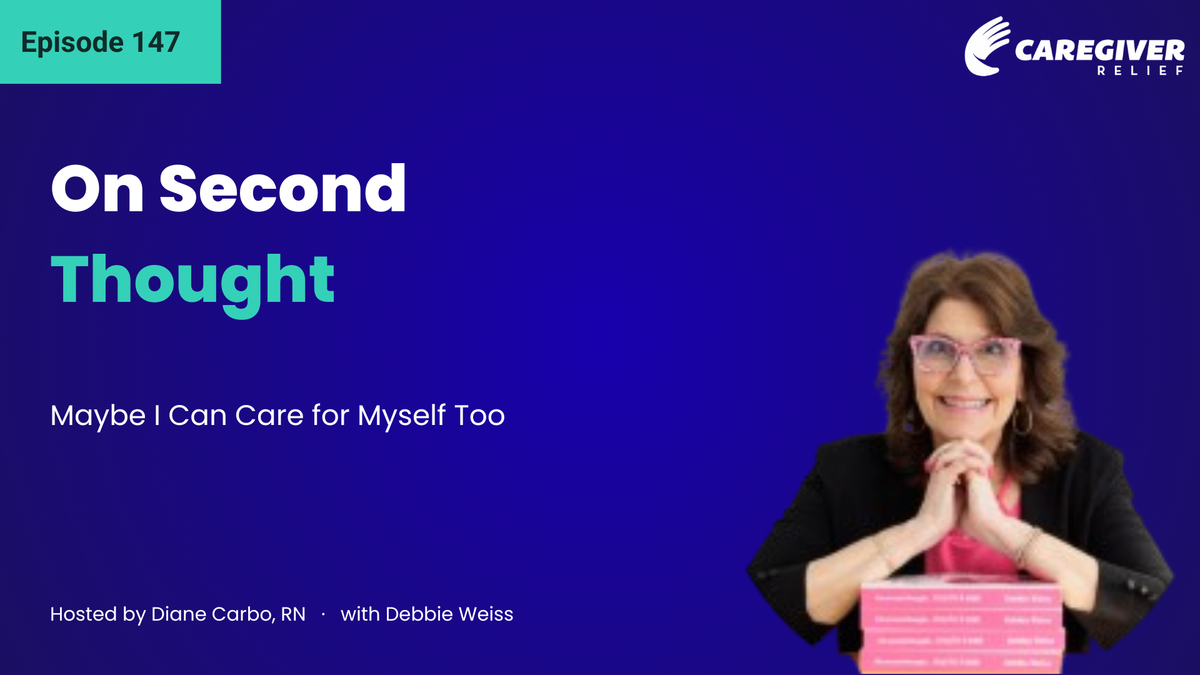
On Second Thought… Maybe I Can Care for Myself Too with Debbie Weiss - Episode 147
Have you ever felt invisible, exhausted, or unsure where you fit into your own life after years of caregiving?
If you’ve been putting everyone else first for so long that you’ve forgotten what brings you joy, this episode is a must-listen.
In this powerful episode of the Caregiver Relief Podcast, host Diane Carbo sits down with Debbie Weiss, author of On Second Thought, Maybe I Can. Together, they dive deep into the reality of losing your identity to caregiving and, more importantly, how to reclaim it—no matter your age or circumstances.
🎙️ In This Episode
Debbie Weiss isn't just an author; she’s lived the caregiving journey for over four decades. From caring for her father after a stroke at age 17, to raising a son with autism, and later caring for her husband during a terminal illness, Debbie knows the weight of responsibility.
Yet, at age 50, she realized she had "lost her laugh." This realization sparked a transformation that led her to write books, start a podcast, and finally prioritize herself.
"I didn't realize that... I had lost my laugh. I didn't really know who I was... I only had hopes and dreams for my kids. Not for myself." — Debbie Weiss
🌟 Key Takeaways
Here is what you’ll discover when you tune in:
- The "Maybe I Can" Mindset: Learn how to stop the knee-jerk reaction of saying "I can't" to new opportunities. Debbie explains how pausing to think, "On second thought, maybe I can," opens doors to a new life.
- Writing Through Grief: Debbie shares the incredible story of how she started writing her first book while her husband was battling terminal blood cancer, proving that the "perfect time" to start something for yourself is now.
- The Power of Boundaries: Why setting boundaries isn't selfish—it's actually a way to train others to respect your time (and how a Jazzercise class saved Debbie's sanity!).
- The Sprinkle Effect: You don't need a massive life overhaul. Discover how "sprinkling" small moments of joy, curiosity, or perspective into your day can move you from Point A to Point B.
- Reinventing Yourself at Any Age: Diane and Debbie discuss how they both reinvented their lives in their 50s, 60s, and 70s. It is never too late to find a new purpose.

💡 Why You Should Listen
This conversation isn't just about the struggles of caregiving; it's about the possibilities that still exist for you.
Diane and Debbie discuss the "cycle of guilt" and how to break it. As Debbie notes, when you take care of yourself, you stop showing up as the "angry, frustrated" caregiver and start showing up as your best self.
Whether you need permission to take a 10-minute walk, start a hobby, or just breathe, this episode gives you the tools to say, "Maybe I can care for myself, too."
📱 Connect on Social Media
Stay connected with us and our guest for daily inspiration, clips, and community support:
Please click here to join the Maybe I Can free FB Community
📚 Resources Mentioned
- Guest Website: debbierweiss.com (Don't forget the 'R'!)
- Debbie's Books: On Second Thought, Maybe I Can and The Sprinkle Effect.
- Podcast: Maybe I Can Podcast.
💬 We’d love to hear from you! After listening, what is one "sprinkle" of joy you can add to your day today? Let us know in the comments below.
Podcast Episode Transcript
Diane: Welcome to the Caregiver Relief Podcast, where we empower family caregivers and aging adults to live with purpose, peace, and confidence. I'm your host, Diane Carbo, rn, and today's episode is about rediscovering yourself after years of putting everyone else first. My guest is Debbie Weiss, author of On Second Thought, maybe I Can, and the host of Maybe I Can Podcast.
Deb is a life strategist, entrepreneur, and caregiver who turned her own struggles into a story of transformation and hope. If you've ever felt invisible, exhausted, or unsure where you fit in the caregiving journey, this episode is for you. So stay tuned as we talk about reclaiming your joy, finding your purpose, and realizing that it's never too late to care for yourself too.
Diane: Thanks, Deb.
Welcome. Today, I'm very excited, to hear about your topic because one thing I know about. Caregivers is they don't practice self-care or are not gentle with themselves in any way, shape, or form.
Debbie: Absolutely. Thank you so much for having me and I am glad to be here to spread my message 'cause I agree with you a hundred percent.
Caregivers think it's selfish to prioritize their own self-care, and it took me a long time to realize that, but we'll get to my story.
Diane: you led such a full life as a mother, an entrepreneur and caregiver. What inspired you to finally write on second thought, maybe I can, and share your story with the world?
Wow.
Debbie: there's a, there's such a long backstory to get there that, I'm just trying to think where I even go with that question. I think I was at a point where I had already been a caregiver for. Over 30, 40 years at that point.
Diane: Yes,
Debbie: and I'd already learned the lesson about the importance of self-care.
I had already allowed, I had been overwhelmed. I had been, burdened and exhausted and all the things. I had already gone through this big transformation already. And so I wanted to figure out how is the best way that I share my message, how do I reach people? And The people in my circle, they kept talking about a book.
Oh, your story. I was like, I can't write a book. I don't know how to write a book. What do you do? Do you just open up a notebook and say my book and start writing? what do you do? my professional background, like I'm a numbers girl. I'm not a words girl, so I don't know what to do, and.[00:04:00]
It kept coming up. And finally one day I was listening to a podcast that I don't ordinarily listen to. And the person was interviewing a woman who helped first time authors get their stories out there. And I really resonated with her. And I thought, Deb, this is hitting you over the head. Like you have to contact this woman.
I did and I really liked her and she was just starting a small group program for first time authors, but I was so scared because I had so many limiting beliefs. I am never gonna be able to do this. I don't know what the heck I'm doing. if, for those of us who are old enough to remember, see Dick Run, C Jake run books, I was like, that is what my book is gonna be and nobody's gonna read it and it's gonna be embarrassing.
But I knew, like I was wondering, oh, I wonder if I really could do this. And just as I was about to say yes and join, my husband was diagnosed with terminal blood cancer. Oh. And I was seeing a therapist at the time and I said to the therapist, I'm embarrassed that I'm even bringing this up. Obviously I'm not doing this now.
I don't know what's gonna happen. You know what my life is gonna look like. And she said, I disagree with you. This is the perfect time. And I said, what, thinking to myself, this woman is crazy, Uhhuh, what do you mean it's the perfect time? I said, what if I can't show up one week? 'cause you know something's going on that's unavoidable or there's homework and I don't do the homework.
Or like just such a, an A student. And she said to me, who cares? Yep. Yep. And I thought, wow, maybe she's right. And so I took the plunge, uhhuh, and it took me a little bit of time to figure out. I still didn't believe that I was actually going to write an entire book. But once I worked it out and realized I don't just open up the book and open up my notebook to a blank page and start, I felt a little more settled.
And I think when I had written 10,000 words, that's when I started to believe, oh, maybe I can do this. And I made sure every day, practically every day. To schedule in time to write, whether if my husband was in the hospital, I just brought my stuff with me. If we were home, I would wake up at, five 30 in the morning and wrote, be right before he gets up, or, whatever it was.
I didn't allow the excuses of, the whirlwind around me. And in the end she was right because. It was very counterintuitive. You would not think that when you're caring for your dying husband, it's a good time to learn something new. But she was Right. that's
Diane: amazing. one of the things that, I realized when you were telling your story is how we are such people pleasers.
And we have such high expectations for ourselves, but we also have very limited beliefs. And, the fact that she, that you, that you listened to your therapist and thought you'd give it a try. Is astonishing because you were overwhelmed by,you're grieving the loss of your husband while he's still with you.
Yeah. You're watching his decline and it's very challenging. like so many caregivers lose their identity in the process of caring for somebody. When did you realize you had lost sight of yourself, and what was that turning point?
Debbie: I became a family caregiver when I was 17. My father had a massive stroke and was permanently disabled.
Luckily, he survived. he lived for 30 years from the, almost to the day that, from the time he had the stroke, and my parents soon divorced after the stroke, and I have one. Younger brother who's four years younger. So if I was 17, he was only 13. Yeah. So he certainly wasn't ready to step into any caregiving role.
Neither was I, but I did, and I became my father's caregiver from that point on for the next 30 years. Oh, wow. Then when my oldest son was two, he was diagnosed on the autism spectrum. And that is just a different, completely different type of caregiving, different type of emotional pain. Yeah. And stress.
And so simultaneously, I think my, my, son was, my oldest son was 10 when my dad passed away. So for about 10 years I was caring for them both simultaneously. And I also. Have a small insurance agency. So I was working full-time and caring, for my customers, my team members, that kind of thing. And I have a younger son who's, 20 months younger than the son with special needs, and I was always on edge.
I would get, really annoyed at my father for so many different things. I started to have physical manifestations of stress that I never had before. I would get heart palpitations. My eye was twitching. I've always had a weight problem. I let my weight get way out of control. And I didn't think there was another way in my mind.
At that point, I felt like what is my choice, number one? Number two. Why the heck is this my life? what did I do to deserve this? especially when I was in my twenties and watching my friends live this carefree life. And I'm trying to understand, at 22 years old, what's Medicaid? What's Medicare, what's the different private disability?
for goodness sake, I don't even know what social security is at 22, Yes. And I, I grew very resentful.
Diane: Yeah.
Debbie: When I turned 50, my friends insisted that we go away to celebrate for the weekend. And my dad had passed away a couple years before that and I thought, oh, I can't leave my family alone.
there was no way, 'cause my husband had, He had a DHD and anxiety. And every morning I would basically, between my two sons and my husband, I'd basically have to give them their marching orders, turn them around and point them in the right direction. We all know what that's I think.
Yes. And how was I gonna leave them? And my friends are wonderful and they convinced me and I went away for the weekend and I was just carefree. I laughed, like I hadn't really laughed since I was a kid, and I didn't realize that. Yes, of course in that 30 years I had good times and I was actually always an upbeat person.
So on the outside it wasn't like I was Debbie Downer, right? But, I had lost my laugh. I didn't really know who I was. We had a deep conversation talking about our hopes and dreams moving forward, and I only had hopes and dreams for my kids. Not for myself. Not to mention, for me, something about the number 50 hit me pretty hard.
And thought, wow. 50 that went fast. Let's hope I have another 50 years if that goes just as fast. If I don't do something to change this. And I don't mean not taking care of my family members. I think I meant taking care of myself. Yes. I didn't know that's what that was. Yes. That I'm gonna die with a lot of regrets and this is my one and only life, so I better do something about it.
And that was the turning point.
Diane: I love that story. the phrase maybe I can is so very powerful. What does that mean to you personally, and how can caregivers begin to adopt that mindset? So it came
Debbie: from the idea that my entire life, if anybody. Said something to me, offered me to try something and it didn't have to be as big as, oh, why don't you just change your career?
It could be as small as you wanna learn how to knit. Nope, Nope. My gut re knee jerk reaction was always, I can't do that. I'm not crafty. Nope. I don't wanna do that. No. To everything and no, because it's. The, in the short term, easier to say no. You don't get outta your comfort zone. You're in your little safe spot.
You know that the devil we know kind of thing. But the book is actually called on second thought dot. Maybe I can, because what I found is, even though still today, my first reaction might be, oh no, thank you. If I just pause for a minute. On second thought, wait a second. Why not? Maybe I can do that.
How do I even know without trying? What about other people in my situation with my, they did it, so why not me? and that's really an aha moment. And any time that I did pause that I did face my fears in the decade plus, I'm 62 now, so in the decade plus that it's been, from the time I turned 50, what I found is anytime I said yes, Even if it didn't work out, it was always better on the other side
Diane: of saying yes. Yeah. Absolutely. Absolutely. And you know what? We have to, a part of a dementia, prevention program is doing something new and different every day. So when I've taken the attitude, and Lord knows I'm not athletic. I don't,I'm creative in some ways, been in others, I'm not.
when somebody says, you wanna do this, I do the same as you. I'm like, and then I go, I take a breath and go. I think I can. I will. Yes. And it's so much, it's so good because you're trying something new and different. You're creating new neural pathways if you need an excuse to, to take the plunge.
But it's also, you're meeting new people, you're having a different experience. And I've seen people that have. Done these things. Somebody like you, you've written a book. how amazing is that? and you never had that on your bucket list. So it's really fun, I think if people, and important that people take a chance, especially caregivers.
'cause we live our lives for other people so much. And we put our expectations on the back burner and our life on the back burner many times. And, that's not good. I've had people care for somebody. you're the perfect example of 30 years, 40 years, 50 years, and it's hard because you lose who you are.
Absolutely.
Debbie: I have to say, and I've actually, I've written two books now. A workbook, journals, a card deck, and I'm telling you that because one of the things, just like you said, you're not athletic. Yeah. Anytime, anything creative, I would say. I don't have a creative bone in my body. I don't have a creative bone in my body my entire life.
Because I wasn't good at art and I, like I said, I didn't like to write, I would avoid classes in college that you had to do a paper. there was nothing in my mind that was creative about me. And what wound up happening was when I was like brave enough to explore this. It was like a Pandora's box.
Like I have had all these ideas in my head. Yes. And the, the top popped off. And now I'm like, oh, and I wanna do this and I wanna do this. I'm gonna create this, I'm gonna, and it's like, who are you? exactly. I literally discovered something about myself. I had no idea existed.
Diane: yes. It's
Debbie: crazy.
It still just blows my mind, honestly.
Diane: it's fun actually. Yes. I know when I first moved to Myrtle Beach, I collected shelves. I got tons of shelves. I organized them into separate drawers, and then I started doing crafts. And my girlfriend, my roommate at the time, what are you doing? I would make.
N hair pieces with on barrettes and I would do shadow boxes that made them look, these people look like,a Victorian lady all with shells. And she would go, how do you do that? I don't know. I just thought I'd do something and have fun and try. Yes. And what, and I even. got a huge mirrors from Goodwill and I would put shells all over them and put, a modge podge all over and take 'em back and have them sell them again.
Oh. Because I had no place to keep them. But it was keeping me busy and creative and it made time pass so much easier and more enjoyable. yes.
Debbie: that's self care right there.
Diane: Yes. and I and it only started in my sixties, girl. Yeah. Because like you, I started caregiving at 16 years old and it's just been a whirlwind of always caring for somebody.
now you've spent so much of your life like I have, living by others' expectations. How can caregivers recognize when they're doing the same and maybe change their course? Ooh. I think,
Debbie: as people pleasers, the hardest concept, and I'm still a work in progress on this, is setting boundaries. And you thinking, at least me, I guess I can only speak for myself.
I would think, if I tell them no Or I tell them, that's not convenient for me. How about Tuesday at six instead? That the whole world will fall apart. People will think ill of me. I won't be doing my quote unquote job, all the things. And I started by really coming home from that trip at 50. I did other things, but, and setting a boundary with my family, prioritizing my exercise because.
Besides the fact that it was good for me physically, honestly, it was better for me mentally. Yes, I would walk into that class and let me just say, this was a class I really enjoyed. I love to dance and it, so it was jazzercise, so it wasn't torture. You can't pick something that you don't really enjoy. It was something I really wanted to do.
Yes. And I would walk into that class and I'd be wound up so tightly and so angry, or I'd have so many problems, ruminating in my mind. And sometimes it would take one song, sometimes it would take three. But it never, ever failed that I didn't leave there. Basically exhaling. And feeling like a different person.
And so obviously, unless it was an extreme emergency, I said to everyone, here's when I go to Jazzercise. You know this schedule in advance. If you need something, I am not available during these times. Yes. or you let me know in advance. I just made it crystal clear and at that time, my kids were, I don't know, maybe early teens.
And so maybe they needed help with homework and as you're running out the door and it was like, sorry, either you have to work on it while I'm gone or I'll help you when I get back. Exactly. Yep. And they learn, by the way. Oh, yes. Yes. So afraid. It's like you are training someone else. Yes.
And they might kick and scream. Yes. But if you stick with it, they'll get it.
Diane: You know what's funny is caregivers have feel like they're a failure if they ask for support or help. And, people will come to them and I think people truly wanna help. And they'll say, can I help? And they say, oh, I've got it, or, no worries.
and they need to learn that you, for survival. You need to say, yes, what can you help me with? Or, I need help getting the trash taken out every Wednesday or. I need help with the yard or I need help with the pet, or getting the pet to the vet or picking up mom's meds or help me organize the meds to make sure we get them on time.
there's so many things that a person could do and I actually encourage people to build a care team, partner support group within their community so that they have, practical assistance. when they need it. And that's really hard for them because, caregivers have very limiting beliefs on things and they get stuck in a cycle of guilt or self neglect.
and I know you've seen that too. we both, you and I both live that. Exactly. so how do we get them out of that cycle of guilt or self neglect?
Debbie: I think the easiest way is flipping it and thinking about when you have a friend or family member that you see as struggling.
And you wish that you could do something to make it easier for them, but you just don't know what it is.
And when you do something to help, how does that make you feel? So good, right? Yes. Because you wanna be there to support them. So I think maybe flipping it and thinking you are doing the other person a favor too, because those people that care and love you, they wanna help you and they don't know what to do.
So by you telling or asking them, ah, that's great. You gave me something.
Diane: Exactly. Yes. I love that. So how did caregiving shape your perspective on resilience, strength, and compassion, both for yourself and others?
Debbie: I guess in every single way since it has been a life defining journey. And the funny thing is, and I don't know about you, I didn't even know what I was doing, had a name. Know what I mean? I had never heard the term, thank goodness, that now it's becoming, something that we discuss in the public.
There's all these statistics and there's all these different organizations. If they were there 30 years ago, I certainly didn't know about them. Yes. Yes. I think things are. For me, just finding that support through with other caregivers, but it shaped my life because looking back and you know how you say, you put all your problems in a hat and you'd still pick your own and that kind of thing, and whenever you look back on your past struggles, it's so much easier to see what it really did for you or what it gave you or how it shaped you.
Yes, and I can say that as a kid and a teenager, I struggled with my weight. I always felt judged from the time I was literally born. So You too. That's funny. Yeah, me too. Yeah. I never wanted anyone to see me, so I didn't speak up. within my own circle I was very loud. But outside of that, if I was in a store and I had a question, I would never ask, I didn't even wanna go up to a counter and order a soda, and I didn't wanna talk to anyone.
I just, I couldn't get out of my own way, let's say. Yeah. Really Even when my father, yeah, but when my father needed me It forced me because I wasn't going to let my insecurities negatively impact him because I was not able to speak up to advocate, to learn the things I needed to learn to help him.
Diane: And
Debbie: so in retrospect, right out of the gate, it showed me that I was capable of so much more than I ever imagined. Yes. It changed my life. it changed my life and I am very proud and glad that I was there for him and for my husband through very difficult times with my husband.
Caregiving wise, he suffered from both mental and physical illness and mental illness. yeah, it's much worse than the physical. I agree. And. So I'm proud that I persevered. I'm proud that I was there for my family members, but each step along the way taught me something about myself that I didn't know that I was capable of.
I thought I was a weakling. I thought I was a war, so to speak, and I've been punched so many times and it's just shown me that no matter what happens, I can always get back up.
Diane: that's funny. from the perspective that people see caregivers as weak, that they think we're, we,when in fact we are strong.
Oh yeah. Because we do so much and we may have a little, low self-esteem. But we absolutely are lioness or lions because we're doing so much,to help support others. I took care of my mom when, from 17 or 16 years to 18 when she went through her, lung cancer and it was, I grew up very fast like you, and I'm the oldest of four, so I also had to take care of my siblings.
And one of the things that made me different from you is that my mom, she always was excited that I was going to nursing school and I had a vision and, she was proud of me. So when, after my mom died when I was a freshman in nursing school. And, everybody in the family and I come from a big Irish family, everybody expected me to quit school and stay home.
And I, after taking care of my mom, I didn't have the thi I didn't get to do the things that other kids did when they were in high school. they were all, no, I did go to prom and stuff like that. That's no big deal. But, you have a burden when you're taking care of somebody and your siblings, there's cooking, cleaning, laundry, discipline, making sure they get their homework.
That was me at 15, 16, 17. My goodness. And 18, and then after my mom died and I actually, but my mom prepared me. she, we didn't talk about her death or anything, but she always taught me how to organize and I could cook and stuff, and I did that for my siblings. they, I'm the oldest and my two brothers and my sister.
My sister was only 11, so I said I am completing nursing school no matter what. And I wanna tell you, nursing school is hard. Yeah. And when I went, there were 200 of us in my class and there were only like 70 of us that graduated. And I went through that while taking care of my brothers and sisters and,
my family, they all resent me because I'm the bossy, know-it-all sister, but they don't know what I went through to help take care of my mom. 'cause I had to be the caregiver and the caregiver for them as well. so I know what you're staying and we have to, Change.
You change your perspective, you change your life. And I was bound and determined I was gonna make my mom proud to become a nurse. And of course then I became an A caregiver, both personally and professionally my whole life. Yeah. You're a glutton for punishment. Yeah, I know. really. And one of many things, many, one of the big.
problems with caregivers is they struggle with guilt when they try to take care of the take time for themselves. Yes. what helped you let go of that guilt?
Debbie: I think I saw that when I was showing up for my family members, I wasn't really showing up as my best self. I was showing up as an angry, frustrated, annoyed person and really, is that what I want for them?
Like I said, I. Boy, especially, now I look back with regret of all the times that I snapped at my father or hung up the phone because before caller ID and answering machines, he would literally call me 10 times a day telling me something that he needs next time I see him or whatever it was. And I would be like, oh my gosh, I can't handle this.
and so that was no good. That was counterproductive to show up in that kind of way. And so I saw what happened when I did go to Jazzercise and the way I came home compared to the way I walked out the door in my house. Yeah. Like the proof was right there. Yeah. So you know, you are not only helping yourself, you are in fact helping your loved ones.
Diane: 100%. it's essential for your survival as a caregiver. it's not an option, it's a necessity and self-care with, even if it's you, I hear so many caregivers say, I don't even have time to take a bath. Oh yeah. And I'm like, oh, no. you've gotta find time. And there you can take 10 min, even if you take 10 minutes out of a day just to sit outside or walk around the house or whatever you need to do, get out in nature, take a breath.
start with an attitude of gratitude every morning that even that alone changes your perspective and your start for the day.
Debbie: I agree with you. I think the, especially for caregivers, it is, I don't have time and I, believe me, I certainly understand why people feel that way, but the truth is that's not the truth.
Because if you sat down and you realized all the time that you were. Possibly wasting whether it's on your phone or watching tv, or I don't know. Oh, and you know what? Even if that's not the case, even if you are literally going every minute. Then get up 10 minutes earlier.
Diane: I tell my clients that and they're going, what is wrong with you?
Why would you do that? you know what? That 10 minutes could be the most important part of your day because it's for you. And I used to do that all the time. I'd get up I very early and just sit and have a cup of herbal tea and just start my day, with thoughts on. Positivity, grateful. I start with gratefulness and prayer and move on.
But,and then I, in some days I had to set priorities. What am I gonna do today? And I would make, I'm a list maker. I would write down everything that I needed to do that day so that I could cross it off and feel accomplishment. And if I missed it, I, it was okay. 'cause I'd go, ah, then I'd move it to the next day.
But you have to take steps too. Be in control of your life and it means taking care of yourself as well.
Debbie: Agreed. I'm a list maker too. Yeah. I'm trying to go to the list on the computer, but I still like a paper.
Diane: I get that, but now it's not the same as like I write it down and I cross it off and I go exactly that.
Crossing off feels
Debbie: good.
Diane: Yes, but I'm also a person who now, this is crazy. I enjoy ironing. That is my brother.
Debbie: My brother finds it relaxing. I'm like, why don't you move from Cleveland to New Jersey and I'll, I got a whole thing. I'll relax you to death.
Diane: My dad was a letter carrier. Back then you had to, he had to have these uniform shirts and I can remember my mom.
Taught me 'cause she worked, they owned a dry cleaning store. her parents did. So she taught me how to iron. And what I love about ironing is I start with a pile of wrinkled and it comes out in this all beautiful, nice. And I've accomplished something that's gives me a sense of accomplishment. Silly.
But in those days I used to even mangle irons, mangle, pillowcases and sheets, which mangling is a big machine that rolls. because it just gave me a sense of making something crinkly and. A mess into something smooth and nice. I love that. Oh, I don't do it now. And Lord knows, oh my God, I wear wrinkled clothes, And it's okay. But in the past, that was something I enjoyed. Now I'm so impressed. With your transformation. It happened at 50. That's a powerful reminder to all of us. It's never too late that, that's right. So what advice would you give someone who feels it's too late to change?
Debbie: like you said, I don't believe it's ever too late.
I have friends talking about. Retirement and when they can retire and all the things, and I'm thinking to myself, okay, maybe I'd like to retire from my day job, my insurance agency, but I don't. See myself ever wanting to retire for whatever it is that I'm doing now. the writing, the speaking, the podcasting, like retire.
I don't wanna ever stop this. This makes me feel fully alive. And after I'd written my first book, I wound up in some small group of people with, Jack Canfield who wrote Chicken Soup for the Soul Series. yes. And I was one of the youngest. Everyone else, most of them were in their eighties Uhhuh.
I thought to myself, I'm a baby in this group. Yep. Yep. And all these people are living their best lives. And some of them were first time authors and others, had written other books. But the point was they were still. Enjoying what they were doing, accomplishing something, and just tapping into their purpose.
Now, it's not like I wouldn't like downtime, but I can have downtime. There is no. There is no age limit. I don't see that there is any age limit. And if you think that there is, or you think that because of your circumstances, because you're inundated with caregiving and if you are caregiving for, parents and children at the same time, and I know it's a lot harder 'cause I've been there with the parents, the children, the job, all of that.
Even. even if there's a little something that you can do every day to spark whatever it is, that next version of you. Yes. Even just the idea. I remember once I was given an exercise of, write down every detail about your Dream day, what would you do? Who would you be with, where would you be?
All the things. And I was like, I have no idea. Yep.
Diane: Yep.
Debbie: Because I didn't allow myself, it was almost like that would be too painful because I thought I would never get there. And so when I finally did the exercise and continue to rethink it, it's it makes sense. You need a map.
So now I know where my destination is. Yeah,
Diane: I
Debbie: know where I am now. I have no idea how I am getting from point A to point B, but I know that if I stay at point A, I'm never getting to point B. And so just taking little. small steps. My second book is called The Sprinkle Effect, and the idea is you just have to sprinkle in little things into your life and slowly but surely, you start to move along that line from A to B,
Diane: not in a straight line, but you.
I have to tell you, I actually did that. here I am 72 and I'm doing podcasts and I'm helping seniors and I'm writing and,I'm laughing because I'm interviewing CEOs of senior tech companies that, I want people to know about. And, about 25 years ago, I was in a car accident and I thought, what am I gonna do if I.
I can't work as a nurse anymore and I, my girl, my sister-in-law was taking a course on how to build your own website. And I said, oh, all right, let's do it together. and I learned so much, and I've had successes and failures and more failures, and, but here I am, I'm still kicking and going strong.
And, I have a need to help people. Oh, that caregiver in me, Yeah, I gotta take care of others, but I'm using the knowledge that I have to share with others because, Family caregivers are expected to do things that were once done by, professional healthcare providers. And, nobody knows how to navigate the medical delivery system I was a care manager, a discharge planner. I've worked in every area of, every area of nursing, ortho, rehab, cancer, home care. I worked on the in, in the insurance side of things. So I have all this experience that. Not many people have, and I'm now trying to share it. So I have reinvented myself and,I don't,I lack for nothing as far as if I wanna go do something I do.
and, but I don't, I It's for socialization for me too. Sure. Exactly. I'm having fun meeting and inter new and interesting people,
Debbie: I find that the thing about the podcast, I don't know, that just amazes me, and I agree with you. It's one of the best things because we would never have met. It's still I feel like an old person saying the power of technology.
we could be in completely different states, different countries, different, I've talked to people in Australia. It's what? This is crazy. And you meet such. Interesting people that you never would've met before. And it is very rare that I get off a podcast that I'm not smiling because I'm so happy to have had that conversation, to have met that person, to learn who they are and what they are doing.
And it's just the best thing ever.
Diane: And what's cool is some of those people that I interview become my friends. Yeah. And we communicate. So let tell us about your podcast. Maybe I can, what inspired it and how does it continue your message of empowerment?
Debbie: Yeah. So obviously we know maybe I can, where that came from.
And I have to say, the podcast was one of those things. I said I can't do that. What am I gonna do? I don't know how to do that. All the things, And I just decided one day, oh, just do it. Just start talking. What's the big deal? Exactly. My, my family says, do you ever stop talking? and I thought, I guess this is a perfect opportunity.
Maybe this is what I was meant for, since I never knew how to shut up. And I have to be honest, is that I've gone through iterations of it that have been a little difficult. Yeah. And have almost backed away from it several times. And now I'm in a place where I'm finding it, you have to find what works for you.
Yeah. I love being a guest. But I didn't, I noticed I didn't enjoy as much, or I didn't feel that I did a great job. Having guests on my show and it felt almost like too much of a responsibility for me, Uhhuh. So the last six months I said, you know what? I have to make this easy for me. And now every week I just get on and I basically talk about a thought maybe, or a situation that I had in my life during the week that typically would inspire what my topic of the week is.
And so to me it's just having a conversation with my audience, like a friend. And sometimes I ramble and sometimes I forget what the heck I'm saying and that's okay because. Yep. I'm a per real person, right? We're not perfect.
Diane: I laugh because,my IT guy says, oh, Diane, try it. You've got so much information, try it.
And I try. I started and I just pretend I'm a radio talk show. Oh, there you go. Do that.
Debbie: I like
Diane: that. and I have, it's, I laugh because I don't mind interviewing anybody. I think it's fun, it's exciting and, but I don't usually make, put myself out there to be a guest and I have a lot of knowledge and information.
Yeah. Why is that? I just decide. In fact, I was just telling my IT guy, Ryan, this week. I'm going to start, I'm going to start, putting myself out there to be a guest for, 'cause I have a wealth of knowledge and, it needs to be shared. 'cause I'm 72. I don't know how much longer I'm gonna be around, but take advantage of me while you can.
Good girl.
Debbie: And let's face it, the coolest thing about the podcast is it lives on right? And you don't know when someone's gonna listen. I just. couple of weeks ago, got an email from someone who had heard me on a podcast as a guest. I don't even know when I recorded this because this was some talking about something with my son that I typically don't talk about.
And so I know I hadn't had that conversation in the past, several months. And, she just said she heard it and it, she really resonated with it. And you don't get to hear about someone whose situation was similar to hers, was similar to my son's. And it just really reminded me that we don't know who's listening.
We don't know when they're gonna hear our message. Yeah. So our voices will live on. Yeah. And it's a pretty
Diane: cool thing. It's a pretty cool thing. Yeah, I actually, I never thought about it like that, but you're right. I like that. 'cause I, it's my legacy, to leave this behind. and I'm excited because everything I'm, I create and share is gonna be applicable in 10 or 15 or 20 years, to what we're dealing with now.
Because every, we have a public health crisis in our country right now. We have very, we have. Not enough youth to take care of our seniors, and every generation from baby boomers on has not replaced their numbers in births. So every generation from us on down, baby boomers on down are not gonna have enough youth to care for 'em.
And the youth are our tax-based. They're our workforce, and things are going to get more and more challenging as we get older. And, and then we have so many, one of the silent ca caregiver crisis we have, or public health crisis is the, the par, the childless couples. And we're having more of them now than ever before.
So things that we're talking about today are going to be applicable to them in the future too. So yeah,
Debbie: that is very true. I actually have a couple of friends who are childless couples, and I know that as they get older. They get concerned. they make sure that they're really close to their nieces.
Diane: Yeah. Or you know what? I actually have people that have attorneys that are taking care of them, when they're, when they get older. I think that's really important and there're gonna be issues and I hope that, in the future, people will come across and look at the podcast and go, oh.
I need to hear that topic and it'll still be, applicable today. so you said you've written another book, the Sprinkle Effect. I see it on Behind You at, although this is audio. I love it. so explain a little bit more about the sprinkle effect.
Debbie: So when I wrote on second thought, maybe I can Unbeknownst to me, I had to decide early on what genre it is. I'm like, I don't know. And then I learned that there's subtle differences between memoir, biography, self-help, and so I had to make a conscious decision that it was a memoir. Meaning wasn't like there. I came back at the end of every chapter and gave you a little recap or what you should learn or anything, right?
You just read it and take it whatever you want. And so then after I did that, everyone said, that's great, but what steps did you take between 50 and now to begin to change your life? And so that's where the sprinkle effect comes in. Sprinkling in little things into my life, and each chapter is a different sprinkle.
So it could be like a sprinkle of belief, a sprinkle of perspective, mindset, action, curiosity, joy. And so each chapter discusses a little bit about the meaning of that. Sprinkle tells a story from my own life. So it's kind of memoir based that relates to that sprinkle and then. Gives you advice of how to apply it to yourself, and at the end of every chapter, there are three activities for you to complete and a journal prompt.
Oh, that's lovely. I love that. Oh, I'm obsessed with it, I have to say because,
Diane: you know what? I get that. and I, in all honesty, Deb, I have to tell you, we are, my listeners out there need this kind of information because they're getting bombarded with so much negativity and they struggle every day with making decisions or just even, take like they.
They don't take care of themselves. So they get to a point where, they start having the chronic stress causes them to be ill. Yes. And I love that. you're offering solutions to their. Problem. and most of it is, life limiting problems, that they can change by changing their perspective.
And I love that they don't need to be a victim. They don't need to feel like they're unloved and unwanted and unheard. And they definitely, and I know so many out there. Like you said, feel invisible. They feel, and they're comfortable in that role and they don't need to be invisible anymore. No,
Debbie: I agree.
And the thing that I really stress in the book is I have read so many self-help books where you. It says, okay, now complete this exercise. And I'm like, I'm not completing that exercise. I'm just gonna move on to the next chapter. How many times? and I still do that. But what I have found is that think about all the books that you read and then you put it on the shelf and you're like, what was in that book?
I don't really remember. Yes. It's when you actually put in the effort. To complete the activity, not just think about it, because I'm like, okay, I'll just sit back and think for a second what my answer is. There's something different about putting pen to paper and so I, the chapters aren't that long.
It really doesn't take that long. They're bite size little sprinkles, and I think that they're important to fit into your life, and I think that it is. Reading. It answering it just that in itself feels empowering. That is enough. That's your start from getting from A to B. Yeah. Yeah.
That's where it begins, is getting in touch with who you are and what you want and what needs to change. nobody can tell you, nobody can answer. Everyone's answers are gonna be different. Here's the information, here's the questions you decide. Yes, and you feel like you're doing something proactively and you are.
Diane: And if you keep saying, I think I can, I think I can. like what used to tell the kids? Oh yeah. Did the book with the train. The book. The train. Yeah. I have it. I can't, yeah. I got it. Yeah. If you think you can, you will. If you think you will fail, you will correct. So put it out to the universe that I think I can.
Maybe I can. Yeah. Finally, Deb, what's next for you and how can our listeners connect with you, follow your work or get your book? So what's
Debbie: next for me is I just come out with some other, when I say I'm obsessed with the sprinkles, I'm gonna show you since I know they can't see, like I love my, one of the things that I love for me, is that rainbow sprinkles just make me happy.
yeah. It's one of the things that just make me smile. And make me feel like a kid again. So I love the design, so I have all these different, I just came out with this card deck that has three cards for each sprinkle. So like a sprinkle of perspective would have one card as a quote, one's an affirmation, and one's a journal prompt so that every morning you can decide, and there's a master list in the deck.
What do I need today? What sprinkle do I need today? How fun. And and then talking about gratitude, I also came out with a gratitude journal because I was not a believer in gratitude. That's another episode. But I found out it is life changing. Oh my gosh. Like I said, these are the ideas that keep popping off.
So my next might be to head to the children's genre world with my sprinkles.
Diane: You know what kids need that today too. Yeah. So many of them are on,on the internet and they, or their phones, they don't have communication skills. They'll be sitting next to each other and they're texting.
They're not, oh, isn't that crazy? It's crazy. And I hope a game like that would be fun for them and good for them. Exactly. Exactly.
Debbie: So in any of the information about me, my website is the best place to find me. It's debbie, r y.com. You gotta put the R in, otherwise you get to a realtor in California.
Diane: I will put all your information on the, in the show notes and I create a personal, Permanent page on my website that will have, all the ways we can get ahold of you and, have your links to your books and stuff. Thank you Deb. Deb, thanks so much for spending time with us and sharing, this is such a pleasant conversation.
I appreciate this.
Debbie: Oh, me too. Thank you so much for having me. This is definitely one I'm gonna. Stop. I won't, it won't wipe the smile off my face for the next hour.
Diane: To my family caregivers out there, you are the most important part of the caregiving equation. Without you, it all falls apart. So please learn to be gentle with yourself.
Practice self-care every day because you are worth it.
Caring for a loved one can be overwhelming — but you're not alone. If you have questions, big or small, our expert team is here to help.
👉 Click here to Ask the Expert
Our Resource section can help you find the information and tools that you need. We have courses, videos, checklists, guidebooks, cheat sheets, how-to guides and more.
You can get started by clicking on the link below. We know that taking care of a loved one is hard work, but with our help you can get the support that you need.
Click here to go to Resource Section now!