Managing Pain in Seniors Without Risky Meds with Mark Garofoli - Episode 185
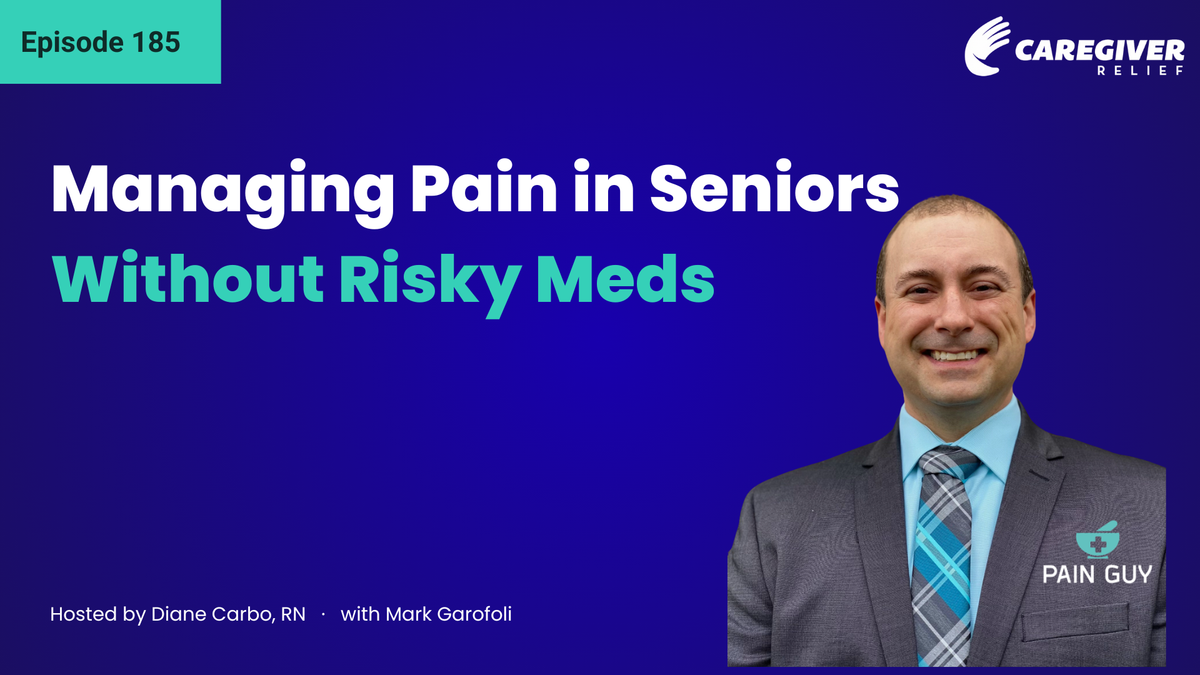
In this episode of the Caregiver Relief Podcast, host Diane Carbo, RN, sits down with Mark "Pain Guy" Garofoli—a nationally recognized pain expert and geriatric pharmacist. Together, they unpack the complexities of pain management in older adults and how to navigate the healthcare system safely.
📝 What You’ll Learn in This Episode:
- The "Risky" Meds Checklist: Why common prescriptions like opioids, NSAIDs, and even Gabapentin require extra caution in seniors.
- The Fountain of Youth vs. Kidneys: How aging bodies (especially the kidneys) change how we process medication.
- Decoding the AGS Beers Criteria: A look at the "gold standard" clinician guide for potentially inappropriate medications.
- Alternative Tools: Exploring non-drug approaches like class four laser therapy, acupuncture, and "active vs. passive" treatments.
- The De-prescribing Movement: How to work with your doctor to reduce "polypharmacy" (taking too many pills).
💡 Top Tips for Caregivers & Seniors:
- Start Low, Go Slow: Why the lowest possible dose is critical to avoiding adverse side effects like dizziness and falls.
- Be Your Own Advocate: Use the D-V-P-R-S scale to track not just pain numbers, but how pain impacts sleep, stress, and daily function.
- Prep for the 15-Minute Visit: Don't let your concerns get lost! Write down your specific questions and goals before you see the doctor.
🌟 Episode Highlights:
"The dose makes the poison. It’s all about the dosage, baby. We have to balance how a medicine works with how much of it is being used to ensure safety and efficacy." — Mark Garofoli
3 Simple Actions for Today:
- Read: Don't just look at headlines; understand the articles and the data.
- Listen: Practice active listening to understand your loved one's specific pain goals.
- Care: Remember that patients don't care what you know until they know how much you care.
Meet Our Guest:
- Mark Garofoli: Visit painguy.us for resources on pain management, addiction, and his TEDx talk.
Podcast Episode Transcript
Diane: Welcome to Caregiver Relief podcast. I'm your host Diane Carbo, a registered nurse. Before we begin today's episode, I wanna ask you a question. Did you know that some of the most commonly prescribed pain medications for seniors can actually. Increase the risk of falls, confusion, hospitalizations, and even loss of independence for family caregivers trying to help a loved one manage pain.
This creates a difficult dilemma. How do you relieve pain without causing more harm? Today we're going to answer that question. Today's episode is when every caregiver, older adult, and healthcare professional needs to hear. We're talking about pain management in seniors without relying on risky medications.
To help us navigate this important topic, I'm joined today by Mark, the pain guy, Garofoli, a nationally recognized pain expert, board certified geriatric pharmacist, certified pain educator, and a TEDx speaker. Mark serves As faculty with, West Virginia University schools of Pharmacy and medicine where he works at the intersection of pain management, geriatrics, and addiction medicine.
He has advised major health systems served on state and federal pain initiatives, and is dedicated to helping healthcare professionals and caregivers better understand safe and effective pain treatment. Today we'll unpack what caregivers need to know about safer pain management, how to avoid medications that do more harm than good, and how tools like the AGS Beerss criteria can help protect older adults while still addressing real pain.
Diane: Mark, thanks so much for coming out, taking time out of your day. to share your knowledge. We desperately need it.
Mark: Absolutely. And thank you as well, Diane and everyone listening of course, too. quite frankly, I'm a firm believer in time being our most important resource. So not only are we here today, but everyone listening, want to thank you as well too.
It is an absolute pleasure to be here to hopefully help us, not only with patient care, but hey, hang out with our colleagues professionally as well too, to, to dive deeper into pain management for our older adults.
Diane: it couldn't come at a better time. Mark, because we have a crisis in America right now, especially with Medicare.
Medicare is not only, rationing our pain management visits and procedures that are meant to. Take a decrease or eliminate use of medications. but they're also making it hard for seniors to get drugs and I can't take them and I have chronic pain. So I'm really excited about you sharing your information with us today.
But before we dive in, can you tell us what first drew you to specialize in pain management and geriatrics?
Mark: Probably everyone listening in the,my early days as a pharmacist, I was in community pharmacies. I was,we eventually working within managed care as well and, different settings along the way.
But I always go back to my, days within a community pharmacy. I, they're either everywhere or nowhere. Yeah, literally, because, there's usually two on a corner, if not three, readily accessible for most of our country, a high percentage, like 90% or something like that, the last thing I read.
but then, you know what, if you're in that other 10% and oh, and you gotta drive a half an hour or something to find anyone in healthcare, let alone a pharmacy or hospital. But
Diane: yeah,
Mark: the bottom line is you get a lot of touch points with people in communities. And profoundly, there were so many people coming in, in pain.
A lot of other things too. I often get other healthcare professionals to be like,[00:05:00] people had hyperlipidemia and cardiovascular concerns and this and that and diabetes and every, yeah, but you know what? They wanna talk about the thing that's hitting them every minute of every day.
Diane: Yep.
Mark: my, my blood sugar level is important, but I'm not thinking about it right now.
But if I'm in pain, bet you bottom dollar. I'm thinking about it 100%. Maybe it's very American or something. I've clicked the button and I wanna receive something immediately. But when you help people in pain, it might take a while, but once it hits and there's effects on a safe and efficacious route, it's very fulfilling.
and there's just so much. everyone's, either on a right side, a left side, or up or down or all around. and, in the realm of prescription opioids and you, it's either oh, opioid failure or opiate phobia. it's like there's nothing in the middle sometimes.
Diane: Yes.
Mark: and you mentioned the AGS Beers criteria.
A lot of folks we used to call it, the beers list. It sounds like a menu and a,
Diane: I know
Mark: good establishment, but, And I will say, by the way, that it's rather, it's about probably one of the most clinician friendly guidelines out there because it's organized by charts or tables
Diane: uhhuh
Mark: instead of paragraph upon paragraph.
we're clinicians, we like to digest things really quick and help our patients. tricky part is, there's a lot of words within the tables, but at least it's organized in that way. it's just one of those things where it started out just talking with a lot of people and realizing, reading the room and realizing that there's so much convoluted information out there and opinions, or a dime a dozen.
And who do we trust? It's one of the biggest questions today with so much misinformation out there of who do you trust and why? and our, our seniors, our older patients in pain, good golly, we gotta help 'em. and hey, maybe it's a selfish thing. Hopefully we're all an older patient over 65 someday, if not already.
So you know what's good for the goose and gander and all that jazz is very important along the way.
Diane: pain often looks different in older adults. What makes pain assessment and treatment more complex as we age?
Mark: There's a lot of things that change in our body as we age. quite frankly, everything I, yeah.
when I say a lot of things, our entire body's changed. It's just how it is. Change is part of our life. but some things stand out. our immune system, perhaps a little bit less effective. it's not gonna come into play as much for pain medicines, but, our good old kidneys and heart things change there as well too.
I've seen multiple, fun reads and movies on the Fountain of Youth and all of that of, you know what, if that thing ever existed, it would literally affect our kidney function. Whatever the heck you drank outta that fountain would affect our kidney function. And either slow down the digression of it, improve it, because that's what gets us, like no matter what, when you see a hundred year olds or a hundred and some year olds living so long, I hope to get there someday if healthy, along the way as well too, but.
Things change in our bodies regardless of how vibrant our days are and active we are and eating and all that. Things just change and that's where it really comes. it's not to discredit, say, on the pediatric side, eh, pain management's pretty darn important in that regard too. the extremes of life, but.
There's just, and the population is huge in a good way. People didn't use to live this long. Oh my gosh. I saw one of our recent drug czars recently. he actually came to wild in wonderful state of West Virginia. Our town actually, and was going over, like what changed over the last couple hundred years and, various things within.
Healthcare, various other things out throughout society, but everybody's living longer. yeah, a hundred years ago people weren't, I wouldn't be here. Y'all wouldn't be here. so there's more of us, and that's a good thing. It's a first world problem, but we gotta, be able to be there and help folks too.
Diane: we also have a situation right now with more seniors than youth. the low birth rates has negatively impacted
Prior, future care for all of us because we have no one to take care of us. so from your experience, mark, what are the most common pain related mistakes people make unknowingly when they're trying to help their loved ones or help themselves?
Mark: Ooh, where do we go wrong? So perhaps the best person to ask is a healthcare professional. 'cause by golly, we're like the worst patients. Okay.
Diane: I'm one.
Mark: Yeah. Okay. You'll admit, I'll admit.
Diane: Yep. If you're
Mark: listening, whether you admit it or not, it's just how we are. Right? Yeah. conversely, there's the folks that stroll into any.
Clinic or pharmacy or hospital or whatever, and they're like, oh yeah, Dr. Google said this and AI said that. And it's
yeah,
Mark: my goodness. That's the other spectrum, right? but big picture, it's when you think about, US healthcare professionals when we are in pain, I've had I my fair share of, hopefully not too, hopefully, thankfully not too many, but,I had a kidney stone one time.
Hope and pray that never happens again. Yeah. Done everything I can to prevent that, but life happens. sounds like we're talking nothing about kidneys here today, now that I realize it, but, it's just one of those things, but it's very tough. and with knowledge comes power and responsibility and, the times that I've personally navigated our healthcare system as a patient in pain, oh my gosh.
I, it's eyeopening because you're skipping over a couple things of, again, if there's blood pressure concerns, diabetes concerns, things like that, that are very important. Yeah. But it's not the. It's not gonna make headlines if there's changes in the treatment of diabetes for a single patient.
But you know, all of a sudden things can hit the fan if it's a patient in pain that's just trying to get their pain taken care of. And more often than not, as you, articulated earlier, it's an older patient in pain. 'cause just statistically through a population, and, you'll walk into a clinic, maybe even urgent care.
I experienced this one time I walked onto the scale 'cause that's, how you get triaged and all that. And right there, right in front it was like, we don't give any pain medicines out. It's like your urgent care, what's more urgent than pain? A couple things by the way, it's at the top.
yeah. and that's tricky for patients and whoever is the patient, quite frankly.
Diane: I had a son who had re RSD, reflex sympathetic dystrophy or chronic regional pain syndrome. And, as a healthcare professional, and I've worked with other people and with severe pain conditions and our healthcare system, our provider.
just let us down. Like you said, they come in, we're not giving you, any more pain. I have a sister who had, a chronic pain, it turned out to be a RSD of her abdomen from a surgical procedure gone wrong. And she was not, she was wearing pain patches and stuff, and she was just gonna turn 65 recently.
She goes to the ER all the time and they finally told her, we can't do anything more for you. So she thinks she's dying. That was the message she was given. And I just told her, Nancy, they just can't handle your pain. You have to look at other things to do because they're giving you everything and they just see you as drug seeking.[00:12:00]
And that's really a hard thing to face. and that it's
Mark: so unfortunate.
Diane: it's, it's, it is because the first thing they say are they say, here's the cycle that most people go through. You go to the doctors, you have an acute injury. Oh, they'll give you few pain pills, send you home.
Then you need more. And like with my son Jeff,he was taking, they get a tol build up, a tolerance to the pain. So what happens is you need more, then they introduce the. Pain management to you to get off of all the meds and try other things, and it's just a cycle. So,that's why I, this title is Managing Pain in Seniors without Risky Medications.
Tell me, what does risky mean and what does that actually mean for older adults?
Mark: Risk is, such an umbrella term.
Diane: Yeah.
Mark: It's when you look at medications in general. So here,I can't speak for all pharmacists, but I'll give it a whirl for 10 seconds. what we concentrate on, okay.
whether knowing it or realizing it or not, here is an elevator spiel. how's it work and how much. So what's the mechanisms of whatever medication or treatment for that matter, even if it's non-pharmacological, not medicine. How's it work and then how much of it? our father of toxicology, he,he had a quote well known.
the lain is ciid doses, facet veno. The dose makes the poison. What he was saying was he didn't really care about how it worked or what it was, just how much, which is very important. It really drives it home. I always say it's all about the dosage baby, but how does it work and how much leads to safety and efficacy?
efficacy is Hey, does the thing work for whatever you're using it for pain? Does it improve function? It could improve that little pain scale. The numbers, dare I say, but really above function, the safety side is where that risk comes in, or those are, is there interactions with other medications, food, beverage, and.
Side effects, philosophically that's what we call them. The substance itself is like, this is what I do. You can call it a side effect, you can call it efficacy, you name it. But risk comes into play with those side effects and how frequent they are, how likely they are.
And what they are, when we're talking about, higher risk medications, generally speaking in pain management, we're obviously speaking about prescription opioids. Yeah. the difference between constipation and respiratory depression is more than appreciative.
Diane: Yes.
Mark: But it's also dose related. Yeah. And selection of which opioid related. And hey, insert us human in there too. We got a lot of different things going on between all of us. Yeah. So,the risk can go down to the, it's not, it tells somebody that gets constipation from an opioid that all that doesn't matter.
Of course it matters. I've actually been there for crying out loud, like, yeah, it matters.
Diane: Yeah.
Mark: it's different than not being able to breathe and dying though. Yeah. But it, there's still, there's risk inherent with each of those. It's just to what degree and what the outcomes could be really.
Diane: So what are some common pain medications or medication classes listening in the beers criteria that people should be especially cautious about and why?
Mark: when we're talking about the a s beer criteria, my short answer to that if it was a multiple choice question, is either all the above or, yes. Okay. Take your pick audience, whatever you prefer there. Okay.
Diane: Okay.
Mark: another version of that, and by the way, I will actually articulate an answer here, but another version that's actually come out of this mouth before is Okay, if you look through the beers criteria.
one of about a half a dozen go-to resources for treating anything, with medication in our older adults. here, particularly with pain management, but there's other tools out there, anticholinergic, burden scales. All of a sudden this got dirty really fast, but I, there's other scales, but that's one of the main ones.
when you're looking in there. There's different, I think I mentioned earlier, there's different tables. One of the main ones is the potentially inappropriate medications for use in an older adult. Usually just say pims, that potentially inappropriate medicine part. So the PIMS are in there, but then the other tables go into, what if the patient has X, Y, Z condition?
What if their kidney function is A, B, C? All these different things that are very common in older adults because we're humans and we're aging and this stuff happens. So when you look at it through that lens of reality All of a, and they keep nicking away at, oh, we recommend not to utilize this, not to utilize that, not to utilize this because there's a lot of risk, as you mentioned, that's inherent and possible with any medication.
So if you have the average older adult. Strolling into a clinic or a pharmacy. Odds are they're qualifying for multiple things within the ags peers criteria. And all of a sudden it's like, what's left? it, when you whittle away like opioids,it's not every single one is listed there, but the concept is there.
then you have, NSAID are nonsteroidal medications, even the over the counter versions, or the plethora of prescription ones. when you look granularly at that guideline. It literally, it almost sounds like a drug rep from the eighties or nineties. It literally says Okay, there's 20 of them almost.
Diane: Yeah.
Mark: just use this one. This one. Okay. All the rest. Don't worry. and folks, if you're wondering, 'cause there's no video, my hands are going a mile a minute here. Okay. If your time is coming up, just this one. Okay. I, it literally sounds like what we're supposed to not listen to as far as you like pharma or something.
But the guideline says for the most part. Unless there's other additional conditions, cib, that's your go-to in an older patient, so they knock out the other ones. there are patient specifics that could come into play with that, and there's a reality to what they're going with as well in that.
And based on thousands of articles in the literature, there's a lot of, good reputation going on there. Boy that's coming in hot. And then, oh, if you have these other conditions, by the way, don't even use that one.
Diane: it's also confusing,
Mark: so you're whittling it down all of a sudden it's okay, what about the, or adjuvant pain medications, or antidepressants that could be helping in pain, profoundly.
when you look at those oh, a lot of them, they're using pain or anticholinergics. Ooh, that's a fall risk. Which by the way, I fully endorse 'cause it's fact.
Diane: Yeah.
Mark: Again, when you're crossing off the list, it's what are you left with?
Diane: Yeah.
Mark: I've been on record to say he got half a Flintstone vitamin left.
When you go through the whole list, it's what? and I'm just saying that facetiously folks, it's. There are a lot of different pain management treatment options out there. The toolbox is actually rather large. It's just honing in what medicine, what treatment doesn't need to be a medicine, but what treatment for what patient and that's why a lot of, folks will reach out even to yours truly, and be like, it's like a consult on the fly.
What do you recommend for this? first they need all the info, then time and all of a sudden now we can't answer. I,it's tricky and we're limited on time as patients and as healthcare professionals. when you have the quintessential 15 minutes to do about three hours worth of work.
Diane: Yeah.
Mark: then we wonder, why didn't the care go well? when it's all an algorithm. It doesn't also always work out in the end. So that's, some of the medications, just trying to jump through 'em there. One of the other actually cool things. So in case the sentiment was negative on that guideline, 'cause it's not, but just based on assessing my own tone and everything, for decades that BE'S criteria has been around and there's never been that final piece of, Hey, why don't you all also publish if you're recommending not to utilize this, the alternatives that you are recommending.
And by golly, a couple years back. Finally did that. it's like, Hey, here's a list of what we recommend not to utilize based on tons of research and data and all that. And here's some alternatives along the way as well. I was taken back. I didn't, I was joyful, but then also I was like, man, my presentations that I do on this, that's what I've always been doing.
To be like, you can't say don't use this without saying, what is the alternative? Wow. I'm like, oh, now everybody can do that. That's good. we're moving the bar along the way. So that's a positive thing.
Diane: you mentioned, non-drug or low risk approaches to pain management. can we talk a little bit about it?
Sure. Because I'm doing whole series on that. I, yesterday I did a podcast with, a Dr. Harrington on, class four laser therapy.
Mark: Okay.
Diane: And, so I'm looking at alternatives because, and the reason why I am is 'cause I'm a person who has chronic pain. I,
I tease and tell people I used to pick up men for a living because, I literally did because in the days I.
I went to, I was a nurse in the dark ages and we literally, we had hoy, but we didn't use them very often, and I worked in rehab. So you really literally did fireman lifts and pa move patients over.
The wheelchair and stuff. so my body's a little broken and I have, I go to pain management, but now all the procedures that are meant to delay or, decrease or eliminate pain meds, which I can't take anyway.
they're rationing them. So I'm trying to do a lot more research for people in the same position I am in.
I need, I want my pain relieved. So I'm really interested in what some non-drug or low risk approaches are.
Mark: It's, and thankfully we've gotten a lot more, information with, within various guidelines these days on those non-pharmacological options.
The, I, how I usually group things. you've got your, I think you mentioned some procedures there. So the interventional procedures.
Diane: Yeah.
Mark: they come across, it's, oftentimes they involve our spine. Yeah. So I'm not downplaying somebody going into a spine. In fact, I hold them up on a pedestal for our interventional docs out there.
I work with some, they're amazing. Okay. to them though, it's like playing darts in the bar. I know. It's literally gosh, who hasn't watched Grey's Anatomy or maybe these days? The pit. Yeah. if you ever notice like, oh, in the pit, it's the er, they're not exactly just crocheting or something.
It's not that calm. But when you notice surgeries and fake. Shows, like you Yes. But based on reality, they're throwing it, they're talking through their lives or whatever. 'cause they're comfortable in what they're doing. It's almost like they're not paying attention.
But that's how you work through it when you are a master at what you do. Yeah. So you want that comfort level along the way. And that's something that's seen with an intervention. And I always, I want patients to know that. 'cause if you're strolling in to have a procedure on your spine and somebody's talking about the sports game from last night, you might have some concerns, but you should know No.
That's what I want to hear. By the way, what was the score anyways? Yep. along the way, so there's interventional, but then there's the plethora of the, non-farm options. I personally usually group into, I, I sometimes live on my own island or have different perspectives, but I say they're grouped into active and passive.
Now different guidelines will say,point out very specific things like chronic lower back pain, or we have guidelines out there that have been vetted and look through all the literature to show that massage is a thing, chiropractor is a thing, we already knew that, but then there's evidence for it along the way.
Diane: Yeah.
Mark: acupuncture, you name it along the way that thing's been around for longer than the. Practically the earth itself. Yes. oh, what about the studies? good golly, it was like Adam and Eve, and then that and other things, Eastern along the way. But the way that I like to look at it is patient-centric, right?
What do you, as the patient, what's your expectation? What do you want to do? if you wanna sit back and be taken care of, that's passive. Okay. Maybe massage is a thing. Maybe Tai Chi's not, 'cause you gotta get up and move and stuff.
whereas if you're like, I want to be part of this. I want to take care of this. I wanna be active in my care. Okay, then maybe not lay back and get a massage. 'cause the, it's probably still relaxing, by the way, which medical ones are very different than spas. But anyways, yeah. not my forte. I stayed in my lane here as a pharmacist, but, we all work together. hopefully, at least I get to, So it's really the distinguish with the active passive.
I mentioned a few there. Overall, there's so many more as well. So that other, episode or conversation that you're having, it'll probably end up being like four or five. 'cause there's just so many different options out there. which is a good thing.
But it comes down to figuring out which one for which patient. And by the way, I always like to emphasize the combinations. You know how many folks, this is gonna be the dumbest thing you hear all day. As far as a question, how many folks have encountered a patient or been the patient that said, I've tried everything, doc.
It is mathematically impossible. Okay. Yeah. By the way, I, am glass half full of anything you want to enjoy together. Okay?
Diane: Yep.
Mark: total positivity, right? But mathematically, that is physically impossible because if you take all the options and you do the exponential math on it for the different combinations along the way, and then add in the different medical conditions that are painful, it's just not possible.
But boy does it take a long time to figure out which combination's gonna work for each patient, right? Particularly when
Diane: absolutely.
Mark: You're the patient that's, we see that with medications a lot because of side effects that arise. We're like, I'm not trying that one again. And it's oh my gosh, they should have started low and went slow.
That, that's one of the slogans. Start low, go slow.
Diane: You're absolutely right. And I,
Mark: because if you come in hot
Diane: Yeah.
Mark: Then that medicine is off the menu for the rest of someone's life potentially. it may no guarantees, but maybe it could have been something that was both safe and effective at the right dose.
that Paracelsus guy said centuries ago,
Diane: Uhhuh, I actually was put on Gabapentin and I started out a hundred milligrams. Now I know three hundred's, a traditional dose, but I do what I preach, I walk my talk, start at the lowest dose Possible. And work into it a hundred milligrams.
Made me so dizzy. That I couldn't stand straight, just that pill, that one little a hundred. And if I had taken 300, I'd probably be in the hospital or something with a head injury.
Mark: It's interesting that you brought up, first off, by the way, lemme not skip over. I'm sorry to hear that happen for you 'cause that's.
You, maybe it's the pharmacist that may probably the human in me. That's just you had to go through that, like that. That's, oh my goodness. Some things can be prevented, others can't.
that's a generally accepted low dose. Really? Yeah, it is. Because you said walk in the walk along the way.
Diane: Yeah,
Mark: we just don't, gabapent.
I don't know how it doesn't come up in conversations anymore. I.
My own podcast,the Pain Pod and the pharmacy podcast network. I've gone over this a couple times with various guests and even yours truly of how,we squeeze on opioids, access and others. Yeah. I mentioned NSAIDs earlier.
Even, what's left? All of a sudden Gabapentin is like the one that everybody goes to and it's you can see the ending. You could it, we've been there before. It's not psychic, it's just, it becomes common sense.
Diane: Yeah.
Mark: You have something that,gabapentin, it's not a controlled substance, federally speaking, but there's half a dozen states where it is a control.
That sounds like a legal nightmare, but it's just, how's it work? like other controlled substances? Then why is it not a control? Good question. I'm not in charge. I take care of patients and try and teach people.
but the utilization along the way. When you mention that, the first thing that's popping in my head, I'm on the edge of my seat. I'm like, how'd that go for you? Because it's in knowing how it works. And you mentioned how much
Yeah.
Mark: it leads down the road of oh,but we've, and you mentioned risk earlier and the idea of, prevention of falls.
Diane: Yeah.
Mark: Here we are talking things like a GS Bear criteria and, pain management in older adults.
And I, no matter what the condition, it's all about preventing falls. For crying a lot. A couple years ago, my wife and I, we did, not really remodeling on our house, added some things, did some patio work and all that. And I was heck bent on, I want steps around our house. I gotta the point of what are these needed for?
We're not even, no one walks over on that side and I'm like, cuss. I work with older patients and I know that's all about preventing falls and I know that I have a little tiny dose of stubbornness in me sometimes. Not always. and it's gonna rain someday when I'm 80, hopefully. And I'm gonna go out there and I'm gonna walk.
And I shouldn't have, and I'm gonna fall and I'm gonna break my hip. And then as I visit the wonderful hospital, I may get an infection, and then next Tuesday everybody's eating eggs or something else for lunch after I'm not around anymore. And I don't want that to happen. So let's get
steps
Mark: everywhere.
Yeah. Because it's all about preventing the falls. Yeah. Because medications, like you mentioned, Gabapentin. Oh my gosh. it, there you go. it's, there's so many different medications that could lead to that cognitive function change that ultimately leads to, if you.
Or it's like a rug sticking up.
Diane: Yeah.
Mark: It's you're gonna fall. Yeah. It doesn't matter who or what age or whatever it's gonna happen,
Diane: my
Mark: reading. And it's all about trying to mitigate that,
Diane: Yes. My reading, has shown that, gabapentin can lead to, dementia.
Mark: that's been one of the recent headlines actually. Yeah.
Diane: Yeah. So I'm like, where do we find the happy medium? And I really think that one of the things we have to do is look at alternative treatments to medications. Because you wanna balance comfort with safety when treating older adults.
Mark: Yep.
Diane: And that's a fine line. And you just made me aware of how challenging it is with, what you have to, it's an art consider.
It is an art.
Mark: It's an art, we often have the, the campfire conversations with learners, whether they're, medical residents, medical fellows, student pharmacists, student nurses, you name it, about how failure is part of winning. Quite frankly, and this gets very philosophical, very quick, but the whole reality though, is when you work in healthcare, whatever your profession is, you're not always gonna win.
yeah. And that's just a reality now. Hopefully you minimize the risk, you minimize the negatives, obviously.
Diane: Yeah.
Mark: a patient having minor side effect is also not a win. But it's, also not death or something bigger along the way and really realizing that, on the patient side is incredibly important as well too.
Yeah. when I'm talking with patients, it's an adventure, it's a journey. this isn't some sprint or something and things are gonna change along the way. And, that doesn't sound easy 'cause it's not, but we will work together and get there. even how defining pain.
asking people,I do this and it, it throws people off so much, but you know what? In the end game it helps. Like how do you define pain? I, on my own podcast, I do that often with folks too, but even to patients, because then as the clinician, you're being told, I.
Here's my goals. Like how do I define oh,I'd love to, we hear it often of that I'd like to be able to walk out to the mailbox. I'm convinced people should start getting their mail delivered to their house. But anyways, like the actual physical house, but.
And beyond that,like when someone defines it, then you know what some goals are and you can go over what are the goals and the reality that, and hopefully smart goals,actual measurable and attainable things along the way.
the pain scale, somebody might be, don't even get me going on pain scales. Oh,
Diane: I was just
Mark: gonna say
Diane: I cannot
Mark: be, I walked into that one my head first appointment. Yeah. But if somebody is unfortunately an eight and it's a chronic pain scenario. I wanna emphasize that word.
Unfortunate that might not change. Yeah. the pain scale that I use is the D-V-P-R-S. I've said it more than 20 times, so it rolls off my tongue, but that's not gonna be the case for everybody. But the D-V-P-R-S, it comes from departments of defense and veterans. Okay? So our tax dollars paid for it, we might as well use it, right?
Diane: Yeah.
Mark: It's got the usual numbers, colors, faces, descriptions, you name it. It's every paint scale put together. That's great. Now, on the bottom part or the flip side of the document is four questions asking about, sleep function, stress.
Diane: Yeah.
Mark: So somebody might be an eight forever.
Unfortunately, I, again, the goal is, it's part of it to improve that, but more so function, but you might help them with sleep.
And I don't mean, oh, take a medicine and fall asleep. No, that's not what we're looking at here. But like stress and function along the way. Whereas that number might not move, an older patient in pain might just, I've encountered this. Not everyone of Hey, doc, I'm just, I, that's not moving, man.
And I'm like, okay, let's concentrate on the other things to help you along the way. Yeah. defining the pain situation and the goals. It's hand in hand for any patient, but I see that often with older patients of really trying to wrap our heads around what are our reasonable goals along the way.
Diane: And the first thing we do as, Our culture is look for a pill to solve our problems. And that's what, so what I wanna talk about is polypharmacy and aging. seniors take multiple medications. And so how does, polypharmacy complicate pain management?
Mark: Oh, that, that was a, that wasn't a question mark.
That was a period.
Diane: Yeah,
Mark: it just does. when you add on more and more medications. Which is inherent with having multiple medical conditions. Yeah. it's just a reality. We in the background have to look at the big picture. There's huge movements out there now for, most would be, a lot of folks would be familiar with de-prescribing.
and it's a very, a lot of pharmacists are involved in this movement that's out there. but I, in a nutshell, and oh, I take heat for, from so many colleagues for saying it this way, back in the day, us pharmacists would be accused of oh, They'll have you on one medicine, and then that'll lead to two more, and then that'll lead to three more and it's more, and all that's all business and all that.
And it's no. These days it's more oh, you're utilizing 12 different medications inherently there's gonna be some concerns there. Let's see if there's opportunities to knock that down a little bit to de-prescribe or de dispense actually, too. Along the way because,I mentioned those, we talked a decent amount about the Ag s beer criteria, but there's the other tools that are out there and half of them concentrate primarily on anticholinergic.
the burden, what slows you down and dries you up, essentially. Yeah. very big picture version of saying that, but.
that cognitive function comes into play there as well. and that's, a huge thing for all patients, quite frankly. but certainly our older adults, when you come for all those body changes that I mentioned earlier as well too,and, all of that, it comes into play in a major way, really.
Diane: I just, we just, I just did a podcast last night on, de-prescribing. Yeah. So my, 'cause I really think it's important that we need to look at all of these things as seniors and we have to be our own advocates. Absolutely. Because,the government ha. The government now is overseeing our healthcare and they've ruined or interfered or, just eliminated the doctor patient relationship in many ways because they tell the doctor what they can do, what they can prescribe, and that type of thing.
So we're in a situation right now where we have to be able to educate ourselves. And, I think that's really important. if a caregiver is worried about a medication but feels uncomfortable questioning a doctor, how can they start that conversation in a productive way?
Mark: Ooh. I love that one because I, that's something I go over with,it would be for any clinician or healthcare professional, but really learners is, an easier way to start.
I always tell, I'll hone in on student pharmacists. I'll be like, listen. You're either gonna be out there rounding or you're gonna be calling a doc from a pharmacy or prescriber of any type or whatever. Just I, when the phone's involved, they say, don't pick up the phone until you have some information and not something that like anybody could pull up on their phone.
'cause what do you need it for? Everyone has the phone with them, okay? Don't pick up that phone or if you're live right there in front of it. Don't open your mouth until you thought through some background, some resources, like we talked about the Ag Gs beer criteria earlier. A good bit, right?
you probably should be fluent in that thing before you start using it as one of your tools in making collaborative decisions, right? Uhhuh, you can't just be like, oh, a GS beers, URI said this. And it's it said 15 other things too. They're all relevant, Yeah. The whole truth and nothing but the truth.
Quote Jack here from the old movie screen, but, it, most people can't handle the truth, right? it, we'll see. It's
Diane: important to just know what the references and resources are right out of the gate.
Mark: another one that comes up, the CDC opioid guidelines or the most recent update? Yeah. Oh my gosh.
I dissect, I one of my nerdiest moments in life. I think I dissected that thing. I convinced more than most clinicians, just dedicating some time to it of the, they, they have 12 recommendations. The first one, they come in hot and they're like, Hey, non-opioids are better than opioids for acute pain.
really, I mean an acetaminophen is better than a oxycodone we'll say,define better first though, safety and efficacy. You gotta balance it along the way. But when you look at the references, it's oh my goodness. Thousands of them were actually, based on, review articles, including hundreds, if not thousands of cases on kidney stones even.
And I'm like, Ooh, near and dear to heart, I've been there. But that's not what we're normally talking about for your acute pain. that's one where it's like very pinpointed. Like when I had a kidney stone, I was drug seeking in the er. Yeah. It was my buddy ketorolac and nsaid. And it took, unfortunately, took three hours to get that thing.
Diane: but and it's not that I'm not a good negotiator folks, it's just, whatever.
Mark: I get that. Yes. But
Mark: we're all the patient, you're half naked on a gurney. It's a little different scenario. But anyways, the, what's the data behind that? it's not all a chess match, but enter those conversations.
Having, your tools all available along the way. And I think that's important on the patient side as well too. not that, a patient needs to scrutinize every guideline, but, have that information available, whatever you want to bring to the table. So
Diane: I encourage all my caregivers and seniors to take because.
Doctors are only, reimbursed for a 15 minute visit. To sit down and write your questions down, put them on a list, and don't be chattering about. All your aches and pains, whatever it is, be specific about what you wanna address, and it's hard for people to do that. But if you can just make the doctor aware of what you want,and your concerns, then they, you might get a sooner resolution to your issue.
Mark: That's phenomenal idea. It's, and in these days there's a lot of, communication either with the prescriber or part of the team with the electronic healthcare records, with messaging before or after appointments. Yeah.
Diane: Yeah.
Mark: it can't hurt if that's possible. Copy, paste those questions from a Word document right in there and hey, that might save you three outta 15 minutes, where they already have 'em and then be like, oh, let's go over that.
I've experienced that. It's phenomenal. Yeah. And it shows engagement as well too. Hey, you're on that active side, let's. Take this together.
Diane: you show your concern. The doctors will listen to you. But as my personal experience with dealing with pain, that many have, more with my son be than me, my myself, but our clinicians discount the pain and they.
Instantly look at you as drug seeking and it impacts the relationship. There's no trust there between the provider and the patient. And that's really sad.
Mark: Yeah, it's, we've, at least in my experience as a patient and hearing from many others, I can only hope that I'm not one to do this for a patient someday.
But, it's like when you're looking at, unfortunately re rebook an airline ticket.
Diane: Yes.
Mark: I hope that bring doesn't bring up any trauma for anyone, but,the person you're talking to is usually at a keyboard and it's just the fingers are going like crazy. It's like, how do you type so fast?
Are you even typing or just doing that to make it look like you're busy? Yes. and we experience that in healthcare now as patients. and that's so absolutely. I always just wanna say can you just pick your head up for a second and acknowledge I'm in the room?
Diane: Yeah.
Mark: I'd prefer more than a second, but gimme that at least.
Diane: I see. I'm bold. I say that,
Mark: but conversely, the stuff's gotta be documented. it's a double-edged sword. having been on both sides, it's tough.
Diane: Yeah.
Mark: but there are ways out there, the teamwork, the having folks that are everyone, not just a one-on-one for visits. Yeah. speaking to our clinicians out there, I've seen the magic and process with other clinicians where they have a team approach and it's, oh, it's majestic.
It's hardly ever accomplished though. and by the way, I'm not, not trying to be hypocritical. I don't hit the nail on the head always either. it depends on what we have going on in a given scenario and our resources. Exactly. Exactly. But, we could aim for it though.
Diane: Mark, if you could, give caregivers or seniors three practical things that they can start doing today to help manage their pain more safely, what would they be?
Mark: Ooh, that's a huge question. All right. deep down I'm an academic, as well too. So working at our university, read literally, that's it. Number one, read. we, oh my gosh. The, yes, there's misinformation out there, but there, before misinformation is fine tuned, targeted, mischievous headlines.
Diane: Yes.
Mark: That's
Diane: true.
Mark: it's like we've given up on reading the articles. Oh my goodness. I'm not trying to channel that guy from back in like the eighties and nineties with the book, with the pictures. That was like, who reads the articles? Yes. Literally or no anymore. No one does.
Diane: Yeah.
Mark: and that's a huge problem.
Diane: Yeah.
Mark: I can't tell you how, last year with, in 2025 when it, when we had what I call Tylenol Gate with all of the hoopla, with everything, with acetaminophen, with me, folks paracetamol. That's what the whole rest of the world calls it. Yeah. I can't tell.
Every night I was up for over a week. I was up till two or 3:00 AM in my time zone reading articles, just 'cause I knew that people were gonna be asking questions. I knew there'd be even podcast invites, interviews, all that stuff with the whole pain guy thing. Yeah. if people don't do that or even just a little fraction of it, then you know you're using someone else's opinion and they're a dime a dozen.
Diane: Yes.
Mark: That, that is profound along the way. listen, would be number two.
I, you know what I'm gonna try and keep you is that one word each? 'cause the explanations are obviously longer, but read, listen. I don't always get the win on that. Okay. 'cause I'm human. Some would say it's 'cause I'm a guy, whatever. but active listening along the way. We don't wanna miss things from our patients or colleagues for that matter.
And last would be care. most people don't give a darn what you know or what you read until they know how much you care.
Diane: Yes.
Mark: You know when your eyes are down and typing on a screen and not looking at a patient. Yeah. That's I know what the care level is regardless of intention. so what do we got there?
We got, read, listen, and care. There we go.
Diane: Mark, how do my listeners, reach you or find information out about your,
Mark: that part's easy actually. You could, yeah, you could go to my,I mean there's always LinkedIn. Everybody loves that. You can message on there as well. You could connect, follow, whatever.
but what I'd recommend for a direct route is my website. it's pain guide.us, so www dot P-A-I-N-G-U-Y. Us. I got a lot of career adventures on there. I got that TEDx talk you talked about, the main things are the headlines and the resources. Resources is my attempt at a one stop shop for all things pain, addiction, diversion, and beyond.[00:43:00]
All the guidelines, the journals, all that stuff. But there's a little Contact Me thing,
Diane: Uhhuh,
Mark: it'll actually pop up one of those annoying little popups. I know no one likes 'em, but then everybody uses them. Yeah. you, when you contact Pain guy on that, my phone literally vibrates. So it's way cooler than email.
'cause I promise you that most folks don't have their email buzzing on their phone or else we'd go
No
Mark: pain. That's if you go to Pain Guy Us and do the Contact Me thing. It'll come directly to my phone. Please give me a couple seconds or maybe even hours to reply, but it will come directly to my phone. So feel free folks.
Diane: Thank you. Welcome to my family caregivers out there. You are the most important part of the caregiving equation. Without you, it all falls apart, so please learn to be gentle with yourself, practice self-care every day because you are worth it.
Caring for a loved one can be overwhelming — but you're not alone. If you have questions, big or small, our expert team is here to help.
👉 Click here to Ask the Expert
Our Resource section can help you find the information and tools that you need. We have courses, videos, checklists, guidebooks, cheat sheets, how-to guides and more.
You can get started by clicking on the link below. We know that taking care of a loved one is hard work, but with our help you can get the support that you need.
Click here to go to Resource Section now!