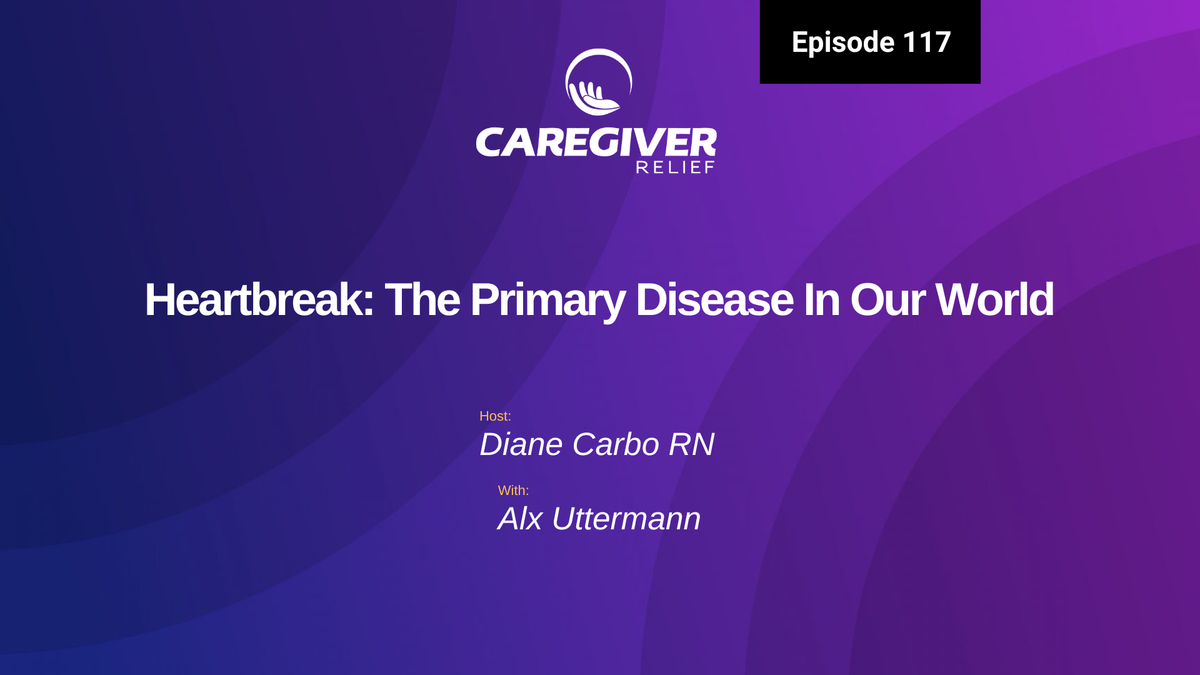
Heartbreak: The Primary Disease In Our World with Alx Uttermann - Episode 117
Caregiving is a role of immense love and dedication, but it often comes with a hidden cost that settles deep within your body and soul. The chronic stress, the unspoken grief, and the constant overwhelm aren't just in your mind—they manifest as anxiety, high blood pressure, gut issues, and chronic disease. All too often, caregivers push through, ignoring the root cause of their suffering.
In this powerful episode of the Caregiver Relief Podcast, host Diane Carbo is joined by healer and teacher Alx Uttermann to uncover a profound truth: heartbreak is the primary disease in our world.
This isn't just about romantic loss. It's the heartbreak of watching a loved one decline, of feeling isolated and underappreciated, of losing connection, and of never having a moment to tend to your own heart.
This conversation is an invitation to pause, breathe, and begin a journey of radical healing for your mind, body, and soul.
In This Episode, You Will Discover:
Here’s a look at the transformative topics Diane and Alx explore in this must-listen episode:
- 💔 Redefining Heartbreak: Alx explains why heartbreak extends far beyond romantic relationships to include loss, disappointment, disconnection, and the overwhelm caregivers know so well.
- 🌱 Alx 's First Encounter with Heartbreak: Alx shares a touching and powerful personal story from her childhood that shaped her understanding of loss and mortality.
- 🩺 The Physical & Emotional Toll: Learn how unprocessed heartbreak and trauma can manifest as anxiety, depression, fear, PTSD, and chronic physical illnesses like cancer.
- 🤝 Heartbreak on a Societal Level: An eye-opening discussion on how individual trauma, when multiplied across populations, leads to a collective lack of empathy and compassion in society.
- 🧽 The Caregiver's "Heart Sponge": Discover why caregivers, who often have big, open hearts, are like sponges that absorb the pain of others and why it's crucial to learn how to "wring out the sponge" daily.
- 🧘 Daily Practices for Healing: Alx introduces the ancient technology of mantra meditation, explaining how repeating specific, energized syllables can dissolve layers of pain and build incredible resilience, even in the most chaotic moments.
- ✨ A Message of Unshakable Hope: For anyone who feels their heart is beyond repair, Alx offers a beautiful and powerful reminder that every single human being can heal and reconnect with the light inside them.
A Path to Radical Self-Care
As Alx so wisely puts it, what caregivers do is a noble, even divine, act. You are the light taking care of the light in another person. But you must not let your own light go out. This episode provides tangible tools and profound wisdom to help you protect your energy, heal your heart, and find strength you never knew you had.
Ready to transform your understanding of stress and begin healing from the inside out? Tune in to Episode 117 now!
Find Alx Uttermann:
- For stress-reducing tools for caregivers and helpers: energeticsofselfcare.com
- For spiritual healing and information: ucbk.org
Podcast Episode Transcript
Diane: Welcome to the Caregiver Relief Podcast, where we support the emotional, physical, and spiritual wellbeing of family caregivers. I'm your host Diane Carbo, a registered nurse and lifelong advocate for caregivers navigating the most demanding and often invisible role of their lives.
Diane: Today's episode is an invitation to pause.
Breathe and take a compassionate look inward because whether you realize it or not, caregiving, stress doesn't live just in your mind. It lives in your body. Chronic stress, unspoken grief, exhaustion, and heartbreak show up as anxiety, depression. brain fog, gut issues, sleep problems, high blood pressure, and even chronic disease.[00:02:00]
And all too often caregivers push through without even addressing the root cause. And that's why I'm not only excited but honored to be joined today by Alex Uttermann. She is a heal. A teacher and co-founder of the Universal Church of Bock's Kitchen. Alex brings decades of experience in ancient Indian healing practices, and today she's here to help us uncover the deeper truth behind our stress and suffering.
We'll be discussing some powerful topics. Heartbreak is the primary disease in our world, not just romantic heartbreak, but with heartbreak of loss, disappointment, abandonment, disconnection, and overwhelm For caregivers, this heartbreak may come from watching a loved one decline from isolation, from feeling underappreciated, or even from never having time to care for your own heart.
This conversation is about radical healing for the caregiver's, mind, body, and soul. Alex, thank you so much for joining us today. You, I, as soon as I. I saw met you and heard about you. I said, I have to have you on because as I told you before, 63% of family caregivers become seriously ill or die before the person they're caring for.
And it's going to get worse because the pressures of the family caregiver are increasing because they're expected to do things once, provide care, once provided by professionals. Welcome. Tell us a little bit about yourself and what is your earliest memory of heartbreak?
Alx: Oh, hi Diana.
Great to be here and thank you so much. This is such an important subject and I'm really grateful that we're having this conversation, if it is of any help to the so many thousands of people who are in the role of caregivers. Yeah. so yeah, my earliest memory of heartbreak, that's a really good question.
I think, actually it was fictitious, but it was running in parallel with my actual life. So my mother, I didn't realize because I was too young to understand, but she was diagnosed with, leukemia when I was about three years old.
Diane: Oh.
Alx: This was the 1970s. And it was fairly,there wasn't a lot of treatment at the time and there wasn't that much known about it like we have today.
Diane: Yes.
Alx: And she, I believe it was a terminal diagnosis. Or at least it was severe in
Diane: those days. It was absolutely. And it
Alx: was serious. So I was three when she was diagnosed. I was five when my dad had his first heart attack. I should mention, IM the youngest of six kids and, they started having children after World War ii.
they were older, by the standard of the day when they started having kids. So my father was 51 when I was born. My mother was in her forties. unusual for the sixties, to have that happen. So anyway, he had his first heart attack when I was five, and that was something that I understood on some level and it was intense to see, my very powerful, brilliant dad, in a hospital.
Laid low. it was a mild heart attack. He was really lucky. But that shook me in some way to the core. like our parents are our first gods.
Diane: Yes. they
Alx: are all knowing, all being people who teach us about the world and they teach us about everything. And to see this, and my father was extremely brilliant character, very strong personality.
And to see him humbled in this way was shocking. But the heartbreak came, the first heartbreak. my mother read to me every night when I was a little kid, every night before bed, there was some sort of story, and I latched onto Charlotte's Web, the children's story about the animals that talk, and the spider who intervenes to save the life of a little pig.
And throughout the course of the novel, not to give too many spoilers, but Charlotte dies. And I made my mother read that book to me six times straight through, over and over, like a chapter a night for months. And I would melt down When Charlotte dies every single time, I mean melt down like crying on the bed, just face down, sobbing.
And by the seventh time I understand that. Yep. By the seventh time my mother. I think I was probably about four by then. She said, you know what? You know how to read. I'm not reading this to you anymore. I can't do it. And what I didn't know, of course, was her backstory was she was dying. Yes. And she's thinking, if my kid is melting down over a fictitious spider,
Diane: yes.
Alx: What's gonna happen when? Yes. So my initial heartbreak actually was the idea that things die. That fine. Kind, fantastic beings like Charlotte, the Spider, or like my own mother can die. I could not wrap my head around that. It was so tragic and it was also a kind of ecstatic, tragic, like I knew there was something in it that was so real.
that I would go UNG glued. And then my mother did die when I was nine. And so that was, and it was a slow progression. Of course.
Diane: Yes it was.
Alx: so I watched the wheels come off of her wagon and didn't really quite understand what I was seeing. Again, I was pretty young.
Diane: Yeah.
Alx: until it was over.
And that was. the heartbreak of heartbreaks, I would say yes.
Diane: Yes.
Alx: As you, I,
Diane: I can relate to that too. But you call heartbreak the number one disease in our world. Yeah. Why do you believe it's the root of so much hu, human suffering?
Alx: Because everything else comes out of that. Whatever loss we suffer, whatever staggering.
heart pain. So it could be, growing up in an abusive family, it could be growing up in a war zone. It could be,sexual assault. It could be, even verbal assault, emotional abuse. these are so traumatizing to our being as human beings that it leaves an indelible mark and it etches us in a certain way.
From perhaps a very young age or at any time, like people who get betrayed in business, a business partner screws them over. Yeah. Somebody trusted, right? A relationship. someone really close to them dies as with the caregivers, right? So a heartbreak takes a full spectrum of. Of possibility and of experience, and there is not a single person in this planet who escapes it.
But it sets up a chain reaction in the human system. Once we have one massive heartbreak, the heart closes. When the heart closes, it means that everything in our system isn't functioning at full force anymore. It's not. We're governed by the heart. We'd like to think it's by the big brain, but it is not.
We are heart creatures. We are run by the heart. Ask any political operative. political, contests are one on emotions of people not rationality,
Diane: right? Yes. and one of the things I will tell you is as caregivers, and I'm guilty of this too because I've been both a professional and a family caregiver, you make decisions based on a ra emotion.
Decisions, you have, they require no log logic and they're not, and people make promises they can't keep it. It's really challenging. The funny thing with me is because I was a professional caregiver, I put my nurse hat on all the time, I get my family calls me the bossy, know-it-all, big sister and 50 before,and, yes.
there, after 52 years of nursing there, I just know stuff. Yeah, I would think so. That's why I, and what you're telling me is. Is so true because, you're, you're defining heartbreak beyond romantic relationships. Totally. A thousand percent don't understand that. yes. I used to watch Lassie every Sunday, and I would tell you, my family used to laugh at me because I sob.
Every Sunday, oh, it's Diane show, and I'm the oldest of four. I, my first experience with heartbreak I think is, I had all in the same year, I had, my grand, my great grandfather. Had last Seven times, oh my goodness. and then that was in the early sixties, it was probably six or seven, so it was the early sixties and, 'cause I was born in 53 and I can tell you that the, my, my little aunts, I call them my great, they're my little great aunts because they were all short, they were all under five foot except for grandmother.
Was five two or five three, she was tall and they would bring out the tea service and they would all sit around and the priest would come. And because I come from a big crazy family, the, I can still remember sitting on the steps in the hallway. They had pocket doors and they kept opening and closing the pocket doors while they waited for my grandfather.
Great-grandfather to pass. Of course, he woke up and would talk. So you know, to hear you say. Beyond, romantic relationships really relates to me. It's, it resonates with me. I live in Joey, my first grade. In first grade he had leukemia and died.
Alx: Oh, no.
Diane: And my grandmother, and when you're talking about this, I'm thinking, oh my God.
Because I used to feel sorry for the people that they left. And that was my response.
Alx: Oh my God. Of course you saw it.
Diane: Yes, I did. At a very early age. And it's not
Alx: the person dying, it's everybody else around them.
Diane: yes. And it, it really has a reaction on everybody. Alex, what are some ways heartbreak manifests in a person's life, emotionally, mentally, physically. Okay.
Alx: yeah,if we're equating, which I think I would do, heartbreak to trauma basically. I would too. we see so much evidence of how that sets somebody up for a lot of challenges in life, especially childhood trauma or adolescent trauma. but heartbreak, on the.
I wanna talk on two levels on the material world. Natural level.
Diane: Yes.
Alx: All the things that you named. we see PTSD, we see, anxiety, depression, suicidal ideation. We see, close up, suspicious, not trusting other people, cynical. Yep. We see huge depression. a lot of fear. If people have had loss after loss, regardless of arena or trauma, after trauma, they're very frightened.
Diane: Yes. You
Alx: know, and that core of fear sets up from where I sit, a lot of disease. Yeah. my, I lived many years in India with a. Master healer who was training us to take on the suffering of human beings and help dissolve it effectively through energetic healing. And his perspective was, when people are super, super fearful internally, they may not even be, consciously that aware of it because it's so ingrained.
Yeah. that it sets up a lot of disease, especially, cancer. And part of healing heartbreak means healing those primordial fears that are rummaging around in somebody's system that were set up from, decades before.
Diane: Yes.
Alx: Decades ago. Yeah. So we see it like that. We see the mental health issues also, not only physical ailments and diseases and problems and challenges, but we see the mental health toll that it takes on people.
I spent a good measure of my late teens and early twenties, utterly self-destructive. Horrible behaviors, toward myself, I didn't take it. I I did take it out on other people, but majority on myself. And I feel that it's such an obvious through line from childhood trauma.
Diane: Yes.
Alx: That was really unexpressed and unprocessed and unacknowledged even, to these absolutely tumultuous, reams of self-doubt. Lack of confidence, complete sense of unworthiness inside, which would sometimes flip into its counterpart arrogance sometimes. Most of the time I was just terrified.
I literally was terrified. I was terrified of the world. I was terrified of people. I was terrified of love. I was terrified of commitment.
Diane: Yeah. Because
Alx: all that stuff can be taken away. I learned that at a very young age. The people you love. Yes, I did too. So
Diane: I relate to what you're saying.
Absolutely. Yeah.
Alx: So we see heartbreak. It comes out. People make crap choices in relationships based out of heartbreaks.
Diane: Yep.
Alx: And set up a whole cycle of, maybe repeating the kind of trauma they are familiar with or finding a whole new way to create more trauma or overly dramatic. Or we see, like narcissism or borderline personality disorder come out of extraordinary heartbreak and trauma.
Nobody is born a narcissist. They are created by abuse and neglect, and that split from the self that occurs when a child is mistreated so horribly that they cannot. It's like a part of themselves cannot stay in that being anymore in that persona anymore, and they split off and disassociate and then create a false persona.
Diane: When I went to nursing school in 1970. One to 74. We had eight weeks in psych and in, psychiatry and every si One of the things I was taught as a nurse that I can relate to with you that I don't think nurses are even being taught now is. Our emotions and our reactions and responses and everything we do are the response can cause a chronic illness or a disease in our bodies, just like you were saying.
So I, people would go, oh, no, not really. Oh yeah. really?
Alx: Oh, there are plenty of stories of people who literally die of heartbreak. Elderly man. The wife dies, and then within a week he has a heart attack and dies. And I've heard, nursing and medical staff say, what can you say about that?
Except heartbreak. yes. I should also mention, just for the sake of transparency, I come from a medical family. My father was a surgeon. My mother was a nurse and a lot of my family are medical, people. Yeah. And a lot of my friends are physicians of different stripes, nurses and so on.
And everyone. Now it's really interesting in the seventies, I don't know how much they were talking about these relationships of trauma to setting up other, catastrophic issues later, but they're talking about it now. I have a very dear friend here who's a cardiologist, and she said, she said, Alex, what I see.
Western medicine has its role and then there are these things I'm dealing with people's hearts and I see the reverberation of their lifetimes of trauma that's going on, and we don't have the tools to address that. This is also really thankful that integrative medicine is coming up as a discipline in the US as well.
Crossing over, having alternative, more Eastern medicine, if you will, mixed with Western medicine.
Diane: Baby boomers are really open to alternative medicine and they're in fact demanding it. And I really think there has to be, I personally feel that we have to have East meets West.
Alx: Must
Diane: it required? We have, and it should be required because when those two fields come together, I've seen amazing things.
I had a holistic, re physiatrist, a physical, rehab doctor and did acupuncture and alternative things that people would say, oh my God,no. Oh my God, yes. yeah, I get it. So can you tell us how heartbreak shows up on societal or a collective level?
Alx: Oh my gosh. okay, it's interesting, I do you remember that book, emotional Intelligence that came out decades ago and was a Oh,yes.
Groundbreaking, yes. For a lot of people. Yeah. There was one study in that blew my mind and remains with me today. And I think of it often with relationship to larger swaths of our populations, and that is. Little kids. they're like preschool kids age. So what are we talking three, four years old, something if, yeah. Five. A child, a normal child, a child who is unscathed by abuse and neglect, sees a little child crying. They will walk over, put their arms around the child and comfort them. That is our natural mode. We want to take care of each other.
Diane: Yes.
Alx: When a child has been abused or neglected and they see another little kid cry, they'll.
Be, withdrawn. They'll be rough on that child. Why are you crying? They'll be harsh and they won't have the impetus to go and take care because they themselves have already been shown that's not what happens in this world. So if you extend that to, let's say, a community or you extend that to a state or to a nation
Diane: Essentially what I see is we have nations full of traumatized people who are enacting traumas on other people. They're basically the pre the preschool children. Either comforting and collecting and helping another kid who's in distress or absolutely enacting more abuse on them. Yep.
I relate to that.
It's
Alx: pretty simple.
Diane: Yeah. Yeah.
Alx: the kinds of dysfunction that we see on an individual level totally translate to collective.
Diane: Yeah.
Alx: 1000.
Diane: One of the biggest, pages, or most visited pages, or even playlist on my YouTube channel is about taking care of a narcissist. And there's so many caregivers out there dealing with that, and it's so challenging.
Oh, so when you're saying that you're right. And they do bully. 'cause I can tell you my dad was a bully. Yeah, he was a functional alcoholic and he, when my mom became sick with cancer, we weren't allowed to talk about it. We weren't allowed to, to address death and dying. We were not allowed to even say, oh mom, you have cancer.
and I was. 15 and 16 and I had to take care of my mom, do the cobalt treatments and everything. I, and my dad just pushed me to do it. He just, you have to do it 'cause I can't, and here I'm feeling. I'm feeling helpless and terrified because she'd have gallons of liquid coming from her chest.
Oh my God. And it was just horrible. So what kind of cancer was it? I, and I was very young and we had just finished taking care of my grandmother who had. Had fallen and broken her hip, came home to our house to recover, and in her vanity, would put her silky pajamas on, slid outta bed, rebroke her hip, and had to come back into the hospital.
And we had to come back with a spike of classs. And she was in our home for, with four kids for several months. Get her up, put her on the bed pan and stuff. So I learned all of that at a very early age. So when I see what, when, it just makes sense to me that what I'm going through, what I was going through, then how it relates to heartbreak and Oh my gosh.
Yeah. That's why I'm saying what's the first step in recognizing and acknowledging the hidden heartbreak we all have.
Alx: Yeah, I think it's being honest with ourselves about those scars. Yeah. And the patterns of behavior and the emotional issues that we have. And if there's a case of a, illness of some kind of disease or a condition, it's really important to look deeply.
What is it? Where did this come from? In addition to treating, medically and all that, but we owe it to ourselves to research internally, where is the origin point of this? What was my earliest pain? What set up this cycle of event and event and event, like a chain reaction that got me to this place now with this condition because in reckoning with that on some level, however we can That's part of the. Lesson in it. You could say that we're learning through going through these kinds of illnesses and pains and it is a step toward dissolving some of the deeply held, heartbreak around that, whatever that was that happened, or a series of things, whenever it occurred that set this in motion.
I had a patient recently who came, she had breast cancer. And I asked her that question, which I asked everybody who comes to see me for healing? Where do you think this originated? She said, oh, I could tell you exactly. A couple years ago, my daughter was going through a lot of mental health issues and it was her daughter was maybe 12 or 14 at the time and was suddenly cutting and, really extreme and was, in and out of suicide attempts.
Diane: And
Alx: she said that stress of that. I know was a one-to-one with setting up this breast cancer. Absolutely. 1000%. she was so clear. She'd thought about it. She'd considered as an emotional body as well as a physical form. Where did this come from? That's really important. and then I should say from the other side of things, from the more supernatural or the more spiritual reality, the biggest heartbreak that every human being faces being in a body.
We've heard the old saw, you're a soul in a body, right? We all know this, but what does that really mean? There's a heartbreak from God, which is that we don't remember that we are part of the same source that creates us. Exactly. We forget that we come into a form and there's like a kind of oblivion that descends on us and then we start thinking, I'm independent.
I am me. I'm making my decisions, I'm doing all the things. And the moment we do that, we start to create karmas action to reaction. Like new second law of, for every action there's an equal and opposite reaction.
Diane: Yes.
Alx: That sets up lifetimes and lifetimes of cycles and pains and. triumphs and tragedies and so on.
That brings us to the current place where all the heartbreaks, I feel, all the emotional hits that we take, the thousand natural shocks that fleshes air to as Shakespeare tells us. The original one, the primordial one, is this deep disconnect from forgetting that we're the source. Or I should say disconnect from remembering that we are also that source.
How we reconnect that's the role of spirituality and that I feel is where the deepest healing comes for all of us is retracing the steps back until we're able to uncover that part of ourselves and recognize it as such that we are actually the same. We're made of the same stuff that we call God or divine or universe or whatever it is.
Diane: Yes.
Alx: That's the biggest heartbreak that every human being faces and we all deal with it differently.
Diane: So how do, how does spirituality or faith play in the healing heartbreak?
Alx: for me, spirituality means doing a lot of meditation, in particular types of meditation that are helping to peel away the layers of the forgetting.
Diane: Yes.
Alx: That literally day by day, month by month, year by year, are dissolving the layers of the traumas and the emotional qualities that we all carry. like egoism and fear and anger and jealousy and all these things that kind of block us from seeing our real nature. Yeah. so that's spirituality on one side, faith on another side, it's so important.
and what with people who are deeply heartbroken is a lot of people lose their faith. Some people get more faith.
Diane: Yeah.
Alx: Through heartbreak. Somehow it drives them to embrace more of the unseen. Yes. it depends on the person. It depends on their makeup, their neurophysiology, their emotional body, their propensity toward either cynicism or a deeper faith. Faith is super duper important. You know that Agree is something beyond yourself.
Diane: I broke away from the Catholic church after my mom died because of the way they treated my mom when she was,she was so supportive of the priest and he wouldn't give her last rights because she was, and she raised us all Catholic.
I went to Catholic school for 12 years. They wouldn't give her last rights because she was married to my father and that wasn't ill. If she was, they were only gonna give her last rights if she would live with my dad for the rest of her life as her. Brother, just stupid stuff, and I was, I, so I left the church.
But I will tell you one of the things I've found, Alex, is I have a faith and caregiving site on my site, on, on caregiver relief. And, what I've learned is. The caregivers that have believe in a higher power, I don't care what religion you are. they seem to handle their caregiving journey better.
I it plays out over and over again.
Alx: Yep. For sure. And that sets up the whole conversation about how much we absorb from the people around us all the time. Good question. And right on that when the heart is really open.
Diane: You
Alx: know so many people who go into, let's say, the helping professions or the healing professions, nursing, for example.
Diane: You
Alx: know, you wanna be of service. That's the point, right? You want to help in some way or another, and that's a big open heart to help people. Usually when someone has a big open heart, it means it's a big sponge for attracting all of the, absorbing all the pain and suffering for the people around us, which is fine, we should do that.
The problem is when a sponge gets oversaturated, it's worthless until it's rung out. We need desperately techniques to wr out the suffering and the pain that we're absorbing from other people. That this is the thing, like in caregiving, the stress on the person who's doing the caregiving. Is multifold.
It's not only the situation of the person who is ill, but it's the whole family dynamic. It's all the people around that person, it's the context. It's all of the emotions bubbling up to the surface, especially if it is a terminal situation. All the family dysfunction comes into the fore, and that person who's a caregiver is receiving all the brunt of that.
whether they like it or they don't like it is immaterial. They are the point person for care, and so they're carrying the burdens of, entire family systems. Having no way to ring out that heart sponge every day to get rid of that, to reset it, clearing the cache on your, computer's, browsers.
Yes. Need to do that as a daily practice. because otherwise what happens is what you're saying, people will get ill in that position. They're absorbing way too much. Yeah. and it's nobody's fault. That's the setup. Yeah.
Diane: the typical caregiver is, does it alone, has involved siblings and judgmental, Did family members that treat them badly? Don't give them a break. Yep. and you're right,the stress becomes so overwhelming and they're that sponge seeking, taking it all in till they can't anymore. That's right. and then the
Alx: system just gives out.
Diane: And the other thing is they feel as if they're a failure, if they ask for help.
Alx: Holy Jesus.
Diane: And they do, I'm telling you. And it's so sad. Yeah, no, I can see it. 'cause that's, it's, it's if even people have babysitters, because a parent can't do it all alone. And if it takes a village to raise a child, guess what? That same village needs to help the elderly help you take care.
No kidding. Of your loved one. And it shouldn't be alone. And totally. I tell my, my, my caregivers, you need to create a care team, partner support group, get people to offer, provide practical assistance to you so that you can get breaks. Because respite care is unaffordable for 99.9% of our family caregivers.
Alx: so what are, which is another expression, oh, sorry. No, go ahead. Go ahead. I'm just thinking, you know that care, like paid for care, not being available for our elderly people and our sick people is another expression of a society run by deeply broken people who have no empathy and compassion.
Diane: Yep. Yep. 100%. And, I don't know. I don't know. But the baby boomers created, we spoiled our children and there's so many. I will tell you, there are so many people that have had children. The children don't wanna help and take care of them. They only want to come back when they're dead and they wanna pick over the bones of the money or the things that they want in the house.
I've seen that a million times too. Wow. Wow. and it's really sad and that's why I encourage family caregivers. You have to practice self-care every day. I tell want them to get a care team partner, support group going. Yes. And I also encourage 'em to put a caregiver contract in place so that they can set boundaries and limits.
But now I'd like to know from you, are there daily practices or rituals you recommend for someone in the midst of heartbreak?
Alx: Yes. Oh yeah. There are many. Yes, there are many. yeah. One of the things, so I spent many years training in India with a master healer who he made it his mission to create, as it were physicians, to take care of the broken hearts.
we have so many hospitals for broken bodies. We have hospitals for broken minds.
Diane: Yes.
Alx: We don't have hospitals for broken hearts. And if the premise, sorry about that. If the premise is, The primary disease in our planet is heartbreak. It would seem that we need physicians who are able to operate on that level.
So my master, he was giving all of that, he was teaching. The years I spent in India were like medical school for spiritual healers. the exhaustive lectures. I couldn't write fast enough. He was getting this information from ancient manuscripts, 5,000 years old. 7,000 years old about all of the complexities and the possible angles of human suffering because no two of us are exactly alike.
It's a weird thing. I was just saying this. I have a friend who's a professor at UCLA and she just had me last week talk to a medical humanities class. Yeah, they're mostly geared toward Western medicine, and so I blew them up even by talking about alternative, methods. Not energy healing, but just alternatives.
Like yes, acupuncture, natural healing, and so on. but. It is so bizarre to me, and it is such a paradox of the human condition that we are simultaneously, utterly universal. we all have the same apparatus, right? We all have a circulatory system and a respiratory system and endocrine and all that.
And these things work in pretty well standardized ways that we can understand and notate and treat, right? Yet, no two of us are exactly alike like snowflakes. We all have an individuated. Nature. Yes. We all have a persona. We all have a history and a trajectory in our even twins stories, even identical twins will have some, it's very interesting, right?
Yep. So we're pretty good at treating the more universal condition of the human form, but we're terrible at treating the individuated, snowflakey unique quality of each person. And anyway, so the ancient. Sears, the Ancient Re of India. They saw very well all the iterations of human suffering and heartbreak, and they found, Divine, I would say medicine to treat every single possible configuration of human pain. And that's what I was trained in. So you know, no two heartbreaks are alike, right? Absolutely. You and I have something in common. We both lost our mothers in a tragic way at a young age, but not everybody has that.
Other people have different things in the mix and different reactions to it. Yeah. so for practices, there is. My money is always on mantras, and when I say mantra, I don't mean affirmations in English or your native language. energized syllables that come from the Sanskrit or other ancient languages that are played on repeat in the human mind over and over and over and over again.
Why is that important? Because mantra technology is, those little syllables. Tiny little syllables that you'll hear in any ancient language, whether it's Hebrew, Arabic, oric, Sanskrit, and so on. They're, angelic syllables. They're charged with angelic energy, and when they're assembled in a particular mantra to create a certain effect in the human system, you're by repeating it over and over again, it sounds like gibberish.
You're like, why am I repeating this crazy phrase over and over again? Yet it's starting to have an effect inside our system. It's starting to dissolve layers of pain and suffering, for example. So there are mantras that are specifically for heartbreak, generic for any kind of heartbreak. There are more mantras that are a little bit more specific for the exact circumstance of heartbreak.
and those I teach every single day to as many people as I can because it's so very important. there are other techniques that can be pursued to address heartbreak, but honestly, that kind of meditation, any meditation is good. It's true, but mantra meditation, because of the nature of the highly charged syllables.
which are unique to mantras from ancient tongues. For example, I have a friend who is a rabbi, and she was saying some years back, she had a huge congregation here in Southern California where I'm living, and she said, I just don't understand, we have 2000 people in our congregation. I never see the majority of them unless it's the high holidays.
In which case the whole temple is packed. Which is an, I don't get it because on the high holidays what we do is do these endless prayers in Hebrew that go on for hours and hours. They have no idea what they're saying. the books have Hebrew and English together, so you can parallel.
Yet everyone is so magnetized to come on the high holidays. That's it's like Christmas in Christianity or whatever. that's the day you're not gonna miss or Easter. You're gonna go.
Diane: And
Alx: she said, I don't get it. And I said,what's the flavor of these prayers that you're doing?
And she said, it's largely about, it's a prescription for, it has to be done in a group. It's step by step, unveiling the foibles and the flaws that are inside each human being and asking for them to be removed. And I'm like, oh. So it's a group process. It's created an enormous amount of protection around everyone who's there.
They feel the energy and they're chanting ancient syllables that have juice to them. I start laughing. I'm like, because of course, like in, in Hebrew bar,
these are tiny syllables, but they're charged in Arabic la they're tiny syllables law like that in Sanskrit. the Montreal just tell it for heartbreak is,clean. K-L-E-E-M,rah being like in the Egyptian rah, the sun. It's the same in the Sanskrit Rah is the light rah. And when somebody takes that up and starts repeating it, not only in a formal meditation situation, like you're gonna sit quietly or lay down quietly, and okay, now I'm meditating and having that mantra running.
But as a background thought all day. In the back of the mind, we know how to multitask. Especially caregivers. My goodness, it's 1800 things that all have to happen now, right? Yep. To have that mantra percolating on the back burner, even while doing all these other things, especially when dealing with the stress and the trauma and the feelings that are there, but put on hold because you have to focus on what the person getting the care needs.
Have them mantra running and it will make an enormous difference in terms of like how much you have to deal with at the end of the day. For example, how dragged out you feel, how exhausted you feel. It will change it. It will refresh it on a continual basis. Our challenge is to remember that we have a tool that we can use and to use it.
That's the challenge. It's so easy to forget and just get subsumed by the stress of the moment because there's a lot going on.
Diane: Absolutely. And to have
Alx: that clarity in it and go,wait. I've got this thing. I'm gonna do this thing. exactly. Exactly. I have this thing I can clinging to a big rock in the middle of the pounding surf of the ocean.
No, I have my rock. I can hold this thing and I'm gonna do this mantra no matter how chaotic everything around me is. And it's astounding to see how quickly, one can start to find that inner strength. Even in the middle of complete chaos, like the eye of the hurricane, everything is, the winds are whipping and the crazy stuff and the family dramas and the blah, and yet internally there's this sense of ahaha.
I am still here as me and I'm intact from all of this. I'm not feeling it, I'm not observing it. Yet, I'm a little bit back because I have this thing, this energized thing that is now my new best friend that I'm taking into all of these stressful situations. And also, it's really advisable to do that mantra when going to sleep at night.
Because what will happen is the more we're thinking it all the way through our waking hours when we're sleeping at night, When the mind is completely out, the mind is gone. Sleeping, it's resting. The soul, our own soul will start to chant that mantra and drink that energy from the cosmic directly with no resistance at all.
How do you know that? 'cause sometimes you'll wake up in the middle of the night and you're like, how is that mantra there? I was not there thinking it, but it's already there. Yeah. Your own soul picks it up and starts to like grabbing that nourishment from the cosmic all night. Which creates so much strength in a human being.
Diane: I encourage my family caregivers to do whatever they can. I encourage them when they get up in the morning to start with an attitude of gratitude, helpful, find something to be grateful for every day, just something small. And I do encourage them to start their day with, a little, daily ritual of some sort, meditation mantras or whatever.
I didn't know about the different types of mantras, to the degree, like I, I've. Done the Hoppa, nopa, the Hawaiian. Oh yeah. I can't figure of how to say it, but,yeah. but they're, it was just, I just tell because they are under stress. I want them to grab something that's comfortable and.
those mantras you're saying there? I went to a Jewish, high service, when Oh yeah. I was younger. Yes. And now I'm laughing because I understood, because I, I'm a Catholic girl. Like we had traditional. This is before even the masses change, which was a mistake I think. But that's a whole nother ball game.
But they had this service and I can understand now 'cause they were saying these words, I didn't know what they were and they were repeating them and I found myself saying them with the rest of the people. Yeah. So now I understand why I felt the way I did at that moment and beyond, you're putting
Alx: your voicing angelic.
Yes. Structure. And it has a power in it. It will have a power. Yes. That's the really interesting thing about our creation. in the, in Genesis it says, in the beginning was the word. Okay. What was the word? What was the word that kicked it all off. There was a sound, right?
Diane: Yes.
Alx: And in Sanskrit they would say, oh, the word was, Om properly a not om the way that we tend to say it, which contains they're generating the operating and the destroying qualities of the divinity. The GOD is in the om, it's in the rise and the decay of that sound, and that's the generative sound that sets the whole creation in motion. They will say from India.
It's interesting to me that the M or the M is the origin point of the, Western ahmen. It's the same word. It's the same word. Yes. Same word. Why does it have power? Why do we say that at the end of all of our prayers in the Christian traditions? Amen. Why do the Muslims say amen at the end of the prayers?
Why? Because it carries some power. It has divine. It's it has a little fragrance of divine reality stuck in there so that we want to grab. We wanna pull that to ourselves because the more we build up that side of ourselves, the more resilience we have naturally that's so important.
Diane: We believe that, especially
Alx: for our caregivers, they need the resilience, right?
So they don't go down on all the family dramas and the pain that they absorb and the stress of taking care of someone who's ill and maybe not very nice, Or however the situation is. It's fraught with a lot of. stress and anxiety built into the dynamic of what's happening and
Diane: negativity, negativity.
Alx: Negativity is very strong.
Diane: It's very strong. And like you, I try to,keep people at bay until I know, if they have, if they're a negative person or their drama, I really try to avoid them with all, and it's very challenging to deal with. Family caregivers that are like that. 'cause they don't, they are comfortable in that role and they can't help themselves get out.
Right.
Alx: exactly.
Diane: and I really want to help them get out of that role because if you feel you're a victim, you will be a victim. But,Alex, if someone is listening feels their heart is beyond repair, what message would you wanna give them today?
Alx: That heart is not beyond repair ever.
Ever, every human being can heal and every human being has a light inside that perhaps is being, blocked off or piled on with life experiences and traumas and pain and suffering and all that and stress. But that light is still there. That light is still inside and our. Our responsibility, I think, is to do our best to try to uncover that and reconnect to that light that is us.
Every single human being has that there. There's nobody beyond. There's nobody beyond repair.
Diane: I agree and having had loss through my entire life. my son, my, recently, my sister, my mother, my father, my grandmother, both grandmothers. I've been around death a lot. Loss, it's a loss of, watching my life before me and then now I'm here doing this instead of nursing because my body's so broken.
Because, I grew up feeling as if the world, the world depended on was on my shoulders. So what do I have? I have a bad cervical, thoracic, our area, because literally carrying it all. I carried it all and I work every day to, to try to work through that, even at 72. And I am a lot more resilient, but I still have a lot to work on.
So that's why I encourage this. So Alex, how do they find you? How do my listeners find you?
Alx: Ah, there are twofold ways. One is in during the pandemic, I got really worried about the frontline healthcare workers for all the reasons that we're talking about.
Diane: Yes.
Alx: I could see, I, especially when we started hearing about physicians committing suicide in the early, yes.
Months of the pandemic because they were so overwhelmed or because they got COVID themselves and they got the res and they couldn't tell what was what Yeah. Anymore. and I have medical family, as I said, and loads of friends and everybody was on the front lines.
Diane: Yeah.
Alx: So I made a commercial website called energetics of selfcare.com.
Most of my work is through a nonprofit spiritual thing, but I did this as a kind of act of love for our healthcare frontline workers, but anybody involved in the helping healing service professions who are all taking it on all the time. That includes, like hospitality. It includes, psychotherapists, it includes all the clergy folks.
Diane: Oh my
Alx: goodness. My friend, the rabbi and other, clergy that I'm in touch with during the pandemic, they were all at wits end because mostly they were meeting their constituents on Zoom, their congregation members and everybody had mental health issues. The clergy were suddenly thrust into the role of being therapists for everybody, and they had their own stuff and so many people left the clergy.
As many people have left their nursing profession in the wake of the pandemic because it was too much. Yeah. So we put a whole, these two tools. Sets online on energetics of selfcare.com. it was geared toward pandemic, but these are universal tools that work forever. It takes you maybe two hours to learn them all.
Diane: And
Alx: then you have them for life as stress reducing techniques for every single day. And the thing is efficient. What do I mean by that? It's just to dissolve whatever the stress is. Instantly, it's, they're the craziest, stupid, simple tools on the planet. so eex of selfcare.com is one. And for caregivers, I cannot highly, more highly recommend these tools.
They will make a world of difference. also anybody who's like a school teacher, service or, occupations just go on and on, and everybody's taking it in the teeth from the people that they interact with. And they, we shouldn't have to, we shouldn't have to hold and carry.
That is my point. energetics of self-care dot com is there, characterize as radical self-care. You don't have to spend three hours trying to do self-care after you spend a stressful day taking care of people. It's 10 minutes, 15 minutes, it's enough done, finish, and you feel like reset and fresh.
It's crazy, but that's how the energy operates.
Diane: I, I've heard other people talk about that. That's why I thought it was so important to have you on, because caregivers have to find what works for them. And it's so important because they are stressed and, I just think you have a solution and you're such a calming presence here.
Alx: Oh, I hope that pays off. And my spiritual side,the more supernatural reality of going into heartbreak and all its thousand faces and how to deal with all of that. is@cbk.org, which is Universal Church of baba's kitchen.org. cbk.org. And also there's, I've been pretty sprawling all over YouTube and, social media in terms of, like interviews and podcasts and this and that.
So people can just do a search for me and find quite a lot of. Quite a lot of things out there. It's this random sprawl across the internet.
Diane: We'll put some of the stuff at the bottom of our page that we're creating with you. I really, any last words of wisdom for my caregivers before we go?
Alx: Yeah. you have to understand that what you're doing is really noble and nobody around you will reinforce that or thank you for it, but you yourself, I'm saying it is. It's a noble profession to help and to be the one who is that focal point for the care of somebody who's in distress or dying, So please don't lose sight of that in the midst of all the other chaos and dramas and turmoil and over stress and feeling of burnout. And why am I doing this? And this is thankless and nobody appreciates me and all like that you're doing something that's so I, for lack of a better word, divine.
I agree. The light in you is taking care of the light in another person.
Diane: How? Don't let the light in yourself go out because you not
Alx: no. Please. It's, that's unnecessary.
Diane: Yeah.
Alx: No need to burn out.
Diane: To my family, caregivers out there, you are the most important part of a caregiving equation.
Without you, it all falls apart. So please learn to be gentle with yourself. Practice self-care every day because you are worth it.
Caring for a loved one can be overwhelming — but you're not alone. If you have questions, big or small, our expert team is here to help.
👉 Click here to Ask the Expert
Our Resource section can help you find the information and tools that you need. We have courses, videos, checklists, guidebooks, cheat sheets, how-to guides and more.
You can get started by clicking on the link below. We know that taking care of a loved one is hard work, but with our help you can get the support that you need.
Click here to go to Resource Section now!