Hard Choices at the End of Life with Steven Cuzmenco - Episode 182
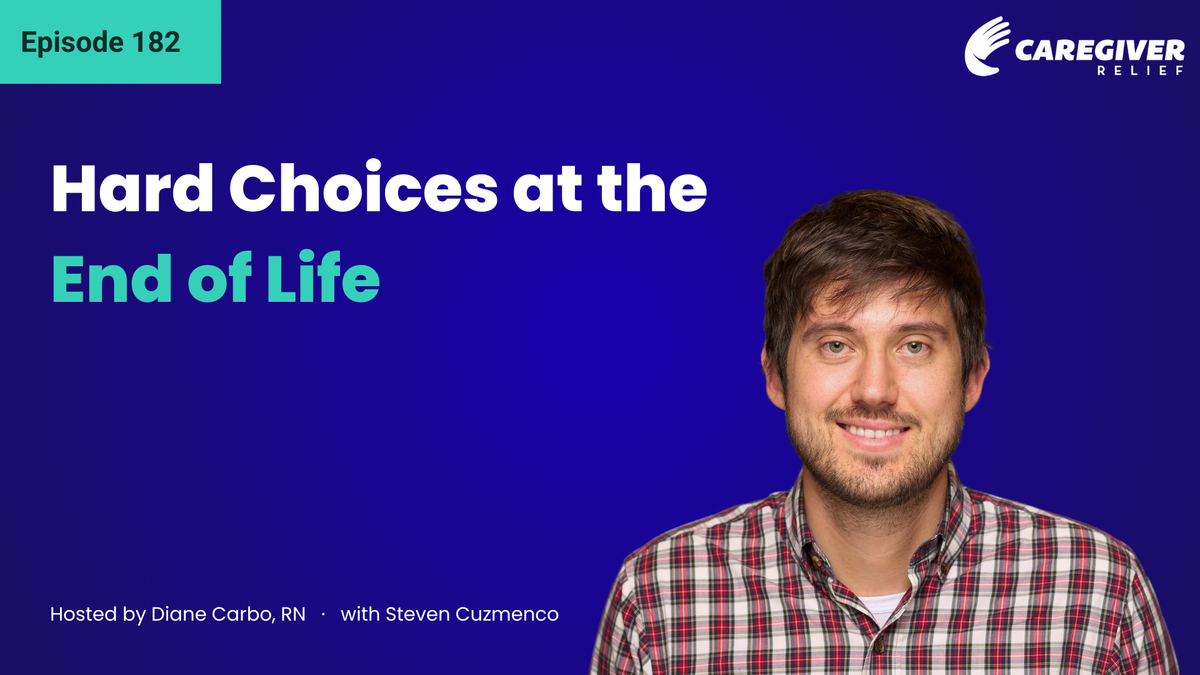
When a medical crisis hits, the technology designed to save us can sometimes become the very thing that keeps us from a peaceful passing. In this powerful episode, host Diane Carbo, RN, sits down with Steven Cuzmenco, a Master’s prepared nurse and PhD researcher, to pull back the curtain on the "hidden" realities of life-sustaining interventions.
If you’ve ever felt blindsided by a doctor asking about ventilators, feeding tubes, or "shocks," this conversation is the guide you need to move from fear to informed advocacy.
📋 What We Covered: The Caregiver’s Roadmap
- The Difference Between "Temporary" and "Permanent" Support: Understanding how ICU measures like breathing tubes are intended as short-term bridges, and when they transition into long-term fixtures like surgically placed tracheostomies.
- The Reality of CPR in Seniors: Steven breaks down what actually happens during resuscitation—including the high likelihood of feeling ribs pop and break—to help families weigh the benefits against the physical toll.
- Artificial Nutrition & Hydration: A deep dive into G-tubes and IV fluids, including the risks of infection, dislodgement, and the potential for "force-feeding" a body that is naturally shutting down.
- Heart Helpers (Pacemakers & AICDs): Understanding how internal defibrillators work to shock a disorganized heart rhythm and what they mean for a patient’s quality of life.
- The "Shift of Hope": A perspective on transitioning from the hope for a cure to the hope for a dignified, pain-free end-of-life journey.
🌟 Why You Should Listen
Making medical decisions for a loved one is one of the heaviest burdens a caregiver can carry. This episode isn't about "giving up"—it's about empowerment through education. Steven and Diane discuss how to use tools like FiveWishes.org to ensure your loved one’s dignity remains intact.
"We are all on our way to natural death... these interventions can prolong that time, but that doesn't mean it's not gonna happen. We're just letting these natural events happen with dignity." — Steven Cuzmenco

🔗 Resources Mentioned
- Five Wishes: A comprehensive advanced directive tool that breaks down wishes by body part.
- Researched RN Podcast: Steven's podcast summarizing nursing research for the public.
Don't forget: 63% of caregivers become seriously ill or die before the person they care for due to the extreme stress of the role. Being prepared is essential for your health, too.
Podcast Episode Transcript
Diane: Welcome to Caregiver Relief. I'm your host, Diane Carbo, rn, and today we're talking about something many caregivers face that few feel prepared for hard choices at the end of life. When medical technology can prolong life, how do we know when it's helping and when it may be prolonging suffering. My guest today is Steven Cuzmenco.
He's a master's prepared nurse. He's also a former cardiac ICU nurse. He's a CPR and advanced resuscitation educator and a PhD nursing researcher. Steven teaches healthcare professionals how to save lives every day. So together we're gonna talk about artificial feedings, ventilators, pacemakers and defibrillators, what they don't do, and how caregivers can think about the quality of life alongside quantity of life.
This is a conversation rooted in compass. Honesty and support for caregivers walking these decisions right now.
Diane: Thank you, Steve. I know you are on the professional side of, teaching the healthcare practitioners. tell us more about what you do and how you do it.
Steven: Absolutely Diane. So thank you for having me, and I look forward to sharing what I know.
I certainly don't know everything, and I am a prospective PhD nursing researcher, still in school to obtain my PhD, but hopefully going to do resuscitation science research and help the teams, with resuscitation in the hospital and out of hospital setting. So what I do is I work for a large.
Hospital organization in the southeast of the United States. And within that I work for the Life Support Education Department. A lot of these larger institutions that are well developed have them. Some of the smaller hospitals may not. They may have one instructor, but I have a whole, my hospital has a whole department and others do as well.
And so day to day. My work is surrounded with resuscitation, either training or resuscitation, process improvement, and that encompasses a wide lens. That's from the early recognition of cardiac arrest or peri arrest, what we like to call. All the way to helping people recover. So that survivorship, you experienced cardiac arrest, you had a long stint in the hospital, you might be at a long-term care facility.
How do you get back to where you're going? It's that whole spectrum that the America heart associate has a, they have a nice, chain of survival is what they call it. So that's what I do day to day teaching and helping improve processes.
Diane: As an old nurse, I find it fascinating that there's a whole,area where it's on life resuscitation that fascinates me.
that just shows how old I am. We didn't have that back when I was in school. one of the things that I deal with and I encourage my family caregivers to do is have ongoing. Conversations with their loved ones about what they want at the end of life, because so many of them feel blindsided when they're suddenly asked to make medical decisions.
it's a conversation that needs to be talked about often, and it's not talked about at all. So I was wondering if you could, Give us some information like in simple terms, what do we mean by methods to prolong life?
Steven: Yeah, that,the simplest way I would put it would be temporary and long term.
And so as a former ICU nurse, I, they, my, that was years ago, but I, every day I would deal with temporary, very invasive. Temporary, measures to prolong life. and so think about what the human body needs. We need oxygen, we need blood flow, we need sustenance, we need nutrition. We need all of our organs to work.
And, so every organ in your body, we have a machine that exists essentially to be able to do the work of that organ, on a temporary basis. some. Some of the, some of those functions end on the long term basis. So like, what I mean by that is your lungs, right? You need your lungs to breathe so that you can get oxygen in your blood.
we have ventilators and so we can put you on a ventilator. We, a temporary measure would be a breathing tube, right? And the ventilator pushes oxygen into your lungs and your lungs brings the oxygen into your bloodstream and you live. And you think of the kidneys. So you might have a heart attack and your blood pressure drops for a long time. So not only is your heart function de debilitated or affected, but your kidney function might be. And so we have machines to temporarily clean your blood. That's what your kidneys do. They filter your blood and take waste out so that you can, live and you have all these normal levels.
You might get labs checked and you don't want any of those values. To be read right when you get your labs checked. And so that's on a short-term basis that we can do that. And then all of those things we have a long-term ability to do. you can be on a long-term ventilator, you can have dialysis long-term, and That's the easiest way for me to think and for me to communicate if I was an ICU nurse back in when I did that. what are your options? You, it depends on the condition, the primary diagnosis, the organs that are affected in whatever state or condition that you were in. But we have temporary ways to support your life.
And then that can be transitioned to long-term. And that's what you're talking about, Diane, with the conversations, what am I willing to accept? and that's, I'm happy to continue that with you now.
Diane: Yeah, I'd like to, people to understand what really is happening in the body as.
Systems begin to shut down naturally. I wanna share with you, Steven, that there's so many times I hear hospice is killing my parent. and it just, first of all, it doesn't make sense, but there's a whole, group, several groups on Facebook that addressed that. So I thought maybe we'd start, but with what's happening in the body, as systems begin to shut down and, then we can talk about some interventions.
Steven: Well, yeah, that's a complex thing to try to dissect, but, essentially every cell in our body, from our heads to our toes, has to have blood flow. It has to have oxygen, it has to have sugar, right? that's on a cellular basis. That is a requirement, a prerequisite of life. And when that is not provided, then the cells begin to die, particularly oxygen on a, in a more immediate basis.
But glucose, right? Like when glucose, I mean like food. We need to eat food. And so as, let's say, someone who has a long term. Chronic condition where the deterioration, the clinical deterioration is on a longer basis. 'cause in the ICU we're talking clinical deterioration over the course of minutes or seconds, maybe hours, but in the, in maybe easier for people to understand the long termdeterioration of the human body essentially.
Yeah, the organs. As they are expected to function, that alters, that's changed in my experience, the quickest, the most, substantial effect of that happens really in the cognition of the person. You may not, your liver failing. You may not really. Notice it early, your kidneys failing.
You may not notice it, but the, especially the caregivers, it is night and day when they start acting different. So the brain, when the brain starts to get, and I'm not talking stroke, right, in acute brain dysfunction, I'm talking more long term. And so they might start acting differently and then that might prompt them to, oh, we need to go to the doctor. They're not acting right. And then the provider might, Order some further diagnostic testing and say, Hey, we have found out is it a primary problem of the brain? Is it a primary problem of another organ? Because liver failure has crossover and symptoms can manifest as confusion.
Kidney failure can manifest as confusion. Heart failure, you can have confusion now. It depends. Sometimes kidney failure, you'll notice a little. It depends on the, I guess the speed at which that organ is affected, which is really the challenging part to try to describe. But I would say that's what happens. The body eventually starts to. It dis, it experiences dysfunction. And so all of those, the normal functions of those body parts, those organs, they don't work the way they're intended to. And eventually, the breathing starts to get involved when we start to see,the breathing affected and breathing becomes hard. That's usually there is not much time left. Yeah. that's a problem, especially if they haven't had time to talk about things and now I can't breathe now I can barely have a conversation about how I even feel like I can't even describe to you how my breathing is, let alone talk about what am I gonna do next month, next year, and what do you want me to sign these papers? What do they even mean? Like you quickly. when you have to start talking about body part functions on an hourly basis, which is the standard in the ICU, you're not really talking about what you're gonna do next week, next month, or next year.
Diane: That's why I think it's so important for families.
I encourage my family, caregivers and the seniors to get the, five wishes.org. it's a, advanced directive where it breaks down all the body parts and says, when this happens, I don't want this or I want this, and it really Oh, that's great. Makes sense. Yeah. I love it. And it. It's really, gives you a chance, to have a conversation like, Hey dad, you are, you've been diagnosed with cancer, and you're telling me you don't want treatment.
let's talk about what you want. And then I get out the advanced directive and say, let's talk about end of life, because eventually it's going to come. And it's the same with people that, with diabetics or with people with dementia, they start losing their body functions change over time and they get worn out.
the sugar in the, Diabetics causes neuropathies and oftentimes amputations. that's a little, hard for families. but, and then people with dementia, they lose their ability to communicate, then they lose their ability. For the most part, will stop eating. And, they change, or even people with stroke, they have different diets for, honey thick, mechanical, thin liquids because your muscles get weakened.
So I wanted to address that because, bo the body begins to shut down naturally and. I, that's when I wanna talk about the interventions that sometimes prolong dying rather than living. So I thought we'd talk about that. Yeah. what would you like to talk about first?
Steven: the breathing is the most, important thing in life.
You can't last very long, so we can talk about that. on a short term basis, you can be placed on a ventilator. And there are temporary breathing tubes and usually, most physicians I've worked with, they really don't like the patients, their patients to be on for more than a week or two.
That's a very long time to be on a
Diane: yes. That's a very yes.
Steven: Because my, so my wife is a speech therapist and you mentioned the honey thick and the nectar thick and even using a straw, there's implications in speech therapy using a straw has aspiration risks.
Diane: Yes.
Steven: And so the reason I mention that is because, as you're on a temporary ventilator for a long period of time, your ability to speak the muscles in your throat that allow you to ingest food and liquids, they, Experience dysfunction and alteration. And they may not work the same way. Yes. The way they did before you had a breathing tube. And so the ventilators can give you oxygen and pressure. They make it easier to breathe. 'cause you don't always have. To be heavily sedated, to be on a ventilator. Yeah. And there that may cause trauma psychologically, because you're unable to speak so you're awake, but you can't produce sound, you can't communicate.
But that's a whole different, story. Yeah. But as far as the pres preservation of the life, the prolongation of the life, the decision then has to be made, okay, how long are we gonna keep them on a ventilator? Can they come off the ventilator and breathe on their own? And that is a tremendously difficult decision that, physicians, nurse practitioners, physician assistants, providers around the country, around the world make every day.
If the determination is that we want to push and have all life sustaining measures maintained, then they have to consider. Long-term ventilatory support, which would require a tracheostomy, and that is a surgically placed breathing tube. It's in between your throat, right above where your neck comes off of your chest, and that allows you to breathe easier and not have to have the risk. It reduces the risk of a lot of things infection, but. Long term you, there's potential that you can ingest food and liquid.
along with that, and that could be the next thing we talk about is nutrition. So
Diane: yeah,
Steven: nutritionally, you obviously need to eat. You can't live very many days without eating water. Of course, not long at all food. You can live a little bit longer without it. But not long. So water, we can replenish your hydration with, IV fluids. that could be, we put a catheter, a small catheter in your vein, and you can get, saline or lactated ringers. These are just fluids. They're sterile fluids in a bag that instead of having to pass through your intestines to get into your bloodstream, they just go right into your bloodstream. And you, 'cause you need to have hydration in order to, that's another requirements of life. And so that can be then transitioned to a temporary feeding tube.
So we can remove the iv, we can put a temporary feeding tube like in your mouth at first, usually in the ICU. If you're ever admitted to the IC you hope you're not. But if you are, you'll have a breathing tube and a feeding tube right next to it. And that feeding tube will be used to deliver temporary.
feeds, like liquid feeds 'cause you can't ingest, like food that requires chewing. It has to be in a liquid form as well as hydration. So we'll go from IV fluids, that's the most acute form of hydration, and then the temporary feeding tube. Then the feeding tube can be also placed in your nose.
So like oftentimes if patients are successfully taken off of the ventilator, but they have failed their speech evaluation, things that, like my wife does, she, they evaluate, their ability to swallow and speak. they may fail that evaluation, but they can breathe without a ventilator. So they have to be on restrictions, dietary restrictions.
Like you mentioned, honey, thick, nectar thick, those are thicknesses of the liquid. And the thicker the liquid is, the easier it is to swallow, into the esophagus and not into your trachea, your airway. 'cause if you, let's say you break the rules, you don't follow your speech therapist and you drink thin water.
Then it can go into your lungs. You can aspirate water liquid into your lungs. It's not a great combination. You high risk of developing pneumonia, which is an infection, and that can put you back on the ventilator because you can't, your, you have an infection in your lungs. Your lungs can't function, and That feeding tube that you would use into the nose can help deliver food and water through into your stomach, but through your nose. And then if for whatever reason the decision that nutrition needs to be delivered long term, then you're talking surgical placement of a feeding tube.
So like a G-tube or a J tube. That's what. The healthcare, that's like the healthcare talk, but it's just a feeding tube. Yes. A long-term feeding tube that's placed, it'll come off of your abdomen, right into your stomach. Sometimes it can be placed into your intestine, but most it's like a peg tube. and that can be used to give feeds long-term.
water if you can't drink it. And then also medications can be crushed. So of course a pharmacist has to be involved because some meds cannot be crushed, some can. You do need to have a pharmacist kind of review the medication lists that are, that anyone is on if they require to be crushed and delivered via tube.
And so then the next thing would be, so we talked about breathing, we talked about hydration, we talked about food. The next thing would be. maybe the kidneys, the long term that, that could be something. and then I do want to touch on AIC CDs, 'cause that's a little bit more complex, but
your kidneys, they can experience dysfunction, your kidneys clean your blood, and so we have. Ways to clean your blood, essentially using a large iv. It's a really big IV that requires to be placed into a large vessel. Usually it's in the neck or the groin, like your leg, where your hip is and so there, I actually used to do all the training for that. I was a ICU nurse educator and I did the training for nurses on how to use those.
Temporary hemodialysis machines. and so those temporary machines we can use for up to,several weeks actually you can use someone, put someone on temporary dialysis for many weeks. And then if the kidneys don't recover. you don't produce urine and your blood tests tell us that your kidneys are not really working well, then the decision has to be made to put you on long-term dialysis.
but you can live many years. If you're on long-term dialysis, sometimes you'll be put like a perm cath. It's like a catheter. That, might be, coming off of your chest or it could be coming off of your arm potentially. There's, fistulas, which is just a fancy term. It's like a surgically placed or surgically developed, large IV kind of, it's very, that's a very simplistic way to put it, but that allows you to essentially have your blood taken outta your body to run through a really high grade filter.
And mixed. They remove the waste and they replace the electrolytes. 'cause your kidneys help maintain electrolyte levels and then they bring the blood back into your body. That's dialysis. That could be long term as well. And you can live many years on those things. the trache, you can live many years.
the peg tube, many years. The dialysis, the five year survival rate's a little lower. For dialysis patients, but it's not like it's zero. It's you can live, which I'm sure we'll talk about shortly with quality of life, that becomes impacted. And then the last thing is AIC CDs or pacemakers. It's a really complicated topic, but essentially.
If your heart, if you have a condition where your heart experience is either a really slow heart rate, your heart rate gets too slow, it's like a pacer in a race, like if you ever run like a foot race, like a marathon, there's like pacers help you keep you in your time. That's what a pacemaker does. It's if your heart goes too slow, the pacemaker says, Nope, you can't go any slower than this. If it goes faster than the pacemaker, that's okay, but it cannot go slower than the pacemaker. And people with pacemakers can live decades. that really depends on the, honestly, the amount of time that the battery lasts. And also if there's any complications, everything has potential complications. AIC CDs. Are a little different if you have a heart problem that not only maybe your heart can go too slow, but an A AICD is automated internal cardioverter defibrillator. All that means is that if your heart rhythm. That normally has to be organized, gets disorganized. This little device in your chest can help it get reorganized. Now it shocks you, it defibrillates you, which is a shock. It's like literally electricity that's sent to your heart. It's always monitoring your heart. And it's internal. It's not external. It's surgically placed.
and you can live many years with those as well. Of course, all of these things require. Frequent visits to the doctor. you maybe even visits to the home, home health, things like that. but you can live,pretty long time with all these measures. that, and that's where the difference between quantity of life and quality of life comes in.
Diane: before we go into the quantity versus quality, can you talk us through what happens during when CPR is occurring, especially on an older person? what happens, what the body reacts, Can you discuss that a little bit for us?
Steven: Absolutely. Yeah. This is my bread and butter. I've probably read 200 articles on cardiac arrest for my PhD studies.
when, you're having a heart attack, 'cause I do want to take the opportunity to differentiate between a heart attack and cardiac arrest. Okay. When you're having a heart attack. Think of your a heart attack as, let's say you're doing bicep curls, with a five pound weight, and then someone just whacks your bicep really hard.
You can probably still lift the weight, but it's pretty hard and you're struggling, but you're still gonna be able to pump it a little bit, right? That's like a heart attack. Your heart. Has an insult, right? An artery is blocked, the muscle is affected. It's still able to pump most times, but it's pumping pretty weak. You're gonna have symptoms, of course, chest pain.
a cardiac arrest is not only is am I not pumping that my muscle anymore, my biceps not pumping. It's stopped completely. It's complete cessation of heart and lung function. So that's. that's defined clinically as death, that's end of life. So in the hospital setting or in the outta hospital setting.
we would provide if we, the way we train healthcare workers is, the first thing is you want to establish whether or not they're responsive because someone could just be in a deep sleep, so you whack you, you don't whack 'em, but you tap 'em really hard. You shout at them, they don't, there's no eyeopening, there's no arms and legs moving, and then they're first then, or they're then trained. To test for a pulse. So you palpate, you feel with your fingers. They feel for a pulse at the same time, they look for any signs of breathing, and those are immediate signs of life. Okay? So they're unresponsive. There's no immediate signs of life. They're then trained to start chest compressions.
and so what this is we put our hands on your chest. We position ourselves, our bodies over your body. let's say you're laying on the ground or laying in a bed, and we put our hands right in the middle of your chest and we push really hard and fast. And that's, chest compressions. So you would get chest compressions if you were in a hospital or in the community.
At the same time, we have to try to breathe for you. So there's all sorts of devices to deliver oxygen. bag, valve mask, which is just a mask that's connected to a kind of this bladder of air. And you can squeeze it and it pushes air into your lungs. It forces air into your lungs. there's pocket masks.
that's a more portable version. It's just that a mask that you put on someone and you can use your own. Lungs to breathe for them. It's like a barrier. It's a little protection from certain illnesses, viruses, and then, we would have to then determine if your heart rhythm is shockable or not. So you're getting chest compressions, you're getting air push into your lungs. Then a temporary or manual defibrillator. 'cause we talked about AIC CDs. Those are long-term defibrillators that are implanted, but we have temporary defibrillators. in the shows you might have seen them, have those, hand pads that they rub together and they say clear, shocking. So now the technology is much more, Much more portable, much smaller. It's these adhesive pads usually, that we will put on your chest and we will evaluate your heart rhythm and to see if it's a shockable rhythm. So that kind of disorganized state. And so we would deliver energy. Essentially when someone's in cardiac arrest, the most important thing is that we.
The way we train healthcare workers is you don't stop compressions. You keep doing compressions because the longer you're off of the chest not delivering blood throughout the body manually via chest compressions, the more chance that they won't survive and they won't survive and they'll be the same person. 'cause we, that's our goal. We want them to be alive and be the same person that they were.
and not in a vegetative state, which, we would say like they're in a coma, but that just means that they're not neurologically intact. There's huge dysfunctions or def deficits. you definitely, may not be able to walk, you may not, we don't honestly know. A lot of times I took care of a lot of patients post cardiac arrest in the ICU and, there's only so much you can ascertain from a physical assessment of someone. Of course, there's MRIs. There's EEGs. There's so many diagnostic tests, and there's more and more coming out as to how you can evaluate someone's neurological status after cardiac arrest. But that's the most important thing. If after a cardiac arrest you are resuscitated, meaning you have. A pulse that's restored. your, the pulse that you can feel on your wrist, it comes back without us mashing on your chest having to breathe for you or defibrillate you. Then the question becomes, okay, what is the damage?
what have has this person, experienced, detrimental, neurological deficits, that would of course, elicit conversations about. Dude, is this how they wanna live? Because all of those things that I talked about several minutes ago about the temporary measures, if you ha if you do experience cardiac arrest, you are gonna have those. And then the decision will be made. The decision will have to be made. What do we take away? do we take away all of the things we take away one at a time? and that's where quality of life comes in. Of course, if we. In the hospital or outta hospital, know ahead of time that someone has, we can talk about like living wills or advanced directives. That's hugely helpful. That helps a ton because then there's no decision. It's, that's what they wanted. they wanted this and so we just follow through with their wishes that have already been outlined and defined for us.
Diane: That's what, just the purpose of this, conversation is to let people know.
Now, one of the things you didn't mention is when you're doing CPR. families don't understand that ribs get broken. Yeah. there are things that happen to your loved one going through this that is going to increase their pain levels and can cause a lot of problems. can you address a few of those things that
Steven: Yeah.
I didn't wanna deter people. but I understand the purpose of your podcast, but Yes. CPR. Has tremendous side effects. that's not the things that we really teach. We teach more so how to, how healthcare, how to do it. But you can experience primarily Yeah. Broken ribs. I was actually just at a community CPR training, in my community yesterday.
And, I was training lay persons, people that are not healthcare. And they were honestly surprised. wait, you do break ribs? I have done compressions numerous times on human, on adults. I haven't taken care of children, but adults and I, it's not, it's pretty normal to feel popping and to feel the ribs break.
that is a side effect, but the benefit is that you hopefully live, you can also experience, you can experience bleeding, internal bleeding, around the heart. The lungs can experience direct trauma from the. The repetitive motion of the chest compressions the liver. The liver is a large organ on the right side of your upper abdomen and the, your ribs can cause laceration or just this means cutting. It can damage your liver. And your liver is a very visceral organ. What that means is that there's a lot of blood. That has to be sent to your liver. It has huge blood vessels, and if your liver lacerate or gets cut, you also experience internal bleeding. That a lot of times, a lot of times the injuries in, and the science tells us that a lot of that, a lot of times these injuries don't require, like surgical repair, they'll just repair on their own. But if they're very extensive, then they might require additional surgical procedures. So like after you're resuscitated, if. If it's, they can do ultrasounds or CT scans and they say, wow, there's a lot of internal bleeding. We might need to go into the operating room and help fix some of this. and then of course those are just the physical.
like immediate side effects. There's essentially, when you're in cardiac arrests, every single organ in your body, including your brain, has inadequate blood flow, right? It's like your kidneys will have dysfunction, your liver if your pulse is restored. and so those are just the immediate side effects. And yes, it's not pretty, but we, the, that's the best saying, the best intervention that we know of is immediate. Chest compressions and high quality CPR and rapid access to a defibrillator. Those are the interventions that have been shown in the science to lead to be the best chance of survival.
Diane: Patients used to get burns from. Yeah. the paddles, is that still occur? 'cause it sounds like they're doing something totally different with the pads.
Steven: They can No, I, it's not as common. okay. It can occur. Yeah. the skin when those pads that, that we use to defibrillate. it depends on the type of cardiac arrest. 'cause there's different types, but if it's like a shockable cardiac arrest Yeah. if you are. Shocked many times. The electricity essentially has to, we put the pads in the outside of your chest. The electricity has to travel through your skin, through your ribs, through all the tissue to get to your heart. And if that happens over and over again, the skin exteriorly, it'll burn. it'll erode sometimes. We have definitely seen that in patients that, that were just in, what we call refractory ventricular fibrillation. It's just a, it's a heart rhythm. That's not compatible with life. If you're in this heart rhythm, you physiologically cannot be alive.
and it requires electricity to reverse or fix the heart rhythm. So yes, I have seen that. it's not as, not, I guess the reason I didn't mention is it's not reported as frequently in literature, so maybe the technology has gotten better, I think with adhesive. Pads. 'cause those paddles that they used to use Yes. They didn't always make a good contact with the skin. Yeah. But now that we have these highly adhesive pads That are placed, we train and we train people, I train people like you have to put the pads on correctly. Yes. I'm really adamant and when I train healthcare workers, because that will happen. And so I think maybe the technology has evolved that we see that less.
Diane: Oh, it absolutely has. From when I, I've been a nurse for 54 years.
Steven: That's.
Diane: I was in nursing in the dark ages.
Steven: I was, I'm, I was 10 years as a nurse in December of just three months ago.
Diane: Oh.
Steven: So that's a long, that's a long career.
That's great.
Diane: Yeah. Yeah. and I like what I do and my goal now is to help seniors. Remain in their homes and the family caregiver, help them navigate the medical delivery system. And one of the things that is so important is get that advanced directive in place. Yeah. And talk about all of these systems.
Again, five wishes.org has an amazing, a very comprehensive, advanced directive. It takes, it's about five or six pages. It, it opens up and asks you questions, if this happens to you, do you want this? And that's really important. now can we talk about, artificial feedings? What are the realities caregivers should understand about them long term?
Steven: the things that come to my mind are the site, you'd have to maintain the site that the temporary feeding tube is placed. because you, it requires surgery, it requires cutting into the skin. So the most, the thing that comes to my mind is that. And this is probably my nursing judgment is like, what's the surgical site? But yeah. the, you have to maintain it, you have to clean it, make sure that it doesn't get infected.
the next immediate concern would be dislodgement. That's, that could potentially be life threatening infection. Yeah. Those, that's I guess how the, that's what's coming to my mind. That's probably how they train nurses. Like what is the most life-threatening thing? And I think about that first. So bleeding. Assessing the site, but that's after many days and weeks and months. That usually subsides as the skin kind of adheres around the tube. But it could be dislodged, dislodgement can occur, that can be life threatening.
because essentially the contents of the stomach or the feeds are going into the peritoneum, which is just the, it's like your belly, but it's like not your stomach. Belly, it's like the area around your stomach, which is obviously a huge issue. And then there's of course the availability of the tube feeds. So whatever the feeds are there might, they might be placed on a pump, so like continuous, they might get bolus feeds, which is like maybe, let's say every four hours, you give them one bottle of this. So making sure that you'd have to gather those feeds. Make sure you have a supply just like you have to go to the grocery store to buy.
Food in your house and cook. but the food for that person is in a different form. It's in a liquid form. and then the next thing would be like electrolytes. So you know, is of course the caloric demands of the person being met. Is that enough food for them? Are they, you have to make sure you checking their weight that they're not losing weight.
A lot of times dieticians aren't too concerned if they're gaining weight unless it's excessive, like just very overweight. But, I. The electrolytes too, have to be checked because like we ha, in order to survive, we have to eat food. Food has calories, sugar, potassium, sodium, magnesium, calcium, these are minerals and vitamins that we need in order to survive.
And so making sure that tube feed, or whatever the formula is that person is getting, is meeting the needs nutritionally and calorically of that person.
Diane: we've talked about mechanical ventilation. I'd like to, talk about, what limitations it is in, somebody who may have a serious or terminal illness.
Because people, families are afraid to take them off. They think they're killing them. Same with, tube feeds. They feel like they're, the family feels like they're causing death.
Steven: Yeah. This is,it's really hard to change your perspective. It has taken me years to see this. but. and I think my interaction with palliative nurses Has helped. I have sat in consults, so like I was the ICU nurse and I was with the caregiver and I would, it was that initial meeting with the palliative nurse and honestly, my interactions with them has taught me. So a lot of what I know about end of life and those conversations,
Diane: yes,
Steven: they're not easy first of all, but the way that, that I would frame is, we are all on our way to natural death and these interventions that we can.
Put in place can prolong that time, but that doesn't mean that it's not gonna happen. And then when we experience illness, our time may shorten, and of course we can put these temporary things in place
That prolong that. But I think the reason I mention that is because that person's. Natural death is, it's inevitable.
it's always gonna happen. Yes. and all we're doing is while by removing them on the ventilator, by taking the tube feeds off, we're just letting these natural events happen. Yeah. With, honestly, with dignity, with pain control potentially, you're not waiting until that bitter end that person you're looking at isn't the same person you knew.
Before they were in that state.
Diane: Exactly.
Steven: That's, and it's not about losing hope. People think, and it is hard. I'm not negating how hard it is to see a loved one's life, and that's extremely hard. I had an aunt pass away a couple years ago, cancer that came back spread to her brain, and she was in her late seventies and they were talking about chemotherapy in her brain.
I didn't even know you can do that. Yeah. It's called intrathecal chemotherapy. Yeah.
Diane: Yeah.
Steven: I had never, I don't know much about neurology. I'm cardiac and I didn't know that, and I was like, there is no way. and I was the nephew, so I didn't have decision making. Yes. I would've been like, there is no way that's gonna help her in any way.
the cancer that she had, right? So I was very in favor of allowing her to pass peacefully. But the reason I mention that is 'cause we, you want to talk about hope so we. Have hope right now if you are listening to this, hopefully you have hope that you're gonna live a long and prosperous life.
Diane: Yeah.
Steven: So when someone is at the end of life, we don't lose hope. We're gonna shift hope. We're gonna shift hope to them. Now we're gonna have a dignified and. And as high quality end of life. So there's, you're still having hope, but it's shifting.
Diane: Yeah.
Steven: So that the person that is maybe on their deathbed, especially if they have the resources available to them for these comfort measures, maybe they.
They have pain meds, maybe they have anti-nausea medicines. They can maybe be put on a little bit of oxygen just for symptom relief, not for prolonging life. there's all sorts of things. And then of course, that's hospice, right? So we're talking about hospice, but,I wanted to mention that because,that was, that's me talking is just as a human being, not as an ICU nurse.
That was my own family. but I was very much in favor of that. she had lived a very long life, but the likelihood that she would come back to a quality of life that she felt like she wanted to have, yeah. It was just, it was so small that chance of that happening. So I was in favor of her going peacefully and trying to remember the times that we had that.
I remember, as a younger kid, 'cause she was like a grandma, the way my family is, she was my aunt, but she was almost like my grandma. And so I really tried to remember that instead of seeing her in the state that she was in. But it, but don't get me wrong though, it, that is. Extremely hard.
I, I don't want to say, oh, there, just let them go. It's fine. they'll be painless. And it's also, it may not be painless, but we try to control or limit the pain that they might experience end of life. But,that's my personal experience with it.
Diane: seniors and family caregivers don't realize that the interventions that they introduce mechanical, ventilation or.
artificial feeding prolongs dying sometimes rather than living.
Steven: Yeah,
Diane: it does. That's
Steven: a good way to put it.
Diane: Yeah. And it really, it causes increase in pain and suffering, and it doesn't encourage, a quality of life. but some people are so fearful of death.
Steven: Yeah.
Diane: And one thing that you mentioned was palliative care and, we don't use palliative care or hospice enough in this country.
Yeah. it, palliative care, as soon as people see, hear palliative care, they think, oh my God, we're gonna die. palliative care can also be a bridge to getting better. It's just that there are times when. you wanna, you're not ready for hospice or you don't want hospice, but you wanna have comfort measures and the nurses with palliative care can make that happen for you.
And there's also support of a healthcare professional as your family member goes through their death and dying process.
Steven: Yeah, the palliative care thing, I really did not get a good understanding of that in my nursing orientation. And honestly, there's been a lot in the last 10 years about palliative care in the ICU.
That's my exposure. and so we actually will have palliative care consults while patients are still in the ICU. The data, the results are pretty incredible. People are in the hospital less, less days. Their quality of life is better. And then, what you can infer is that they're not getting treatments that they wouldn't want.
they're not getting these prolonging. And you talked about the limitations of ventilation, we, you sure you can survive on a, temporary, breathing tube. But, eventually the human body is not made to lay in a bed on a ventilator for days and days. It's, we are physically not made for that. They will deteriorate. They will have comp.
that's a fact. They will eventually have some sort of complication. On a ventilator, whether it's a pressure injury, whether it's a DVT, a clot in the leg Whether it's infection, skin breakdown, even of the mouth, even just your mouth and your, the area there where the, so they are great.
Pieces of, medical technology ventilators are incredible, right? We, especially the COVID pandemic, there was a shortage of them and, but they are not, I personally, so I don't have this written down, but personally I would accept a ventilator and a trach conditionally if my physical ability wasn't impaired.
And it was less than 12 months. So if, so essentially for me, if I cannot walk and the chances that I won't be able to get up
Out of bed are low. If they're low and it's. Gonna be forever. It's permanent, then I personally wouldn't want that intervention done. and that's my experience of seeing it, seeing the, yeah, you mentioned the pain.
it's a really difficult reality to live. We say it. Oh, I, yeah, I'm fine with it, man. Seeing people. I've spent time in our progressive unit at my hospital and, everyone has a tracheostomy and they're severely physically debilitated. They almost all have pegs. you can't even think about chewing food and like drinking, whatever you like to drink water in your mouth.
You can't do that,with a ventilator. And physicians and doctors are gonna be less likely to, they'll probably share that with you, that they feel hesitant, Hey, with this advanced illness, I am not sure that we're gonna get anywhere. This may not be the best approach.
these, there, there are limitations. It's not a forever thing. you, and you wouldn't want it to be a forever thing.
So it's, I think it's great. You know what you do. Diane is really great as a, as a. A former ICU nurse, that tool that you mentioned. Yeah. like that would be helpful for even ICU nurses to know about what, how 'cause that enables them to communicate with patients more directly, more clearly not, and not just patients, but the caregivers.
'cause the caregivers are put in a really tough spot because they love that person. They're there for them. They want what's best for them, and. Maybe that can clash. Maybe what the patient wants and what they want can clash and those are not, there is no black and white answer to that kind of dilemma, right?
what happens if we disagree? It's just you have to communicate, you have to understand knowledge, those things can help.
Diane: I encourage every senior to choose a power of attorney that will honor their wishes. Yeah. And only one person, not two. Because once you get two power of attorney share, they fight and argue.
And one will say. here's a perfect example. I had two sons. my oldest son we were talking power of attorney and I said, Casey, my youngest son, I'll make him the power of attorney for healthcare. And the first thing outta Jeff's mouth is, mom, you're gonna have a hangnail and he's gonna pull the plug.
he just, it's just silliness and it's, and people don't understand that when you make the, you are able to express your wishes, then we honor your wishes. But that power of attorney is. In place when you are no longer able to express your wishes. Yeah. They are your advocate and that's really important.
And the other thing I wanna talk about is the feeding tubes. People don't understand that with a feeding tube. They have to be sitting up all the time. Yeah. Your body goes through a. Response of decline, and as the system starts shutting down, like your inability to swallow, people will drool.
And you're, it's actually you're force feeding them. and yeah, they're, and then there's always in, in and out of hospitals for aspiration pneumonia because yeah, the fluid went up into their throat and it went into their lungs. there's those things.
Steven: Absolutely. I've, and I've seen that recurring pneumonia and, it's, as a nurse, it's, it is hard to, you're doing your job taking care of them right, and getting them where they are expected to be.
But as a person, it's not uncommon for nurses to experience moral injury like. They, what they believe is right is not being done. and yeah, and you're talking with the drooling and having to sit up. That's, that's very advanced. That's, I guess that would be outside of the hospital.
I'm very much, much though. Yeah. That's, yeah. That's really hard to see.
Diane: Yeah. and families don't understand. I actually had a hundred, I was a,a supervisor in a Jewish home, and I got a call that this 104 year old man who had a feeding tube, was not doing well, and there was no DNR or anything on the chart.
And so I had to call his son who was a doctor and I said to him, Hey, there's no DNR. Can I get something? Can you come in and we can take care of this? 'cause we don't wanna set him out 'cause he'll do CPR and all that. And he insisted that he be sent out. I was, that. You talk about moral injury, I was like,
Steven: yeah,
Diane: I felt so bad for that old man.
he's 104 and they're gonna do all that to his poor little body. and he did eventually, he died that day. But, I just was shocked. and then I wonder what kind of doctor would do that, but who knows? But,
Steven: and
Diane: no judgment.
Steven: It's, it is, I will say. It is hard to, 'cause nurses do this, sometimes they will, they're able to see things objectively and say, yeah, wow, this person is in a really bad state.
Yeah. And it is hard for caregivers to or, and family to see that. Because it's My dad, the one that raised me, the one that took me, as a kid to X, Y, and Z. But yeah, I think that visiting family in those homes would be helpful to see my wife's, grandfather passed away shortly after the pandemic.
Her grandmother passed away in 2020 from COVID. She refused the ventilator. And I actually was, I was a little upset about that because I really think she should have accepted the ventilator. but she was of sound mind. And she said, I don't want it. They took her off. She was on a mask that was just attached to her face,
and I was actually going, I was in favor of her accepting the life prolonging. Just for, to see. But she had, she said, I don't want it. And she passed away that day. and it was very hard, but we respected her wishes. my, my mother-in-law did. But the grandfather passed away and seeing him, he passed away of, of dementia and it was very hard to see that.
yeah, I have more experience with delirium, which is like acute confusion, but dementia. Yeah. It's a very challenging, one of the worst things some people have said to see your, because it's so long and it's so slow, and then some days they're good and you're like, maybe we're getting better.
And then the next day and then the next day and it's like a rollercoaster is what I've been. Told that it feels like,
Diane: yeah, that's why they call it the long goodbye because yeah, they, and I will tell you that a lot of caregivers, after taking care of somebody with dementia for a very long time, they feel guilty because they feel relief that they've passed.
And it happens, Oh,
Steven:
Diane: yeah. And it's, there's nothing wrong with that. It's a normal human, feeling because you put so much time, energy, and effort you've given up. I don't know if you know this or not, but 63% of family caregivers become seriously ill or die before the person they're caring for.
Steven: Wow.
Diane: The stress is terrible.
Steven: Oh, yeah.
Diane: And there's there's lack of support and, they're the second an invisible patient. They really are when they're taking
Steven: care. I didn't know that, but it's not surprising and. And it makes sense because when you know your loved one is ill acutely ill Yeah. Or long term how it's like hard to sleep, it's hard to eat and do things for yourself.
And so then you become, you ne that's that self neglect.
Diane: Yeah.
Steven: And then it's totally, that's, that
Diane: Yeah.
Steven: That's really hard. But,
Diane: Steve, what would you say to caregivers who are carrying guilt or fear about making these decisions?
Steven: if they feel guilty.
I honestly,
that's a hard one. I think that having a support system, having a friend, having a family member to talk to,
Diane: yeah.
Steven: I would also, I don't know if it exists, I don't know this world. Maybe if there's support groups, if you're. Yeah. I mean that, right there is probably gonna be one of the best things. If you are experiencing something hard in life, if you find someone else who's going through that hard thing and you you can communicate with them, you can relate. It helps you, it helps everyone. So I, to me, if. if I had met a caregiver and they were struggling and they're outta the ICU, and especially with these decisions, 'cause in, in the critical care setting, decisions are a little bit more black and white.
But in the long term care setting, they're not, it's not black and white. I would try to reach out to, supports that you have if you have family or friends, if you have siblings, cousins even, I would try to find,
Diane: yeah. And I encourage if you are, a person of faith, reach out to your pastor, your, yeah, your rabbi,
Steven: your spiritual beliefs might help a lot.
Diane: yes. And that is also a way to get through, what you're dealing with. My grand, my great-grandfather had last right, seven times. And every single time my little aunts, my great aunts would bring out the tea service and everybody would sit around and I could remember, him laying in the dining room on his bed, and he would, and all of a sudden he would get up and say, the one time he woke up, he said, as they think he's dying and the priest is there.
he wanted to know where his, his new suit was 'cause he wanted to see if it was back from the tailors. there God. Wow. He was just too ornery. God wasn't ready for him yet. But
Steven: yeah.
Diane: Steve, this has been very enlightening and I, you really appreciate your approach to end of life care and, I wish you much success in your PhD.
Steven: Thank you. And I learned a lot. I don't know everything. And so those resources that you mentioned. I would learn a ton from that because I, my experience is just mine, but I was, I'm happy to share it and I hope that it does help people.
Diane: you have a podcast. yeah.
Your podcast. Can you share a little bit how they can find you if they wanna listen to more of your information?
Steven: Absolutely. I have a podcast called Researched rn. I created this podcast for nurses, clinical nurses, bedside nurses. But anyone can listen. it's available publicly. I summarize research articles that are pertinent to nursing practice.
With no kind of. Focus on any specialty? I try to pick different things. I've, I have had end of life, articles that I have discussed. Like fundamentals of end of life communication for nurses, what nurses can do to communicate at the end of life. I had a episode on.
Supporting the caregivers of hemodialysis patients. Yeah. So what are the interventions that those caregivers can be provided with to support them to wanna continue hemodialysis for their loved one? But, you can find it anywhere that you get podcasts, researched, rn, it's for nurses, but any anyone in the public is absolutely welcome to listen to it.
Diane: some of us old farts don't mind listening to something new and different and learn and still learn.
Steven: Yeah.
Diane: Yeah.
Steven: Thank you. Appreciate that plug.
Diane: Thank you for your time. Thank
Steven: you for your time. I appreciate the opportunity. Yeah. Thank you so much.
Diane: To my family caregivers out there, you are the most important part of the caregiving equation.
Without you, it all falls apart. So please learn to be gentle with yourself and practice self-care every day because you are worth it.
Caring for a loved one can be overwhelming — but you're not alone. If you have questions, big or small, our expert team is here to help.
👉 Click here to Ask the Expert
Our Resource section can help you find the information and tools that you need. We have courses, videos, checklists, guidebooks, cheat sheets, how-to guides and more.
You can get started by clicking on the link below. We know that taking care of a loved one is hard work, but with our help you can get the support that you need.
Click here to go to Resource Section now!